4 The Map pattern
In this chapter, the map pattern is presented as the simplest and most universal parallel building block: the same operation is applied independently to many data elements, so each thread can work on one output without coordinating with any other thread. The core idea is that a map has no cross-output dependence, and in a pure map each output reads only the input at the same index. That independence is what makes map “embarrassingly parallel” and ideal for GPUs, CPUs with SIMD or OpenMP, and even distributed systems such as MapReduce.
The chapter then shows how to recognize map in practice using a checklist: identify the inputs, the outputs, what each output element reads, and whether any thread needs information from another thread. It walks through several examples, including vector addition, scalar-vector multiplication, and ReLU, to show that map can involve one input array, multiple arrays, or a shared scalar, as long as each thread’s work remains independent. The CUDA implementation follows the same basic structure each time: compute a global thread index, check bounds, and apply one element-wise operation.
Finally, the chapter highlights two common mistakes that break the pattern or its safety: reading data that another thread is writing, which creates race conditions, and overwriting an input array when the original data is still needed. It emphasizes good habits such as using a separate output array, treating read-only values as normal kernel arguments, and remembering that threads do not run in a predictable order. By the end, the reader should be able to spot map problems quickly and write correct CUDA kernels for them with confidence.
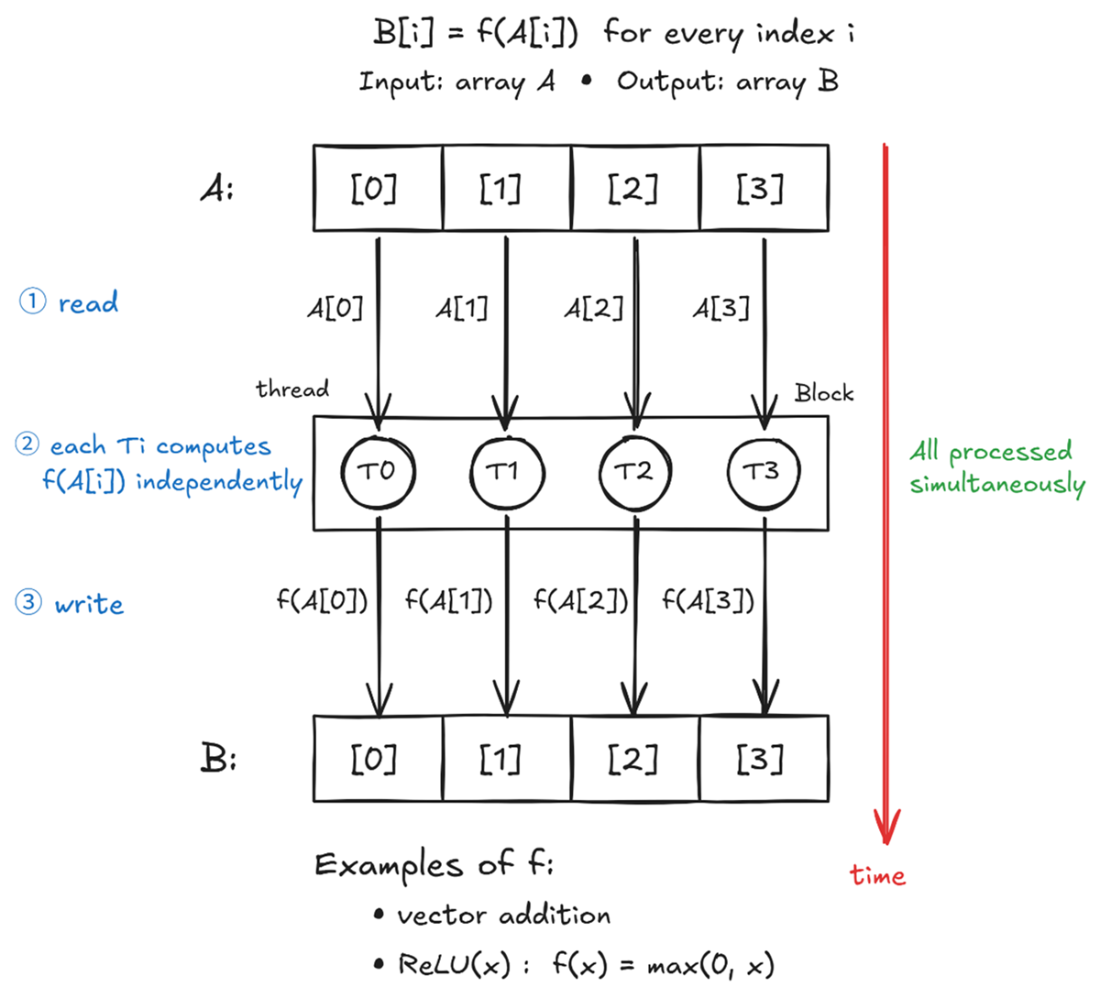
The Map pattern: one thread, one output element, one independent transformation. Each thread reads from array A, applies function f, and writes the result to array B, with no thread depending on any other. The same pattern covers everything from simple vector addition to neural network activations like ReLU. One caution: ReLU’s max(0, A[i]) is an element-wise maximum (a map), whereas finding the single largest value across the whole array is a reduction (chapter 5), not a map.
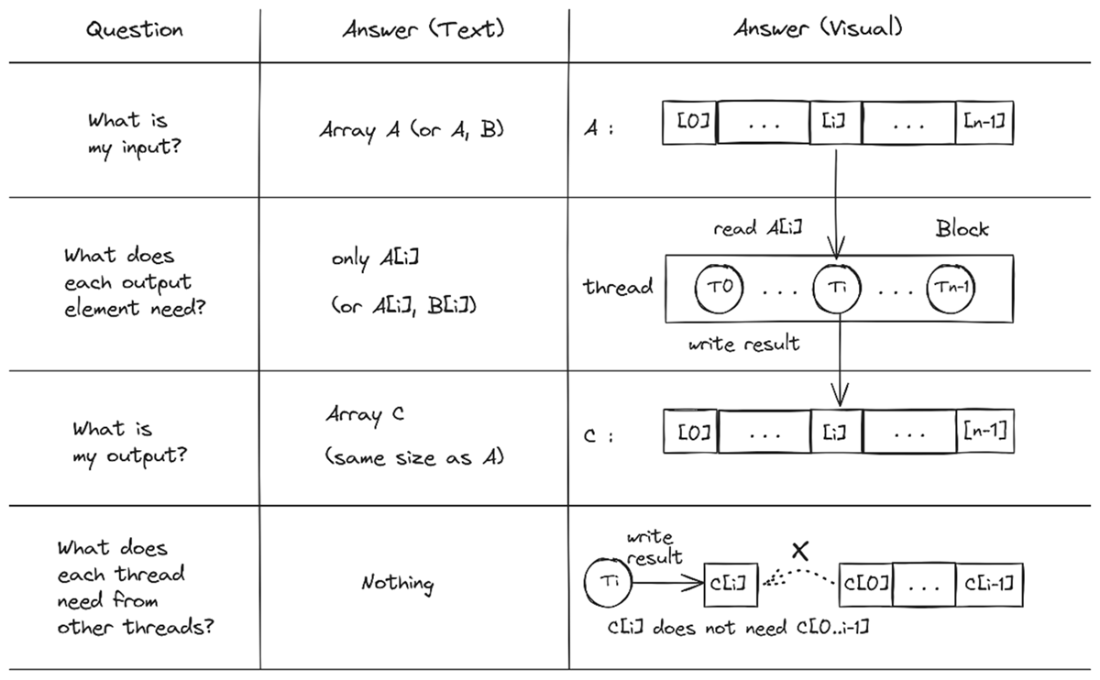
The Parallel Checklist: four questions that confirm the Map pattern. Before writing a kernel, ask what your input and output are, what each output element needs, and what each thread needs from other threads. For the Map pattern, the answers are always the same: one or more input arrays in, one output array out, each output element reading only its same-index inputs, and no thread ever waiting on another.
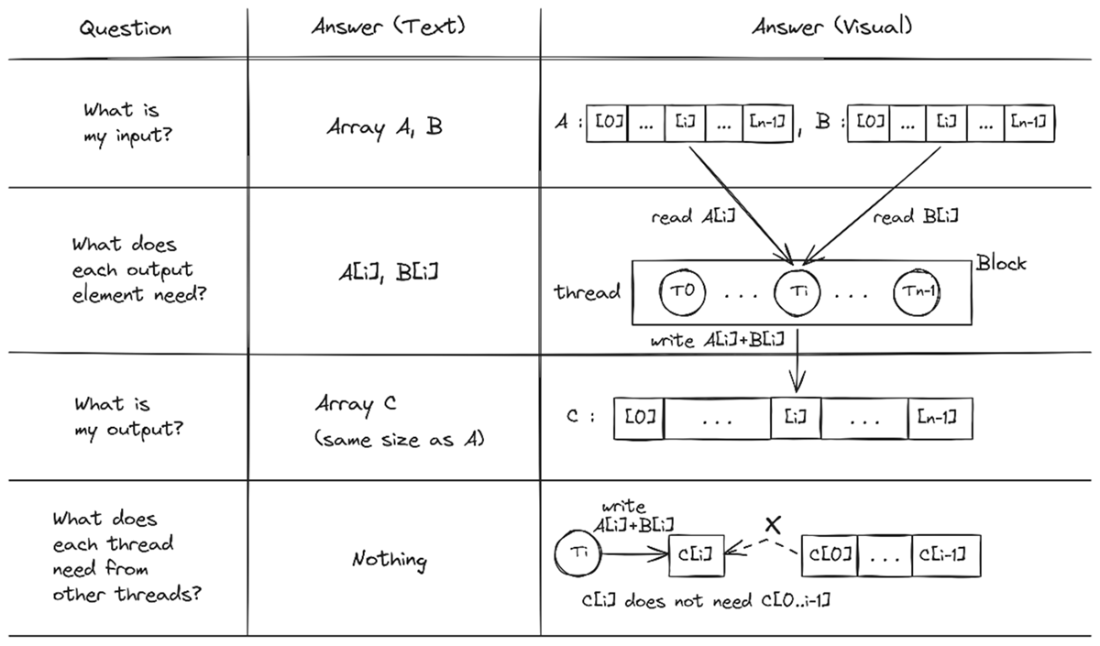
Parallel Checklist for vector addition: all four boxes checked. Each thread reads A[i] and B[i], writes A[i]+B[i] to C[i], and needs nothing from any other thread: no dependency on any other output, no waiting. All four checklist answers confirm it: vector addition is a textbook Map pattern.
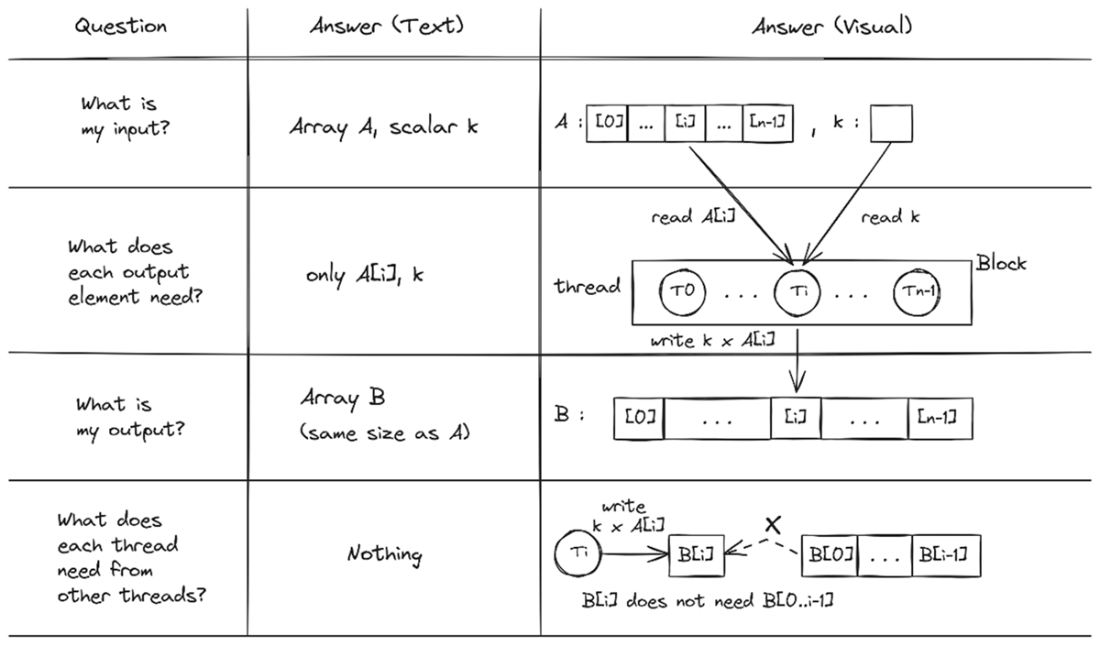
Parallel Checklist for scalar-vector multiplication: another clean Map. Each thread reads A[i] and the shared scalar k, writes k × A[i] to B[i], and needs nothing from any other thread: the scalar is read-only, so every thread can use it simultaneously without conflict.
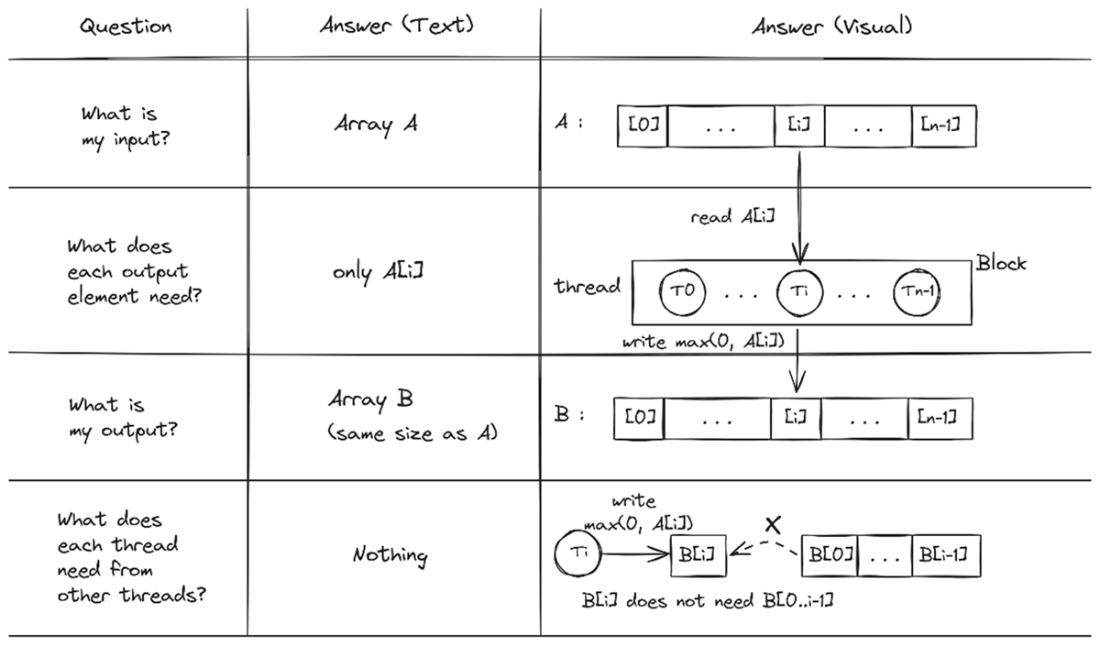
Parallel Checklist for Vector ReLU. Each thread reads A[i], writes max(0, A[i]) to B[i], and needs nothing from any other thread: negative values get clamped to zero, while zero and positive values pass through unchanged, all in parallel.
Summary
- The map pattern applies the same operation to every element independently. No output depends on any other output: one thread per output element.
- The independence test: first, no output may depend on another output’s result (if one does, you need a different pattern); second, it’s a pure map only when every read lands at the thread’s own index i. A read at some other index is a gather, a close cousin that is still safe to run in parallel.
- Parallel Checklist: four questions (inputs, outputs, what each output reads, and what each thread needs from others) identify any map.
- Thread indexing: compute a unique global index with int idx = blockIdx.x * blockDim.x + threadIdx.x, then always check bounds with if (idx < n) to prevent out-of-bounds memory access.
- Scalars by value: pass simple values (like n or k) directly to kernels. Anything a kernel reads through a pointer must live in memory the device can reach, which is why arrays go through cudaMalloc and cudaMemcpy.
- Two mistakes to watch for: reading a neighbor while another thread overwrites it, and destroying an input by writing the result back into it.
- Map is everywhere, from scaling a vector by a constant to neural network activation functions like ReLU. Once you see the pattern, you’ll recognize it in NumPy, PyTorch, SQL, and beyond.
FAQ
What is the map pattern in parallel programming?
The map pattern applies the same operation to many elements independently, so each output element depends only on its own inputs and not on any other output.
Why is map considered “embarrassingly parallel”?
Because each piece of work is completely independent, there is no need for synchronization or communication between threads, making it very easy to run in parallel.
What does “one thread per element” mean in a map kernel?
It means that if you have n output elements, you launch n threads, and each thread computes exactly one output element at the same index.
How do you tell whether a problem can be solved with map?
Ask two questions: can each output be computed without needing any other output, and does each output read only same-index inputs? If both are yes, it is a pure map.
What is the difference between a pure map and a gather?
In a pure map, each thread reads inputs only at its own index. In a gather, outputs are still independent, but some reads come from other indices instead of the thread’s own index.
Why does vector addition fit the map pattern?
Each output C[i] is computed independently as A[i] + B[i], so every thread reads only its own positions in the input arrays and writes one output value.
Why can a scalar like k be passed as a normal kernel argument instead of an array?
Because every thread uses the same value of k, so it is read-only and shared safely by all threads without needing GPU memory allocation or copying as an array.
What is the most common mistake when writing a map kernel?
Two common mistakes are reading data another thread is writing, which can cause a race condition, and overwriting the input array when you still need its original values.
Why should a map kernel usually write to a separate output array?
Writing to a separate output array preserves the original input data and avoids accidentally destroying values that later code may still need.
What four questions does the Parallel Checklist ask for map?
It asks: what is the input, what is the output, what does each output element read, and what does each thread need from other threads? For map, the answers are one or more input arrays, one output array, same-index reads only, and no inter-thread dependence.

 Grokking Parallel Programming ebook for free
