Overview

1 Why parallel programming?

The chapter begins by explaining why parallel programming became necessary. For many years, software appeared to get faster automatically as hardware improved, thanks to shrinking transistors and rising clock speeds. That era ended when heat and power limits stopped single processors from becoming much faster. Instead of relying on one faster core, chip designers turned to multiple cores and, especially, GPUs with thousands of simpler processing units.

The chapter then shows that parallelism is valuable only when work can be divided into independent pieces. Some problems, like doubling every element in an array or processing millions of pixels, are ideal because each task can run separately. Other problems, like summing values or computing Fibonacci numbers, contain dependencies that force parts of the computation to happen in order. This leads to the central lesson that the amount of sequential work sets a hard limit on speedup, even with many processors.

Finally, the chapter explains why GPUs and CUDA matter. GPUs were originally designed for graphics, but the same structure that makes them good at rendering images also makes them excellent for matrix math, image processing, and AI workloads. CUDA opened GPU programming to general-purpose code and taught programmers to think in terms of patterns such as map, reduce, scan, histogram, and stencil. The broader message is to match the tool to the task: CPUs are best for complex, branch-heavy logic, while GPUs excel at doing the same simple operation across huge amounts of data.

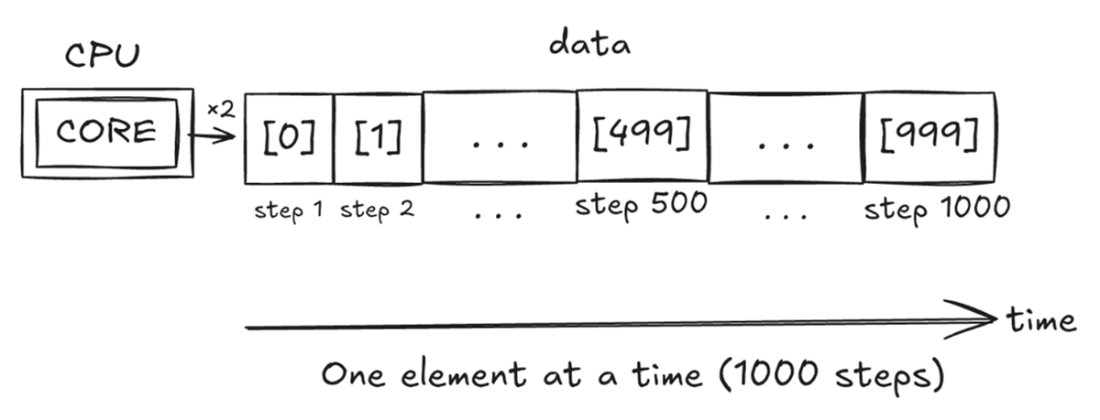
Sequential processing: one core, one element at a time. A single CPU core works through a 1,000-element array step by step, doubling each value before moving on to the next. With only one core doing the work, the total number of steps equals the size of the data: 1,000 elements means 1,000 steps, and the time grows right along with it.
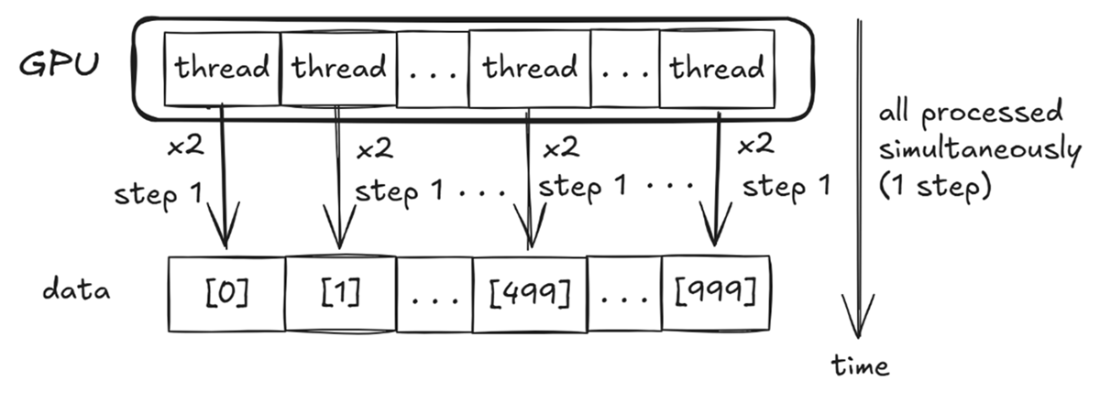
Parallel processing: every element at once. A GPU assigns one thread per element, doubling all 1,000 values in parallel; the hardware schedules these thousands of threads onto its many CUDA cores.
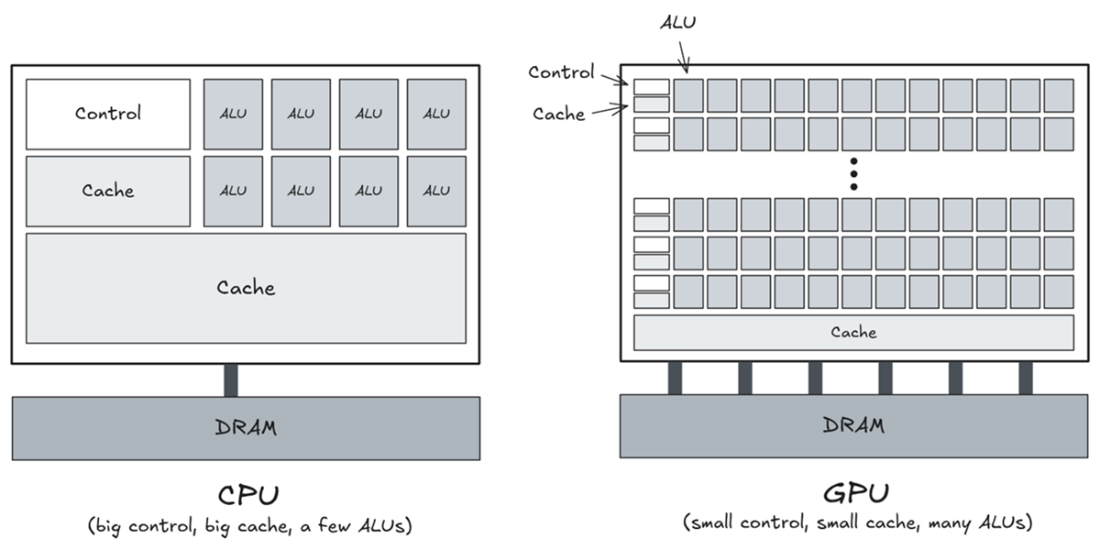
Where the transistors go. A CPU devotes most of its silicon to control logic and cache, leaving room for only a few ALUs; a GPU spends the same silicon on row after row of small ALUs with minimal control and cache, and connects to its DRAM through many more memory channels. The two designs are answers to opposite questions: finish one task fast? Or finish many tasks at once?
Summary

  • Around 2003–2005, heat killed the free lunch: single-core speed gains hit a physical ceiling.
  • Instead of one fast processor, use many working simultaneously. A modern laptop has 6–16 cores, high-end desktops well past 24; a GPU has thousands.
  • Parallel computing did not start with GPUs: MPI spreads work across separate machines, OpenMP across the cores of one CPU, and SIMD across values inside a single core. GPUs are the newest branch of that family, and they specialize in data parallelism: the same operation applied to many pieces of data at once.
  • Thousands of simple processing units make GPUs perfect for massively parallel tasks like image processing, matrix math, and AI training.
  • Learning CUDA teaches you parallel thinking that carries over to just about any parallel framework, including PyTorch and TensorFlow.
  • Dependencies, not core count, decide how much of a problem can run at once. Before parallelizing anything, ask whether any task needs another task’s result before it can start.
  • Amdahl’s Law: the sequential parts of your code limit the overall speedup, no matter how many cores you throw at it. But Gustafson’s Law offers a brighter view: scale the problem size with the cores, and parallelism keeps paying off.
  • swforces.com, a free online lab, lets you write and run real CUDA code, no GPU hardware required.
  • Part 2 builds up the recurring parallel patterns (Map, Reduce, Scan, Histogram, and Stencil), and Part 3 turns to the performance techniques that make them run fast on real hardware.

FAQ

Why did programmers once call hardware improvements a “free lunch”?For decades, programmers could write code once and see it run faster on newer hardware without changing the code. That happened because processors kept getting faster as transistors became smaller and more numerous, so performance gains seemed to come “for free.”
What ended the era of the “free lunch” in processor performance?The “free lunch” ended when single processors hit a physical limit known as the Power Wall. Around the mid-2000s, increasing clock speeds started creating too much heat, so CPU base speeds plateaued and chips could no longer rely on faster single cores for easy speedups.
Why do modern CPUs have multiple cores instead of just one very fast core?Because making one core faster became limited by heat and power consumption. Chip makers shifted to multi-core designs so multiple processors could work on parts of the same task at the same time, improving performance without pushing one core beyond its cooling limits.
What is parallel programming?Parallel programming is the practice of using more than one processing unit at the same time to solve a single problem. Instead of doing all work sequentially, the program splits work into pieces that can run simultaneously.
How are CPUs and GPUs different in the way they are designed?CPUs are optimized for low latency, meaning they try to finish one complex task quickly using a few powerful cores. GPUs are optimized for high throughput, meaning they use thousands of simpler cores to do many similar tasks at once, which makes them ideal for data-parallel work.
Why are GPUs so effective for tasks like image processing and matrix math?Because those tasks usually involve many independent, repeated operations over large amounts of data. That matches the GPU’s strength: running the same simple operation across thousands of elements in parallel.
What is the difference between data parallelism and task parallelism?Data parallelism applies the same operation to many pieces of data at once, like doubling every element in an array. Task parallelism runs different operations at the same time, like one thread compressing a file while another encrypts data.
Why can’t every problem be sped up with more cores?Because some problems have data dependencies, where one task must wait for the result of another before it can begin. If tasks depend on each other, they cannot all run at the same time, which limits the benefit of parallelization.
What is Amdahl’s Law and why does it matter for parallel programming?Amdahl’s Law says that the speedup from adding processors is limited by the part of the program that must remain sequential. If even a small portion of the work can’t be parallelized, that sequential part becomes a bottleneck and limits total speedup.
Why should someone learn CUDA instead of only using higher-level tools like PyTorch?Learning CUDA helps you understand how GPUs really work, including memory movement, synchronization, and performance bottlenecks. That deeper knowledge transfers to many other parallel frameworks and helps you diagnose problems instead of guessing.

pro $24.99 per month

  • access to all Manning books, MEAPs, liveVideos, liveProjects, and audiobooks!
  • choose one free eBook per month to keep
  • exclusive 50% discount on all purchases
  • renews monthly, pause or cancel renewal anytime

lite $19.99 per month

  • access to all Manning books, including MEAPs!

team

5, 10 or 20 seats+ for your team - learn more


choose your plan

team

monthly
annual
$49.99
$499.99
only $41.67 per month
  • five seats for your team
  • access to all Manning books, MEAPs, liveVideos, liveProjects, and audiobooks!
  • choose another free product every time you renew
  • choose twelve free products per year
  • exclusive 50% discount on all purchases
  • renews monthly, pause or cancel renewal anytime
  • renews annually, pause or cancel renewal anytime
  • Grokking Parallel Programming ebook for free

choose your plan

team

monthly
annual
$49.99
$499.99
only $41.67 per month
  • five seats for your team
  • access to all Manning books, MEAPs, liveVideos, liveProjects, and audiobooks!
  • choose another free product every time you renew
  • choose twelve free products per year
  • exclusive 50% discount on all purchases
  • renews monthly, pause or cancel renewal anytime
  • renews annually, pause or cancel renewal anytime
  • Grokking Parallel Programming ebook for free