5 Working With Types
Go’s type system is presented as a practical way to model real-world problems with clarity and safety. The chapter uses a recipe application to show how named types, structs, collections, pointers, methods, and interfaces can work together to represent ingredients, measurements, steps, and complete recipes. Rather than relying on loosely structured data, the code becomes more expressive, more self-documenting, and less prone to accidental misuse.
The discussion begins by showing how user-defined types add meaning to basic values such as numbers and strings. Named types like measurements and units help distinguish concepts that would otherwise look identical to the compiler, while structs combine related fields into a single entity. The chapter also emphasizes Go’s preference for composition over inheritance, demonstrating how embedding lets one type build on another to create specialized measurement forms and richer domain models without complex class hierarchies.
From there, the chapter shows how behavior is attached to types through methods, with a useful distinction between value receivers and pointer receivers depending on whether the method should modify the original value. Interfaces then shift the focus from what a value is to what it can do, enabling polymorphism through shared method sets such as conversion behavior. Finally, type assertions and type switches are used to inspect interface values when concrete type-specific logic is needed, tying everything together into a flexible recipe system that can scale, convert units, and generate summaries in a clean, idiomatic Go style.
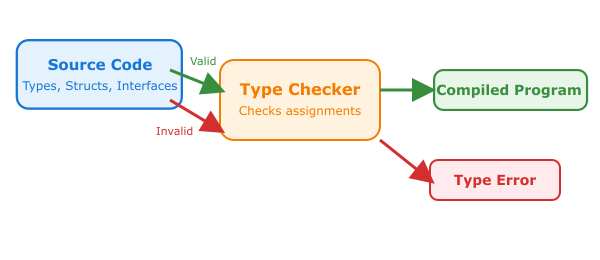
Type checking - allows for the compiler to determine if the code is valid prior to the system running
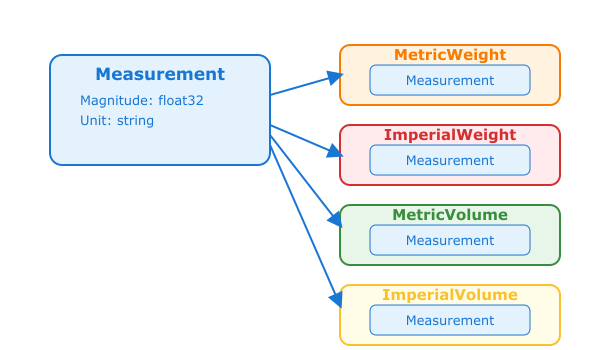
Type embedding - allows for the extension of structs by creating a new type from an existing type.
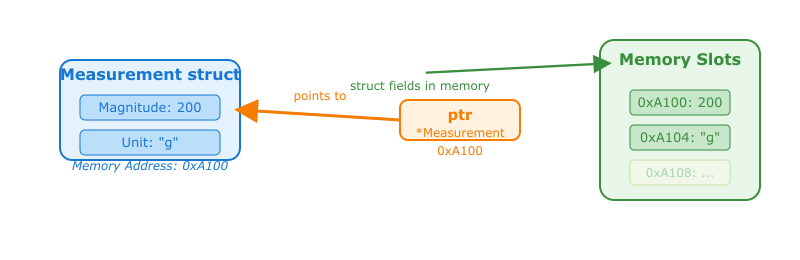
Pointers help programs manage shared sections of memory throughout an application
Summary
- Go’s type system lets you model real-world domains using named types, structs, and composition for safer, more expressive code.
- Named types and structs clarify intent, group related data, and enable attaching methods for behavior.
- Type embedding (composition) extends types and shares fields/methods without inheritance.
- Collection types (slices, maps) organize groups of values, supporting abstractions like ingredient lists and grocery lists.
- Pointers allow efficient sharing and modification of data, especially for methods that update receiver state.
- Methods and interfaces add behavior and define contracts, enabling polymorphism and flexible code.
- Type assertions and switches let you check and handle concrete types at runtime when working with interfaces.
- Composing and wrapping types enables you to extend functionality and add domain-specific logic.
FAQ
What is the purpose of Go’s type system in this chapter?
Go’s type system is used to model real-world data and relationships more accurately. It helps you create safer, more expressive code by defining named types, structs, methods, interfaces, and collections that reflect the problem domain.What is a named type in Go?
A named type is a new, distinct type based on an existing type, such astype Magnitude float32. Even if it has the same underlying representation, Go treats it as a separate type and requires explicit conversion when mixing it with the original type.How is a type alias different from a defined type?
A type alias, written with=, gives an existing type another name without creating a new type. A defined type creates a distinct type that can have its own methods and stricter type checking.Why are structs useful in Go?
Structs let you group related values, possibly of different types, into one composite type. They are useful for modeling entities like measurements, ingredients, steps, and recipes in a clear and organized way.What happens if you omit a field when creating a struct value?
Go assigns the zero value for that field’s type. For example, an omitted numeric field becomes0, and an omitted string field becomes an empty string.What is type embedding in Go?
Type embedding is Go’s way of composing types instead of using inheritance. By embedding one type inside another, the outer type gains access to the embedded type’s fields and methods.Why are slices and maps wrapped in named types in this chapter?
They are wrapped in named types to give collection data more meaning and structure. For example, aRecipeBox is a slice of recipes, and a GroceryList is a map from ingredient to measurement.
 Go in Action, Second Edition ebook for free
