10 The Standard Library
This chapter introduces Go’s standard library as the practical toolkit that makes everyday programming easier, especially for building command-line applications. It explains that Go ships with a rich set of packages that cover common needs such as formatted output, user input, command-line parsing, file handling, data encoding, buffering, pattern matching, and string or number conversion. The chapter’s running example is a CLI utility for validating and converting JSON and XML, showing how multiple standard packages can work together in a real program.
The discussion begins with basic console I/O and formatted text using the formatting package, including printing, building strings, reading input, and creating errors. It then moves into command-line configuration with flags, showing how to define help text, optional settings, and positional arguments. From there, it introduces the core I/O abstractions and the operating system package, emphasizing how readers and writers make code flexible across files, standard input and output, and other data sources while exit codes, file descriptors, environment variables, and temporary files help create well-behaved tools.
The later sections focus on working with structured data and text. JSON and XML packages are used to map data into Go structs, validate it, and convert between formats, with custom marshalling and unmarshalling for extra control. Buffering improves performance with line-by-line reading and efficient writing, while regular expressions and string utilities support validation and format detection. Finally, number conversion tools help safely parse and display typed values. The chapter closes by stressing that these packages are highly composable and that mastering them gives you a strong foundation for building reliable, portable Go applications.
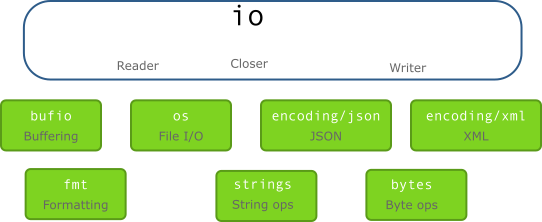
io.Reader and io.Writer interface composition with multiple package implementations
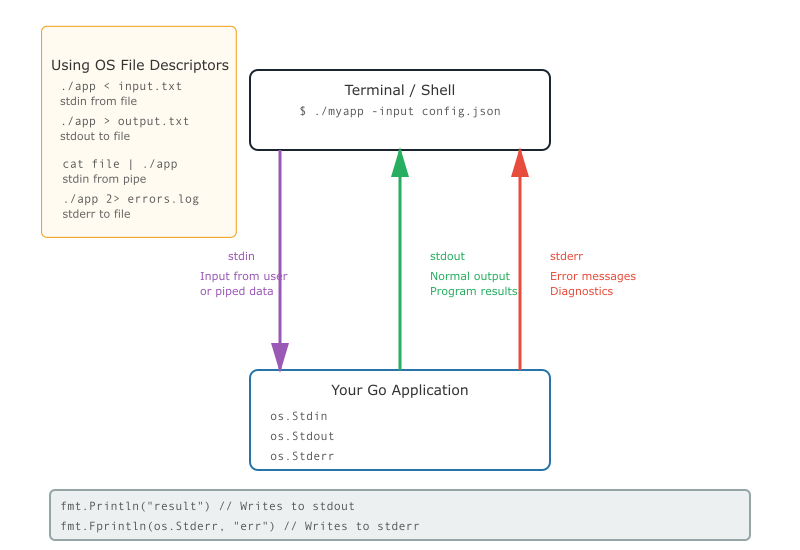
Standard input/output/error streams and their relationship to the terminal
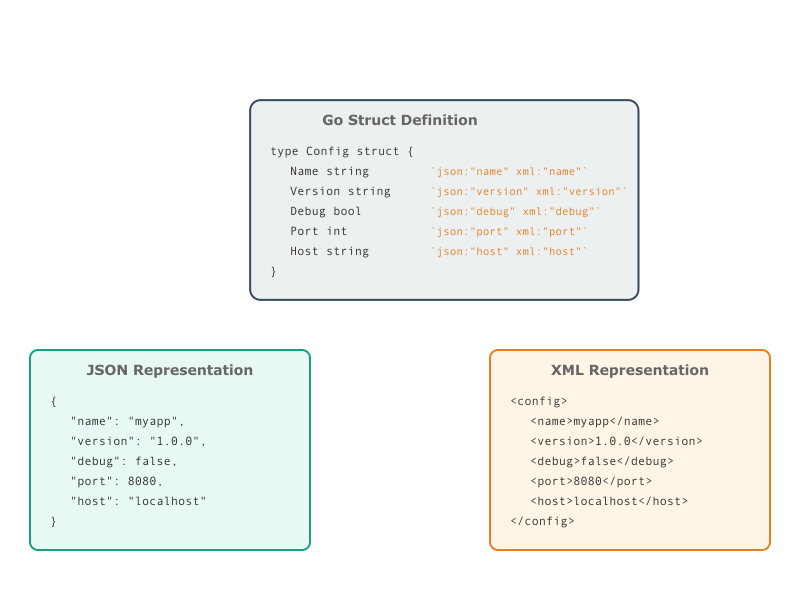
Struct tags enable marshalling to both JSON and XML formats
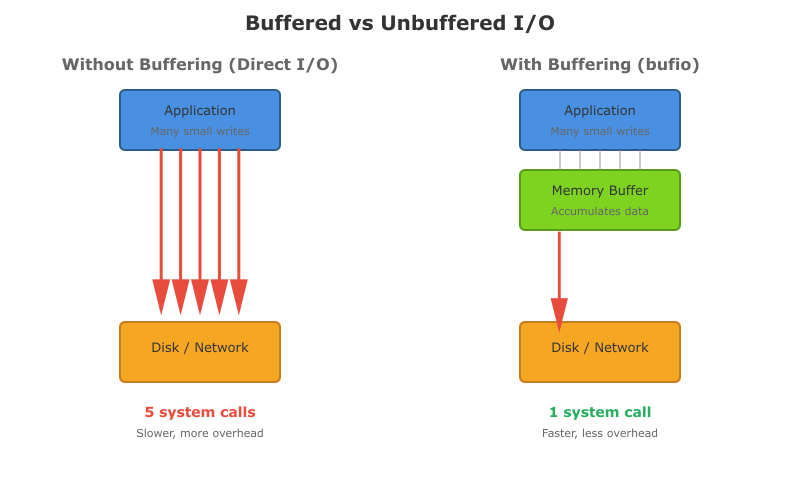
Comparison of unbuffered vs buffered I/O showing performance benefits
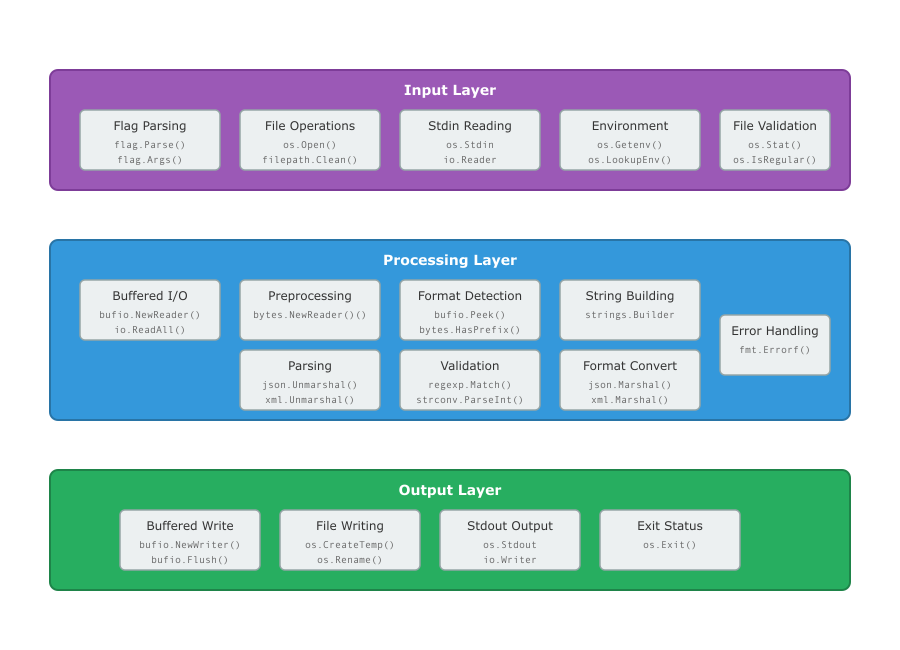
Complete CLI tool architecture showing all layers and components
Summary
- The
fmtpackage provides formatted I/O functions for printing, formatting strings, and reading input with type conversion. - The
flagpackage simplifies command-line argument parsing, supporting boolean, string, integer flags, and positional arguments. - The
iopackage defines fundamental interfaces (Reader,Writer,Closer) that enable flexible, composable I/O operations across files, networks, and memory. - The
ospackage provides platform-independent file operations, environment variables, and process management for cross-platform applications. - The
encoding/jsonandencoding/xmlpackages enable marshaling and unmarshaling structured data with struct tags for field mapping. - Custom
MarshalJSONandUnmarshalJSONmethods provide control over serialization for validation, transformation, and sanitization. - The
bufiopackage adds buffering to I/O operations, significantly improving performance by reducing system calls. - The
regexppackage offers compiled regular expression support for pattern matching, validation, and text extraction. - The
stringspackage provides essential string manipulation functions including searching, trimming, case conversion, and splitting. - The
strconvpackage handles type-safe conversions between strings and basic types with detailed error handling.
FAQ
What is the Go standard library, and why is it important?
The Go standard library is the set of packages included with Go when it is installed. It is important because it provides many of the common tools needed to build applications—such as formatting, file handling, command-line parsing, encoding, and I/O—without requiring third-party dependencies.What does the chapter’s CLI tool do?
The chapter builds a JSON/XML validation and conversion command-line tool. It reads data from files or standard input, validates the data structure, converts between JSON and XML, and writes the result to standard output or a file.What is the difference between fmt.Print, fmt.Println, and fmt.Printf?
fmt.Print writes text without adding a newline, fmt.Println writes text and appends a newline, and fmt.Printf writes formatted output using verbs like %s and %d.What are format verbs in the fmt package used for?
Format verbs control how values are displayed or parsed. For example,%s formats strings, %d formats integers, %v uses a default representation, and %#v shows a Go-syntax representation.How does the flag package help build CLI applications?
Theflag package lets you define command-line options such as boolean, string, and integer flags. After calling flag.Parse(), you can read the values from the variables you defined and use them to control program behavior.What is the purpose of io.Reader and io.Writer?
io.Reader and io.Writer are core Go interfaces for reading and writing data. They make code flexible because the same function can work with files, memory buffers, network connections, or standard input and output.Why are os.Stdin, os.Stdout, and os.Stderr important in CLI tools?
They are the standard input, output, and error streams.os.Stdin is used for input, os.Stdout for normal output, and os.Stderr for error messages and diagnostics, which helps keep normal output separate from errors.How do JSON and XML tags work in Go structs?
Struct tags tell Go’s encoding packages how to map fields to JSON keys or XML elements and attributes. By using tags, the same struct can often support both JSON and XML serialization and deserialization.Why would you use bufio.Reader or bufio.Writer?
bufio.Reader and bufio.Writer add buffering to input and output operations. This reduces system calls and improves performance, especially when processing large files or writing many small pieces of data.When should strconv be used instead of fmt.Sprintf?
Usestrconv when converting strings to numbers or booleans, or when formatting basic values with more control and better performance. It also provides explicit error handling, which is especially useful for parsing user input safely.
 Go in Action, Second Edition ebook for free
