17 Improving your data models
This chapter shows how to make your MongoDB data layer more robust with Mongoose by tightening schemas, enriching models with behavior, and wiring models together through associations. You start by moving beyond a bare schema to enforce data consistency, then learn to attach reusable operations to your models, and finally connect documents so your application can express real relationships (like subscribers showing interest in courses). Throughout, you validate the work interactively in Node’s REPL, building confidence before integrating with routes and views.
You refine a simple Subscriber schema using Mongoose validators and options: require critical fields, normalize emails to lowercase, enforce uniqueness, and constrain numeric ranges (for example, ZIP code bounds). The chapter contrasts schema types and clarifies that “unique” is an index helper, not a validator. You then add instance and static methods—instance methods operate on a single document (such as assembling display info or querying by that document’s attributes), while statics serve broader, collection-level queries. Practical cautions include avoiding arrow functions for methods that rely on this, and using promise-based queries (find, findOne, findById, remove) so results and errors can be handled cleanly. With REPL, you connect to the database, create and query subscribers, verify validators (including duplicate email errors), and exercise custom methods end to end.
Next, you model associations using ObjectId references to represent relationships familiar from relational databases. You introduce a Course model with its own validations and link it from Subscriber via an array of ObjectIds, enabling one-to-many or many-to-many patterns depending on whether you store single values or arrays. In REPL, you create a course, push its id into a subscriber’s courses array, save, and use populate to replace referenced ids with full documents for richer results—while noting that unnecessary population adds overhead. The lesson concludes by chaining these steps into a repeatable script that clears data, creates sample records, associates them, and runs targeted queries, setting the stage for controller actions in the next chapter.
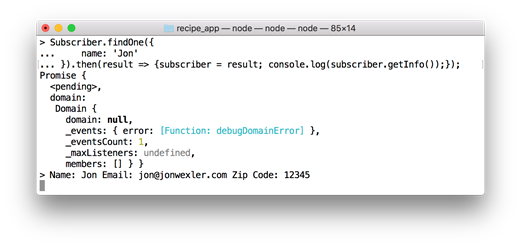
Example response for Mongoose REPL commands
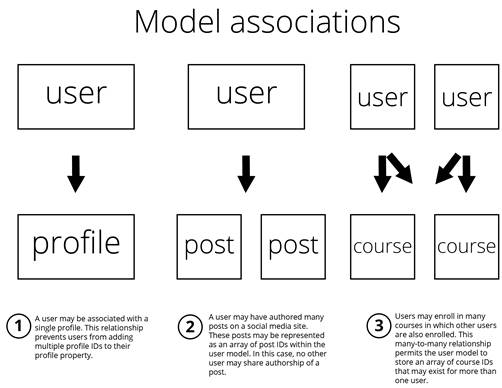
Relational database associations
FAQ
What are Mongoose SchemaTypes and when should I use them?
SchemaTypes let you declare the type of each field in a schema so Mongoose can cast and validate values. Common types include:String (text values), Number, Boolean, Date (JavaScript Date), Array (use [] literal), mongoose.Schema.Types.Mixed (arbitrary object), and mongoose.Schema.Types.ObjectId (references to other documents, crucial for associations).How do I add validations to a Mongoose model?
Add an options object for each path in your schema. Example for a subscriber: require a name (required: true), require and normalize email (required: true, lowercase: true) and make it unique (unique: true), and constrain zip codes with a range (min: [10000, 'Zip code too short'], max: 99999). Note: unique is a schema helper that creates a unique index, not a validator.What’s the difference between instance and static methods in Mongoose?
Instance methods (defined onschema.methods) operate on a single document (e.g., subscriber.getInfo()). Static methods (defined on schema.statics) operate at the model level for broader queries. Avoid arrow functions when defining these methods because Mongoose relies on this binding to the document or model.Why call exec() on a Mongoose query inside a method?
exec() returns a true Promise and avoids callback-style invocation, making it easier to compose with then/catch. For example, an instance method can return this.model('Subscriber').find({ zipCode: this.zipCode }).exec().Which common query helpers should I know and what do they return?
Useful helpers include:find (array of matching docs), findOne (single matching doc), findById (doc by ObjectId), and remove (delete docs—use with care). All return Promises, so handle them with then/catch.How do I test my models in Node’s REPL?
In your project folder, runnode, then: const mongoose = require('mongoose'); require your model(s); mongoose.connect('mongodb://localhost/recipe_db'); set mongoose.Promise = global.Promise. Create docs with Model.create, query with findOne/find, and test custom methods like getInfo(). If you hit duplicate email errors, clear with Subscriber.remove({}) while testing.How do I create associations between models like Subscriber and Course?
Add a path that stores referenced ObjectIds with aref to the target model. Example on Subscriber: courses: [{ type: mongoose.Schema.Types.ObjectId, ref: 'Course' }]. One side of the relationship is sufficient—both models don’t have to reference each other.How do I attach and persist a related document to an array of references?
Push either the document or its_id into the reference array (e.g., subscriber.courses.push(course) or subscriber.courses.push(course._id)) and then call save() on the modified document to persist the change.What does populate do, and when should I use it?
populate replaces stored ObjectIds in reference paths with the full documents in the query result (e.g., Subscriber.populate(subscriber, 'courses')). Use it when you need details from the related documents. Avoid populating on every query to prevent unnecessary time and memory overhead.How can I find all subscribers enrolled in a particular course?
Query the reference array by ObjectId:Subscriber.find({ courses: mongoose.Types.ObjectId('5986b8aad7f31c479a983b42') }). This returns all subscribers whose courses array contains that course’s id.
 Get Programming with Node.js ebook for free
