Functional programming treats optional data as a first-class modeling concern rather than an awkward special case. The chapter argues that many everyday APIs in .NET are “dishonest” because they promise a plain return type but may actually return null or throw an exception when data is missing. By contrast, the Option type makes absence explicit: a value is either Some(value) or None, and client code must deal with both cases. This leads to signatures that better describe what a function can really do, especially for partial functions such as parsing or collection lookup.
The chapter then shows how to use Option in practice. It introduces pattern matching with Match as the basic way to consume an option, so callers can supply one branch for the empty case and another for the present case. It also walks through a C# implementation of Option, first in a more idealized algebraic style and then in a more C#-friendly optimized form using a struct, implicit conversions, and helper values like Some and None. These design choices make optional values easy to construct, inspect, and integrate with existing code while keeping the API concise and expressive.
A major theme of the chapter is that null is harmful because it blurs the line between valid absence and programming error. The author explains how null pollutes data models, makes function signatures ambiguous, encourages defensive null-checking, and still leaves plenty of room for NullReferenceException. C# 8 nullable reference types are presented as an improvement, but one that is limited by opt-in requirements, inconsistent enforcement, and imperfect flow analysis. The recommended approach is to use nullable reference types for required values at boundaries, but represent optional values with Option<T> inside the codebase, converting external nulls to None as soon as they enter.
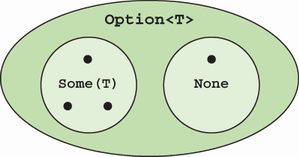
Option<T> is the union of the set Some<T> with the singleton set None.
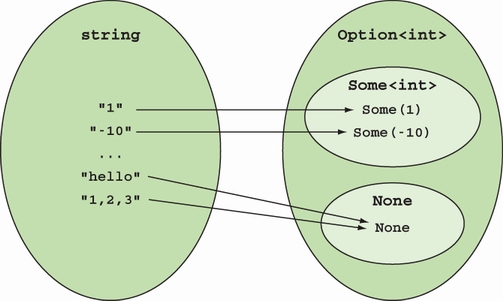
Using Option to convey that parsing is a partial function. For input strings that provide valid representation of an integer, the parsing function wraps the parsed int into a Some. Otherwise, it returns None.
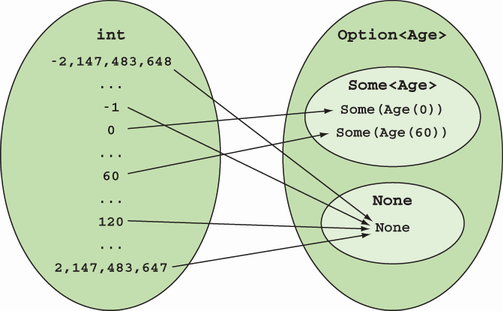
Converting from int to Age can also be modeled with Option.
Summary
Use the Option type to express the possible absence of a value. An Option can be in one of two states:
None, indicating the absence of a value
Some, a simple container wrapping a non-null value
To execute code conditionally, depending on the state of an Option, use Match with the functions you’d like to evaluate in the None and Some cases.
Use Option as a return value when a function cannot guarantee a valid output for all possible inputs including
Identify the boundaries of your code and prevent any null values from seeping in:
Enforce required values.
Convert optional values to Option.
FAQ
What is the main idea behind modeling absence of data with Option in this chapter?The chapter introduces Option as a type that explicitly represents either a present value (Some(T)) or no value (None). This makes optionality part of the type system instead of relying on null or exceptions.Why does the chapter argue that null is a bad way to represent optional data?null is considered problematic because it is ambiguous: it can mean either “missing by design” or “missing because of a bug.” That ambiguity leads to unclear function signatures, defensive null checks, and runtime errors like NullReferenceException.What problem do the NameValueCollection and Dictionary examples demonstrate?They show that .NET collections can represent missing data in inconsistent ways: NameValueCollection returns null when a key is absent, while Dictionary throws KeyNotFoundException. The chapter uses this to show why these APIs are not honest about absence of data.What does Option<T> mean in functional programming terms?Option<T> is a sum type with two cases: None and Some(T). It describes a value that may or may not exist, making the absence of a value explicit and type-safe.How do you create and consume an Option value in the examples?You create a present value with Some(value) and an empty value with None. You consume an Option using Match, which runs one function for None and another for Some.Why is Match important when working with Option?Match is the core way to safely handle both cases of an Option. It forces you to deal with the presence or absence of a value explicitly, which helps avoid forgetting the missing-data case.How does Option help when modeling partial functions?A partial function is one that is not defined for every input. The chapter shows that returning Option<T> is a natural way to model such functions: return Some(result) when computation succeeds and None when it does not.Why is parsing a string into an int a good example of a partial function?Not every string can be parsed as an integer, so a signature like string → int is misleading. Using string → Option<int> makes failure explicit and total, because it always returns a valid Option<int>.How can Option be used to improve APIs for looking up values in collections?Instead of exposing collection lookups that return null or throw exceptions, the chapter suggests adapter methods like Lookup that return Option<T>. This gives a clear and consistent result: Some(value) if found, None otherwise.What does the chapter say about C# 8 nullable reference types compared with Option?The chapter says nullable reference types help, but they still have limitations: they require opt-in, can be disabled locally, may produce warnings only in certain contexts, and don’t give a uniform model for optionality across value and reference types. The author therefore recommends Option<T> for optional values and treating null as an error inside your code boundaries.
pro $24.99 per month
access to all Manning books, MEAPs, liveVideos, liveProjects, and audiobooks!

 Functional Programming in C#, Second Edition ebook for free
