The chapter opens by explaining why concurrency is so tricky when multiple threads share mutable state. While functional programming usually avoids that problem by favoring immutability, some real systems need shared state for things like counters, caches, and business entities that must remain consistent under concurrent access. The text surveys common synchronization strategies, contrasting locks with alternatives such as compare-and-swap, software transactional memory, and, most importantly here, message-passing concurrency.
Message-passing concurrency is presented as a model in which a lightweight process owns its state exclusively and processes incoming messages one at a time. The chapter first builds an idealized agent abstraction, then refines it into a practical C# implementation using .NET dataflow blocks so messages are queued and handled sequentially without exposing the state to outside mutation. Simple examples, such as a logger and a ping-pong exchange, illustrate how agents can coordinate behavior, maintain internal counters, and support asynchronous processing while preserving thread safety.
The later part of the chapter shows how agents can solve real application problems, especially when multiple requests arrive concurrently. A currency-rate service demonstrates how a coordinating agent can route requests to per-currency-pair agents, reducing contention while still sharing useful cached state. The chapter then compares agents with the broader actor model, noting that actors are more suitable for distributed and fault-tolerant systems, while agents are simpler and confined to one process. It also shows how to hide agents behind conventional APIs, using them as implementation details for services such as counters and account-processing workflows, where sequential command handling helps enforce business rules and keep persistence consistent with in-memory state.
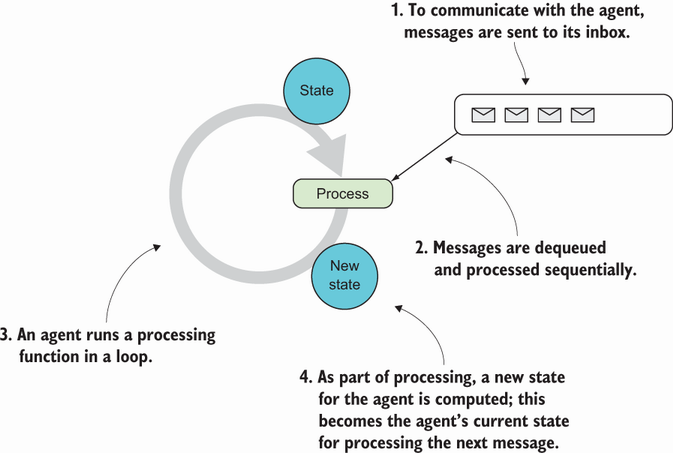
An agent consists of a message inbox and a processing loop.
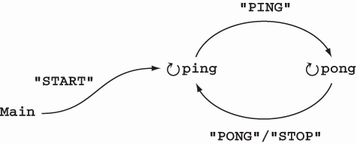
Simple interaction between agents by exchanging messages
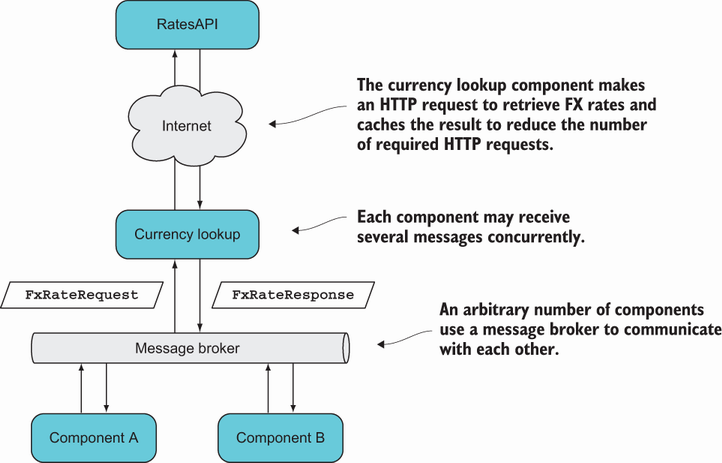
A system in which several requests may be received concurrently
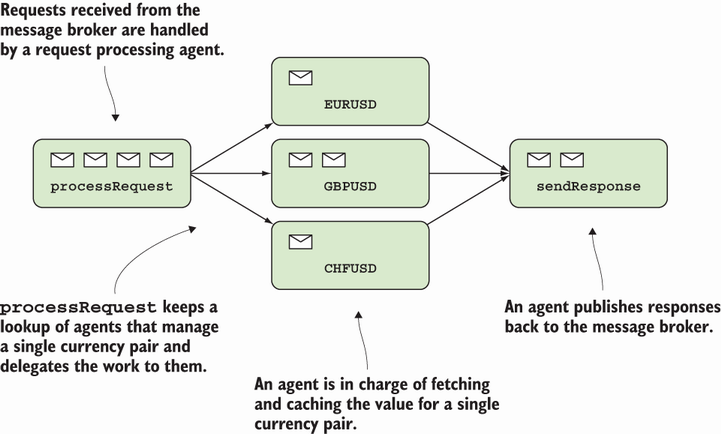
Breaking up the work between agents that can run concurrently
Summary
Shared mutable state that’s accessed concurrently can cause difficult problems.
For this reason, you should avoid shared mutable state entirely whenever possible. This is often the case in parallel processing scenarios.
In other types of concurrency, notably in multithreaded applications that need to model real-world entities, shared mutable state is often required.
Access to shared mutable state must be serialized to avoid inconsistent changes to the data. This can be achieved using locks but also using lock-free techniques.
Message-passing concurrency is a technique that avoids locks by restricting state mutation to processes (actors/agents) that have exclusive ownership of some state, which they can access single-threadedly in reaction to messages they’re sent.
An actor/agent is a lightweight process featuring
An inbox in which messages sent to it are queued up
Some state of which it has exclusive ownership
A processing loop in which it processes messages sequentially, taking actions such as creating and communicating with other agents, changing its state, and performing side effects
Agents and actors are fundamentally similar, but there are important differences:
Actors are distributed, whereas agents are local to a single process.
Unlike with agents, the actor model includes error handling provisions such as supervisors, which take action if the supervised actor fails.
Message-passing concurrency feels quite different from other FP techniques, mainly because FP works by composing functions, whereas actors/agents tend to work in a fire-and-forget fashion.
It’s possible to write high-level functional APIs with underlying agent-based or actor-based implementations.
FAQ
What problem does message-passing concurrency help solve?It helps avoid race conditions and deadlocks caused by shared mutable state by letting a single owner process messages sequentially while keeping state private.Why is shared mutable state sometimes unavoidable in concurrent programs?In server-style multithreaded applications, shared state is often required for things like global counters, in-memory caches, and representing unique real-world entities safely across requests.How does message-passing concurrency work in general?It uses lightweight processes or agents that own state exclusively, accept messages through an inbox, and process those messages one at a time so the state cannot be updated concurrently.What is the main idea behind an agent in this chapter?An agent is a process with an inbox and a processing loop that receives messages sequentially, computes a new state, and uses that new state for the next message.Why does the idealized agent implementation use an immutable state type?Because if the state were mutable, it could be changed outside the agent’s processing loop, breaking thread safety and undermining the guarantees of sequential processing.How is an agent implemented more practically in C#?The chapter uses ActionBlock from the TPL Dataflow library to manage the inbox and sequential processing, replacing the recursive loop with a safer, stack-friendly approach.What is the difference between agents and actors?Agents live within a single application, while actors are designed for distributed systems; actors also typically provide stronger fault tolerance features such as supervisors and message routing across machines.How can agents be used to handle concurrent requests safely?A single coordinating agent can serialize access to shared state, such as a cache or account registry, while delegating independent work to per-item agents so different requests can still proceed concurrently.Why should expensive work not be done inside an agent’s synchronized body?Because it can block the agent and delay unrelated requests; expensive operations like database access should usually happen outside the agent so the agent remains free to process other messages.How can an agent-based implementation be hidden behind a conventional API?By exposing a normal class or method interface, such as Counter.IncrementBy, while using the agent internally to manage state and concurrency, so callers do not need to know about message passing.
pro $24.99 per month
access to all Manning books, MEAPs, liveVideos, liveProjects, and audiobooks!

 Functional Programming in C#, Second Edition ebook for free
