Asynchronous programming is presented as a practical necessity in modern distributed systems, where expensive I/O work such as network calls or file access should not block a thread while it waits. The chapter explains that C# models a single future result with Task and Task<T>, and notes that ValueTask can be a more efficient alternative on hot paths or when operations often complete synchronously. From this perspective, a task is treated as a container for a value that will arrive later, much like other abstractions discussed earlier in the book.
Building on that idea, the chapter shows how Task<T> supports functional composition through Map, Bind, and LINQ comprehensions. It contrasts blocking code that waits on Result with non-blocking code that uses await, and demonstrates how asynchronous workflows can be chained, recovered from, and retried using combinators such as OrElse, Recover, and Retry. The examples also show how to combine independent asynchronous operations in parallel with Apply, while sequential dependencies are naturally handled with Bind.
The second half broadens the discussion from single future values to asynchronous streams with IAsyncEnumerable<T>. These streams let values be consumed as they arrive, which is useful for scenarios like reading files line by line or processing data from multiple sources without loading everything into memory first. The chapter demonstrates functional consumption of async streams with LINQ-style transformations and asynchronous iteration, while also noting the limits of the approach: once you need aggregation or sorting, you often have to wait for the full stream, which reduces some of the benefits of asynchrony. Overall, the chapter connects asynchronous C# features to a functional style that favors composable, declarative workflows.
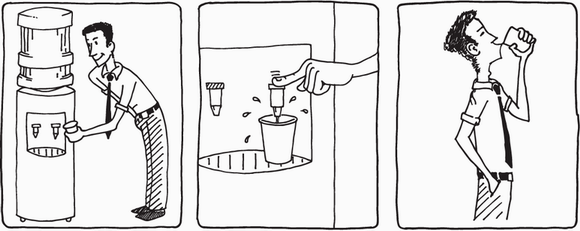
When an operation can be performed quickly, we’re happy to wait for the operation to complete, ceasing other work. This is the way synchronous code works.
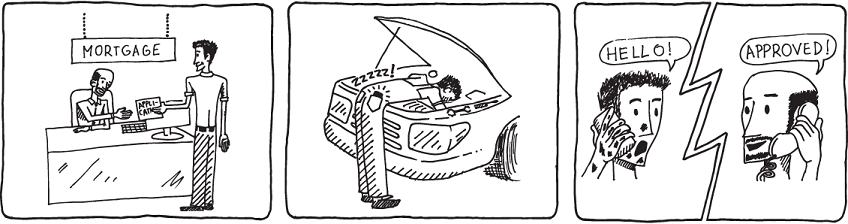
When we initiate an operation that takes a long time to complete, we then go on to do other work, expecting to be notified when the operation is complete. This is how asynchronous code works.
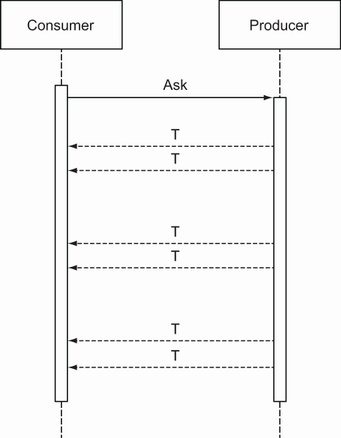
An asynchronous sequence. The consumer of information asks for some data, which is returned asynchronously by the producer of information with a non-negligible delay between the produced values.
Summary
- Task<T> represents a computation that asynchronously delivers a T.
- Tasks should be used when the underlying operation may have significant latency, such as most I/O operations.
- Task-returning functions can be composed with Map, Bind, and several other combinators to specify error handling or multiple retries.
- If Tasks are independent, they can be run in parallel. You can use Task as an applicative, and composing several Tasks with Apply runs them in parallel.
- IAsyncEnumerable<T> represents a sequence of T’s that are delivered asynchronously.
- Use the extension methods in System.Interactive.Async to work with IAsyncEnumerable; this also includes the implementation of the LINQ query pattern.
- Keep in mind that some operations on async streams, such as sorting and aggregation, require all elements in the stream, therefore losing some of the efficiency gained by using an async stream.
FAQ
What is the purpose of using Task in C# for asynchronous work?
Task represents an asynchronous operation that will complete in the future, allowing the program to continue doing other work instead of blocking while waiting for a result.
How is Task<T> similar to other functional containers like Option<T> or Try<T>?
Task<T> can be treated as a container for a value of type T, except the value arrives asynchronously. Because of that, it supports functional operations such as Map and Bind.
When should an asynchronous method return ValueTask instead of Task?
ValueTask is recommended on hot paths where performance matters and when the operation often completes synchronously, because it can avoid heap allocation for a Task.
Why is blocking on Task.Result discouraged in real applications?
Calling Result blocks the current thread until the asynchronous operation completes. This is usually unnecessary and inefficient in real-world client and server applications.
What do async and await do in an asynchronous method?
await suspends execution until the task completes, freeing the current thread to do other work. The async modifier is required when await is used in a method body.
How can Task<T> be used with Map and Bind?
Map transforms the result of a task once it completes, while Bind chains asynchronous operations by passing the completed value into a function that returns another task.
What is the difference between Bind and Apply for tasks?
Bind is sequential because the second task depends on the result of the first. Apply is for independent tasks and can run them in parallel, so it is better for combining unrelated asynchronous operations.
How do you handle failures in asynchronous computations?
You can inspect a task’s failure state through properties like Status and Exception, and use helpers such as OrElse for fallback tasks or Recover to map failures to a fallback value.
What is IAsyncEnumerable<T> used for?
IAsyncEnumerable<T> represents a sequence of values delivered asynchronously, such as reading a file line by line or receiving paginated results over time.
When does IAsyncEnumerable<T> provide the most benefit?
It is most useful when values arrive gradually and can be processed as they come in. It helps avoid waiting for the entire sequence before starting work, though aggregations like SumAsync still require all elements to be received first.

 Functional Programming in C#, Second Edition ebook for free
