9 Upcoming: generative AI for marketing
Generative marketing is the application of modern generative AI—multimodal, open-ended models and increasingly agentic systems—to accelerate and elevate marketing work. Unlike traditional, narrowly predictive ML, these models can create tailored text, images, and experiences, enabling true one-to-one personalization at scale. The chapter argues that early adopters can unlock compounding growth effects as AI continuously improves targeting and creative effectiveness, but success depends on solid prerequisites: high-quality first-party data, thoughtful governance, and a clear plan for how humans and AI collaborate.
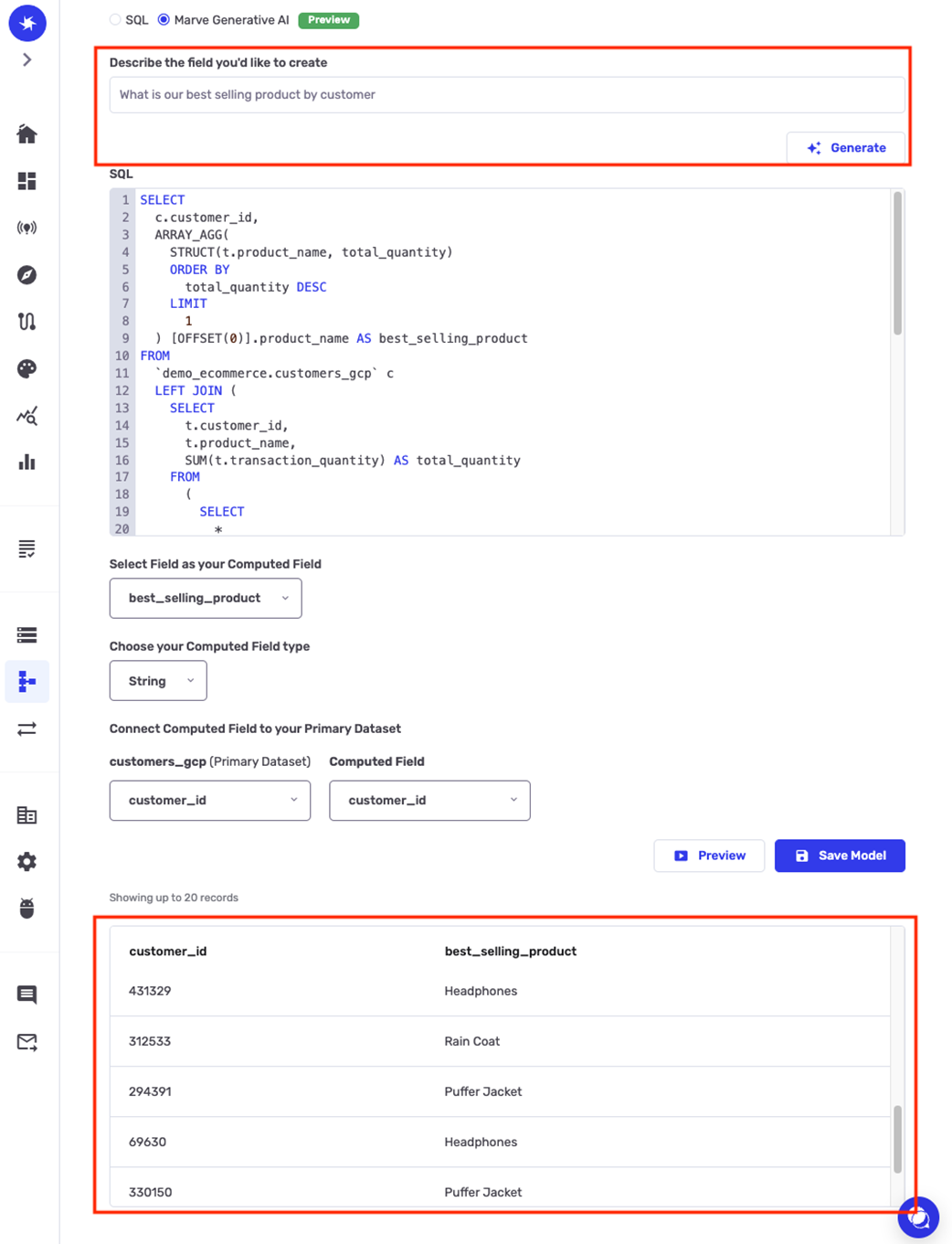
Today’s practical landscape is dominated by point solutions that augment specific parts of the workflow. Marketers are using natural-language business intelligence to surface drivers for segmentation, generative creative tools to quickly produce brand-aligned assets, audience-suggestion features to translate objectives into testable cohorts, destination-specific AI in channels to optimize copy and formats, and models to interpret sentiment or simulate customer personas for rapid messaging feedback. A step-by-step example shows how teams can derive personalization fields from first-party data, generate audience ideas, and produce creative variations—linking context to action to scale from dozens of campaigns to thousands of tailored interactions.
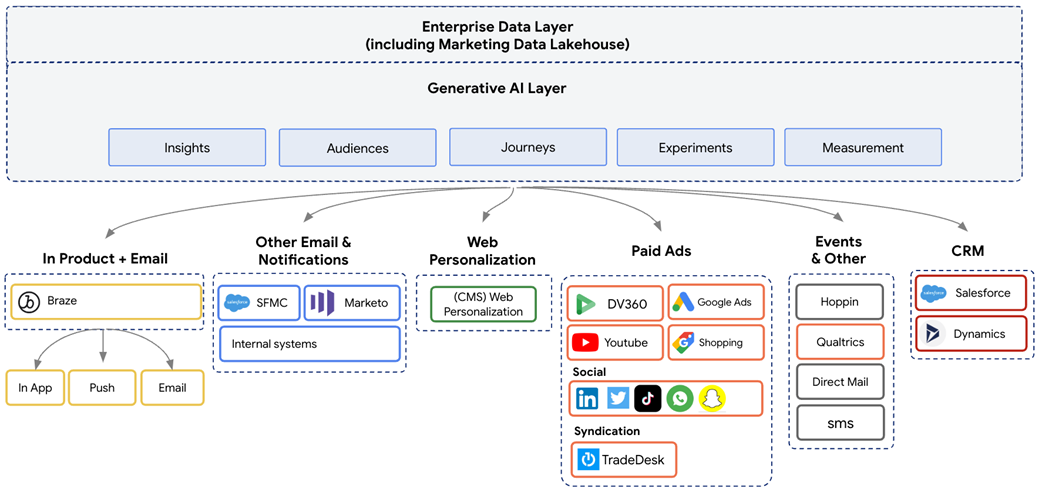
To turn these capabilities into durable advantage, the chapter recommends centering strategy on first-party data in a marketing data lakehouse, connected via composable, AI-native tools that support zero-copy access and open data models. It outlines multiple ways to infuse company context into models (from prompt engineering and RAG to fine-tuning and embeddings), and emphasizes user design that keeps humans in the loop with clear review, approval, and explainability. Governance is critical—covering legal, privacy, bias, cost, and organizational readiness—and roles will evolve from marketer as creator, to approver, to advisor as autonomy grows. The overarching guidance: keep data decoupled from channels, choose flexible architectures, and build policies and workflows that balance speed with control.
Product insights generated via natural language with AI.
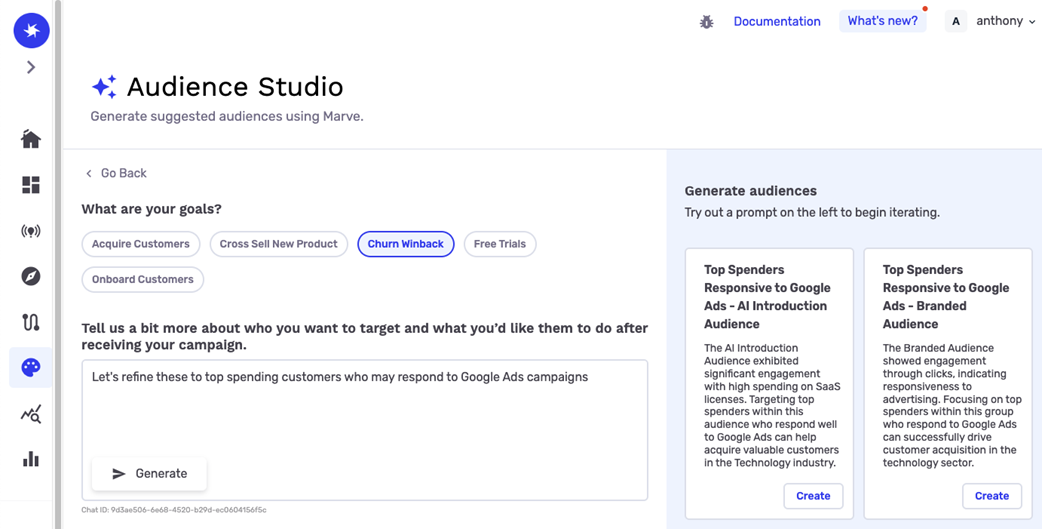
Example of audience suggestions provided by GrowthLoop.
AI-generated display ad creative based on an audience
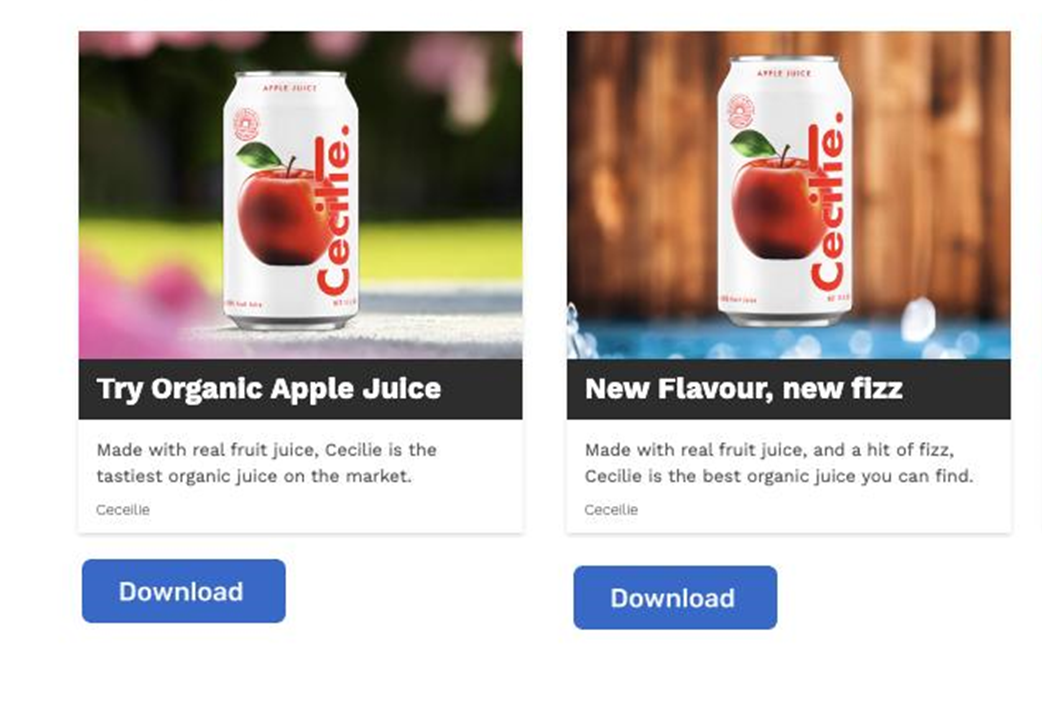
Diagram showing the centralization of generative marketing capabilities
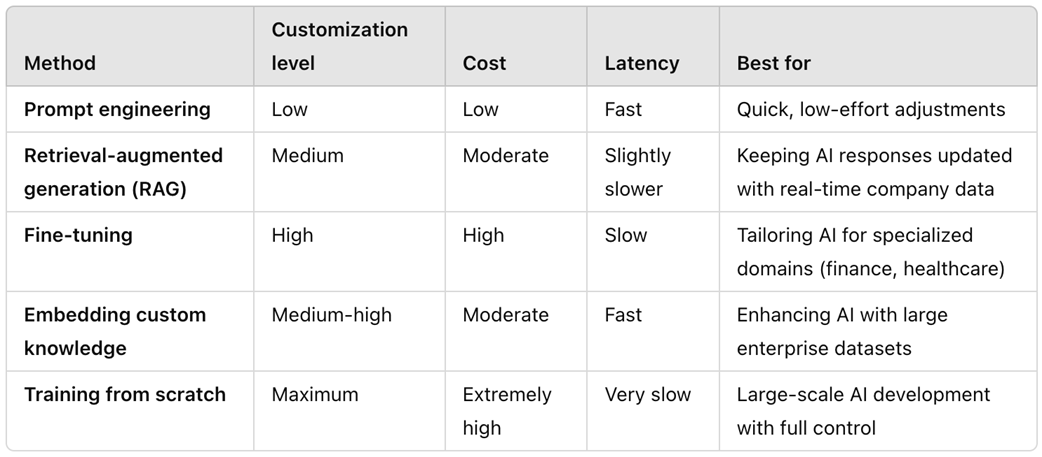
Generative AI model customization using your organization’s data
Summary
- Historically, marketing teams have used AI (specifically machine learning) to predict specific outcomes using structured input data (e.g., churn likelihood or lifetime value predictions based on engagement data).
- Today, marketing teams are applying new generative AI models to marketing, which we refer to as generative marketing.
- Generative marketing will help describe first-party data, create insights from first-party data, harness those insights to suggest targeting and personalization, generate creative suggestions, suggest measurement models, and help interpret marketing results.
- Successfully adopting generative marketing requires a holistic strategy that encompasses data, technology, organizational risk, and team workflows.
- Generative AI models are constrained by the data made available to them, so companies that embrace a holistic and unified first-party data strategy—like the one we have recommended in this book—stand to gain a competitive advantage.
FAQ
What is generative marketing?
Generative marketing is the application of generative AI (including large language models and multimodal models) to marketing tasks. These models learn patterns from massive text, image, video, and code datasets and can generate net-new content and recommendations—spanning copy, creative, targeting ideas, insights, and even agent-driven actions.
How is generative AI different from traditional ML in marketing?
Traditional ML typically predicts a specific outcome from structured data (e.g., a churn score). Generative AI can infer broad patterns and produce open-ended outputs (e.g., messaging, images, audience ideas) from complex instructions—enabling creation, not just prediction.
Why does generative marketing matter now?
It unlocks true one-to-one personalization at scale by using customer context (especially first-party data) to generate multichannel experiences. Beyond scale, its continuous self-improvement can drive compounding growth—small weekly gains (e.g., 2% per week) can translate into dramatically larger outcomes than monthly gains (e.g., 1% per month).
What practical use cases can marketers adopt today?
- Business intelligence copilots for NLQ, summaries, anomaly detection (e.g., Looker Duet AI, Power BI Copilot, Tableau Einstein Copilot)
- Creative development tuned to brand assets and formats (e.g., Adobe Express, Jasper, Typeface)
- Audience suggestions within composable CDPs that convert natural language into production audiences
- Destination-specific features in channels (e.g., Google Ads’ AI-generated ad assets; Klaviyo subject line and SMS generation)
- Interpreting sentiment and simulating persona feedback for rapid message testing
How do audience suggestions work with first-party data?
Composable CDPs connect customer-level, transactional, and engagement data to activation channels. With campaign objectives and business context, generative AI proposes audiences at scale. Marketers can use natural language (e.g., “high-value customers at risk of churn”), refine via dialogue, and review explanations before activation.
Can you summarize the chapter’s REI campaign example?
A marketer uses natural language to derive a personalization field (best-selling product per customer), requests AI-generated audience suggestions for a churn win-back goal, and then generates on-brand Google Ads creatives tailored to that audience—uploading both audience and assets for activation.
What data strategy best supports generative marketing?
Centralize first-party data in a marketing data lakehouse and pair it with a composable CDP for activation. Favor zero-copy access and an open data model to avoid blind spots and lock-in, and leverage cloud-native AI (e.g., BigQuery ML row-level LLMs) for scalable, governed personalization.
How can we tailor models with our organization’s data?
- Prompt engineering: low cost, fast, context-limited
- Retrieval-augmented generation (RAG): up-to-date knowledge via retrieval without retraining
- Fine-tuning: deeper customization, higher cost and data needs
- Embeddings + vector search: accurate retrieval of enterprise knowledge without changing the model
- Training from scratch: maximum control, rarely practical due to data/compute demands
What risks and governance steps should we plan for?
- Legal and regulatory: clarify IP ownership and PII subprocessors; ensure privacy compliance
- Security: validate data flows to model providers; consider I/O controls or isolated deployments
- Bias and limits: monitor data blind spots and model bias; prefer explainability
- Human-in-the-loop: require review/approval for AI outputs; sample at 1:1 scale
- Organizational readiness: training, clear policies, and change management
How will tools and roles evolve as autonomy increases?
- Tech choices: prioritize composable, AI-native platforms with AI at every layer, AI-driven workflows, and AI-friendly UX
- Roles: shift from marketer as creator → approver → advisor
- Controls: add notifications, inspection/explanations, and clear generation guidelines
- Trends: move from point solutions to end-to-end platforms; rising consumer AI will demand better personalization amid smarter spam filters; agentic workflows will grow

 First-Party Data Activation ebook for free
