6 Identity resolution and enrichment: building a complete customer profile
Identity resolution is the discipline of unifying fragmented first-party data into a single, reliable customer profile so teams can target, personalize, and measure effectively across channels. Done well, it expands reach (with proper opt-ins) and elevates customer experience; done poorly, it drives mistargeting, churn, and potential regulatory exposure. Because identities are expressed across varied signals (emails, devices, addresses, cookies, transactions) and toolsets, the chapter frames identity resolution as a set of building blocks, clarifies trade-offs using the lens of false positives vs. false negatives, and underscores data hygiene and governance as prerequisites—especially in regulated industries where accuracy and consent handling are paramount.
The authors recommend building on transparent, observable, and source-of-truth–anchored deterministic methods: single-field matching (e.g., email or user ID), composite keys (multiple attributes), and deterministic cascade rules (prioritized sequences that reflect field and source reliability). These approaches are fast to test, easy to explain, monitorable, and can grow in sophistication over time, while probabilistic methods commonly bundled in CDPs augment web and mobile use cases. The discussion extends to broader entity resolution—households in B2C and accounts in B2B—where addresses, firmographics, and third-party identifiers help unify records, but CRM hygiene and operational review remain critical. Technology choices span monolithic CDPs (convenience, built-in UI) to composable architectures that implement deterministic models in a lakehouse for greater control; risk is mitigated with privacy-first consent propagation, hashing/encryption where appropriate, clear usage policies, automated tests, and regular human audits.
For acquisition, the chapter details anonymous-to-known resolution: shifting from legacy third-party cookies toward resilient first-party tracking (client-side and server-side), with some organizations adopting full first-party collection to improve durability, control, and activation. It then covers third-party enrichment as a complement to first-party data: identity stitching to connect sessions and devices, contact expansion to raise paid media match rates and add channels, and profile enrichment with demographics and intent—implemented more safely via data clean rooms, cloud-based entity resolution services, and open identifiers like UID 2.0. Vendor selection and licensing hinge on audience value, data freshness, matching approaches, data access terms, and regulatory compliance. Together, these practices deliver more complete, consent-aware customer profiles that power smarter segmentation, personalization, and measurement.
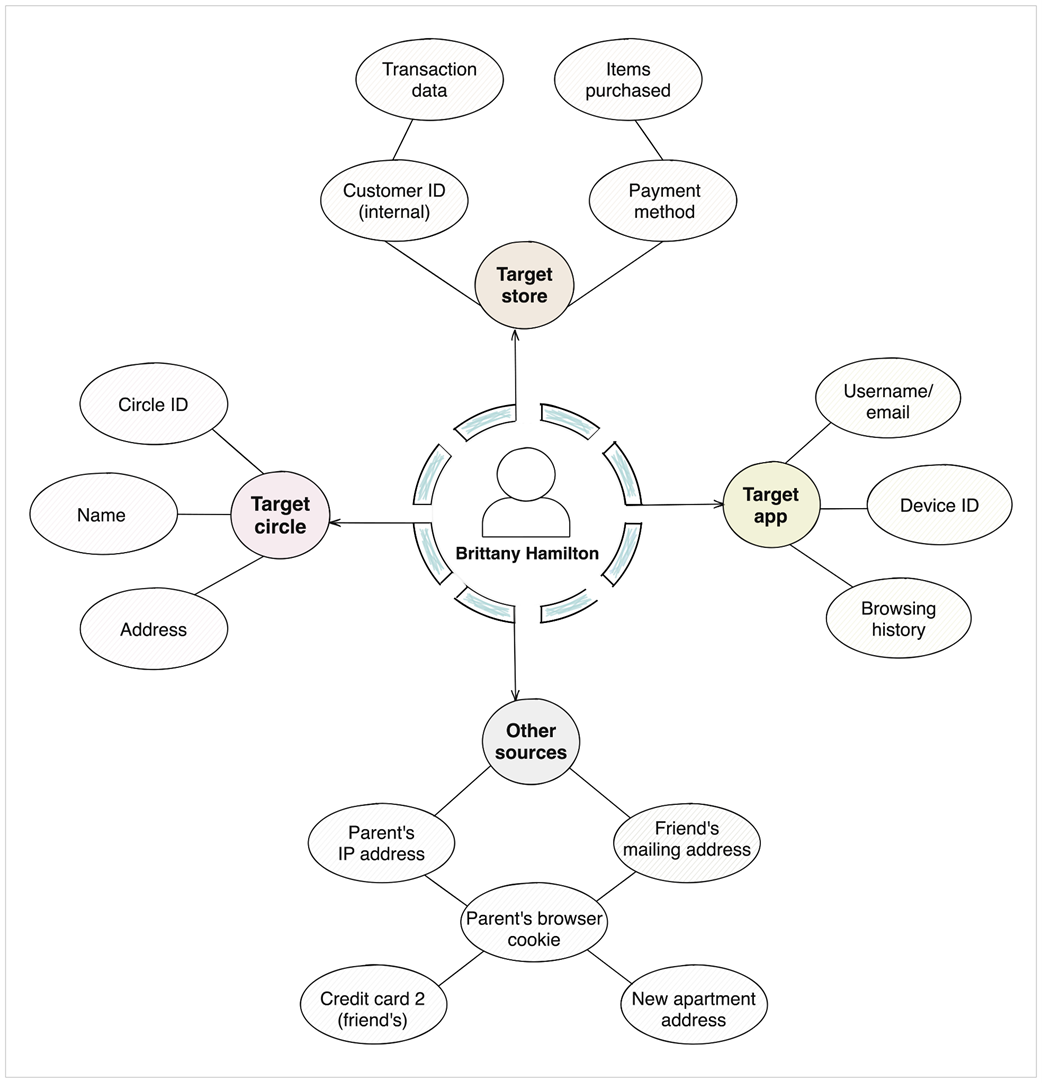
One customer, many data points: The quest for a unified view
Identify resolution confusion matrix
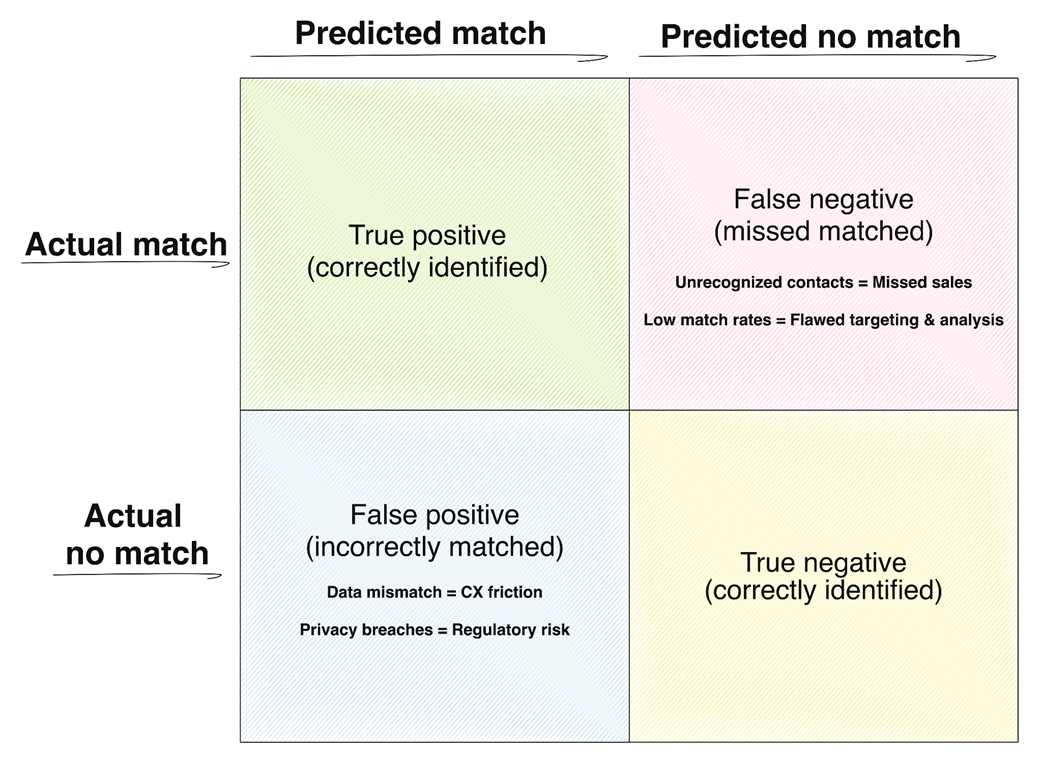
Diagram demonstrating single field identity resolution
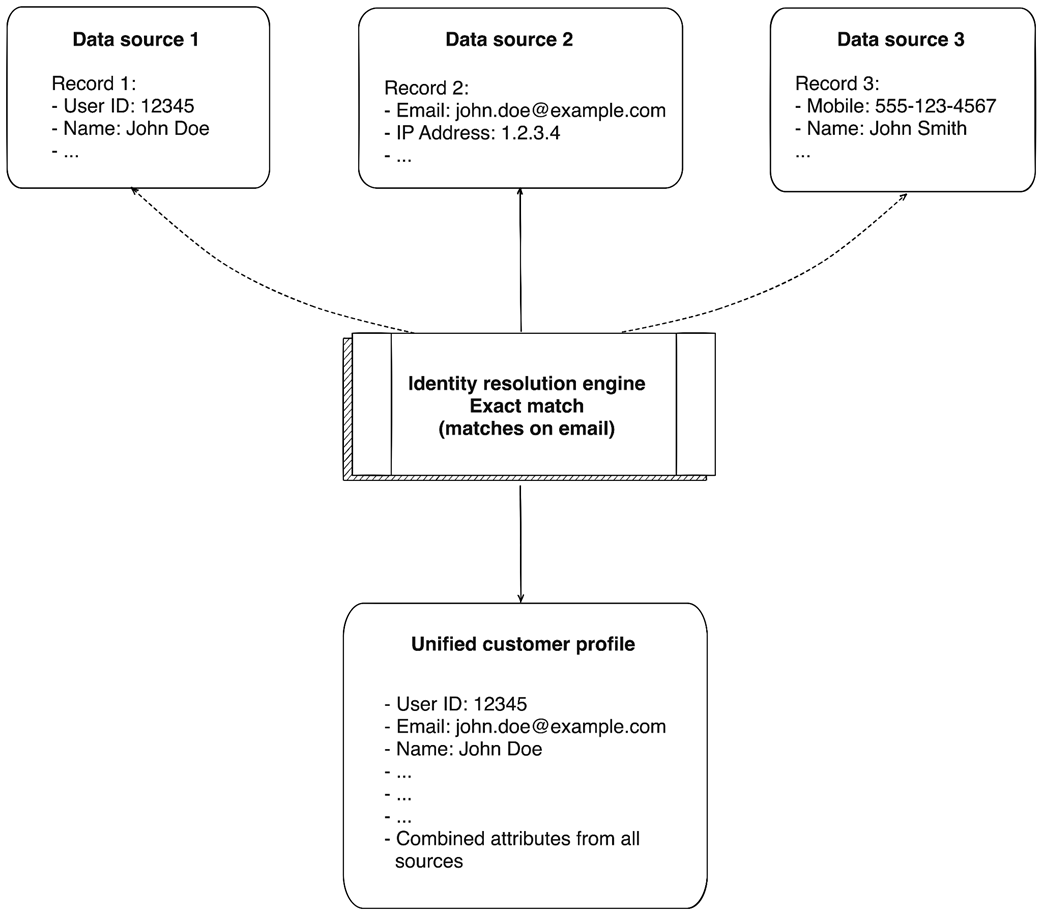
Diagram demonstrating composite field identity resolution

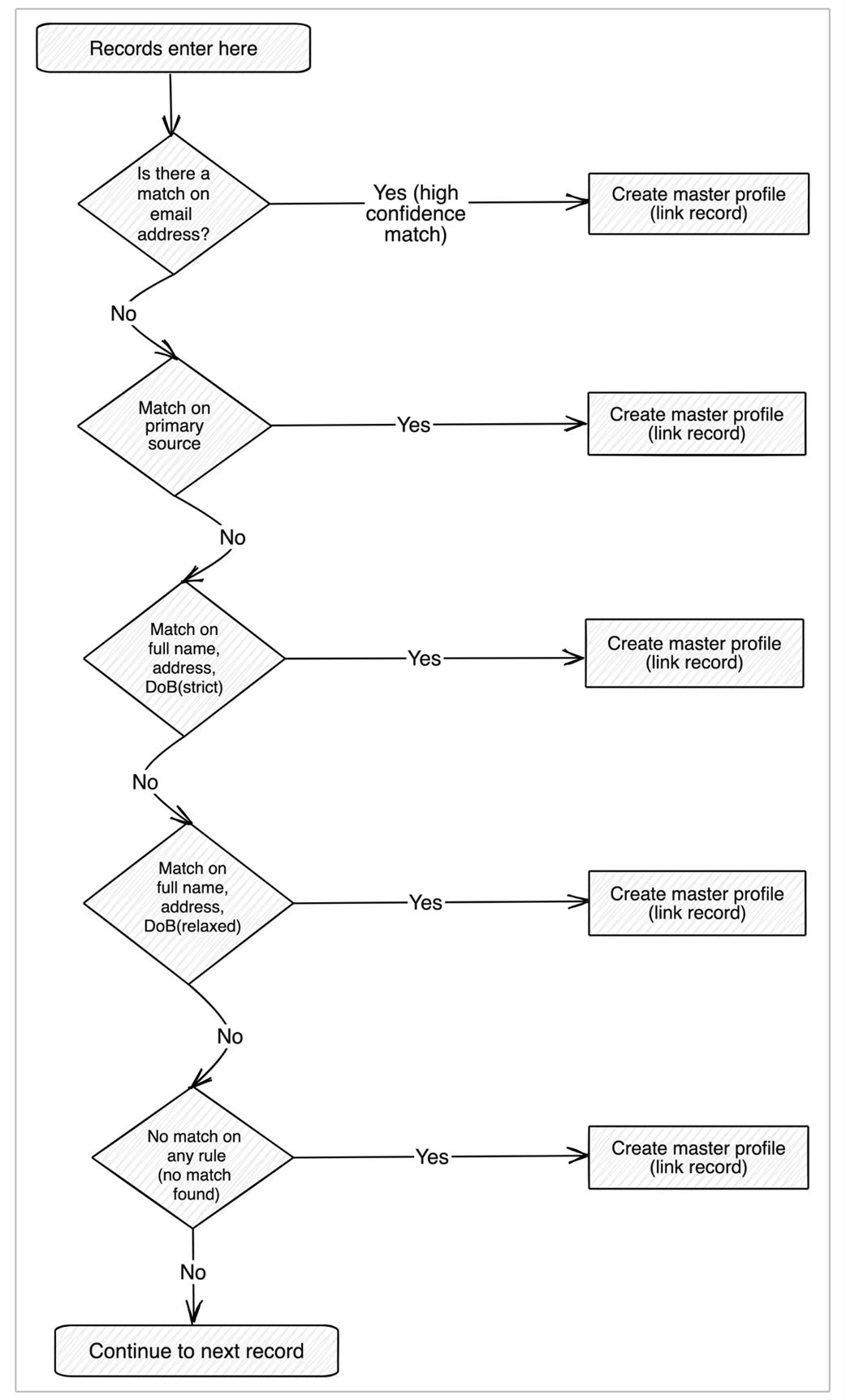
Diagram demonstrating deterministic cascade identity resolution
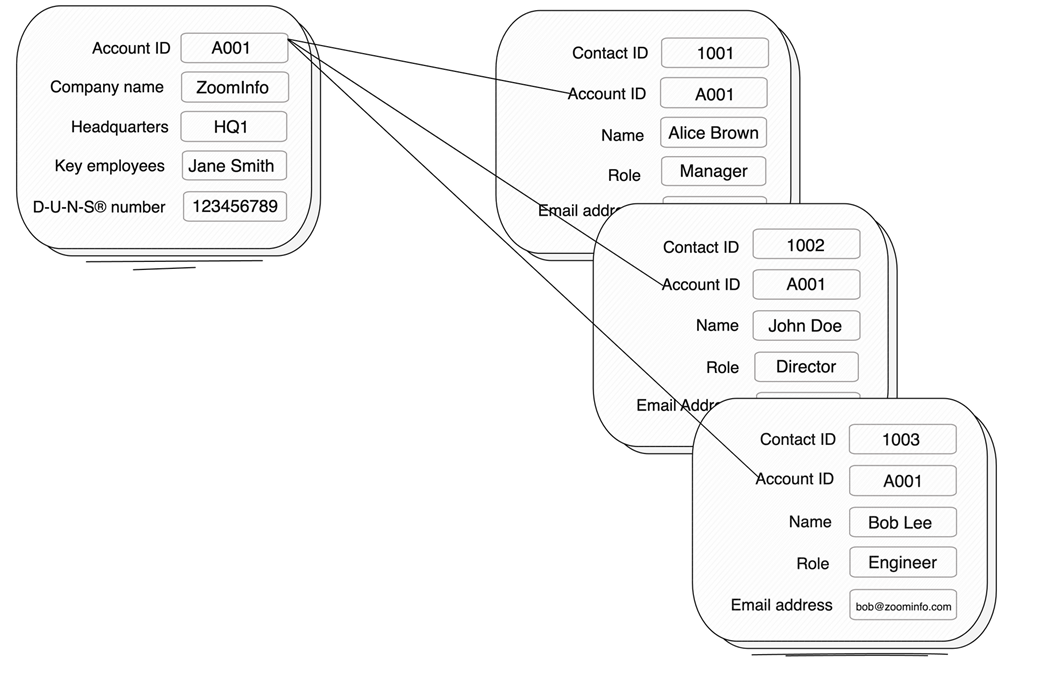
Account and contact one-to-many relationship
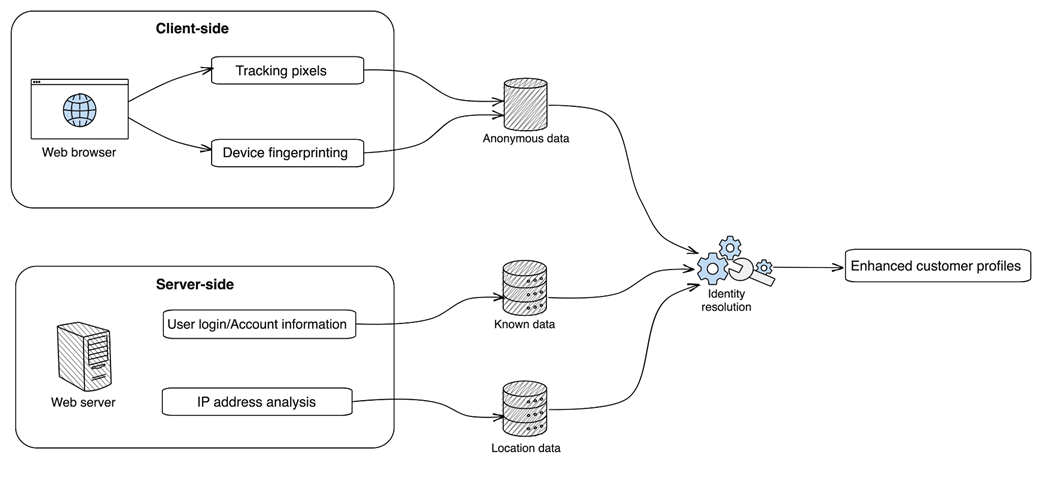
Client-side vs. server-side data collection for anonymous-to-known identity resolution
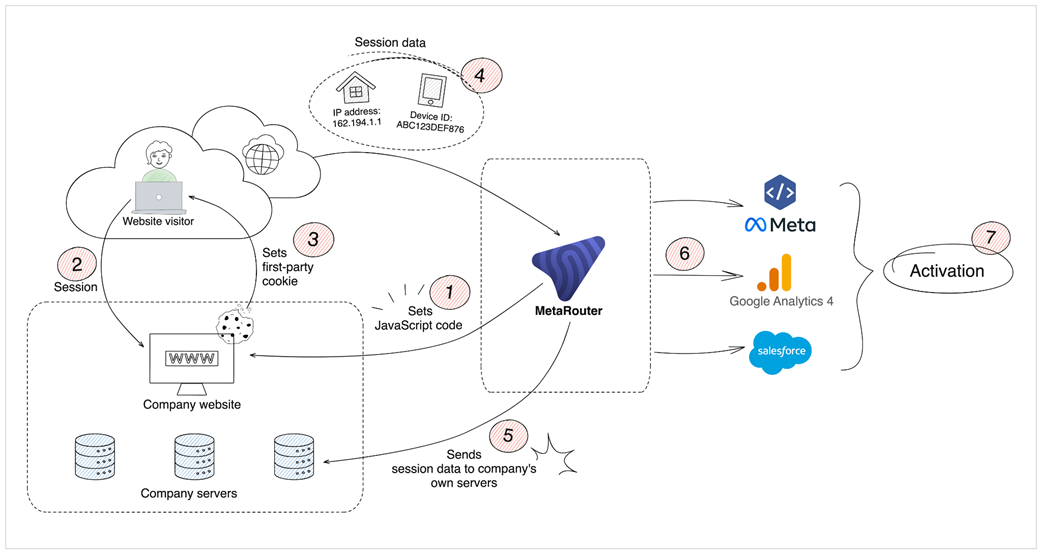
The metarouter journey: Client-side and server-side data linking for enhanced targeting
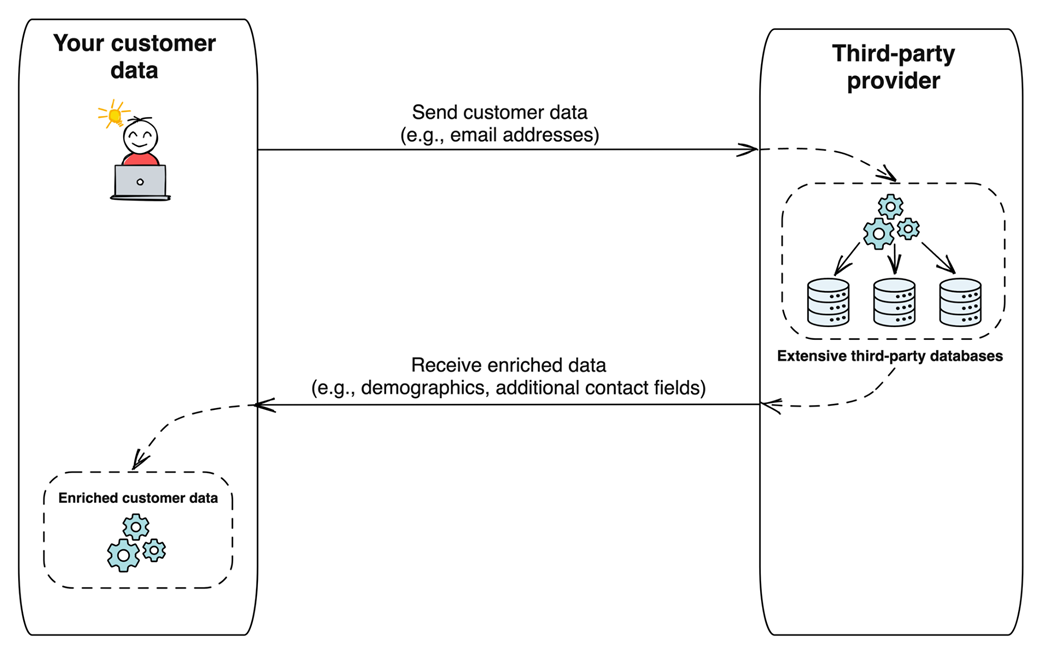
Traditional third-party enrichment (sending/receiving data)
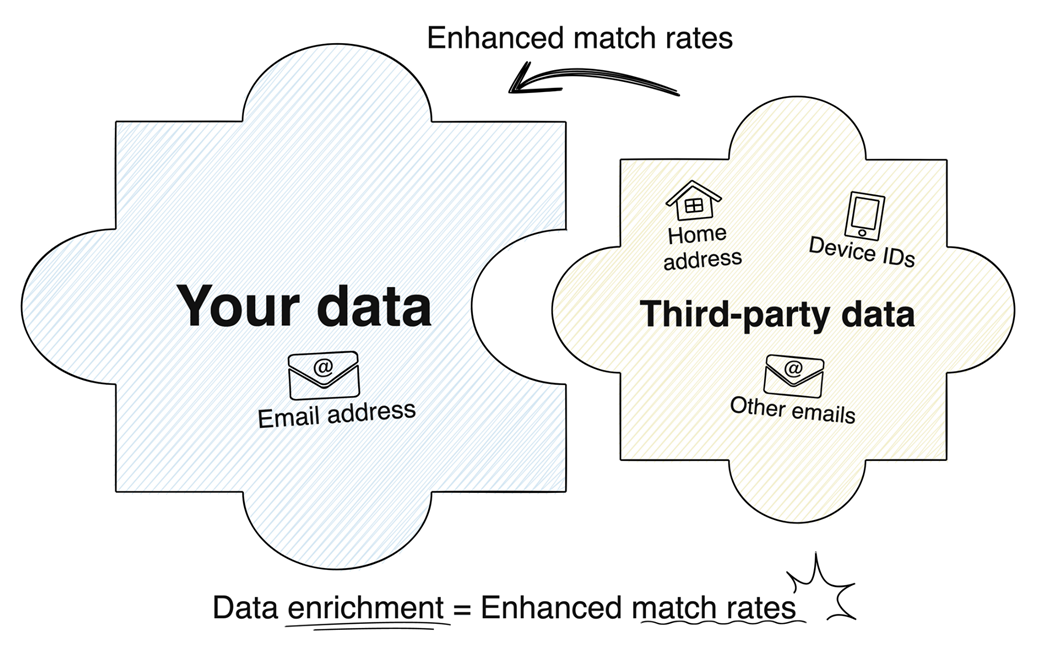
Data enrichment for enhanced match rates
Summary
- Identity resolution is a critical aspect of your first-party data strategy because it directly impacts who you can target with your marketing.
- Identity resolution is the process of linking various pieces of customer data to create a unified view of each individual. It's crucial for effective targeting, personalization, and customer experience.
- The biggest challenge is the fragmentation of customer data from different sources. This makes it difficult to accurately link all relevant data to the correct individual, risking both false positives and false negatives.
- We recommend starting with deterministic methods like single field matching, composite key matching, or deterministic cascade matching as foundational approaches. These methods are transparent, observable, and reliable, making them suitable as the core of your identity resolution strategy.
- Anonymous-to-known identity resolution is a valuable extension for acquisition marketing. Companies track anonymous website visitors over time and target them on paid media channels. Third-party cookie tracking has given way to first-party cookie tracking supported by third parties, and now, full first-party tracking.
- Third-party enrichment enhances your first-party data with external data from providers like TransUnion or LiveRamp, which can provide valuable additional information about your customers. This can improve match rates, expand audience segments, and provide a more holistic view of your customer base.
FAQ
What is identity resolution and why is it critical to marketers?
Identity resolution is the process of matching prospect and customer activity across sources to build a unified profile for each person. It powers accurate targeting, personalization, and measurement across channels. Done well, it extends reach and improves campaign performance; done poorly, it degrades customer experience, wastes spend, and can trigger compliance issues.What needs to be in place before we run identity resolution?
- Capture accurate first-party data from apps, websites, and devices, mapped to the customer journey.- Establish strong data hygiene and governance (e.g., standardized fields, deduplication, freshness checks).
- Define a primary source of truth (often transactions/orders) to anchor identities.
- Ensure opt-ins and consent metadata travel with PII through the pipeline.
How do false positives and false negatives affect outcomes?
- False positives (merging different people) risk poor CX, mis-personalization, and regulatory exposure if PII is mis-shared.- False negatives (failing to merge the same person) fragment insights, lower reach, and miss life-event opportunities.
- Use confusion-matrix sampling to monitor results and tune thresholds to minimize both error types based on business risk.
Which foundational deterministic methods should we start with?
- Single field matching: Exact match on a unique key (e.g., email, user ID, mobile). Simple and low false-positive risk, but limited scope.- Composite key matching: Match on multiple fields (e.g., name + ZIP + DOB). Broader coverage, but sensitive to data quality and standardization.
- Deterministic cascade matching: Prioritized, rules-based sequence that applies the strongest match rules first and falls back to others; creates a robust, extensible foundation.
Why is deterministic cascade matching often preferred?
- Transparent: Rules are simple to explain and review.- Observable: Easy to monitor with checks for non-unique keys, stale/conflicting sources.
- Foundationally linked: Prioritizes reliable sources (e.g., transactions) and strongest identifiers (e.g., email) first.
- Practical: Fast to test, implementable in SQL, and scalable in complexity.
Where does probabilistic matching fit in?
- Use probabilistic methods (e.g., string similarity, device-based inference) to augment deterministic foundations—especially for web/mobile behavior.- Many CDPs provide probabilistic stitching out-of-the-box but with less transparency.
- Recommended pattern: Deterministic for communications and profile unification; probabilistic to connect pre-login and cross-device activity.
How do we handle households and B2B (company) identity resolution?
- Households: Often resolved via physical address; expect edge cases (multiple addresses, complex relationships) and consider customer input over time.- B2B accounts: Resolve companies using deterministic cascades on company name, HQ, key employees, and third-party IDs (e.g., D‑U‑N‑S).
- CRM hygiene matters: Sales Ops often reviews and merges duplicate accounts to support accurate lead scoring and routing.
Should we build identity resolution or buy a platform?
- Monolithic CDP: Faster to start, UI for rules, includes probabilistic web/mobile stitching; good when data team support is limited.- Composable/CDI approach: Build deterministic models in your lakehouse for transparency, control, and monitoring; integrate CDP-like components as needed.
- Data onboarding services: Pay-per-activation to boost paid media match rates (without owning the identity graph).
- Third-party data providers: License identifiers/attributes to enrich profiles and reach.
How can we convert anonymous visitors to known profiles in a privacy-first way?
- Favor first-party cookies; third-party cookies are restricted/deprecating.- Combine client-side and server-side tracking; server-side is more resilient to blockers.
- Use progressive profiling and SSO to capture identifiers with consent.
- Supplement (cautiously) with IP/device signals and fingerprinting where compliant.
- Consider full first-party tracking (owned infrastructure) for control, resilience, and longer data usefulness.
What is third-party enrichment and how should we use it?
- How it works: Match your first-party data to third-party identity/attribute graphs via secure methods (in-cloud services, data clean rooms, or hashed transfers).- Core use cases: Identity stitching (cross-session/device), contact expansion (more identifiers for activation), and profile enrichment (demographics/firmographics/intent).
- Enablers: Cloud entity-resolution services (e.g., with LiveRamp/TransUnion), universal IDs (e.g., UID 2.0).
- Buying tips: Evaluate freshness, coverage, compliance, match workflow, usage rights, and pricing drivers; consider bundled access via CDPs/onboarding/cloud vendors.

 First-Party Data Activation ebook for free
