5 Modernizing the marketing data platform: data lakehouses and composable CDPs
Modern marketing is constrained by fragmented data and the need to prove ROI while delivering personalization at scale. This chapter outlines a modern approach that unites a data lakehouse with a composable customer data platform to turn first-party data into real-time, actionable insights. Lakehouses consolidate structured, semi-structured, and unstructured data in one environment, while composable CDPs activate it directly where it lives—eliminating new silos, reducing duplication, and enabling fast, compliant campaign execution.
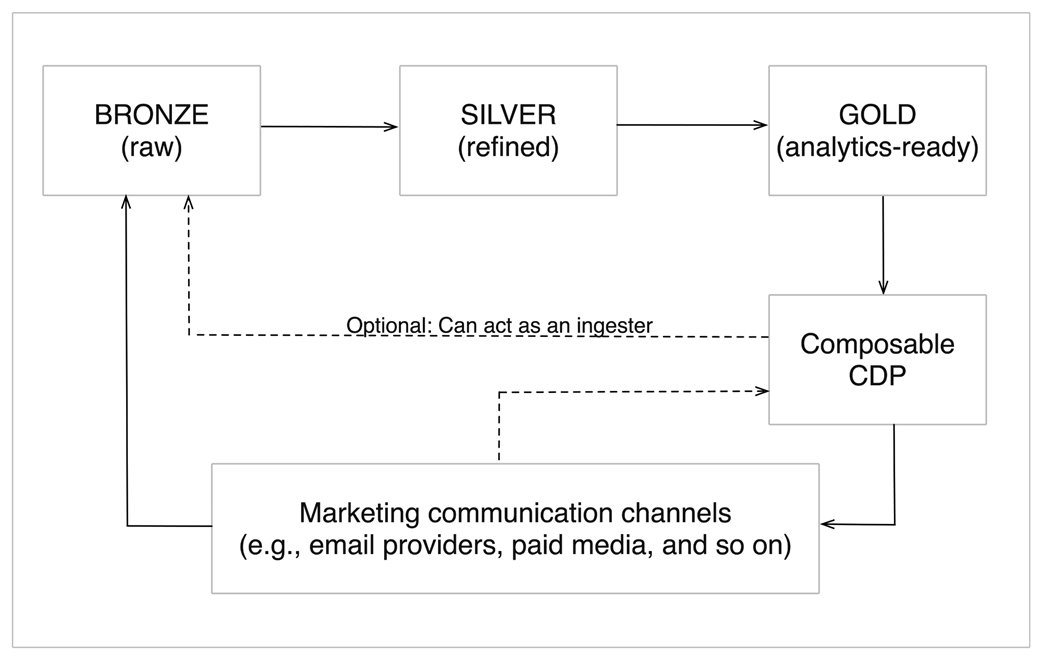
The lakehouse blends the flexibility of data lakes with warehouse-grade performance and reliability (including transactional integrity), giving marketers a consistent, holistic customer view. Using a medallion architecture—Bronze for raw intake, Silver for cleansing and unification, Gold for analytics-ready and activation—teams progress from messy inputs to trustworthy, high-value datasets. Composable CDPs then layer on top as a lightweight, modular activation tier: they query or stream from the lakehouse in real time to build and sync segments, personalize experiences, and orchestrate campaigns, all while preserving governance and avoiding vendor lock-in.
To implement, the chapter contrasts brownfield and greenfield paths, offering realistic timelines, cost and risk trade-offs, and stepwise adoption strategies. It covers designing resilient architectures (modeling choices, tech stack decisions across cloud-native and third-party options), executing migrations and parallel runs, enforcing data quality and privacy, reverse-engineering legacy logic, and building robust governance with auditing and disaster recovery. Finally, it recommends formal deliverables, training, and reference patterns, and shows how to measure ROI through faster time-to-market, conversion uplift, reduced platform costs, and improved data team productivity—starting with focused pilots that prove value before scaling.
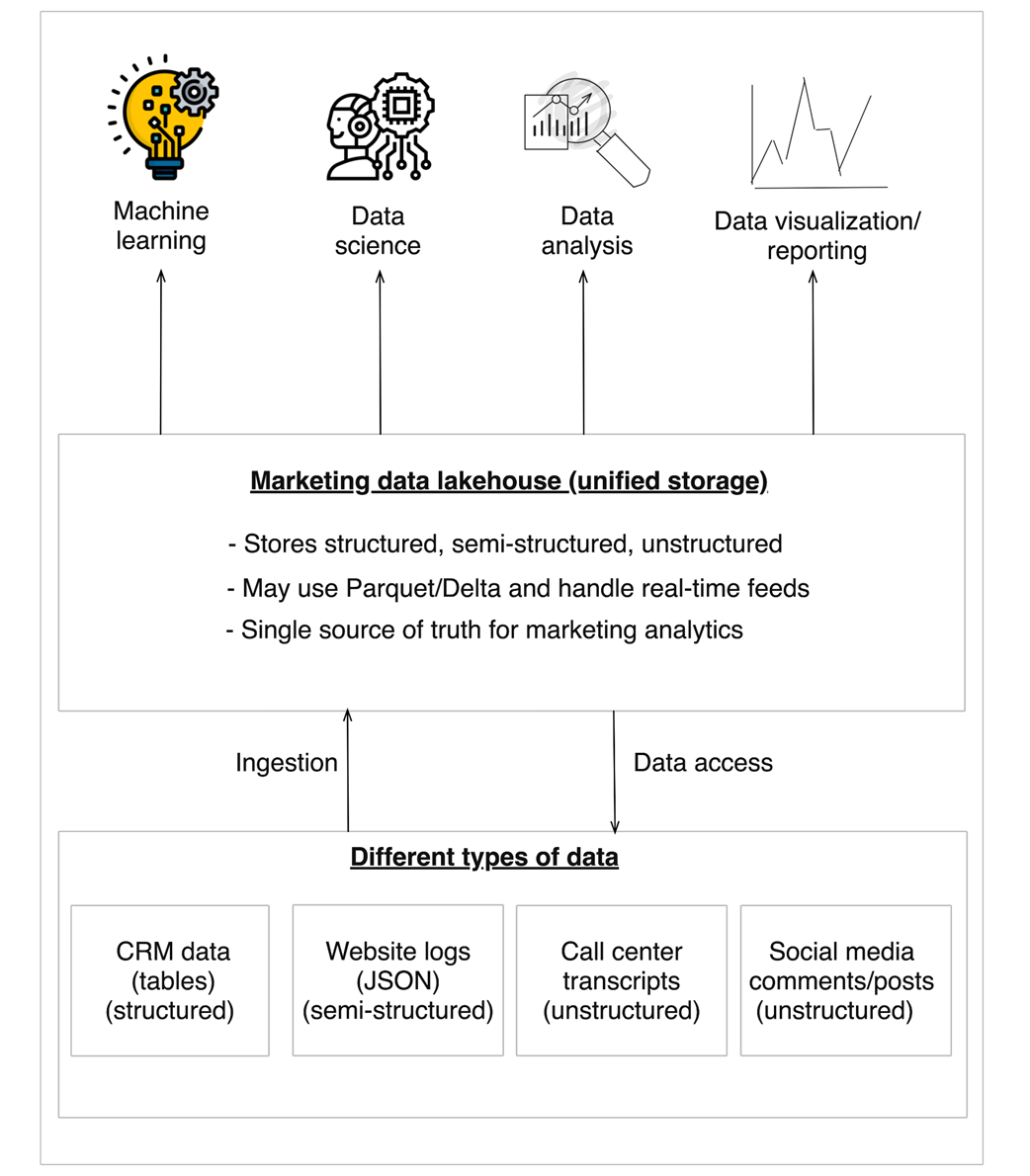
A simplified view of a marketing-focused lakehouse
A simplified view of a marketing-focused lakehouse
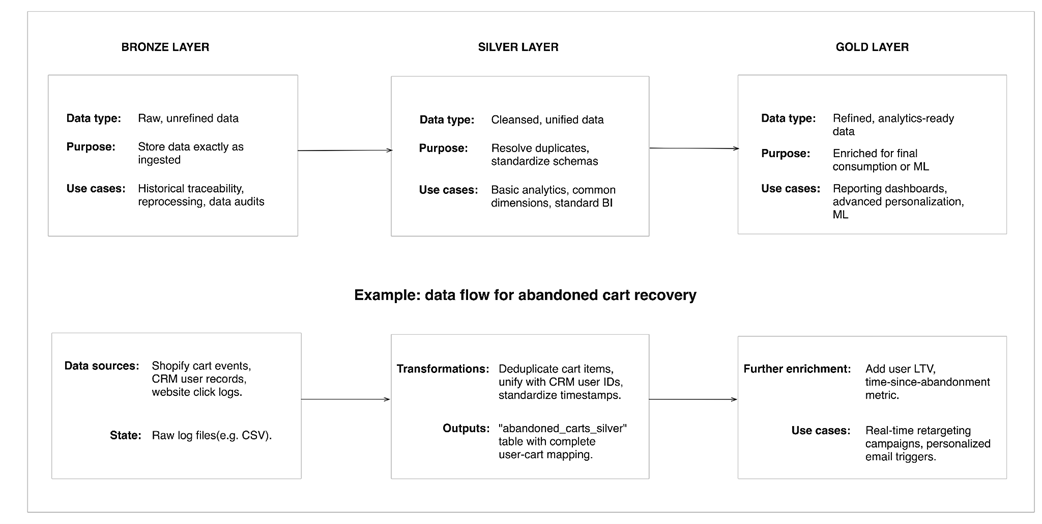
Medallion architecture for abandoned cart recovery
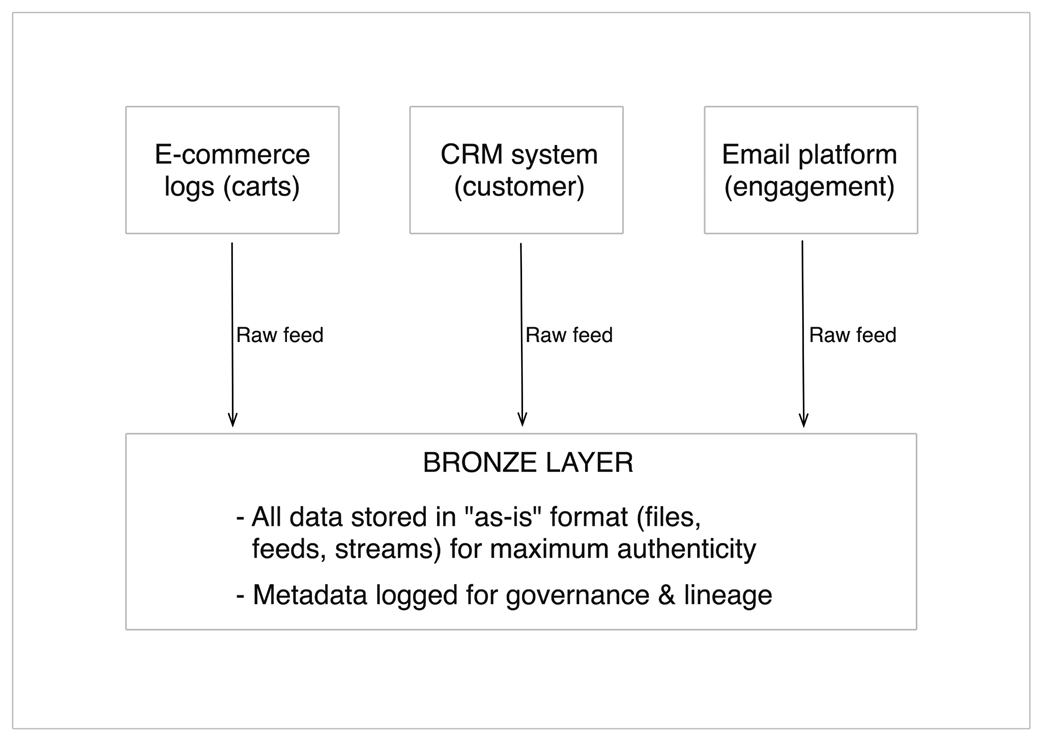
Bronze layer data flow for abandoned cart recovery
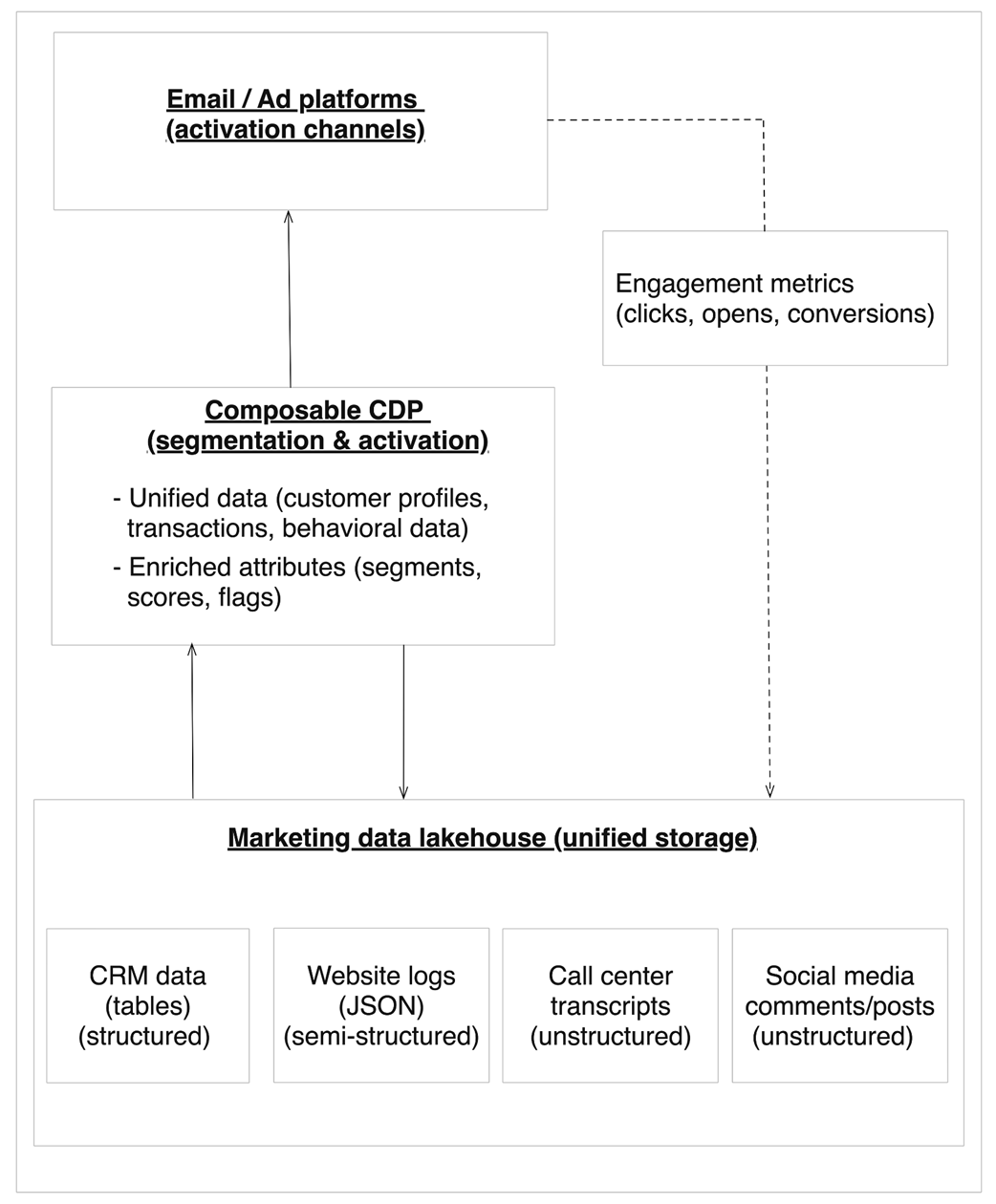
From bronze to gold, fueling a Composable CDP
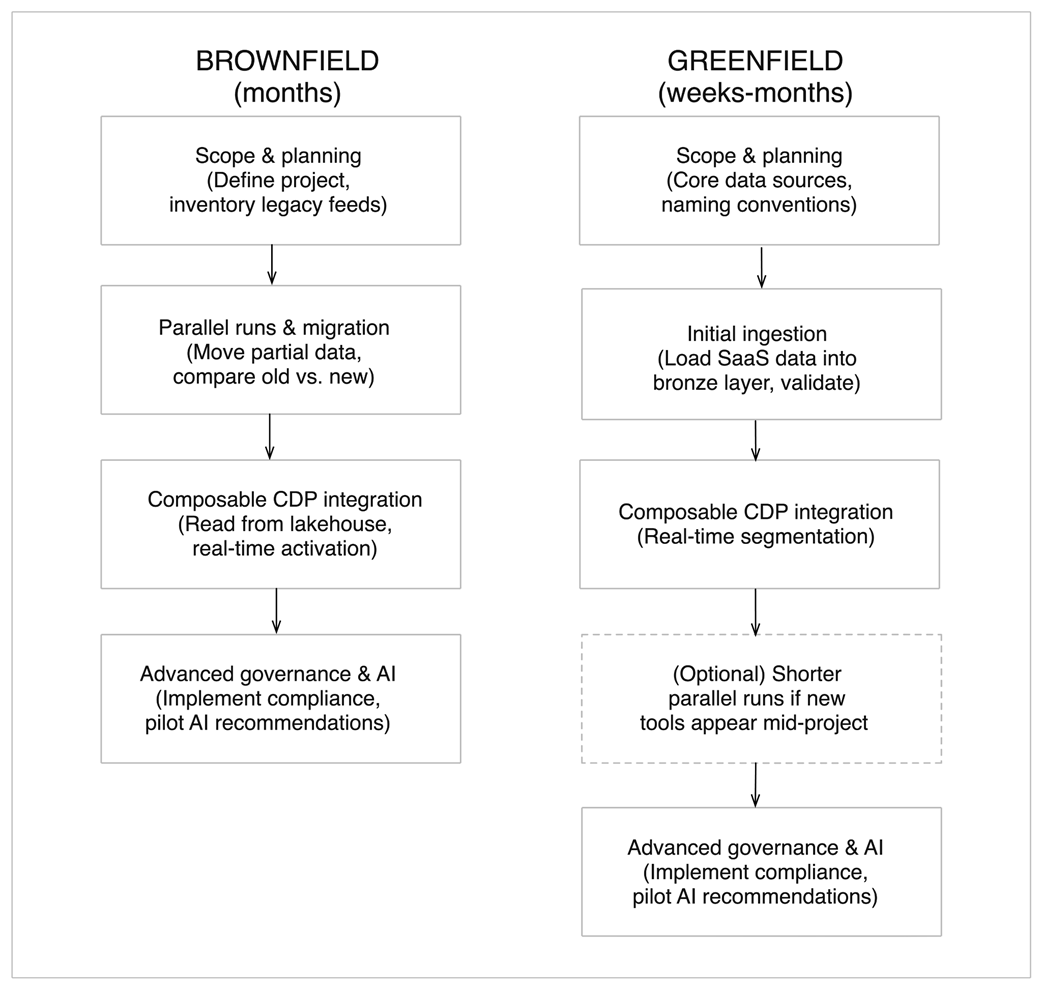
Sequence brownfield vs. greenfield
Summary
Data Lakehouses provide a holistic framework to unify and manage fragmented marketing data, reducing silos and creating a single source of truth.
Composable CDPs serve as the real-time activation layer, tapping directly into your lakehouse so you can transform raw customer data into targeted segments for immediate campaigns.
The Medallion Architecture (Bronze, Silver, Gold) guides data from raw forms to analytics-ready states, ensuring consistent quality at each stage.
Together, these components help marketers build personalized, scalable, and effective interactions, leading to better business outcomes.
Start with realistic planning by assessing brownfield vs. greenfield scenarios, anticipating parallel runs or changing needs, and setting feasible timelines.
Prioritize governance and data quality with robust security, compliance, and data modeling, especially as your marketing stack grows.
Adopt incrementally—migrate historical data in phases, reconcile old and new outputs, and retire legacy systems only when ready.
Balance performance with cost by weighing advanced capabilities (like active-active DR) against your marketing ROI.
Collaborate across teams—involve marketing ops, data engineering, and analytics stakeholders early to align on goals, avoid siloed efforts, and accelerate problem-solving.
Visualize each project phase and track ROI continuously so stakeholders can see tangible gains, ensuring sustained support for your marketing lakehouse initiative.
FAQ
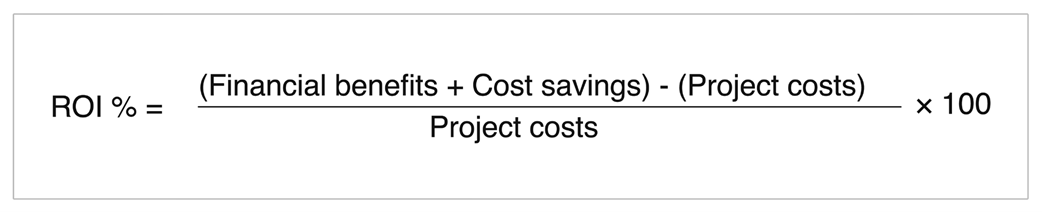
What is a data lakehouse and why should marketers care?A data lakehouse combines the flexibility of data lakes with the performance of data warehouses in a single environment. It can store and analyze structured, semi-structured, and unstructured data—from CRM tables to call center transcripts—so teams get a holistic customer view without juggling multiple silos. Marketers benefit from faster insights, more accurate personalization, and fewer copies of data to manage. Many lakehouses also support ACID transactions, which helps keep segments and offers consistent in real time.How does a composable CDP differ from a traditional CDP?Traditional CDPs copy your data into their own platform, creating a new silo, longer implementations, and vendor lock-in. A composable CDP sits on top of your existing lakehouse or warehouse, reads data in place, and activates audiences in real time without duplicating records. Setup is typically faster, governance is simpler because your security policies stay in one environment, and you can plug in or swap components without rebuilding the stack.Do we need to replace our existing data warehouse or CRM to adopt a lakehouse?No. A lakehouse can complement what you already have. Keep your warehouse for structured reporting that works today, and add a lakehouse to handle un/semi-structured data, streaming events, and advanced analytics. You can adopt incrementally to avoid “rip and replace,” while planning for governance, security, and cost controls during any parallel migrations.What is the medallion architecture (Bronze, Silver, Gold) and how does it help marketing?The medallion architecture organizes data into three layers: Bronze stores raw, full-fidelity feeds and metadata; Silver cleanses, unifies, and standardizes entities like customers and carts; Gold prepares analytics-ready, often de-normalized datasets for BI, segmentation, and activation. In practice, abandoned-cart events flow from raw logs (Bronze) to unified customer views (Silver) to activation-ready segments (Gold) that a composable CDP can sync directly to channels.How do a lakehouse and a composable CDP work together for real-time activation?The lakehouse serves as the single source of truth, continuously ingesting events (e.g., clicks, cart updates) via streaming pipelines. The composable CDP queries or streams just the relevant fields—like “customers who abandoned carts in the last hour”—to build segments on demand and push them to email, ads, or other channels. Because data stays in place, activation is faster, cheaper, and consistent across tools.How is data privacy and governance handled in this model?Since the composable CDP reads from your lakehouse or warehouse, your existing security, access controls, and compliance policies apply uniformly. You can enforce encryption, anonymization, and role-based access once, rather than across multiple silos. Audit trails, lineage, and ACID compliance support accurate, recoverable datasets—making it easier to meet regulations like GDPR and CCPA while running real-time campaigns.What’s the practical path to implementation—Brownfield vs. Greenfield?Brownfield modernizes an existing environment and often requires parallel runs to validate metrics, manage cost overlap, and re-engineer legacy scripts. Greenfield starts fresh, enabling quicker setup but demanding early standards (naming, schemas) to avoid creating new silos. Both approaches benefit from a phased rollout: prioritize high-impact use cases (e.g., cart recovery), validate data quality, then expand.Which technology stack should we choose: cloud-native or third-party lakehouse tools?Cloud-native services (AWS, Azure, GCP) integrate tightly with their ecosystems and are straightforward if you already standardize on one cloud. Third-party platforms (e.g., Snowflake, Databricks) often offer cutting-edge analytics and multi-cloud flexibility but add licensing costs. Many teams choose a hybrid approach. Use what your team knows, avoid over-engineering, and prefer open table formats to remain portable.What pitfalls should we watch for and how do we mitigate them?Common risks include schema drift, undocumented legacy logic, streaming complexity, and parallel-run cost spikes. Mitigate with clear exit criteria for cutover, automated validation checks, robust monitoring, and thorough documentation of transformations and segment definitions. Build in auditability, versioning/rollback (“time travel”), and a right-sized disaster recovery plan (active-active or active-passive) aligned to business SLAs.How do we measure ROI for a lakehouse + composable CDP initiative?Track faster time-to-market for campaigns, improved conversion/retention from real-time personalization, reduced platform and storage costs after decommissioning legacy systems, and higher data team productivity. A simple formula is (Financial benefits − Total costs) ÷ Total costs. Prove value early with a focused pilot—like abandoned-cart recovery—then scale to additional use cases once results are validated.
pro $24.99 per month
access to all Manning books, MEAPs, liveVideos, liveProjects, and audiobooks!

 First-Party Data Activation ebook for free
