3 Marketing first-party data: crawl, walk, run
This chapter presents a pragmatic, people-first roadmap for adopting a first-party data marketing strategy. Framed as a crawl-walk-run progression, it tackles the core change-management hurdles—realigning teams by objectives and lifecycle, centralizing processes around a single source of truth, and standardizing measurement—so organizations can move from early reach to provable, incremental impact. The authors advocate a use-case–driven approach to overcome internal resistance: prioritize a small set of high-value, low-effort use cases, prove visible wins quickly, and use them to build momentum across cross-functional partners.
In the first phase, the goal is velocity: remove barriers so marketers can self-serve audience design and activation directly from unified first-party data. Teams often start with manual audience queries to prove value, then invest in scalable, composable technologies that connect to the data where it lives. Standardized suppressions and opt-outs are centralized to improve compliance, accuracy, and audience sizing. With automated, cross-channel syncing in place, teams launch their first audiences, adopt simple segmentation (e.g., lifecycle or RFM) to avoid overlap, and gain visibility through a centralized audience hub. The payoff is faster iteration, higher-quality targeting, and freed-up data teams who can focus on expanding attributes rather than ticket-based audience pulls.
The second phase establishes discipline in experimentation and measurement: assign treatment and control upstream of channels to enable cross-channel tests, use consistent statistical methods, and measure incrementality on any metric available in the data lakehouse. As volume grows, governance and optimization address saturation and overlaps. The third phase elevates performance with predictive models (propensity, churn, lifetime value, next best action), starting with interpretable approaches to build trust and pairing predictions with clear labels marketers can use. Teams then graduate to multi-step, cross-channel journeys and multivariate tests, planning for adequate sample sizes and longer time horizons. With foundations in place, they can safely layer in generative AI to accelerate ideation and journey design, using conversational workflows and feedback loops—while respecting compliance and organizational readiness.
Summary of key recommended stages to drive first-party data adoption.

Diagram showing a typical manual process for audience creation.
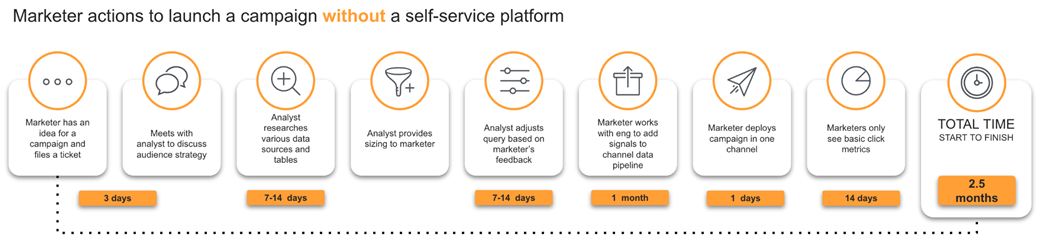
Campaign process flow shown side by side with a self-serve platform.
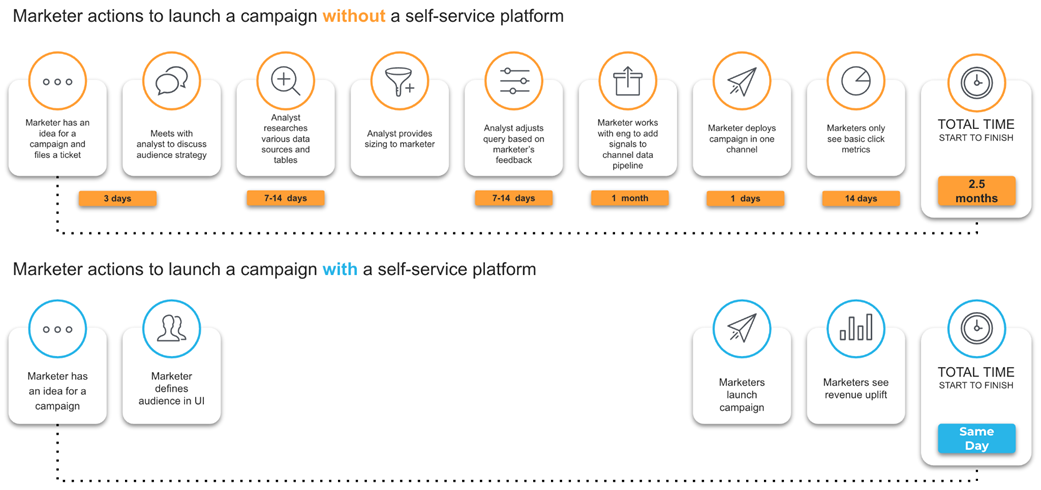
Lifecycle segmentation model
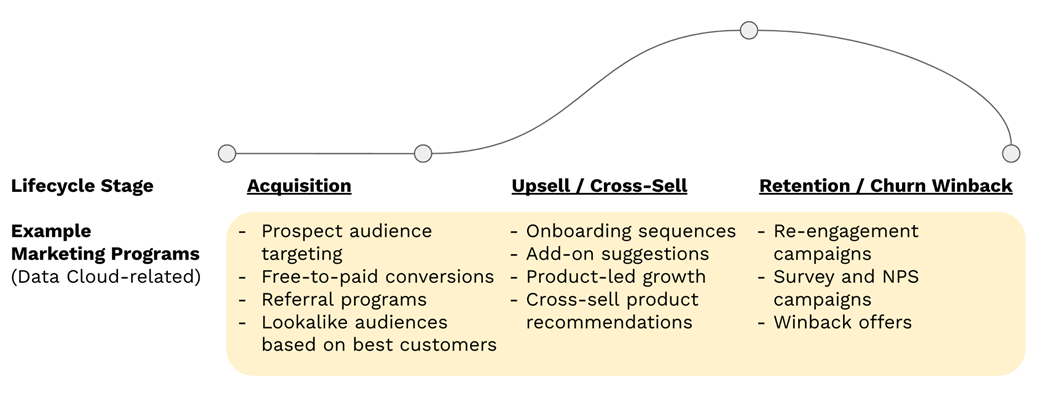
GrowthLoop example of an audience hub
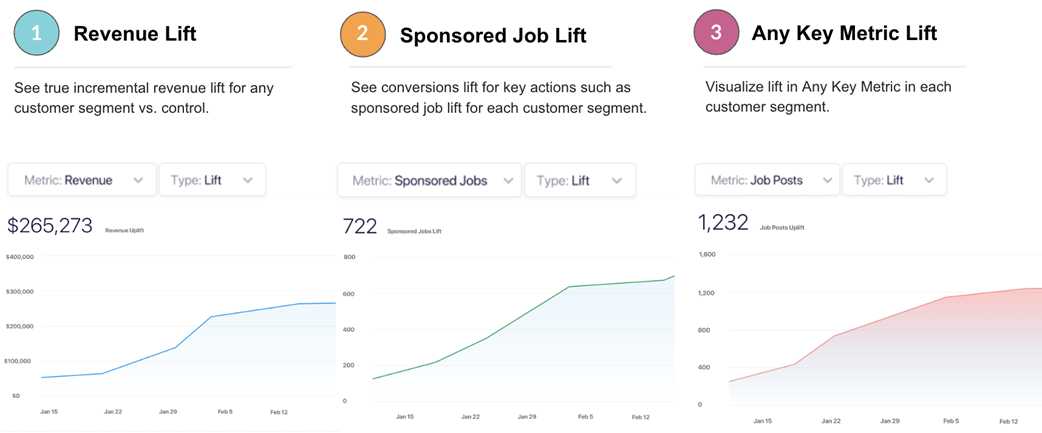
GrowthLoop measurement for a sample audience
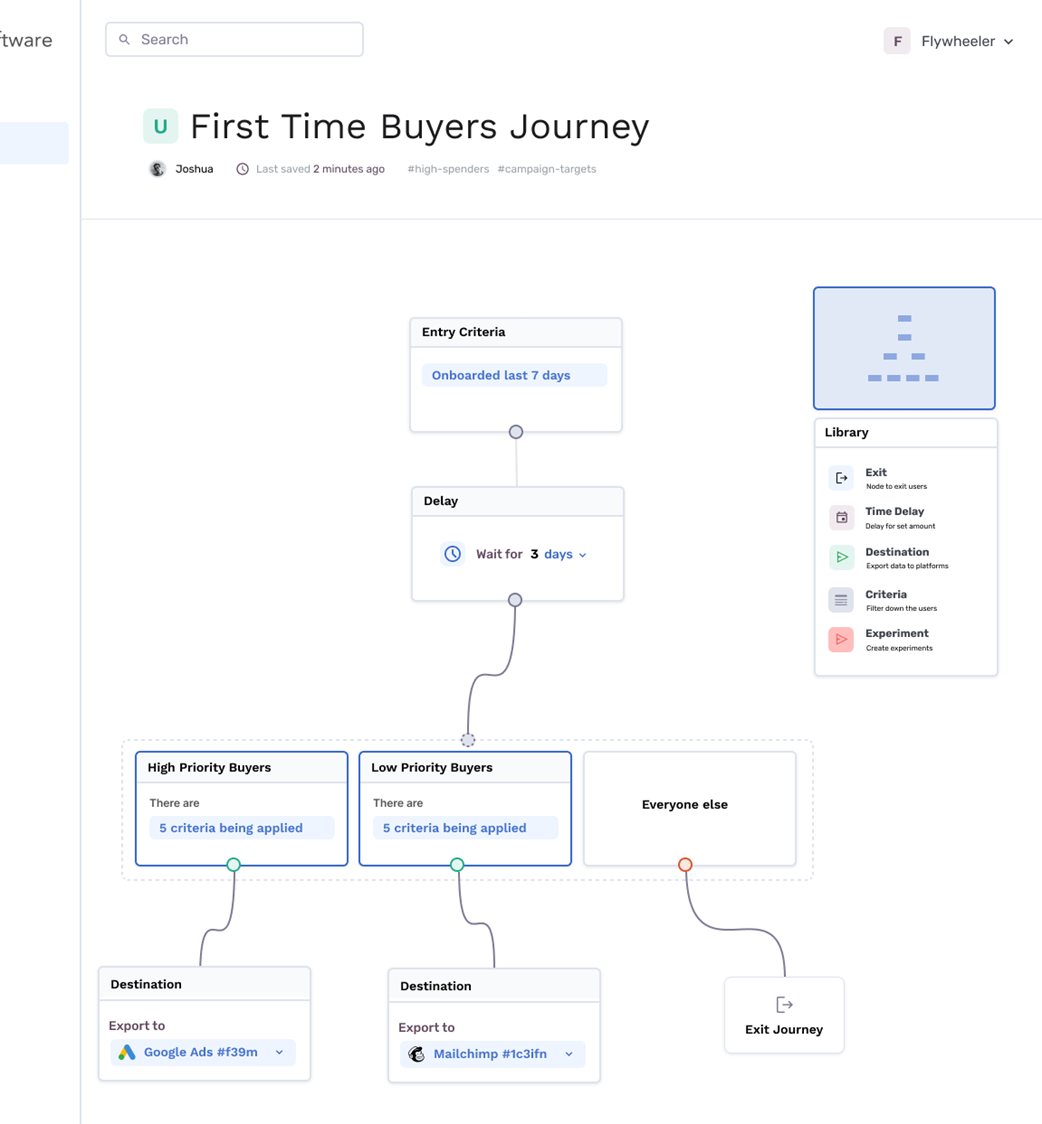
An example of a customer journey.
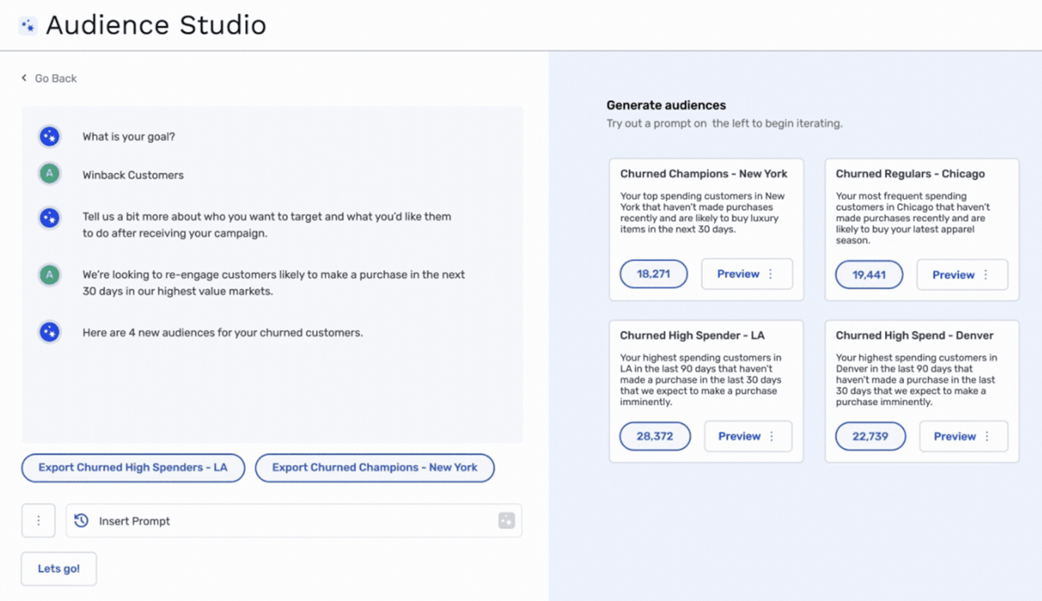
Generative marketing dialogue for a specific audience in GrowthLoop
Summary
- Change management is often the most challenging part of a first-party data transformation, and success relies on thoughtfully designed phases that deliver valuable wins along the way.
- In the first phase of change, organizations should focus on bridging the data between teams with self-serve capabilities for marketers.
- In phase 2, the focus should be standardized experimentation and measurement that ensure you accurately identify wins.
- In phase 3, you can use the foundations your team has built up to that point to introduce predictive models and multi-channel journeys.
- Your team can introduce generative AI to assist with ideation and decision-making to spark further innovation.
- Changemakers at successful organizations design with the current people, processes, and systems in mind to minimize friction in driving change.
- Changemakers find ways to motivate transitions and use user-centric design to achieve change.
FAQ
What does the “crawl, walk, run” approach mean for first-party data activation?
It’s a phased roadmap for change management and value delivery. Crawl (Phase 1) removes barriers by enabling self-serve audience design and quick wins across channels. Walk (Phase 2) standardizes experiments and measurement to prove incremental impact consistently. Run (Phase 3) adds predictive models, multi-step journeys, multivariate tests, and selectively introduces generative AI—once foundations are in place.
How should we choose our first use cases?
Prioritize by two dimensions: value (business impact unmet by current tools) and level of effort (data availability and modeling complexity). Start with high-value, low-effort cases and avoid overbuilding the data model before first wins. Examples: B2C engagement-based targeting (e.g., reach non-email openers on social), B2B account-based marketing using CRM stage data, and B2B2C employer-level engagement targeting.
What are self-serve audience capabilities and why are they critical?
They let marketers explore first-party data, set inclusion/exclusion rules, see instant audience sizing, and iterate quickly—without ticketing a data team. Short term, teams often use BI dashboards to unlock this; long term, a composable CDP that connects directly to the data layer provides durable audience design and activation. Benefits include faster velocity, better targeting quality, fewer bottlenecks, and shared source-of-truth suppressions.
How should we standardize opt-outs and suppressions?
Centralize all suppression logic (e.g., legal opt-outs, minors, fraud, delinquency) in the customer profile/data pipeline and apply default suppressions to all audiences. Tailor sets by channel or population when needed. This improves compliance, audience accuracy, and operational reliability, while giving marketers trustworthy audience sizing.
How do we build and automate our first cross-channel audience?
- Pick a few high-value, low-effort audiences.
- Define objectives and success metrics (e.g., incremental revenue or conversions).
- Specify targeting and personalization attributes (including ML predictions if available).
- Map requirements to existing data; close gaps or create computed fields.
- Set up automated, reliable syncs to destination channels.
- Review and launch; start automated exports and iterate.
What’s the role of MECE lifecycle segmentation and an audience hub?
A MECE framework (e.g., lifecycle stages, RFM, or clustering) avoids audience overlap and clarifies ownership. A centralized audience hub provides visibility into all active audiences, approvals, exports, and overlaps—reducing conflicts and helping teams prioritize targeting opportunities.
How do we automate experiments to prove incremental impact?
Assign treatment/control in the data layer before exporting to channels, and only export treatment members. Standardize methodology in the audience activation flow: randomize assignments (stratify when needed), calculate sample size and duration, track assignments over time, and plan for spillover risks (e.g., geo tests). This enables consistent, cross-channel incrementality measurement.
How should we measure marketing performance “on any metric”?
Ingest engagement and conversion signals from all channels back into the central data layer. Evaluate incremental impact across funnel metrics (from page views to purchases) and product lines to detect synergies or cannibalization. A centralized measurement layer lets you compare audiences and campaigns apples-to-apples on the KPIs that matter.
Which predictive models should we start with, and how do we drive adoption?
Begin with interpretable models (propensity, churn, lifetime value, next best action) to build trust and inform creative/personalization. Make outputs marketer-friendly by converting scores into categories (e.g., high/medium/low) and exposing them alongside other attributes. Always validate performance through controlled experiments before scaling.
When should we adopt journeys, multivariate testing, and generative AI—and what should we watch for?
Adopt journeys after you’ve proven measurement and models: use them for acquisition, onboarding, cross-sell, upsell, retention, and winback. Apply multivariate splits with proper power and longer observation windows to get conclusive results. Introduce generative AI only after phases 1–2 are stable; align with compliance, use it for audience/journey/creative suggestions, and leverage conversational iteration and feedback loops from campaign results.

 First-Party Data Activation ebook for free
