7 Understanding financial fraud and foundational detection strategies
Financial fraud has shifted from a physical crime to a fast-moving digital threat that exploits e-commerce, online banking, payment systems, and the growing power of AI. The chapter emphasizes that fraud prevention is now a major strategic priority because losses, reputational harm, regulatory exposure, and customer trust erosion all scale with the speed and complexity of modern transactions. It also highlights a central tension: financial institutions must stop fraud quickly and quietly, without adding so much friction that legitimate customers become frustrated or abandon the service.
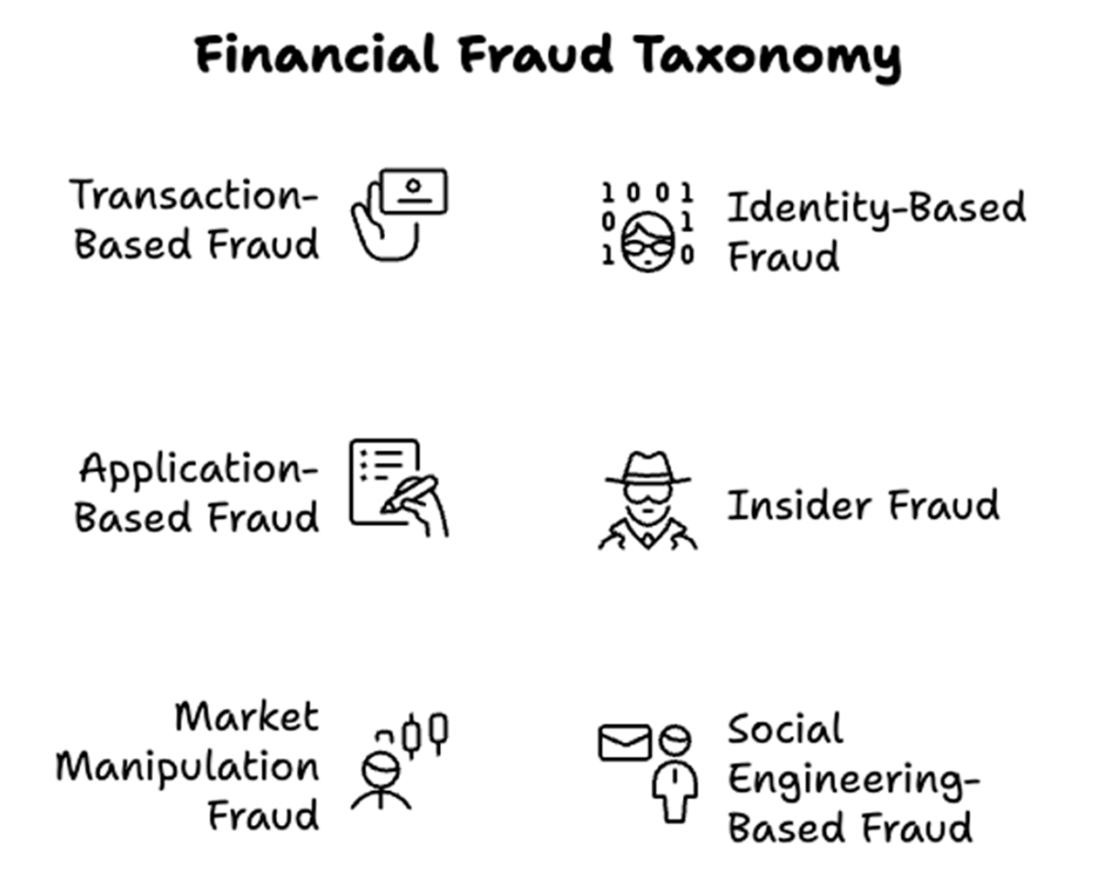
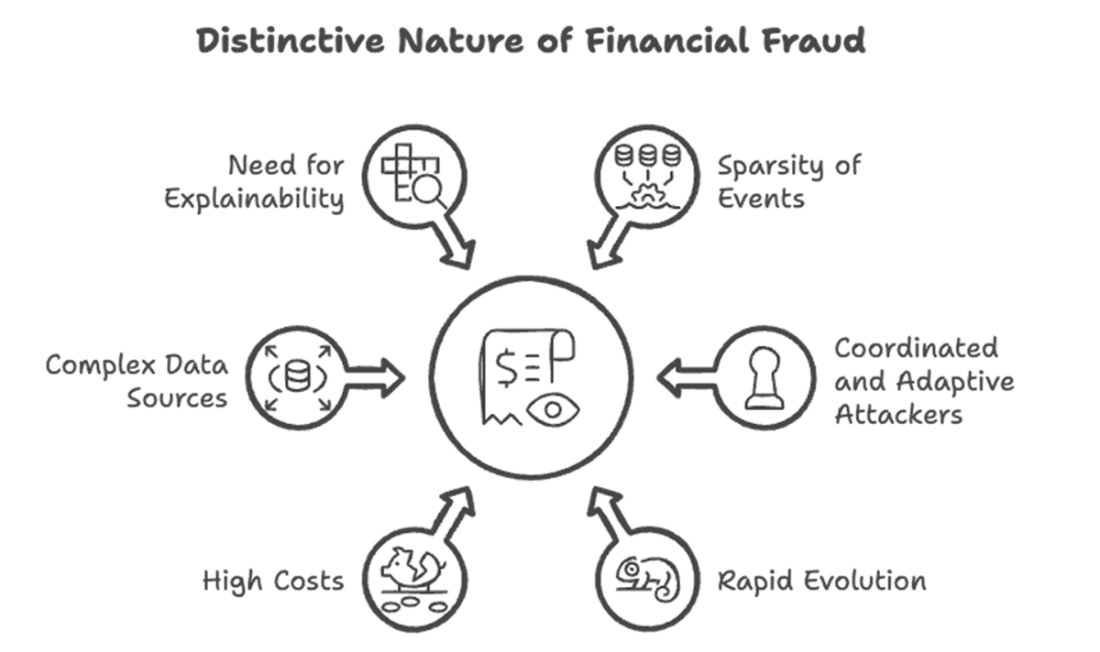
To make sense of the problem, the text organizes fraud into major typologies, including transaction-based, identity-based, application-based, internal or employee fraud, market manipulation, and social engineering attacks. It then explains why fraud detection is fundamentally different from many other machine learning problems: fraud is rare, adversarial, constantly evolving, highly costly when missed, and expensive when falsely flagged. Because of this, anomaly detection can help surface unusual behavior, but it is not enough on its own; effective fraud defense requires explainability, contextual signals, and methods that can adapt to organized and changing attack patterns.
The chapter presents a four-layer framework as the foundation for practical fraud systems, moving from data assets to modeling, strategy and monitoring, and finally application. It shows how basic defenses such as rule engines and graph-based pattern discovery fit into this structure, then extends the discussion to AI-powered approaches like supervised learning, unsupervised anomaly detection, graph analytics, semi-supervised methods, synthetic data generation, and LLM-based investigation support. The overall message is that resilient fraud management depends on layered, modular systems that combine real-time scoring, operational controls, human review, and continuous monitoring so institutions can respond effectively as fraud tactics evolve.
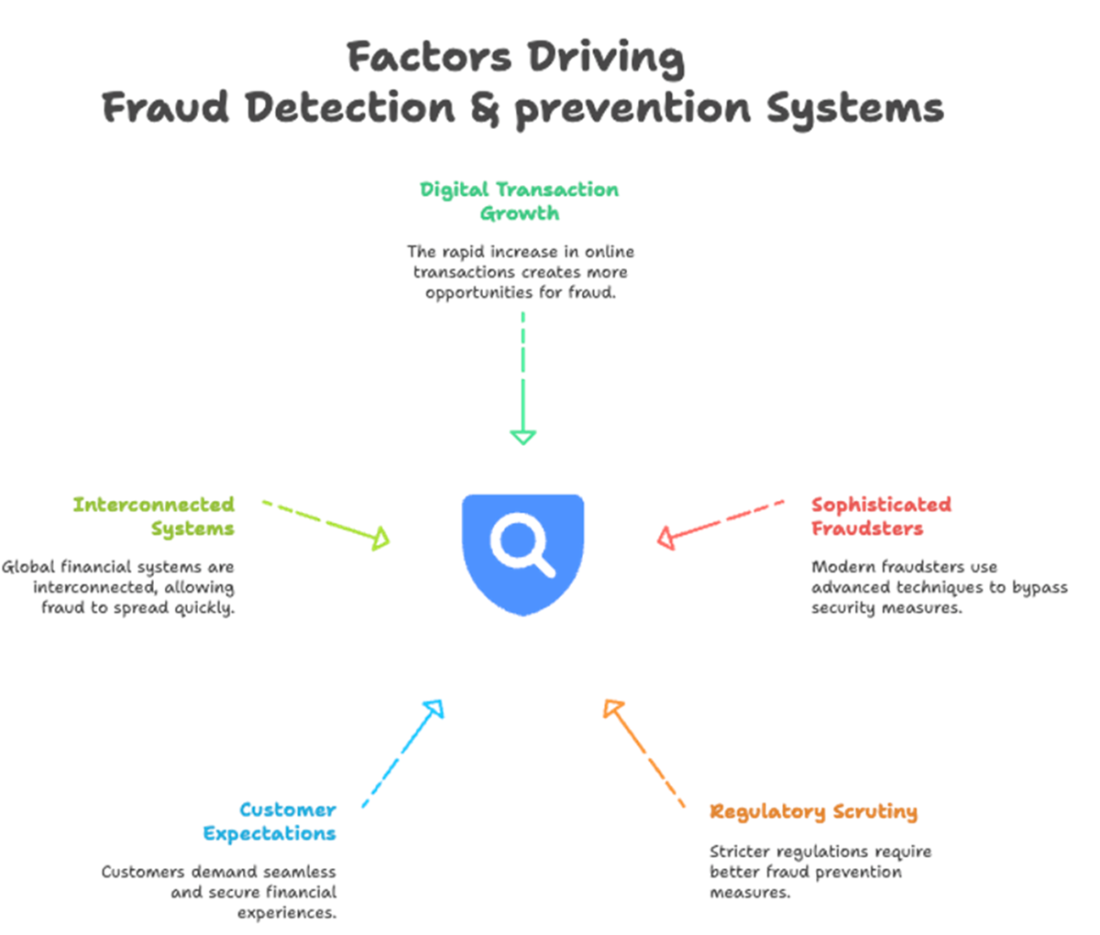
Key drivers shaping the modern Fraud Detection & Prevention System, which is represented by the central shield and magnifying glass icon. This system's growth is accelerated by five converging forces: the rise of digital transactions, sophisticated fraudsters, interconnected financial systems, heightened regulatory scrutiny, and elevated customer expectations for secure experiences.
A structured typology of financial fraud. This framework organizes fraud into six primary categories based on the core attack vector based on the core attack vector, such as exploiting a transaction, compromising an identity, or deceiving a person. This structured view is crucial for developing specific and effective AI-driven countermeasures for each type of threat.
Core Characteristics That Distinguish Financial Fraud from Other AI Challenges. The central icon, a scroll representing a financial record ($) under scrutiny (eye), symbolizes the core challenge of identifying a fraudulent financial event. This task is uniquely difficult due to a set of interconnected factors: extreme class imbalance (Sparsity of Events), the need for explainability, complex multi-source data, organized and adaptive attackers, the rapid evolution of fraud tactics, and the high costs of both false negatives and false positives.
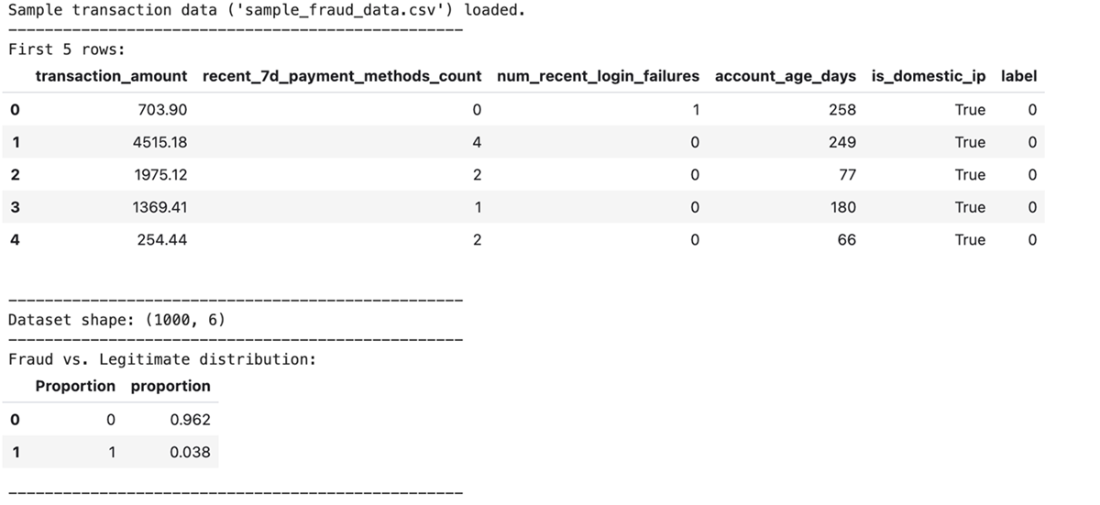
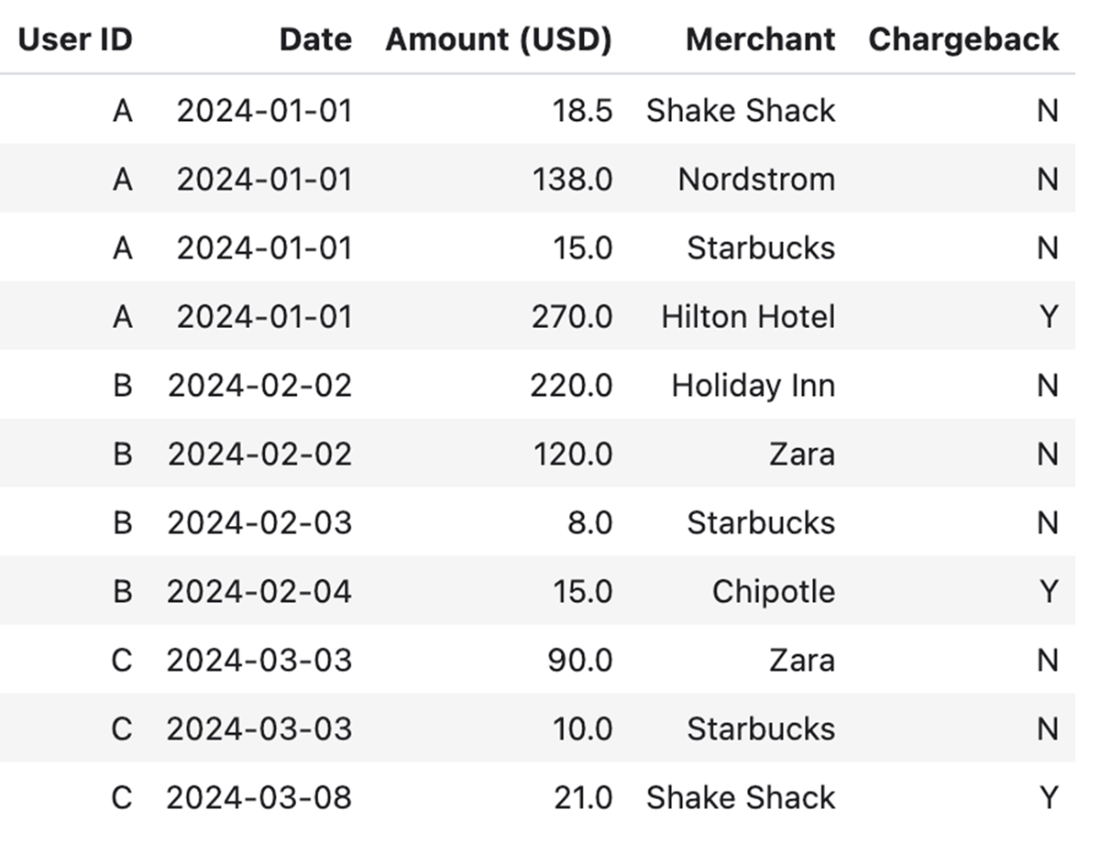
Filtered transaction records of users with recent chargeback reports
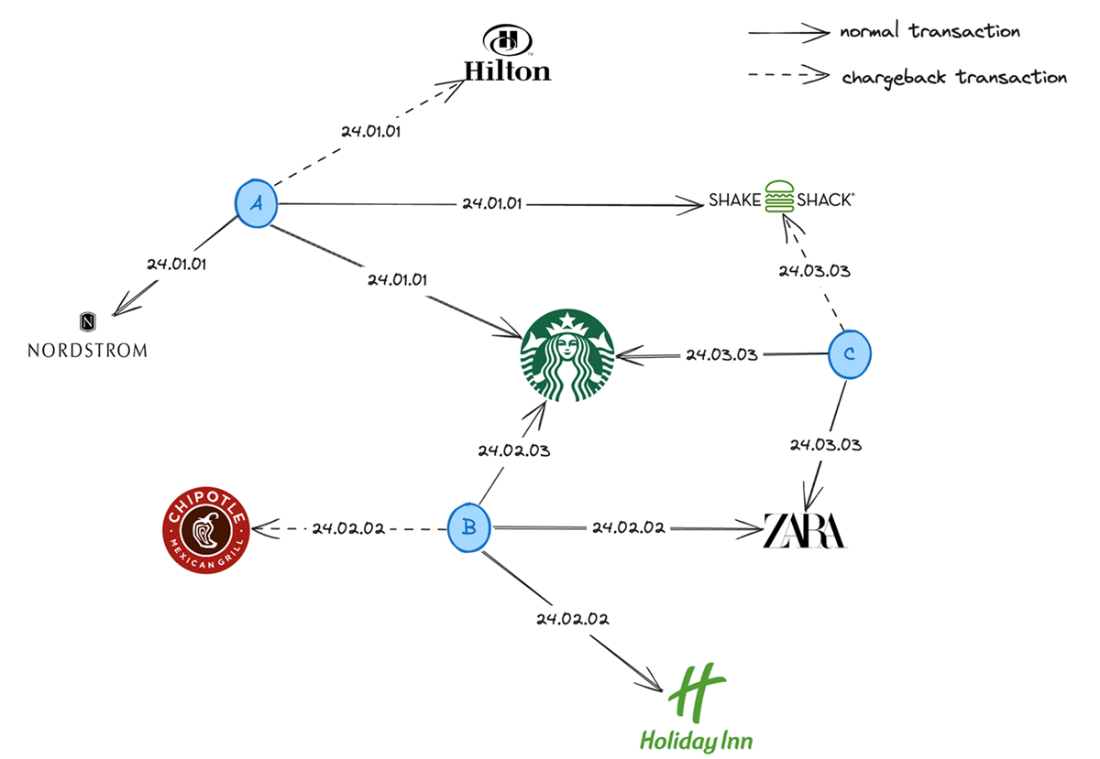
A conceptual visualization of transactions involving users who filed chargebacks. This simplified graph highlights the ability to quickly identify commonly shared merchants among users. The numbers on the edges represent the transaction dates (YY.MM.DD format). The solid lines indicate normal transactions, while the dashed lines represent transactions that were later disputed as chargebacks. While this example remains intentionally minimal, such graph-based relationships become even more valuable in complex real-world scenarios where detecting shared connections can reveal fraud rings or coordinated behavior.
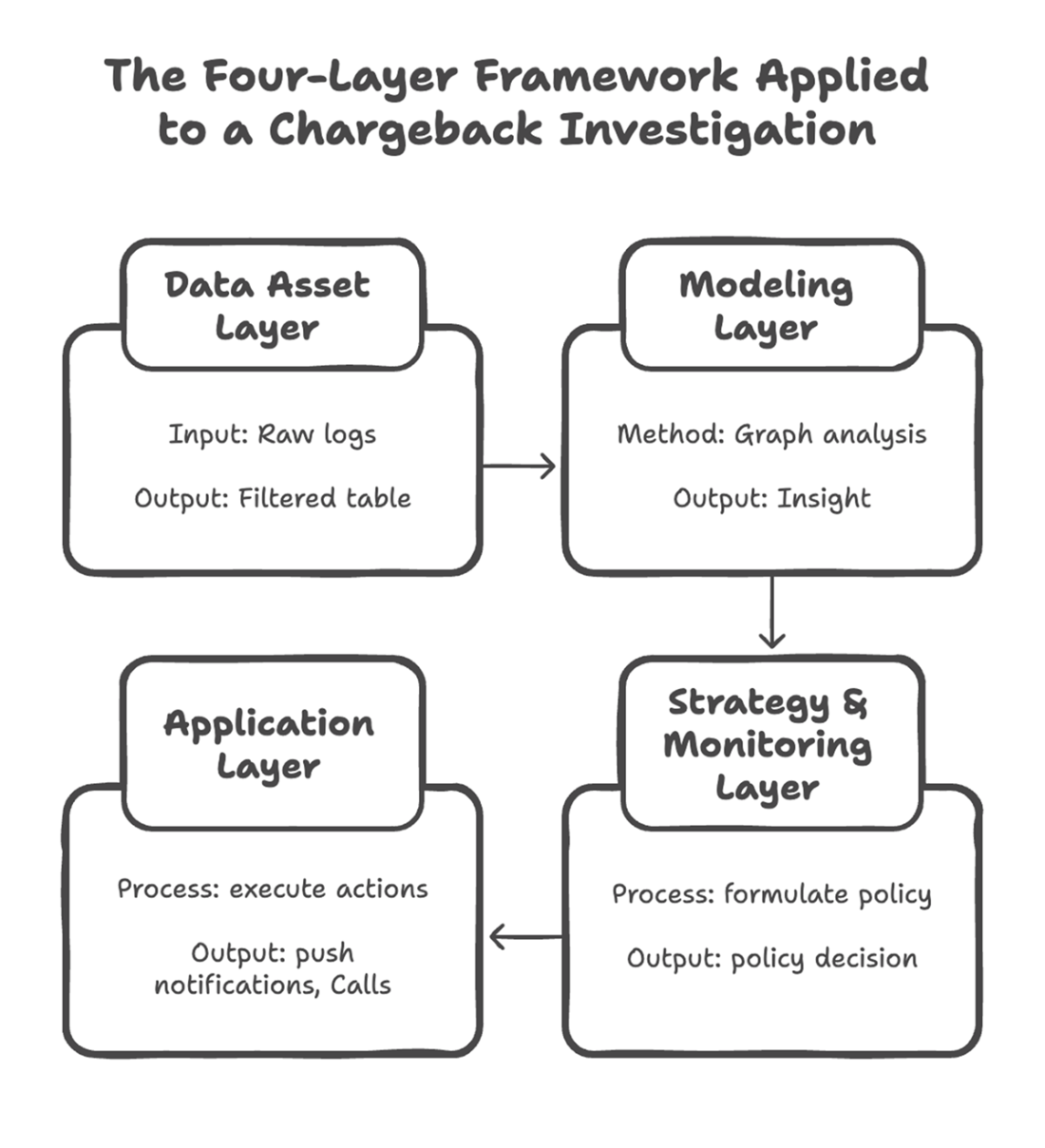
The Four-Layer Framework applied to a simplified chargeback investigation. This diagram traces how raw data is transformed into a concrete response. The process begins in the Data Asset Layer where raw logs are prepared. The Modeling Layer then uses a simple analysis (like a graph review) to uncover an insight. This insight informs the Strategy & Monitoring Layer, where a policy decision is made (e.g., "alert affected users"). Finally, the Application Layer executes this policy by triggering specific actions like push notifications. This workflow demonstrates a key principle: the framework isn't just for complex AI models. Even a foundational, logic-driven investigation benefits from this structured approach, ensuring that data insights are methodically translated into strategic, auditable actions.
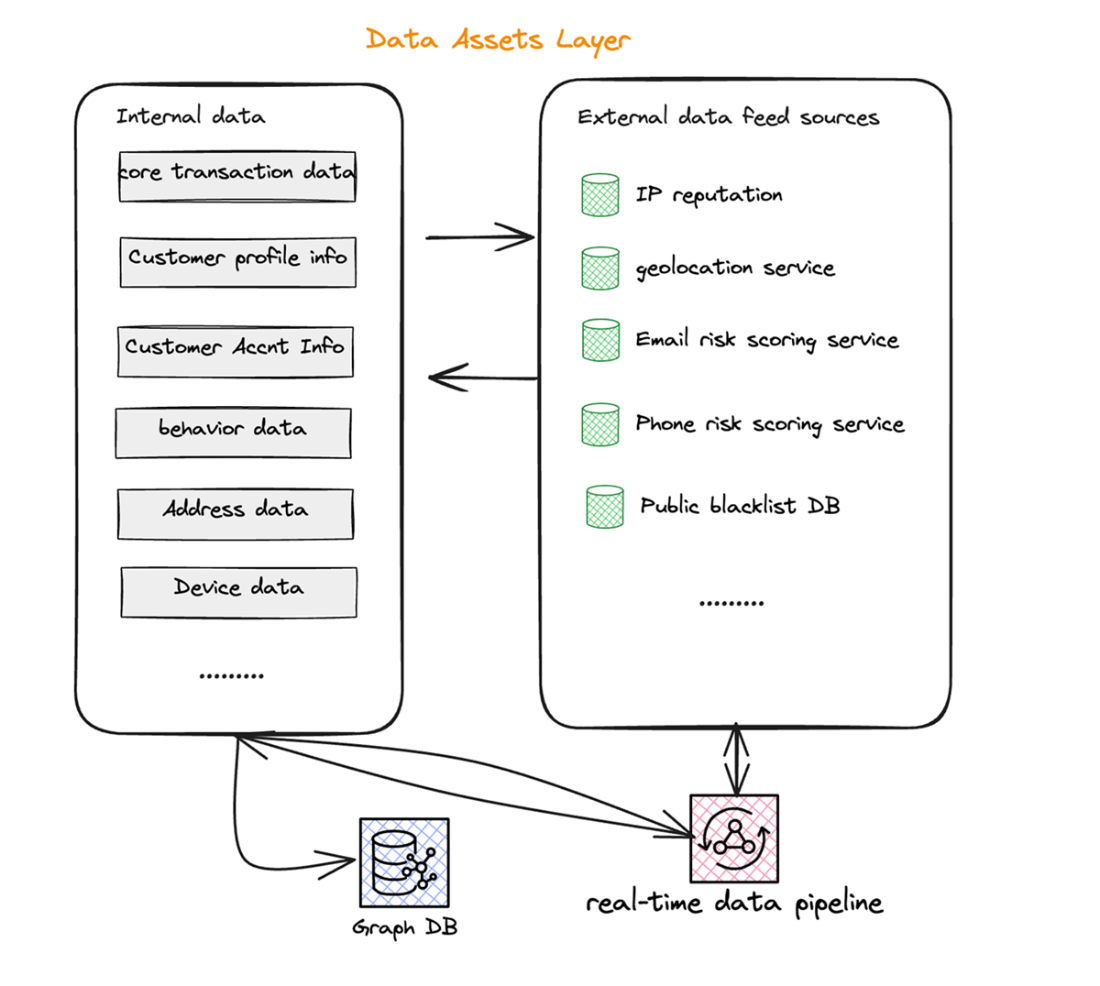
A conceptual illustration of the Data Assets Layer for fraud detection. This diagram does not represent a fixed architecture or specific tech stack, but rather emphasizes the importance of organizing diverse internal and external data sources—such as transactions, behavioral logs, device fingerprints, and risk signals—into a coherent asset layer. Real-world implementations vary significantly across fintech, traditional banking, and e-commerce platforms, but the foundational goal remains the same: to make rich, timely, and relational data readily available for downstream fraud detection models and logic.
Summary
- The escalating global cost and sophistication of financial fraud, amplified by digital transactions and AI-driven attack vectors, underscore the critical need for advanced detection and prevention capabilities in the BFSI sector.
- Financial fraud encompasses six primary vectors—transaction, identity, application, internal, market-manipulation, and social-engineering fraud—each requiring tailored detection strategies due to their unique characteristics and methods of operation.
- Financial fraud's unique traits heavily influence effective AI detection system design.
- An AI-enhanced Data Asset Layer for fraud detection prioritizes real-time data ingestion from diverse sources (transactional, customer, device, session, external, network/graph) and sophisticated feature engineering to capture dynamic, adversarial patterns.
- The Modeling Layer in fraud detection leverages a spectrum of AI techniques: supervised learning (addressing class imbalance), unsupervised anomaly detection (for novel threats, managing false positives), graph-based analytics (for organized fraud), semi-supervised learning, and generative AI for synthetic data augmentation to combat data scarcity.
- Large Language Models (LLMs) are increasingly used to augment fraud investigations and reporting, necessitating a specialized LLMOps framework (distinct from MLOps) that includes robust Retrieval-Augmented Generation (RAG) pipelines with curated knowledge bases, intelligent chunking, vector databases, advanced retrieval, contextual prompting, and stringent guardrails.
- The Strategy & Monitoring Layer translates AI model outputs into actionable intelligence by defining dynamic risk thresholds, integrating business rules, managing watchlists, utilizing champion-challenger testing for strategy optimization, orchestrating human review workflows with feedback loops, and ensuring continuous performance monitoring for model decay and data drift.
- The Application Layer operationalizes fraud defenses through real-time transaction decisioning (approve/decline/challenge), proactive account monitoring, enriched case management systems for analysts, automated customer alerting, and seamless integration with core financial systems to balance security with customer experience.
- A comprehensive understanding of these fraud characteristics, detection techniques, and layered architectural considerations is crucial for developing the practical, AI-driven fraud solutions detailed in subsequent chapters.

 Financial AI in Practice ebook for free
