4 Risk & compliance – credit risk fundamental
Credit risk sits at the center of lending because every loan is ultimately a bet on repayment. The text explains how credit evolved from trust-based local judgments into standardized scoring systems, while showing that the core questions remain the same: can the borrower and will the borrower repay? It also highlights how modern products such as BNPL, micro-lending, and merchant cash advances have increased the need for faster underwriting, stronger compliance, and better ways to evaluate nontraditional borrowers.
The chapter traces the full credit lifecycle across pre-loan, in-loan, and post-loan stages, showing how risk management changes from origination to monitoring to collections and restructuring. It emphasizes that default is not a single event but a process over time, which is why vintage analysis and survival analysis are so important for spotting early warning signs and handling incomplete loan histories. Regional regulation, collateral practices, and product-specific rules also shape how lenders define default and what data they can use, making time-aware and policy-aware modeling essential.
Finally, the text presents a domain-driven framework for building AI credit systems through four linked layers: data assets, models, strategy and monitoring, and application. It argues that AI becomes truly useful when combined with credit-specific metrics like AUC, KS, and PSI, along with interpretable techniques such as binning, Weight of Evidence, and Information Value. The overall message is that successful AI in credit is not about replacing domain knowledge, but amplifying it with scalable analytics, explainability, fairness, and regulatory discipline.
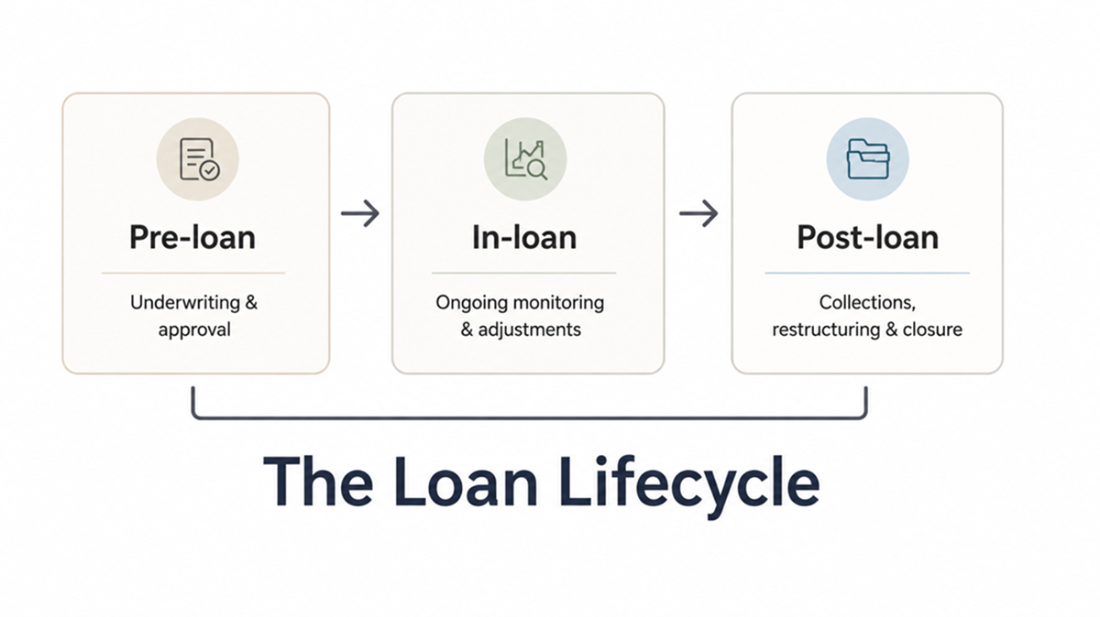
The three key phases of the loan lifecycle—pre-loan, in-loan, and post-loan—apply to both personal and corporate credit products. Each phase contains distinct activities, decision points, and opportunities for AI-enhanced risk management.
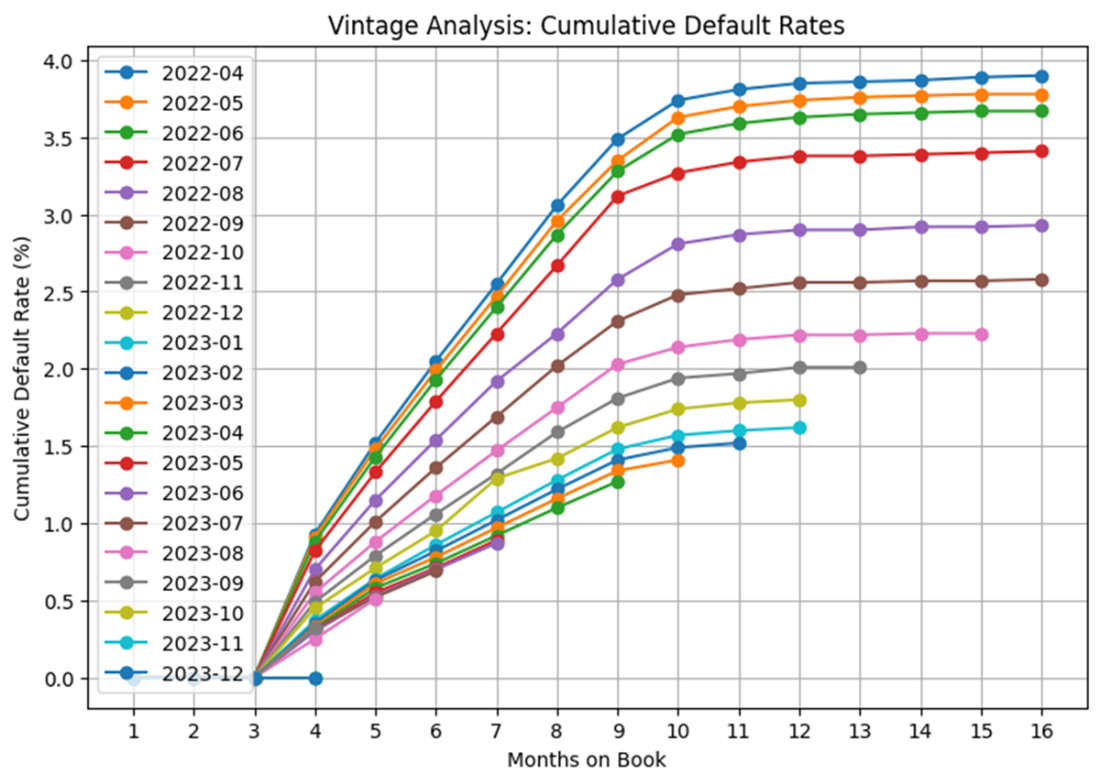
A vintage chart showing cumulative default rates over time. Each line corresponds to a specific monthly loan cohort. A sharper upward slope suggests faster default accumulation—often a warning sign of macroeconomic stress or relaxed underwriting. Flatter curves imply healthier loan performance. Visualizing default patterns by vintage helps lenders monitor portfolio risk, refine acceptance criteria, and communicate trends to regulators.
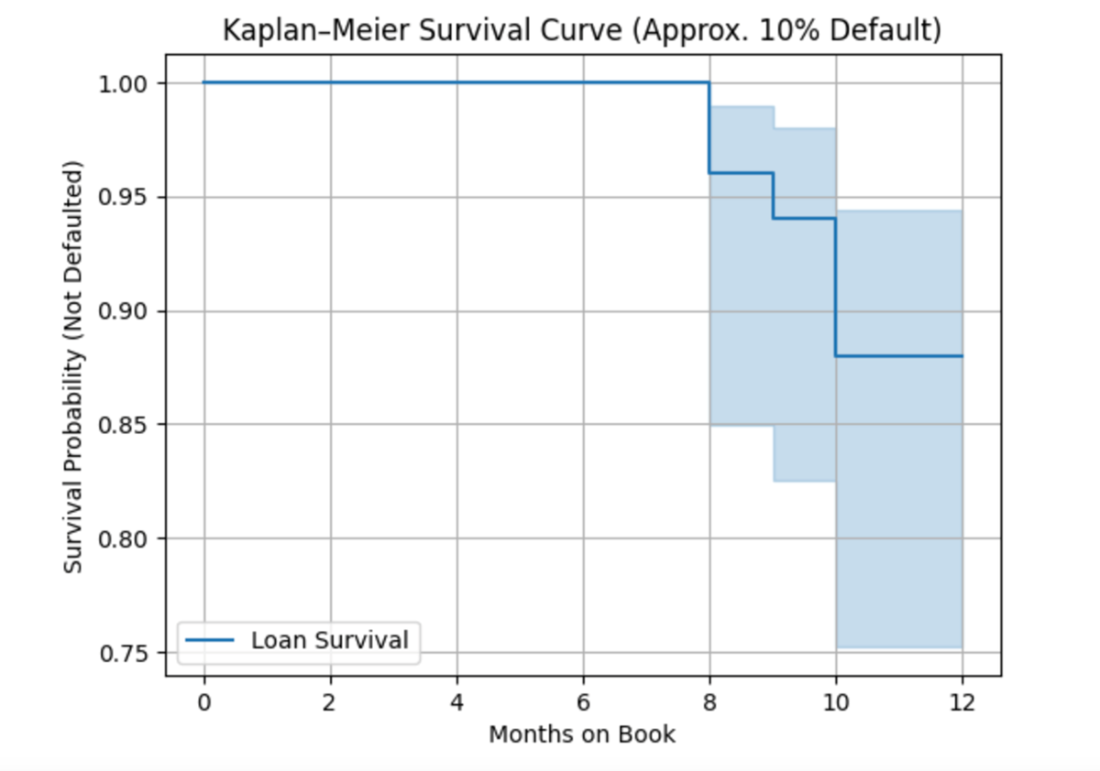
Kaplan–Meier survival curve for a synthetic loan portfolio. Each downward step in the curve reflects a default event. By month 12, about 10% of the loans have defaulted, consistent with our simulated parameters. Survival analysis enables granular, time-aware risk modeling by tracking each account independently rather than in aggregate.
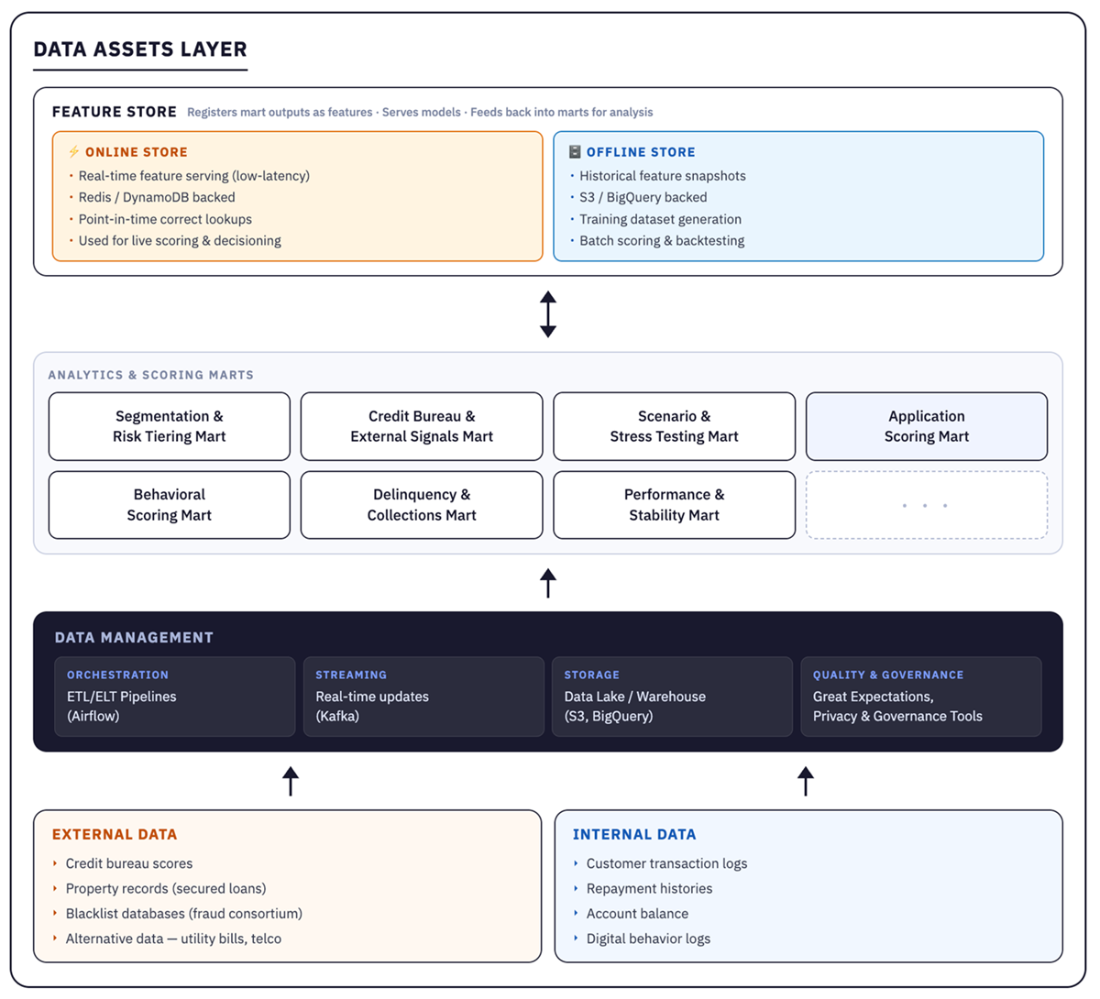
The Data Assets Layer. This figure illustrates how multiple data sources—ranging from internal transaction logs and repayment histories to external credit bureau scores and alternative signals—flow into a centralized environment. Tools like Airflow or Kafka manage real-time ingestion, while data lakes and specialized marts support segmentation, behavioral scoring, and performance tracking. Privacy, data quality, and governance mechanisms ensure compliance with regulatory standards throughout the pipeline.
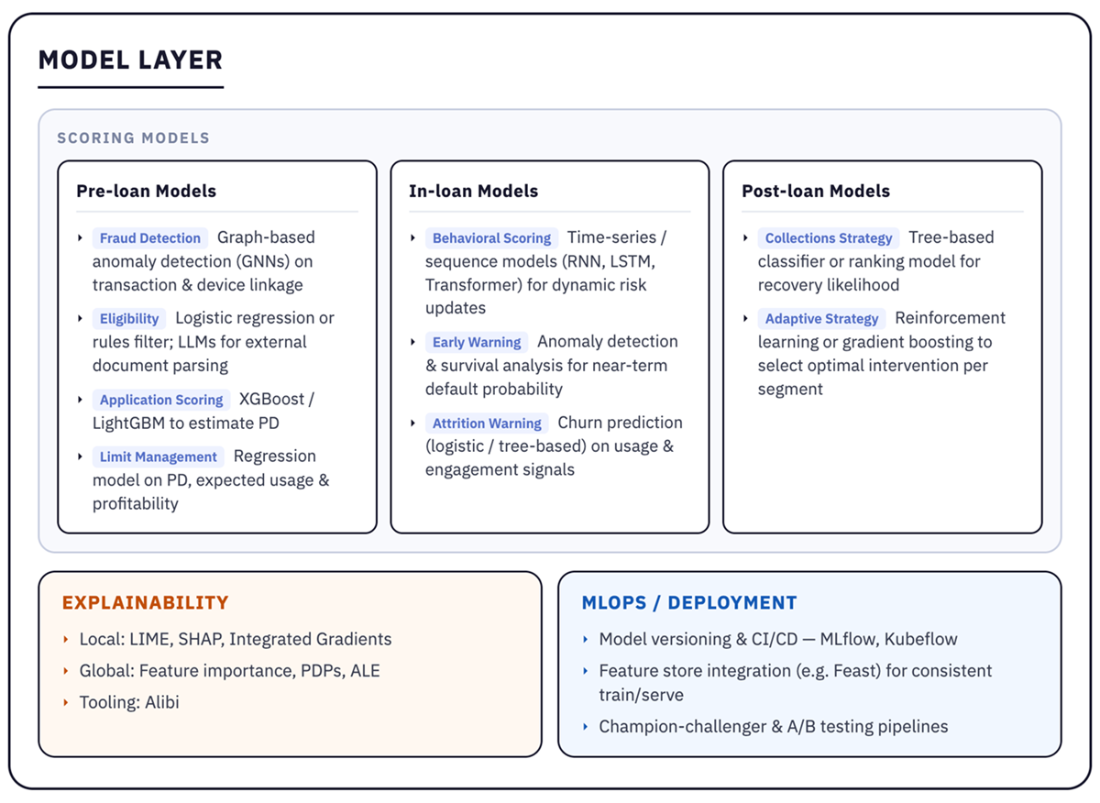
The Model Layer. Here we see how credit risk modeling is segmented across the pre-loan, in-loan, and post-loan phases. Fraud detection, limit assignment, and application scoring guide decisions before credit is granted. Behavioral and early-warning models monitor borrower performance once the loan is active. Post-loan models optimize collections strategies and restructuring. MLOps frameworks (e.g., MLflow, Kubeflow) standardize versioning and deployment, while explainability tools (SHAP, LIME) help meet fair-lending and audit requirements.
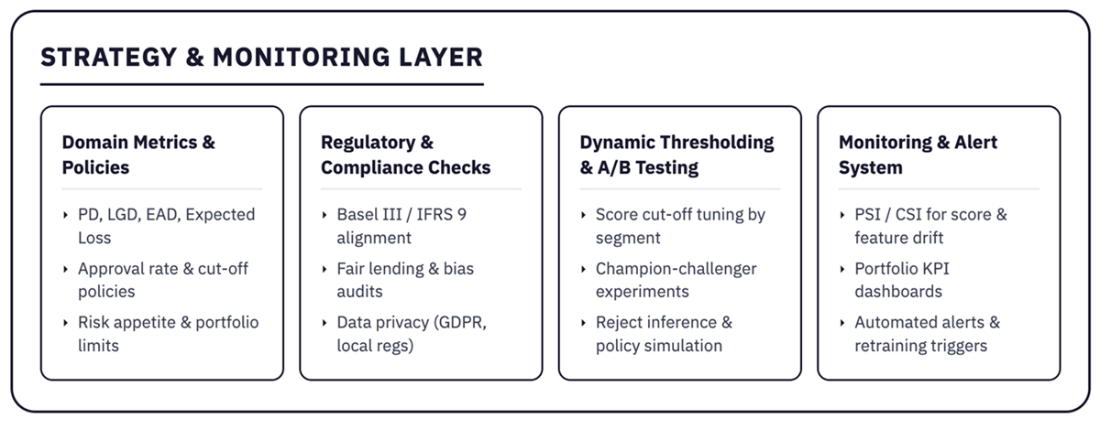
The Strategy & Monitoring Layer. Domain metrics, regulatory checkpoints, dynamic thresholds, and real-time monitoring converge to govern how model outputs are applied. By defining policies—such as rate caps or acceptance floors—institutions can respond quickly to changing market conditions or compliance updates. Drift detection, A/B testing, and automated alerts help maintain consistent performance and reduce risk as credit portfolios evolve.
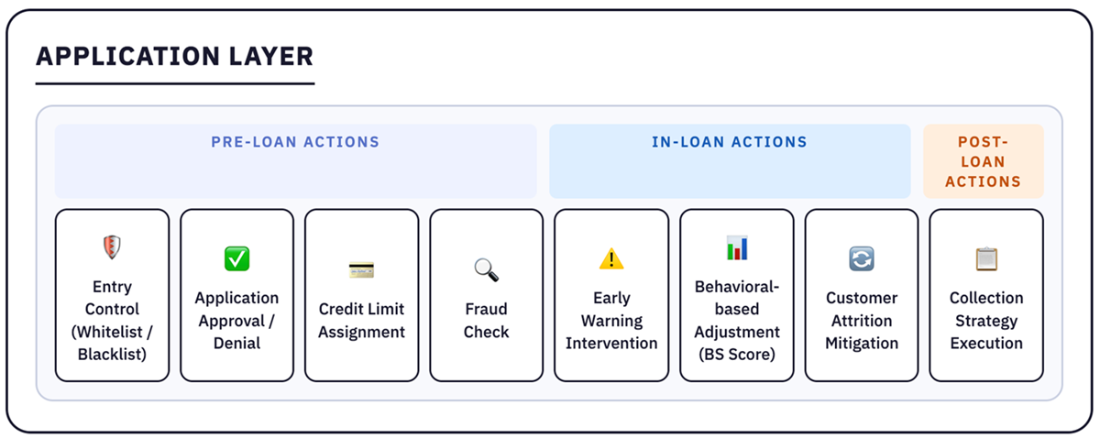
The Application Layer. This figure depicts how the final, user-facing actions—entry control, approval/denial, fraud checks, limit adjustments, early-warning interventions, and collections—are orchestrated in practice. Each step integrates outputs from the Model Layer and policies from the Strategy Layer, ensuring that every lending decision, from BNPL checkout approvals to MCA restructuring, aligns with institutional risk appetite and regulatory obligations.
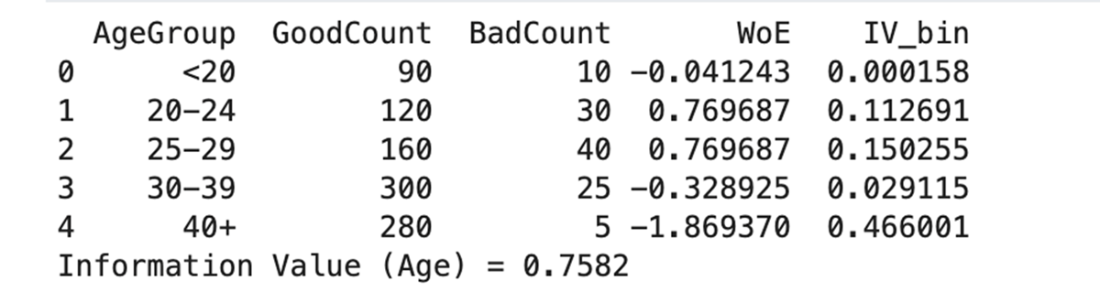
Age Binning with WoE and IV. This table shows how different age groups perform in terms of good/bad rates, Weight of Evidence (WoE), and Information Value (IV).
Summary
- Credit risk depends on evaluating both willingness and capacity to repay, with interest as compensation for uncertainty.
- The credit lifecycle has three stages—pre-loan, in-loan, and post-loan—each with distinct decisions, data flows, and compliance checks.
- Modern lending products like BNPL and MCA demand faster decisions and more granular data, raising new regulatory concerns.
- Standard credit scoring evolved from human judgment to statistical models like FICO, enabling broader financial inclusion.
- Time-aware modeling techniques, including vintage analysis and survival analysis, reveal when defaults happen—not just if.
- Separating data governance, modeling, strategy, and application into distinct layers is what lets credit systems adapt to new regulation and data sources without being rebuilt from scratch.
- Key metrics—AUC, KS, and PSI—are essential for measuring model accuracy, discrimination, and population drift.
- Binning, WoE, and IV transformations make credit models more interpretable and audit-friendly.
- Missing values, sentinel codes, and outliers must be handled explicitly to ensure fairness and model stability.
- AI models in credit scoring must balance accuracy with interpretability, blending black-box ML with explainable, domain-aligned techniques.

 Financial AI in Practice ebook for free
