3 Working with generative AI in finance
Generative AI is reshaping finance by moving the focus from building custom models for each task to engineering complete AI systems around powerful foundation models. In this new approach, the model is only one part of the solution; the surrounding data pipelines, security checks, compliance controls, and deployment practices matter just as much. The chapter frames this shift through a practical financial use case, showing how firms can adopt large language models for tasks such as summarization, advisory support, and workflow automation while staying aligned with the industry’s high standards for accuracy and governance.
A major theme is that financial AI teams must stay pragmatic about model choice and technique. Classic machine learning still excels for structured prediction problems, while LLMs are best used for language-heavy work and reasoning over unstructured content. Because LLMs can hallucinate and do not function as databases, robust retrieval-augmented generation is essential for grounding outputs in current facts. When teams need a model to adopt a specific style or domain voice, parameter-efficient fine-tuning offers a cost-effective way to adapt behavior without retraining every parameter, making it especially attractive in resource-constrained and regulated environments.
The chapter also emphasizes that production-grade financial AI requires layered guardrails and careful rollout. A secure architecture should filter inputs, retrieve trusted internal knowledge, route requests to appropriate models, and apply output compliance checks before anything reaches the user. As the system evolves, AI agents and agentic AI may automate more complex tasks, but only under strict supervision, logging, and permissioning; emerging standards like MCP help standardize tool access, though governance still must be built separately. Overall, the message is that successful generative AI in finance comes from combining technical capability with disciplined risk management, phased deployment, and continuous monitoring.
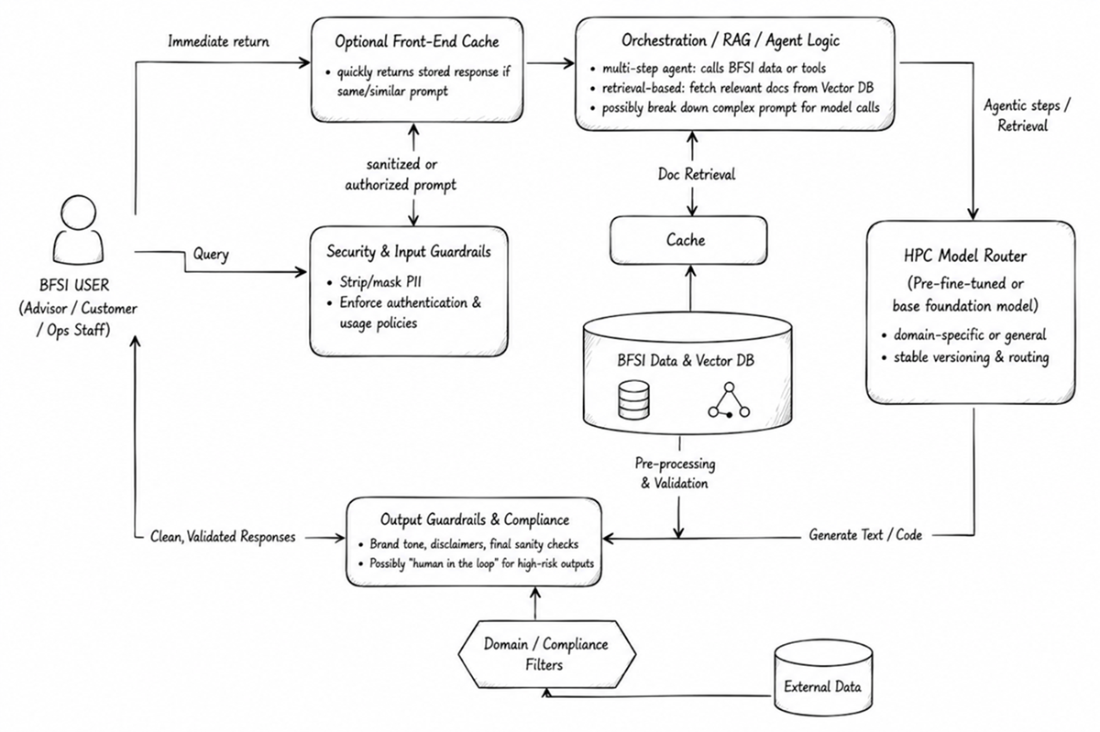
A BFSI Generative AI Blueprint. This workflow illustrates the key components of a robust system, from initial user query and security guardrails to data retrieval, model routing, and final compliance checks. While real-world deployments vary, this blueprint shows the essential layers required to build trustworthy AI in a high-stakes environment.
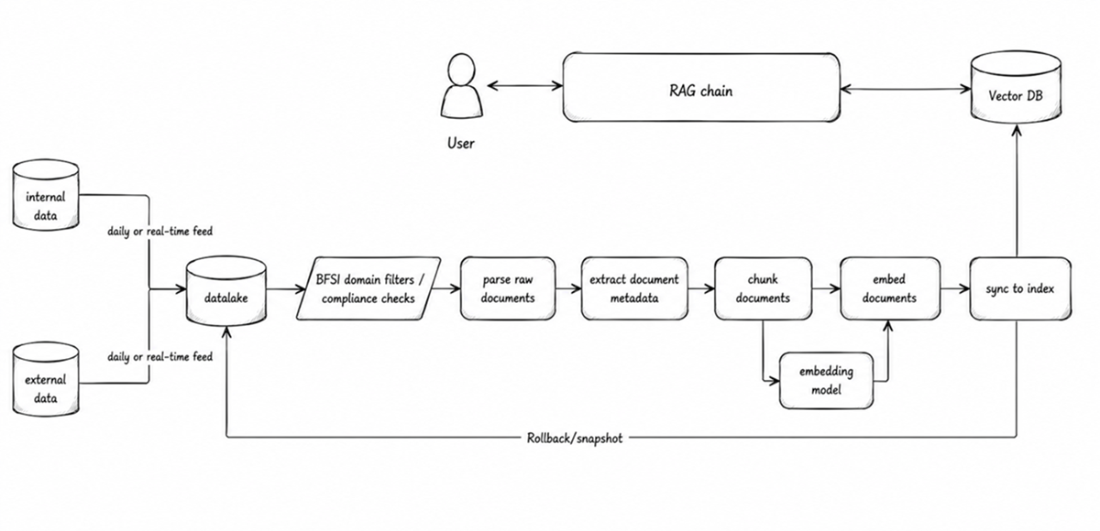
BFSI ingestion pipeline and RAG workflow. This figure illustrates how new or updated documents move from internal/external sources into a data lake, where they’re parsed, chunked, and embedded. The “embedding model” produces vector representations, which are then synced to a vector database for rapid similarity searches. A “RAG chain” (retrieval-augmented generation) layer fetches the most relevant snippets at query time, ensuring that updated compliance bulletins or policy bulletins are readily available. By automating these ingestion steps, BFSI teams can keep the vector store current on a daily—or near real-time—basis, reducing the risk of outdated answers and providing a “snapshot” rollback if needed.
Summary
- The rise of powerful foundation models has shifted the focus of AI development from "model building" to "AI engineering," where the primary task is to safely and effectively steer a pre-existing engine.
- While this new paradigm is powerful, finance imposes unique, high-stakes requirements for data quality, security, and factuality that demand a more rigorous approach than other domains.
- A production-grade financial AI system is not a single model but a layered architecture, incorporating security guardrails, caching, RAG pipelines, model routing, and compliance checks.
- Choosing the right foundation model involves a pragmatic, hands-on testing process and a strategic decision between the speed of commercial models and the control of open-source alternatives.
- Retrieval-Augmented Generation (RAG) is essential for grounding LLMs in real-time, factual information, but its success depends on a high-quality data ingestion pipeline and a smart chunking strategy.
- Parameter-Efficient Fine-Tuning (PEFT) is a cost-effective method for teaching a model a specific style or behavior, allowing for deep customization without the massive cost of a full fine-tune.
- AI Agents can automate complex workflows, but emerging protocols like MCP are needed to standardize tool interaction and ensure the reliability and safety required in finance.
- Deploying a generative AI application successfully is a marathon, not a sprint, requiring phased rollouts, continuous cost optimization, and robust governance to manage the entire model lifecycle.

 Financial AI in Practice ebook for free
