Overview

2 From model to money: a strategist's guide to real-world financial AI

The chapter argues that in financial AI, technical excellence alone is not enough to keep a project alive. Many promising models fail because teams focus on the architecture before clarifying the business purpose, leaving leaders unconvinced that the work will create measurable value. The central message is that successful financial AI must be framed in terms of strategy, ROI, and survival in a highly regulated, budget-sensitive environment.

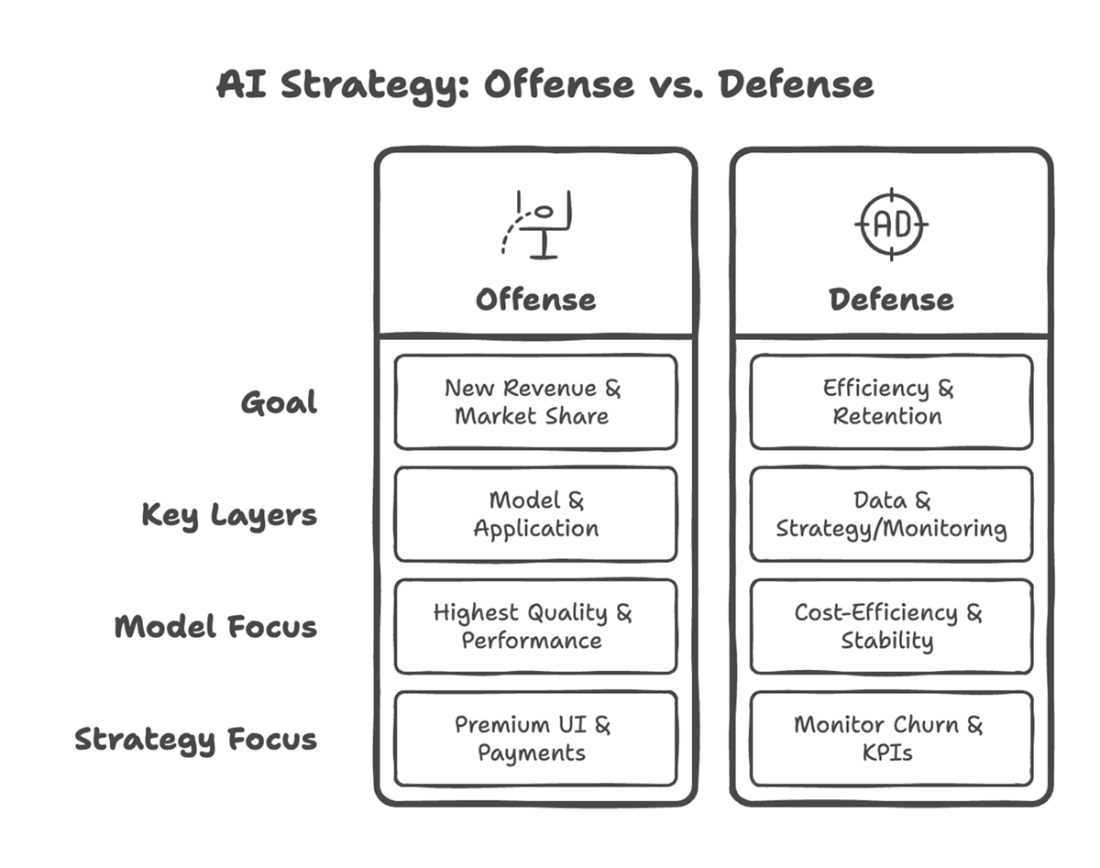
Using the fictional AlphaStream platform and its proposed “Alpha Digest” feature, the chapter shows how the same AI idea can support either an offensive or defensive strategy. An offensive approach treats the feature as a premium product that drives new revenue, while a defensive approach uses it to improve retention, efficiency, or internal workflows. The choice changes everything: the data required, the model quality, the application design, and the KPIs used to judge success.

The chapter then explains how to build a convincing financial case and how to anticipate real-world obstacles that often derail production systems. It highlights that ROI improves as AI moves from isolated pilots to deeply integrated workflows, and it gives examples of value creation across customer experience, risk, operations, and market intelligence. Finally, it emphasizes the hidden risks beneath the surface, including market volatility, hallucinations and bias, compliance exposure, and human resistance to change, concluding that durable financial AI depends on transparency, guardrails, human oversight, and organizational alignment.

AI Strategy: Offense vs. Defense. This diagram illustrates the fundamental trade-offs between an "Offense" strategy, which prioritizes new revenue and a high-performance model, and a "Defense" strategy, which focuses on efficiency, retention, and cost-effective stability. The chosen strategy dictates the design priorities for every part of the 4-Layer Framework.
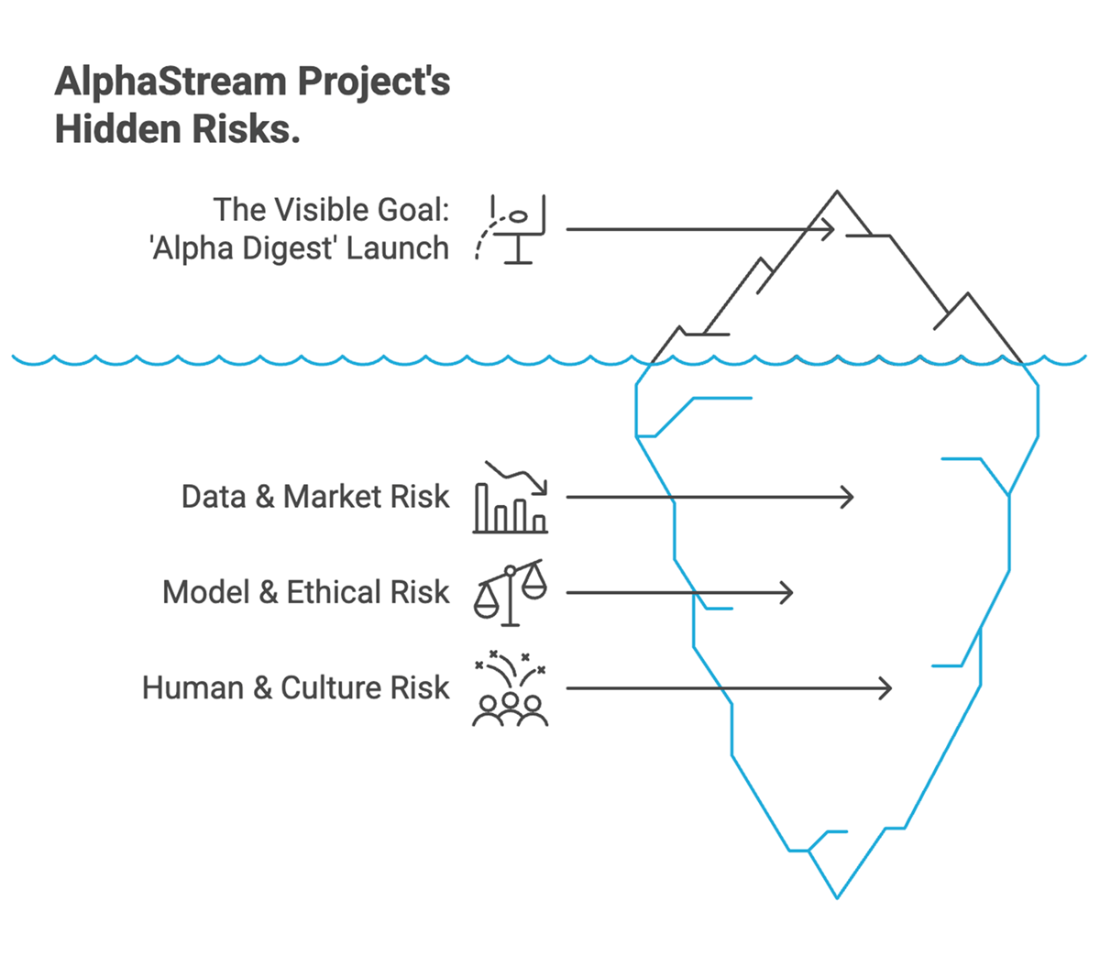
The Project Iceberg: Visible Goals vs. Hidden Complexities. Building a financial AI application is like navigating an iceberg. The visible goal—launching a new feature—is only a small fraction of the total effort. The vast majority of the work lies below the surface, in managing the hidden complexities of data infrastructure, model integrity, ethical considerations, and organizational culture. Neglecting these deep-seated challenges is the most common reason projects fail.
Summary

  • In finance AI, technical excellence is not a guarantee of success. An AI project's survival depends on its ability to create and prove tangible business value.
  • Framing an AI initiative with a clear "Offense" (revenue growth) or "Defense" (cost reduction) strategy is the first and most critical step in aligning a technical solution with core business objectives.
  • A successful ROI case is built on specific, measurable KPIs and is often strengthened by a powerful "cost avoidance" argument that quantifies the value of mitigating risk.
  • Real-world financial AI projects are inevitably challenged by messy legacy data ("data swamps"), the "black box" problem of complex models, and unpredictable market events, requiring proactive risk management from day one.
  • Building a trustworthy application demands more than just technical solutions; it requires a deep commitment to Responsible AI, including proactive fairness audits and transparent processes.
  • Positioning AI as an "augmentation" tool that empowers human experts, rather than a replacement, is key to fostering the organizational adoption necessary for long-term success.


FAQ

Why do technically strong AI projects often fail in finance?Many fail not because the model is bad, but because the project lacks clear business purpose and financial value. In finance, a model must answer the “So what?” question: how will it increase revenue, reduce losses, or cut costs enough to justify its expense?
What is the main lesson of Chapter 2?The chapter’s main lesson is that financial AI should be planned from the business strategy backward. Before designing data pipelines or models, teams must define the project’s purpose, expected ROI, and the obstacles that could prevent real-world success.
Who should read this chapter?This chapter is aimed at technical leaders, product managers, and data scientists who are responsible for moving AI projects from concept to production. It is especially useful for anyone who needs to align technical work with business outcomes.
What is the “Alpha Digest” example?“Alpha Digest” is a fictional AI feature for a trading platform called AlphaStream. It gives users a personalized summary of the most relevant investment posts, including key arguments, price targets, and sentiment, helping them cut through information overload.
What does “Offense” mean in financial AI strategy?“Offense” means using AI to create new value and revenue. In the chapter, this could mean turning Alpha Digest into a premium subscription feature, with success measured by metrics like conversion rate and ARPU.
What does “Defense” mean in financial AI strategy?“Defense” means using AI to protect or improve the existing business through efficiency, retention, or cost reduction. For AlphaStream, that could mean using Alpha Digest as a free feature to reduce churn or as an internal tool to help moderators work faster.
Why is ROI so important for financial AI projects?Because budget holders need proof that the project is worth funding. A financial AI initiative must translate technical results into business metrics such as revenue growth, cost savings, time reduction, lower false positives, or avoided compliance risk.
What kind of ROI metrics are used in the chapter?The chapter discusses metrics such as subscription conversion rate, ARPU, churn reduction, moderator workload reduction, false-positive rate, case resolution time, and compliance penalty avoidance, depending on the project’s strategic goal.
What are the biggest real-world risks to financial AI projects?Key risks include market volatility, black swan events, hallucinations or bias in model outputs, regulatory changes, and organizational resistance. These can derail even a technically successful project if they are not addressed early.
How can teams make a financial AI project more likely to survive?By starting with business strategy, defining measurable ROI, building transparency and guardrails, using human-in-the-loop workflows where needed, and planning for operational, regulatory, and cultural challenges before going into production.

pro $24.99 per month

  • access to all Manning books, MEAPs, liveVideos, liveProjects, and audiobooks!
  • choose one free eBook per month to keep
  • exclusive 50% discount on all purchases
  • renews monthly, pause or cancel renewal anytime

lite $19.99 per month

  • access to all Manning books, including MEAPs!

team

5, 10 or 20 seats+ for your team - learn more


choose your plan

team

monthly
annual
$49.99
$499.99
only $41.67 per month
  • five seats for your team
  • access to all Manning books, MEAPs, liveVideos, liveProjects, and audiobooks!
  • choose another free product every time you renew
  • choose twelve free products per year
  • exclusive 50% discount on all purchases
  • renews monthly, pause or cancel renewal anytime
  • renews annually, pause or cancel renewal anytime
  • Financial AI in Practice ebook for free

choose your plan

team

monthly
annual
$49.99
$499.99
only $41.67 per month
  • five seats for your team
  • access to all Manning books, MEAPs, liveVideos, liveProjects, and audiobooks!
  • choose another free product every time you renew
  • choose twelve free products per year
  • exclusive 50% discount on all purchases
  • renews monthly, pause or cancel renewal anytime
  • renews annually, pause or cancel renewal anytime
  • Financial AI in Practice ebook for free