14 Driving operational efficiency: building autonomous retention agents
This chapter introduces a shift from passive analytics to proactive, autonomous retention action in financial services. Instead of waiting for users to return to the app, the system watches for silent churn signals, especially among stressed users whose behavior suggests they are drifting away. The core idea is to use AI agents to monitor risk, reason about context, and initiate retention outreach before customers are lost.
To do this responsibly and efficiently, the chapter extends the existing four-layer architecture rather than replacing it. Data becomes accessible through tools, traditional machine learning is used as a low-cost filter, and an LLM-based agent handles nuanced reasoning only for the small subset of high-risk users. The resulting retention copilot can inspect user context, apply cluster-level guidance, generate tailored intervention strategies, and operate in a daily pipeline that fits existing business workflows.
The implementation emphasizes governance and measurable impact. Human review remains mandatory through a draft-approve process, supported by guardrails that limit risky, inappropriate, or overly frequent outreach. Finally, the chapter shows how to evaluate the system using retention lift, statistical testing, and ROI calculations, making clear that the value of an agent depends not just on sophistication, but on sound architecture, compliance, and business results.
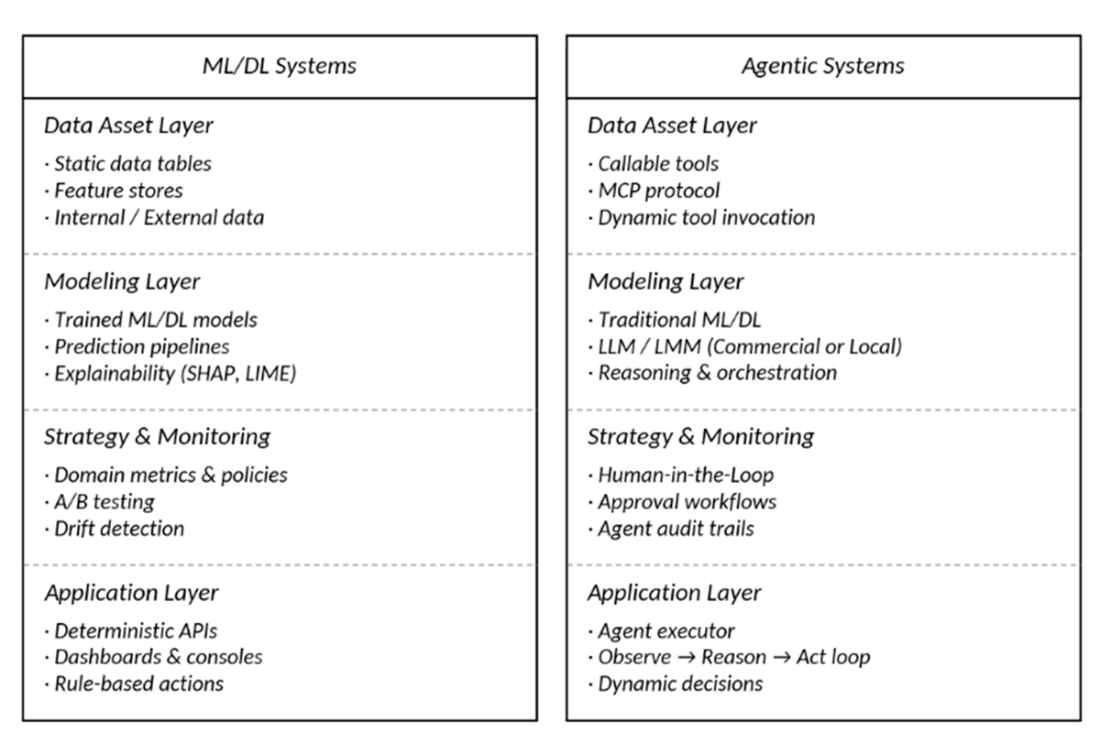
The 4-Layer Framework extended for agentic systems. The fundamental structure remains intact, but each layer's implementation changes. The Data Asset Layer now exposes data through callable Tools. The Modeling Layer expands from traditional ML to include LLM-based reasoning. The Application Layer becomes an Agent Executor rather than a simple API. The Strategy & Monitoring Layer adds Human-in-the-Loop governance alongside traditional metrics.
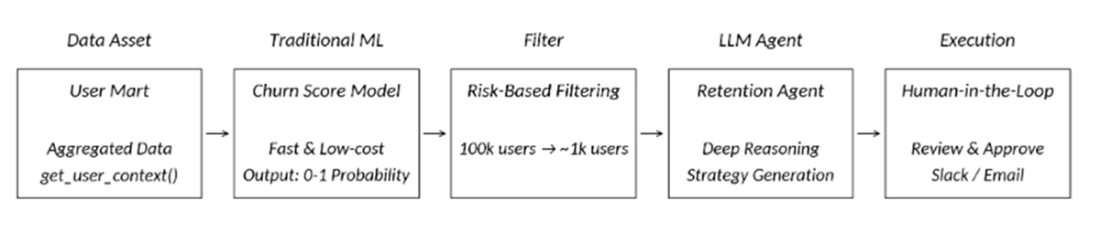
The cost-aware Retention Intelligence Pipeline. Traditional ML (Churn Score model) filters 100,000 users down to approximately 500-1,000 high-risk candidates. Only these candidates proceed to the LLM-based Retention Agent for nuanced analysis and strategy generation. This architecture reduces LLM costs by 99% while preserving reasoning quality where it matters most.
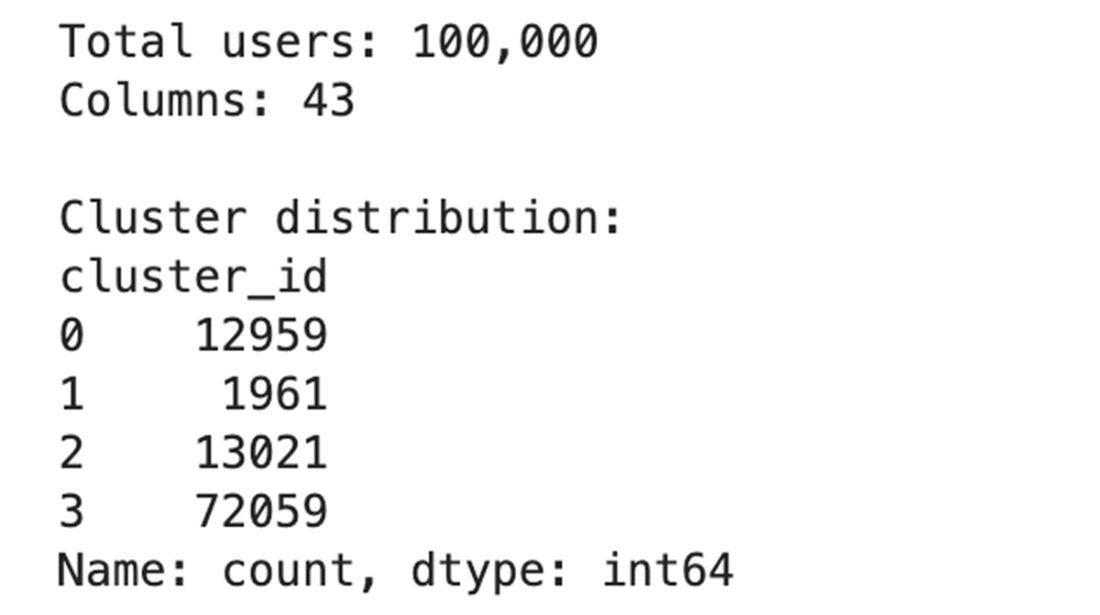
User Mart structure verification showing 100,000 users across 43 features, with cluster distribution revealing that Passive Savers (Cluster 3) dominate at 72,059 users, while Panic Speculators (Cluster 0) and Cold Start Newbies (Cluster 2) each represent roughly 13% of the user base.
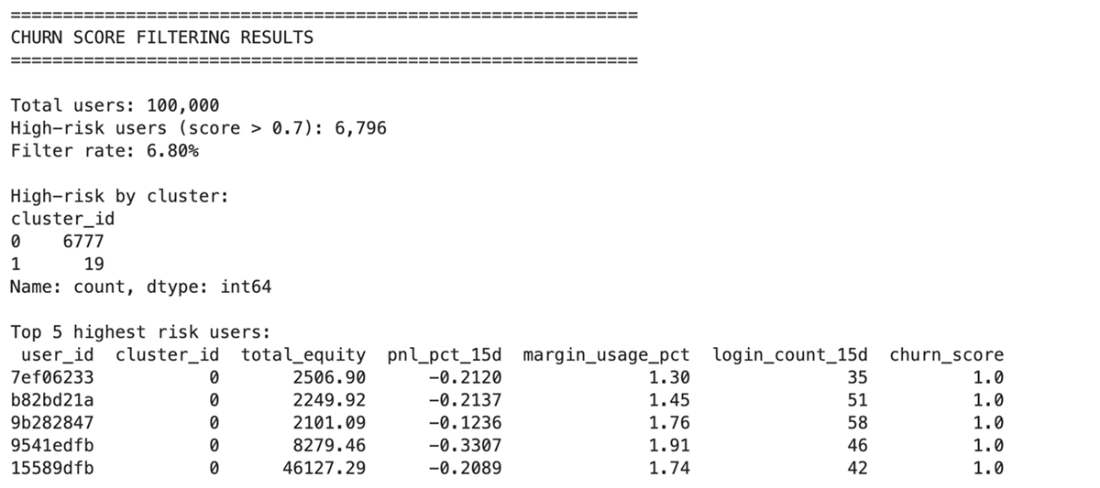
Churn score filtering results showing 6,796 high-risk users (6.80% filter rate) with 99.7% belonging to Cluster 0 (Panic Speculators). This concentration validates our Chapter 13 clustering—the users exhibiting panic behavior are indeed the highest churn risk.
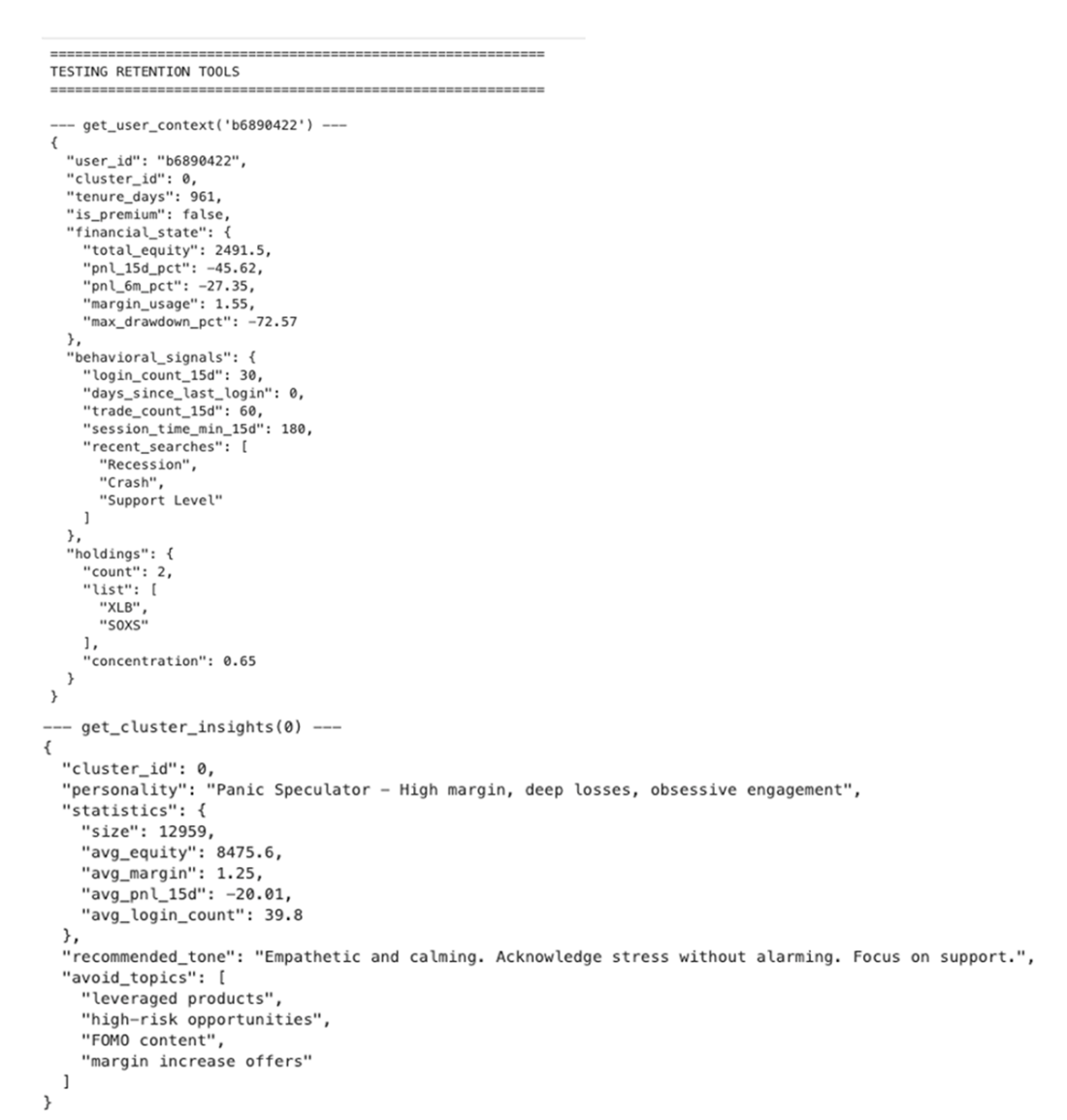
Tool output examples showing user context with -45.62% 15-day PnL, 1.55 margin usage, and panic-related search terms, alongside cluster insights with aggregate statistics and communication guidelines. The search keywords ["Recession", "Crash", "Support Level"] clearly indicate a user in financial distress.
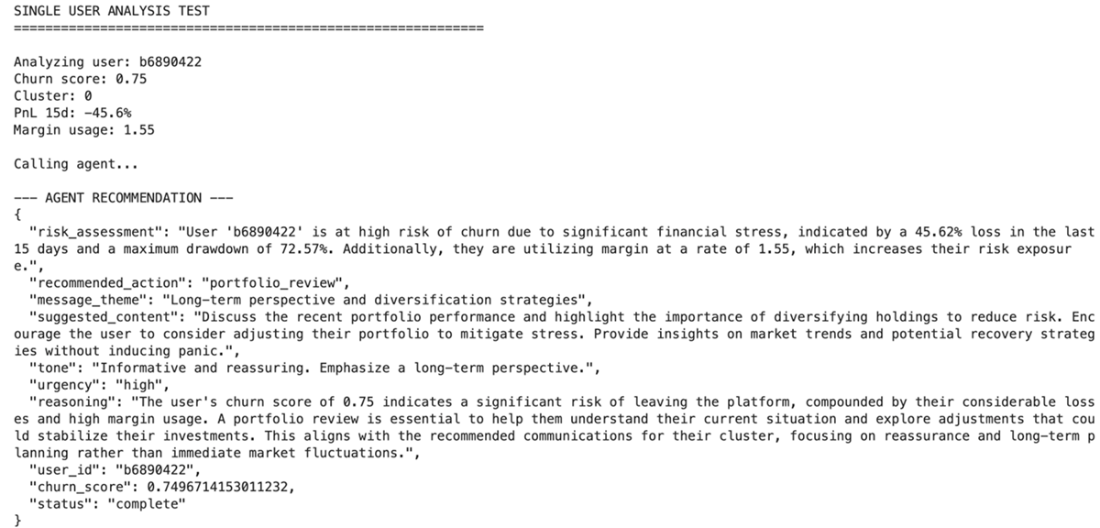
Agent recommendation for user b6890422, a Cluster 0 Panic Speculator with -45.62% 15-day losses. The agent correctly identifies the risk factors (significant losses, high margin usage, 72.57% max drawdown), recommends a portfolio review with informative and reassuring tone, and explicitly avoids recommending high-risk products—demonstrating adherence to the guidelines encoded in its system prompt.
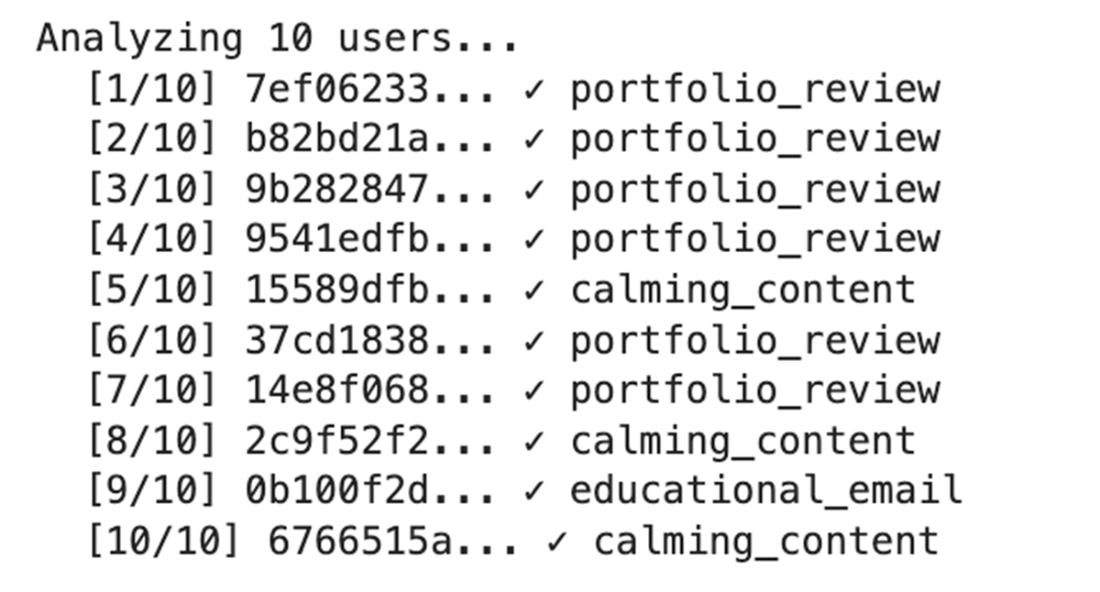
Batch analysis of top 10 high-risk users showing the distribution of recommended actions: portfolio_review (6), calming_content (3), and educational_email (1). All users belong to Cluster 0, and the agent consistently avoids recommending aggressive actions, demonstrating appropriate calibration for stressed users.
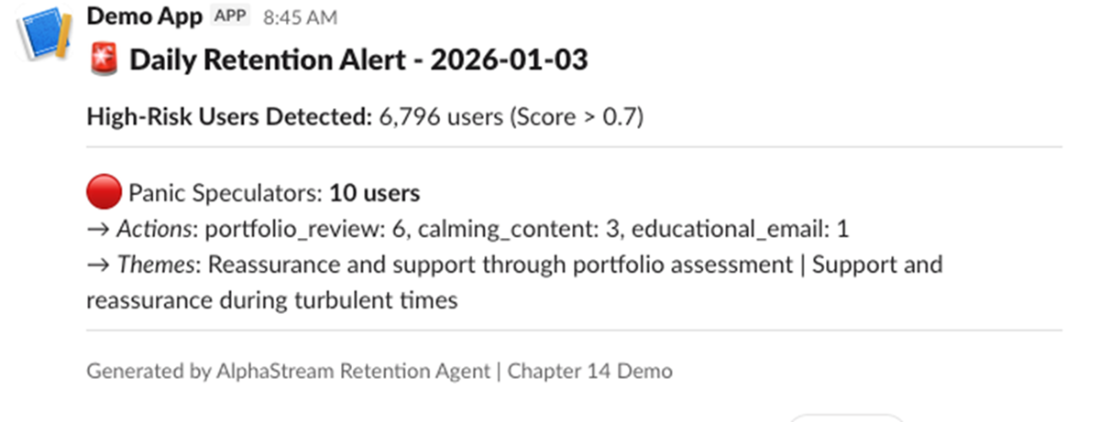
Cluster-level strategy summary showing Panic Speculators (Cluster 0) with 10 high-risk users, action distribution across portfolio reviews, calming content, and educational emails, and common message themes focusing on reassurance, support, and financial stability during turbulent times.

Slack alert as it appears in the #retention-alerts channel. The message shows 6,796 high-risk users detected, with Panic Speculators broken down by recommended actions (portfolio review, calming content, educational email) and common message themes. This gives RMs immediate visibility into the day's retention priorities without logging into a separate dashboard.
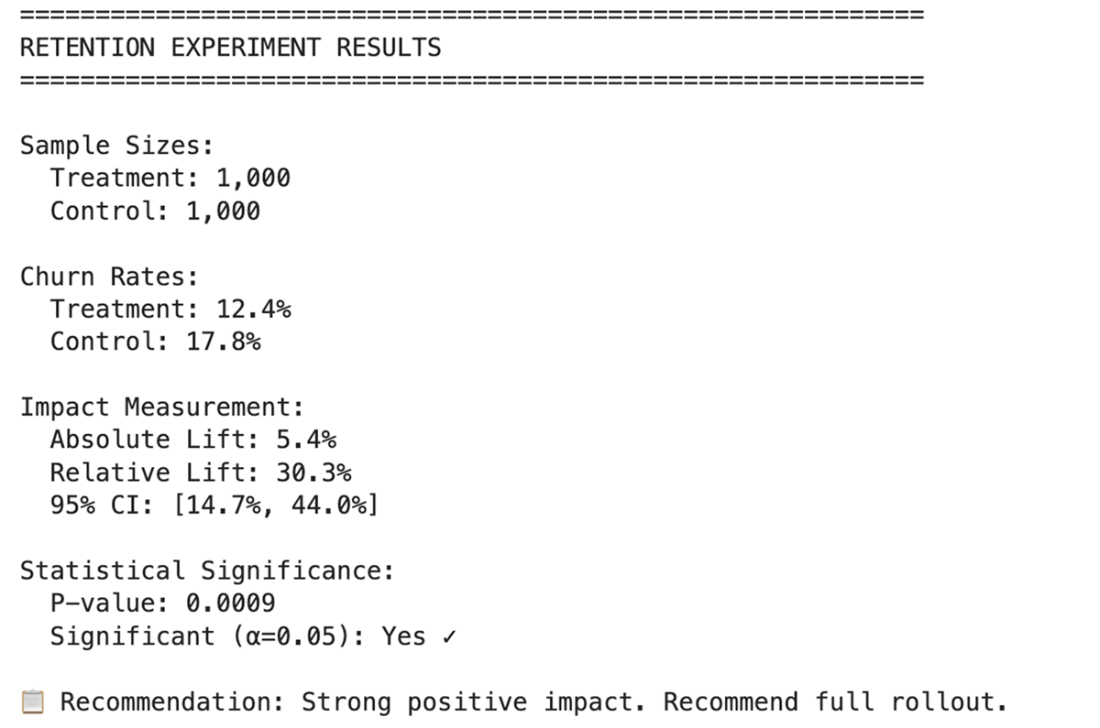
Retention experiment results showing 12.4% churn in the treatment group versus 17.8% in control, yielding a 30.3% relative lift with 95% CI [14.7%, 44.0%] and p-value 0.0009. The confidence interval excludes zero, confirming the positive effect is unlikely due to chance.
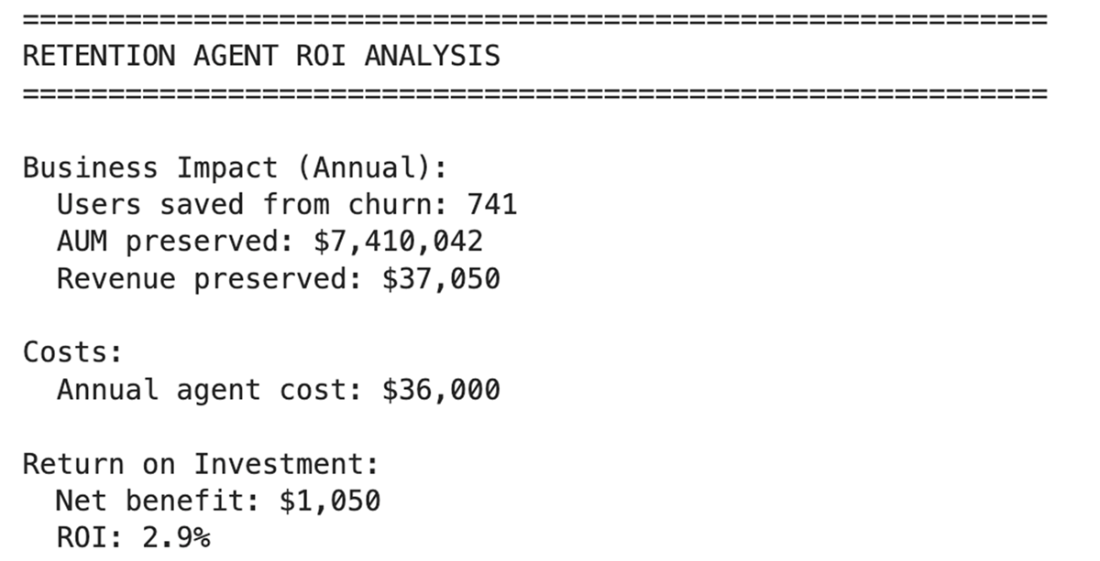
ROI analysis showing 741 users saved annually, $37,050 in preserved revenue against $36,000 annual agent cost, yielding a modest 2.9% ROI. While positive, this suggests opportunities for optimization—either increasing intervention effectiveness or reducing operational costs.
Summary
- AI agents represent a paradigm shift from reactive dashboards to proactive, autonomous systems that can monitor, reason, and act—extending human judgment rather than replacing it.
- The 4-Layer Framework evolves naturally to accommodate agents: the Data Asset Layer exposes data through callable Tools, the Modeling Layer incorporates LLM-based reasoning alongside traditional ML, the Application Layer becomes an Agent Executor, and the Strategy & Monitoring Layer adds Human-in-the-Loop governance.
- Cost-aware architecture is essential for agent viability: the "Filter First, Reason Later" principle uses inexpensive traditional ML to reduce the population requiring LLM analysis by over 93%, making agent deployment economically feasible at scale.
- Tool design transforms static data into agent-accessible functions—get_user_context and get_cluster_insights provide the information foundation for agent reasoning, following patterns that generalize to MCP standardization as agent ecosystems grow.
- The agent loop implements iterative observe-reason-act cycles: rather than single LLM calls, the agent gathers context through multiple tool invocations before producing recommendations, enabling nuanced analysis that rule-based systems cannot match.
- Operational integration through Slack delivers agent insights where teams actually work—daily retention alerts surface high-risk users segmented by cluster with recommended strategies, minimizing friction between AI analysis and human action.
- Human-in-the-Loop governance is a permanent architectural requirement in regulated industries: the "Draft-Approve" pattern ensures regulatory compliance while guardrails prevent inappropriate recommendations from ever being generated.
- Rigorous experimental design distinguishes activity metrics (recommendations generated) from impact metrics (retention lift, revenue preserved)—A/B testing with statistical significance testing provides honest assessment of agent effectiveness.
- ROI calculation translates retention lift into financial outcomes, connecting abstract metrics to concrete business value and justifying continued investment in agent infrastructure.

 Financial AI in Practice ebook for free
