13 Enhancing customer experience: building a personalization engine
Consumers now expect financial apps to feel as adaptive and insightful as the best media platforms, but finance demands a very different kind of personalization. The chapter explains that a financial platform must guide users through risk and uncertainty rather than simply optimize clicks or conversions, because a trade can lead to loss, churn, and regulatory exposure. As a result, the system is framed as a neutral discovery and trust-building tool that surfaces relevant information, helps users interpret market noise, and supports long-term retention instead of pushing aggressive product recommendations.
To make that possible, the chapter builds a data foundation that combines fragmented sources into a unified user profile. It shows how transactional ledger data and high-volume clickstream logs are stitched together through a batch pipeline into a daily “User 360” mart, capturing both financial state and behavioral context. From there, the book introduces a richer representation of each customer using embeddings: holdings, search intent, account history, and risk-related numerical signals are turned into a hybrid “Financial DNA” vector, so the system can distinguish between users who may hold the same asset but differ greatly in wealth, maturity, or anxiety.
Once users and assets share a common semantic space, the chapter demonstrates how personalization becomes a matching problem rather than a rule-writing exercise. It shows how clustering can uncover hidden customer tribes such as panicked speculators, leveraged holders, new users, and passive savers, and how content can be ranked in real time by similarity to each user’s vector. The chapter then emphasizes that good business outcomes require more than relevance: teams must validate recommendations with A/B tests focused on retention and stability, and add guardrails so risky content is blocked when it conflicts with suitability or fiduciary expectations.
A snapshot of a User 360 mart for retail investors. Each row represents a single user-day profile, combining identity attributes, financial state (balances and PnL), behavioral signals, and portfolio composition into a unified view used for personalization and risk-aware decision support.

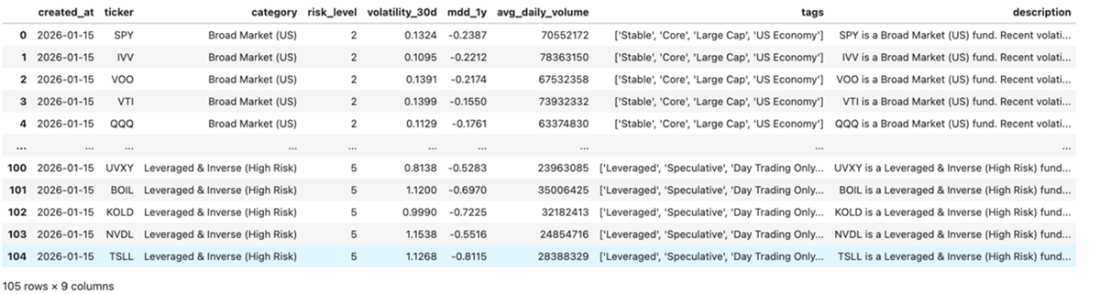
A snapshot of the ETF Metadata Mart. Each row represents a tradable asset enriched with LLM-generated semantic tags and descriptions, enabling the system to connect quantitative identifiers with qualitative meaning for discovery and personalization
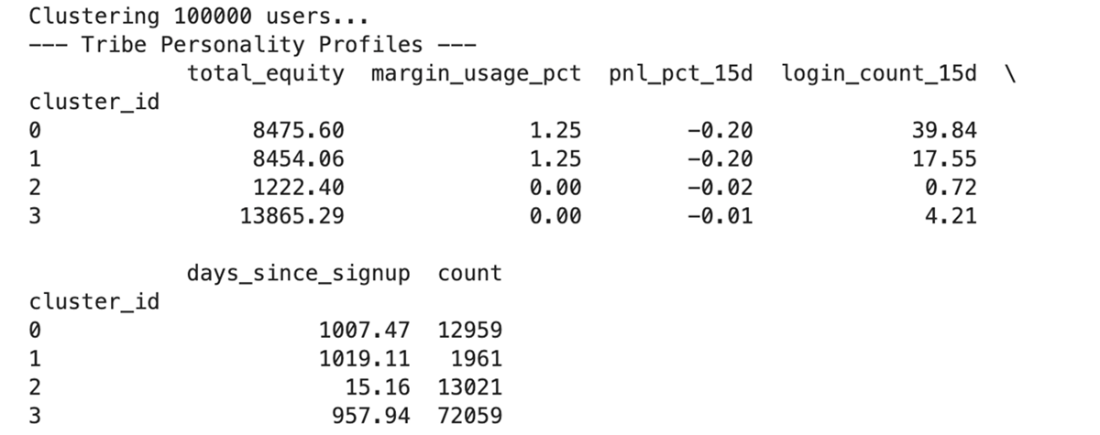
The Tribe Personality Profiles. This summary table reveals four distinct behaviors. Notice the stark contrast between Cluster 0 (High Margin, High Login) and Cluster 3 (Zero Margin, Low Login), confirming that our vectorization successfully captured the difference between "Risk-Taking" and "Risk-Averse" users.
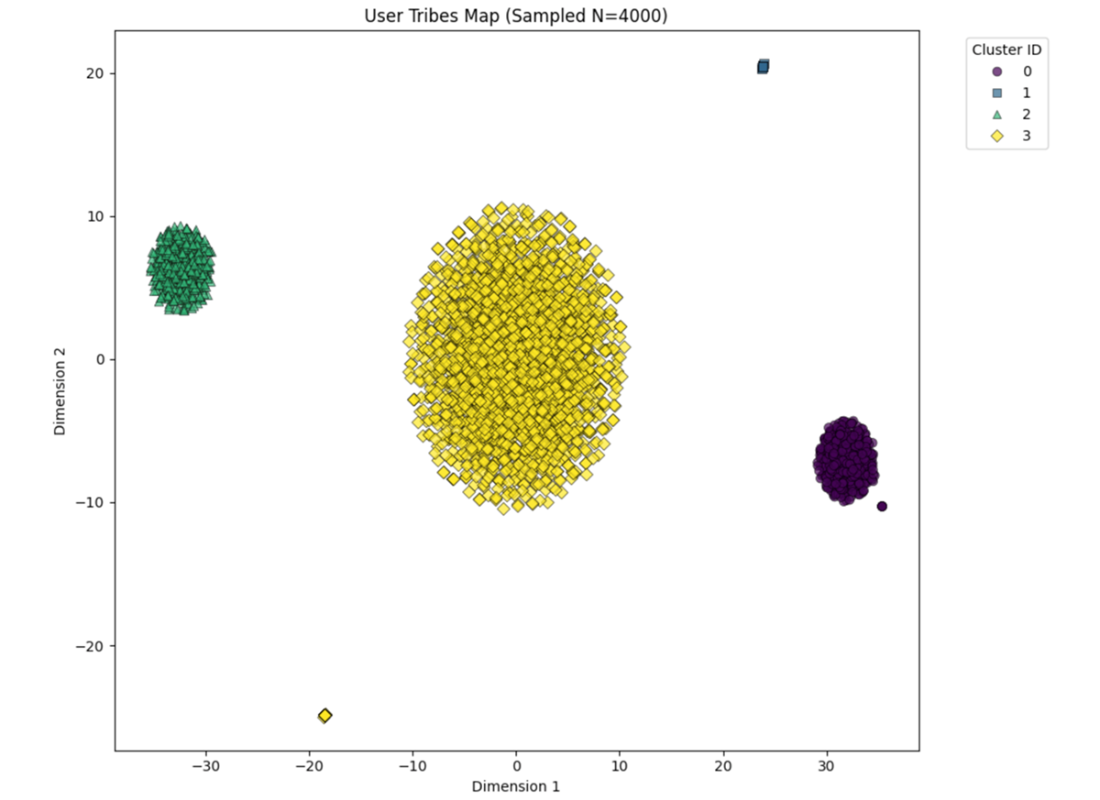
The Financial DNA Map. The spatial separation confirms our hypothesis. The "Newbies" (Cluster 2, Green Triangles) form a tight, isolated island on the left, completely separated from the "Savers" (Cluster 3, Yellow Diamonds) in the center. Interestingly, the two leveraged groups (Cluster 0 and 1) are visually close but distinct, separated primarily by their behavioral intensity (login counts).
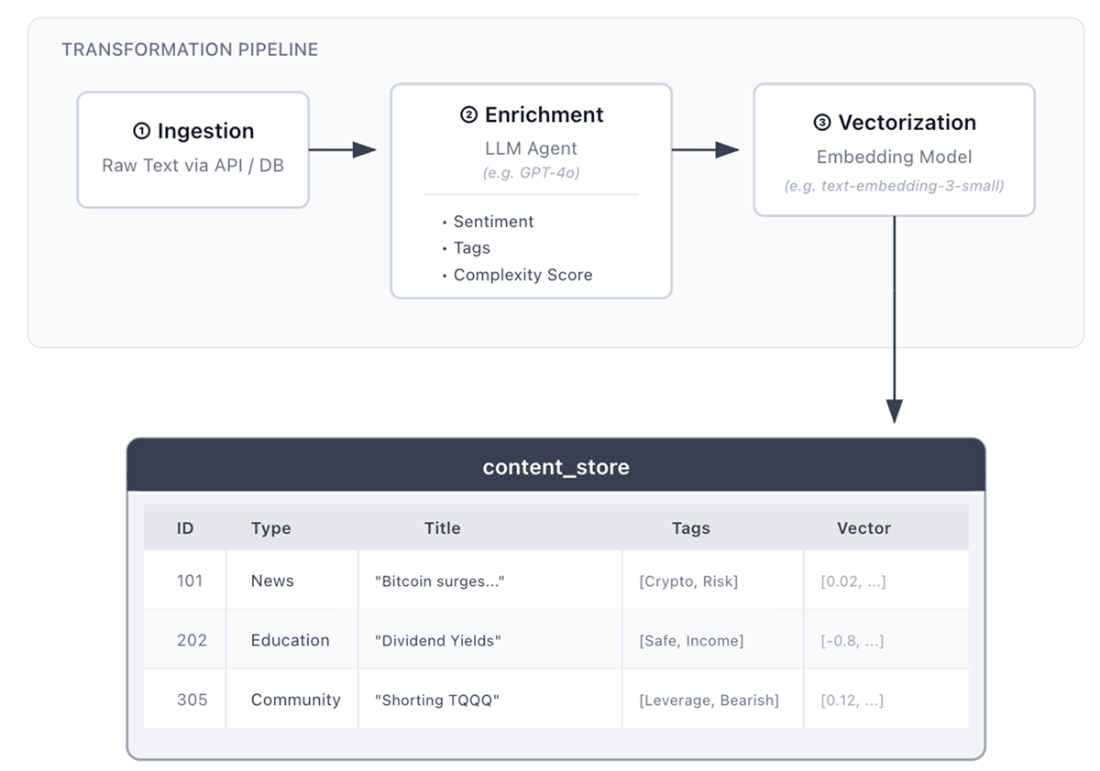
The content lake architecture. Raw financial content is ingested, semantically enriched by an LLM, and transformed into dense vector representations. The resulting content_store serves as a real-time, queryable asset for personalized discovery in the application layer.
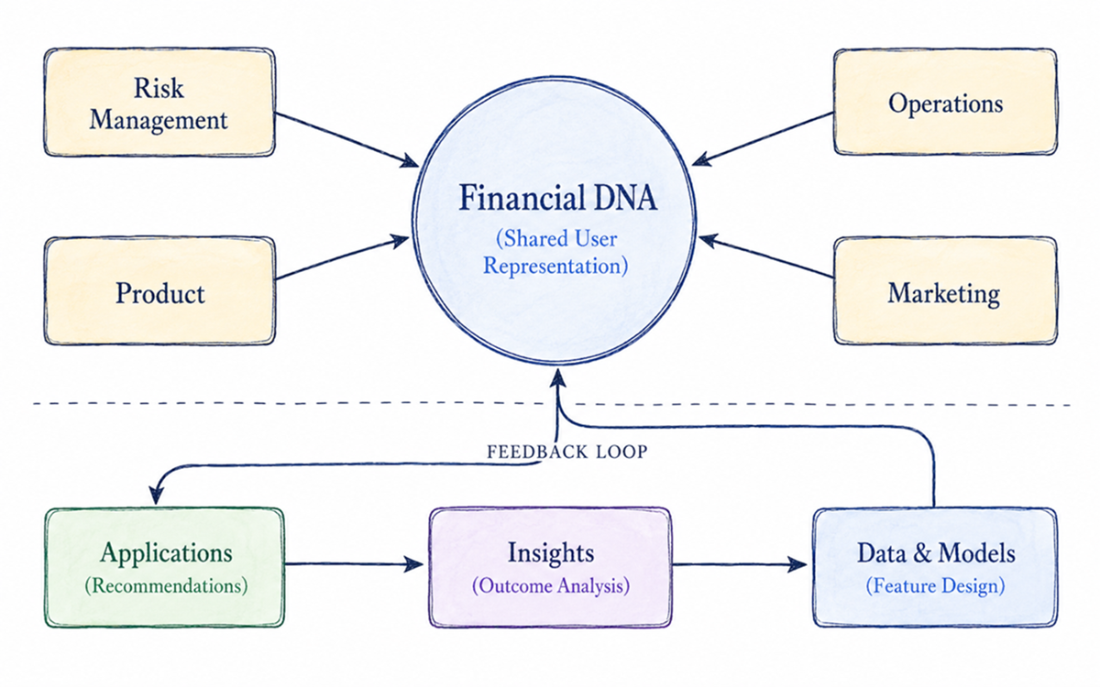
Financial DNA as a shared representation across organizational functions. Consumer-facing teams (Risk, Operations, Product, Marketing) draw from a unified user model, while application-layer insights feed back into data collection and model refinement—forming a continuous improvement loop rather than a one-directional pipeline.
Summary
- Financial personalization differs fundamentally from e-commerce: the goal is not conversion but discovery and trust-building, since a trade marks the beginning of risk rather than the end of a customer journey.
- The "User 360" pipeline unifies two distinct data worlds—the transactional Ledger (what users own) and the behavioral Clickstream (what users think)—into a single Feature Store for downstream AI models.
- Raw text strings like tickers and search terms carry no inherent meaning for machines; embedding models transform them into high-dimensional vectors that encode semantic relationships.
- The "Financial DNA" is a hybrid vector combining semantic encoding (portfolio and search intent) with normalized behavioral features (login intensity, tenure, wealth scale), enabling the system to distinguish between users with identical holdings but opposite risk profiles.
- K-Means clustering on these vectors reveals hidden "Tribes"—from Panic Speculators to Passive Savers—without any manually programmed classification rules.
- The Content Discovery Engine operates on a separation principle: slowly evolving user context is computed in batch, while rapidly flowing content is vectorized in near real-time and matched at query time via cosine similarity.
- Semantic matching solves the Cold Start problem by measuring geometric distance in a shared vector space, enabling personalized recommendations even for users with zero interaction history.
- Click-through rate is an insufficient metric for financial systems; success must be measured by long-term retention, reduced panic behavior, and sustained trust over time.
- The "Fiduciary Filter" enforces ethical guardrails: AI proposes candidates, but policy rules override recommendations that violate suitability principles, risk profiles, or jurisdictional constraints.
- Financial DNA transcends personalization—it serves as a shared language across Risk, Operations, Product, and Marketing teams, enabling coordinated action based on a unified user representation.
- Modern financial systems are feedback loops, not pipelines: application-layer insights should influence upstream feature design, labeling strategies, and data collection priorities.

 Financial AI in Practice ebook for free
