12 Augmenting investment decisions: LLM-guided portfolio allocation
The chapter presents a hybrid investment workflow that turns an LLM into a bounded decision advisor rather than a signal extractor or autonomous trader. It builds on earlier quantitative and qualitative engines by combining momentum-based market signals with structured macroeconomic indicators, then asking the LLM to synthesize them into portfolio recommendations that a human analyst can review. The core idea is to augment judgment, not replace it, by making the model reason within explicit constraints and produce auditable outputs.
To make the process reliable, the chapter emphasizes careful simulation design: point-in-time data access, publication lags for macro series, and clear timing assumptions about when decisions are made and when trades would execute. It uses a deliberately challenging five-ETF universe to stress the allocation workflow, defines a system prompt that limits concentration, turnover, and risky volatility exposure, and requires JSON responses so recommendations can be parsed and logged consistently. Quantitative momentum and volatility features provide a numerical foundation, while the LLM interprets these signals alongside macro context to propose constrained target weights.
The historical replay shows how the workflow behaves over time, but it is framed as a policy simulation rather than evidence of predictive alpha. The hybrid approach can outperform a naive equal-weight baseline, yet that result is interpreted cautiously because the baseline is intentionally weak and the period is short. The most important outputs are the reasoning traces, flags, and decision logs, which create transparency for review and compliance. The chapter closes by stressing the production gap: real-world deployment would need transaction costs, slippage, risk controls, and monitoring for model drift, with human oversight remaining the final decision layer.
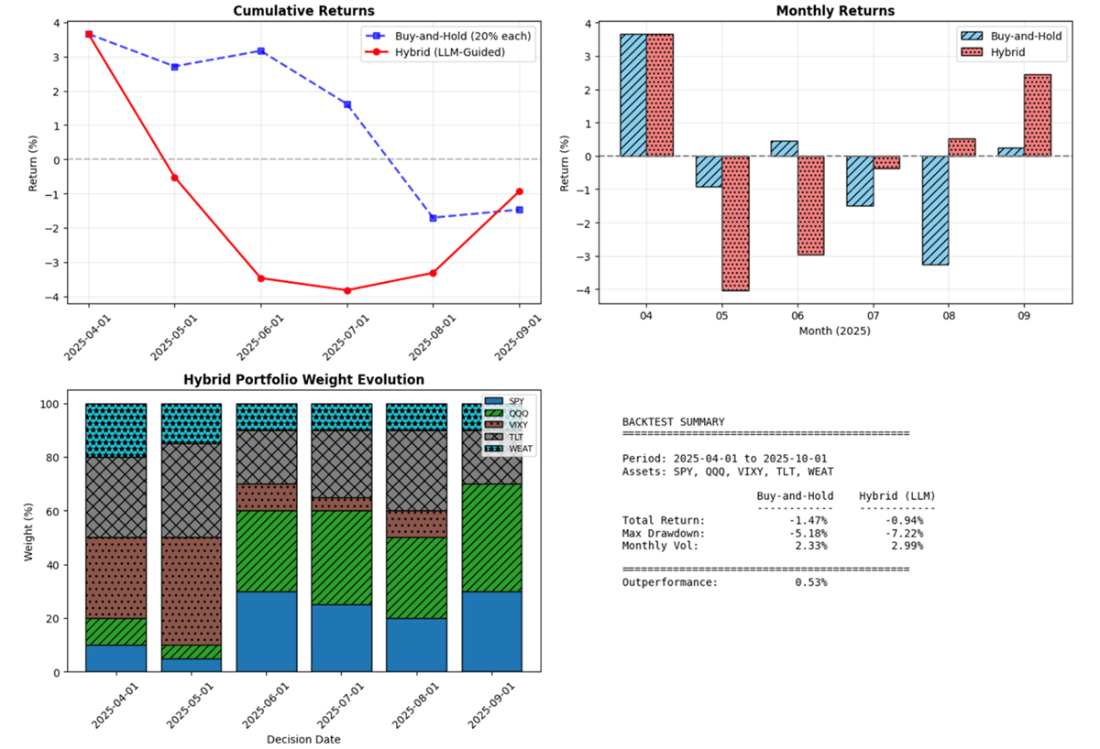
Simulation results dashboard. (Top left) Cumulative returns compare the Buy-and-Hold baseline (squares, dashed line) versus the Hybrid LLM strategy (circles, solid line). (Top right) Monthly returns show period-by-period variance, using diagonal hatching for the baseline and stippling (dots) for the hybrid strategy to aid grayscale readability. (Bottom left) Weight evolution illustrates how the LLM reallocated capital across assets, distinguished by unique texture patterns. (Bottom right) Statistical summary of the simulation run.
Summary
- Alpha blending combines signals from different sources into coherent portfolio decisions—a challenging problem because signals may conflict, have different time horizons, or provide redundant information.
- The synthesis workflow maps to our 4-Layer Framework: FRED indicators and ETF prices in the Data Asset Layer, momentum signals and LLM interpretation in the Modeling Layer, the recommendation workflow in the Application Layer, and human review with decision logging in the Strategy & Monitoring Layer.
- The system prompt provides bounded discretion within explicit constraints—maximum position sizes, turnover limits, and flagging rules create safety boundaries while allowing the LLM flexibility in interpretation.
- Information timing discipline prevents lookahead bias by respecting publication lags for each indicator—M2 money supply has a 45-day lag while VIX publishes daily.
- Six months of simulation demonstrates methodology, not investment alpha—statistical significance requires far more observations across different market regimes.
- The hybrid approach showed different risk-return characteristics than buy-and-hold, illustrating a trade-off (higher returns but also higher drawdown) rather than clear dominance.
- LLM outputs are non-deterministic and model-dependent, making them unsuitable for autonomous trading but valuable for structured analysis that humans review.
- The decision log creates an audit trail documenting inputs, recommendations, reasoning, and flags—essential for compliance, debugging, and performance attribution.
- Human review is mandatory; the goal is augmented decision-making where AI surfaces considerations and humans make final decisions.
- Production deployment requires infrastructure far beyond this prototype: transaction cost modeling, execution systems, risk monitoring, and governance frameworks for model updates.

 Financial AI in Practice ebook for free
