Overview
Appendix F. References and further reading
This appendix serves as a chapter-by-chapter research map for the book, pairing the sources cited in each chapter with selected materials for deeper study. It emphasizes that the references are not just background reading, but the supporting papers, datasets, documentation, standards, and industry reports behind the book’s examples and implementations. Overall, it is designed to help readers verify claims, revisit the technical foundations, and explore adjacent topics in greater depth.
Across the chapters, the citations trace a broad arc from governance, regulation, and AI strategy in finance to practical modeling choices in credit, fraud, investing, personalization, and autonomous workflows. The sources include official regulatory frameworks, applied case studies, benchmark datasets, core machine learning papers, and production tools, showing how the book connects finance problems to concrete AI methods such as LLM grounding, fine-tuning, survival analysis, scorecards, gradient boosting, graph learning, and agentic systems. In several places, the readings also highlight the importance of evaluation, fairness, monitoring, and operational discipline alongside model performance.
The further-reading lists extend each chapter with especially useful books, surveys, and practitioner references, often chosen for their balance of rigor and applicability. They point readers toward foundational texts on AI risk management, credit scoring, interpretability, fraud analytics, graph representation learning, financial machine learning, recommendation systems, and agent design, while also directing attention to industry surveys and evolving research on generative AI in finance. Taken together, the appendix functions as a curated roadmap for readers who want to move from the book’s examples to a more complete view of the field.
FAQ
What is the purpose of Appendix F in Financial AI in Practice?
Appendix F collects the sources cited throughout the book and provides curated further-reading recommendations for each chapter. It is organized chapter by chapter and includes references to papers, reports, datasets, and documentation, with URLs verified as of July 2026.Which chapter references are listed for the introduction to AI in finance?
Chapter 1 references Morgan Stanley’s AI assistant case study, the GDPR, and the Federal Reserve’s CCAR page. Its further reading recommends the NIST AI Risk Management Framework and FINRA’s AI key topic page.What resources are recommended for learning about how AI creates business value?
For Chapter 2, the appendix recommends Prediction Machines by Agrawal, Gans, and Goldfarb for an economics-first perspective on AI value creation, and McKinsey’s annual State of AI survey as an ongoing view of enterprise AI adoption and value capture.Which key references support the chapter on generative AI in finance?
Chapter 3 cites the CFA Institute’s practical LLM guide, the original Retrieval-Augmented Generation paper, LoRA and QLoRA, the Llama 3 model paper, and Anthropic’s Model Context Protocol announcement. Further reading includes Chip Huyen’s AI Engineering and Sebastian Raschka’s Build a Large Language Model (From Scratch).What are the main references for credit risk fundamentals?
Chapter 4 references the Kaplan–Meier estimator, the lifelines Python library, IFRS 9, the Federal Reserve’s SR 20-12 allowance-for-credit-losses guidance, and CFPB Regulation B. Further reading points to Naeem Siddiqi’s Intelligent Credit Scoring and Credit Scoring and Its Applications.Which datasets and tools are cited in the end-to-end credit scoring chapter?
Chapter 5 uses the AMEX Default Prediction and Home Credit Default Risk Kaggle datasets. It also references XGBoost, a benchmark study on tree models for tabular data, Apache Airflow, and Great Expectations. The further reading recommends Machine Learning for High-Risk Applications.What are the main interpretability and monitoring resources in the explainability chapter?
Chapter 6 cites OptBinning, Evidently, SHAP, LIME, and NIST SP 800-53 Rev. 5. Further reading recommends Christoph Molnar’s Interpretable Machine Learning and Fairness and Machine Learning by Barocas, Hardt, and Narayanan.Which fraud-detection references are included in the appendix?
Chapter 7 cites Deloitte’s report on gen AI and fraud, Fortune Business Insights’ fraud market estimate, PSD2, and SMOTE. Further reading includes the ACFE’s Occupational Fraud: A Report to the Nations and Baesens et al.’s Fraud Analytics Using Descriptive, Predictive, and Social Network Techniques.What graph analytics resources are listed for fraud detection?
Chapter 9 references a 2024 review of graph neural networks for financial fraud, NetworkX, the Louvain community-detection paper, Graph Convolutional Networks, GraphSAGE, and PyTorch Geometric. Further reading includes William L. Hamilton’s Graph Representation Learning and the Leiden algorithm paper.What does Appendix F recommend for portfolio allocation and autonomous agents?
For portfolio allocation, Chapter 12 cites FRED, an agentic stock-selection study, and a McKinsey report on gen AI in private markets; further reading includes Black–Litterman and backtesting guidance. For autonomous retention agents, Chapter 14 cites ReAct, OpenAI function calling, FINRA Regulatory Notice 24-09, and Slack webhooks, with further reading from Anthropic’s agent guidance and AI Agents in Action.
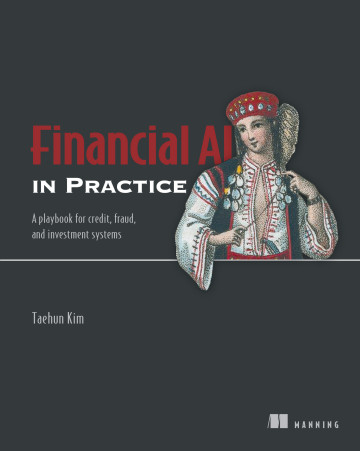 Financial AI in Practice ebook for free
