Appendix D. A quick reference on key financial AI metrics
This appendix emphasizes that in financial AI, metrics are not just statistical scores but direct reflections of business impact. A model can look excellent on paper and still create serious losses if it misranks risk, blocks valuable customers, or fails to align with operational goals. The central message is that evaluation must connect model performance to money, risk, and decision quality.
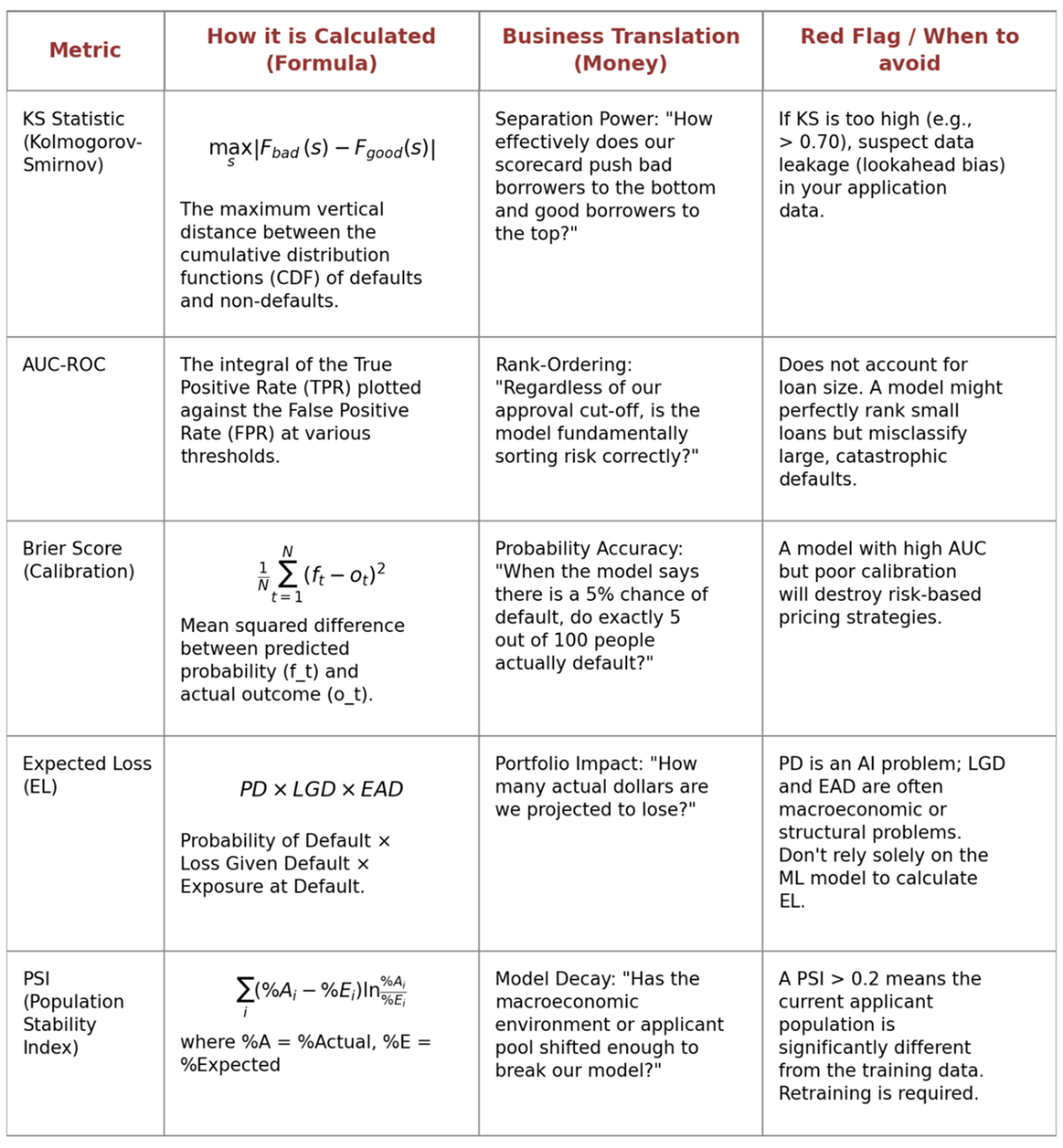
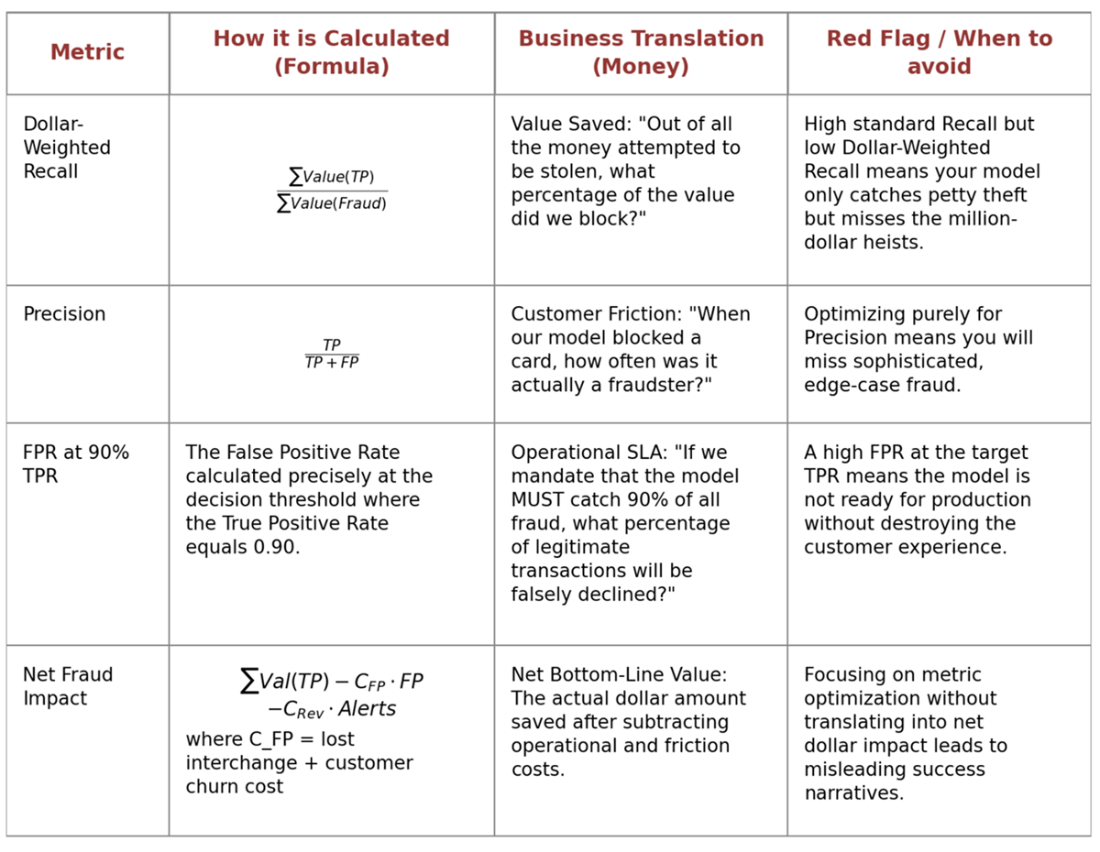
For credit risk, the focus is on separating good from bad borrowers, measuring how well predicted probabilities match actual default rates, and checking whether performance remains stable over time. For fraud detection, the challenge is the extreme imbalance of fraud versus legitimate activity, so evaluation must consider not only transaction counts but also the financial value at stake and the operational cost of false alarms. In both areas, the appendix frames metrics as tools for balancing accuracy, calibration, and practical trade-offs.
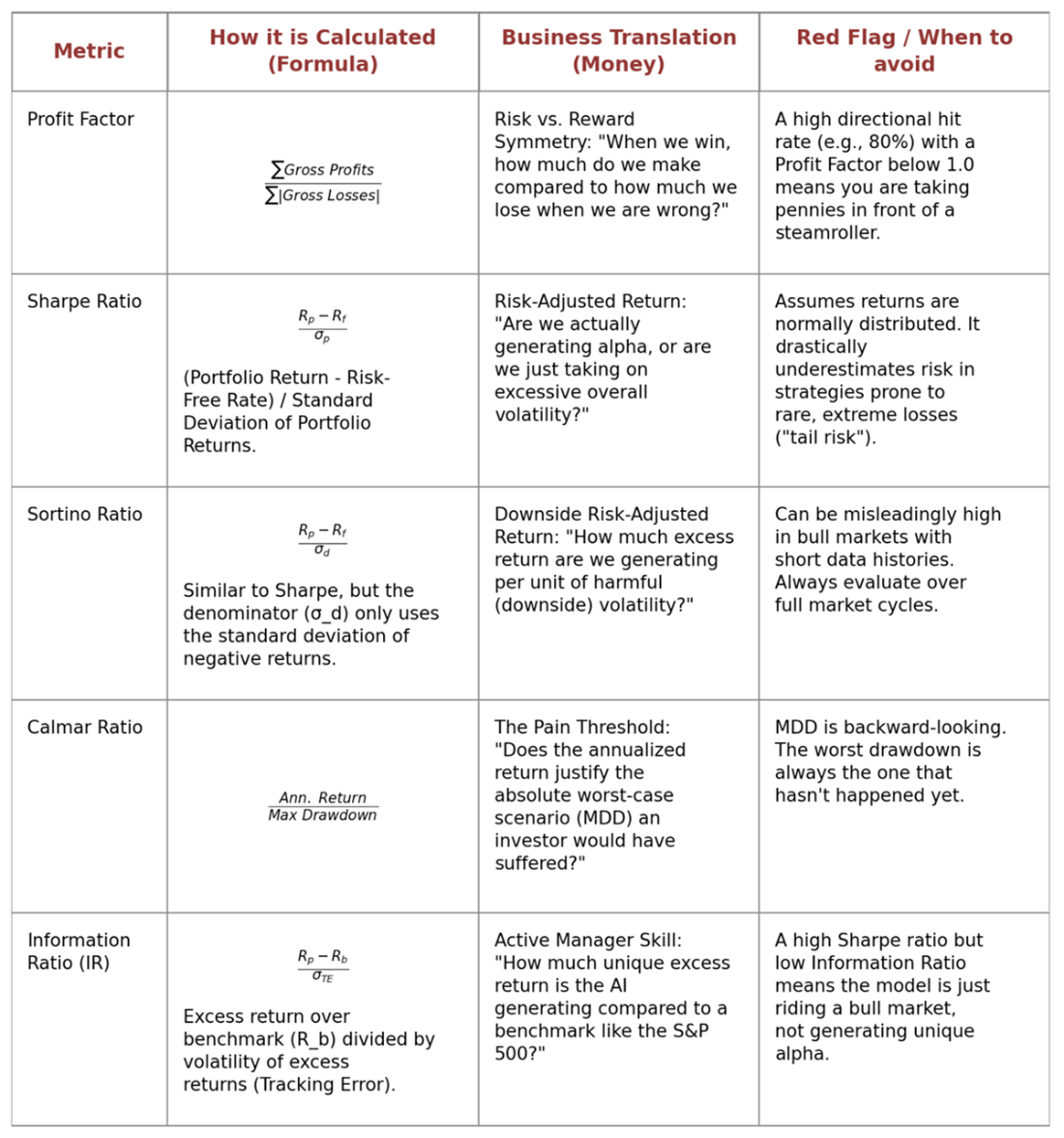
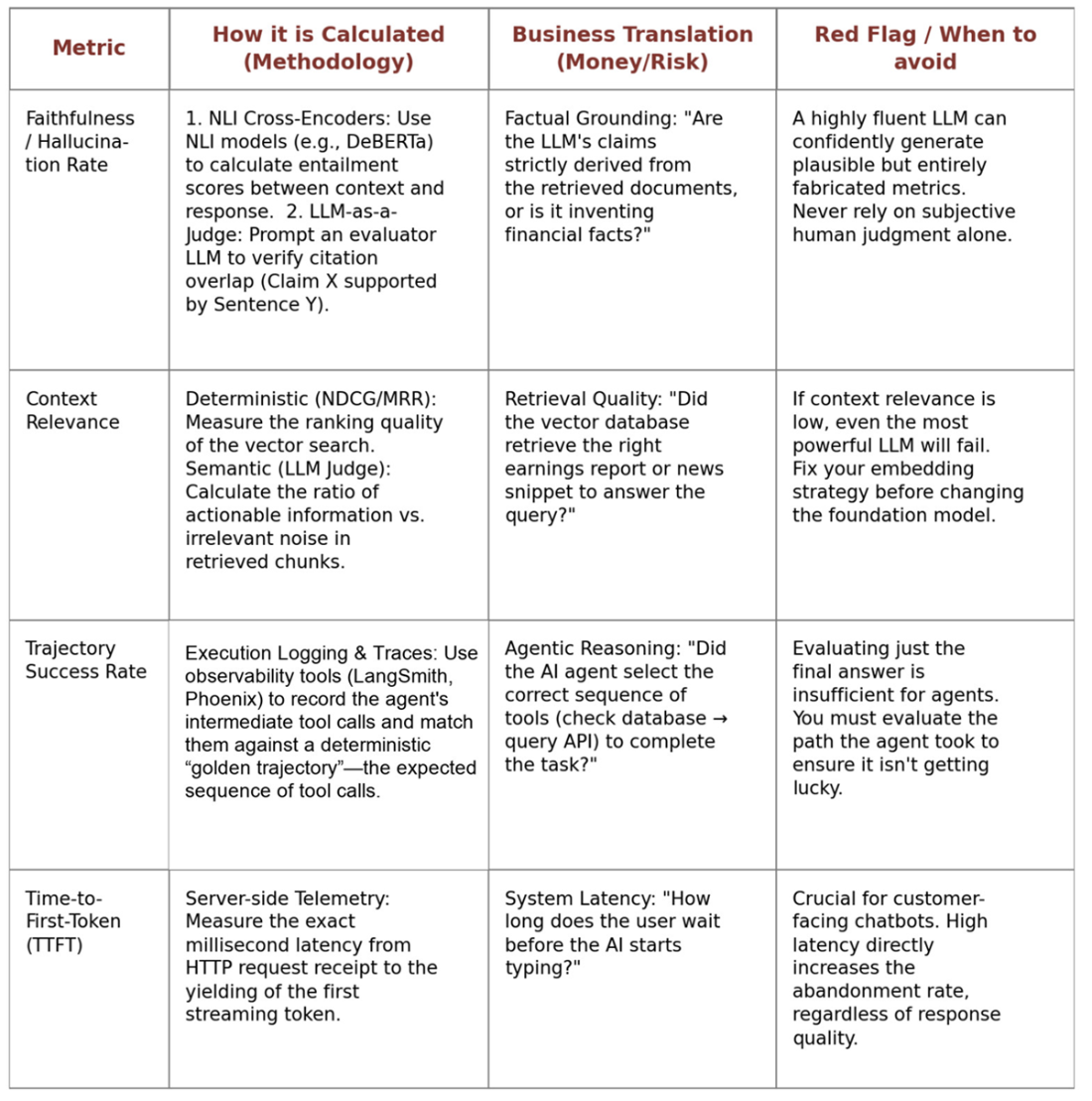
The same business-first approach extends to investing and generative AI. In quantitative trading, evaluation must capture payoff asymmetry and downside risk rather than relying on normal assumptions alone. For LLMs, retrieval systems, and autonomous agents, traditional metrics are insufficient, so the important measures include factual grounding, reasoning quality, and latency. Across all domains, the appendix serves as a reference for choosing metrics that reflect real-world financial and operational consequences.
Table D.1 Core metrics for credit scoring
Table D.2 Core metrics for fraud detection
Table D.3 Core metrics for quantitative investing
Table D.4 Core metrics for Generative AI and Agents
FAQ
Why do standard machine learning metrics like accuracy often fail in financial AI?In financial AI, metrics are tied directly to business outcomes, not just statistical fit. A model can be 99% accurate and still cause major losses if it misranks risk, misprices defaults, or creates operational friction. Financial evaluation must reflect monetary impact, not only predictive correctness.What are the main metrics used to evaluate credit scoring models?Credit scoring models are typically evaluated by how well they separate good borrowers from bad borrowers, how well their probabilities are calibrated to actual default rates, and how stable they remain over time. These metrics help assess both predictive power and long-term reliability.Why is calibration important in credit risk models?Calibration measures whether predicted probabilities match real default outcomes. A model may rank borrowers well, but if its probabilities are poorly calibrated, lending decisions, pricing, and portfolio risk estimates can become inaccurate. In credit, that can lead to underpricing or overexposure.What does model stability mean in credit risk analysis?Model stability refers to how consistently a credit model performs over time as borrower behavior, macroeconomic conditions, or portfolio composition changes. A stable model is important because credit environments shift, and a model that degrades quickly can create hidden risk.Why are fraud detection metrics different from standard classification metrics?Fraud detection is highly imbalanced, so ordinary metrics can be misleading. In addition, fraud models must account for transaction value and operational costs, not just counts of correct predictions. The best fraud metric is often the one that reflects total business loss, not just classification performance.Why can a highly precise fraud model still be bad for the business?Even a high-precision model can create too many false positives for valuable customers. If it blocks legitimate VIP transactions or causes excessive friction, the business may lose revenue and customer trust. Fraud systems must balance detection with customer experience and operational cost.What should be measured when evaluating quantitative trading models?Trading models should be evaluated not only by return, but also by risk-adjusted performance and downside behavior. Important considerations include the symmetry of payoffs, volatility, and how much penalty the strategy takes during losses. This helps reveal whether returns are robust or just the result of hidden risk.Why are downside-risk metrics important in investment AI?Downside-risk metrics matter because two strategies with similar average returns can have very different risk profiles. A strategy with frequent small gains but occasional severe losses may be much worse than one with steadier performance. Financial AI must measure how painful the bad outcomes are.What metrics matter most for LLM, RAG, and agentic workflows in finance?For LLMs and agents, traditional ML metrics are not enough. Key metrics include factual grounding, reasoning quality or trajectory, and latency. In financial applications, it is also important to know whether outputs are reliable, traceable, and fast enough for production use.Why is latency a key metric for generative AI systems in finance?Latency affects whether an LLM or agent can be used in real workflows. In finance, slow responses can disrupt customer service, trading support, compliance review, or analyst productivity. A model that is accurate but too slow may still fail operational requirements.
pro $24.99 per month
access to all Manning books, MEAPs, liveVideos, liveProjects, and audiobooks!

 Financial AI in Practice ebook for free
