In this chapter, the focus is on the role of event producers in an event processing network and on how they fit into the overall flow of events. A producer is broadly defined as anything that introduces event objects from outside the network, but the model keeps its boundaries clear by treating the producer as a proxy whose internal logic is outside the scope of the network. The chapter also explains that a producer can represent an abstract type, a class of producers, or a single concrete instance, which is useful when an application has many similar sources or when the number of sources changes over time.
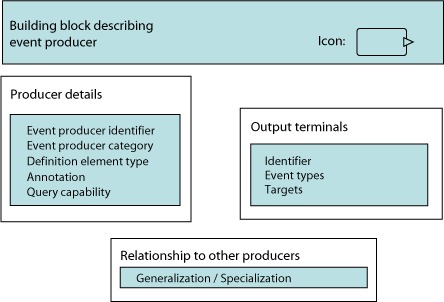
The text then breaks down the definition element used to model producers. It contains producer details, output terminals, and relationships to other producer types. Producer details identify and classify the source, while output terminals describe the events emitted, their identifiers, event types, and targets. Relationships allow specialization and generalization among producer types, so a specific source can inherit the structure of a broader abstract one while still supporting additional terminals if needed. This framework helps capture only the interfaces that matter to the event processing network, not the producer’s internal behavior.
The chapter also surveys common kinds of producers and how they interact with the network. Hardware sources include sensors and detectors such as GPS units, RFID readers, cameras, and environmental sensors; software sources include simulated sensors, instrumented applications, adaptors, and feeds; and human interaction sources include user-entered actions, verification devices, presence systems, and surveillance-related inputs. It then distinguishes sensor-style and detector-style interactions, discusses push and pull approaches, and introduces queryable producers that retain history for diagnostics or compliance. The Fast Flower Delivery example ties these ideas together with concrete producer definitions for stores, drivers, GPS sensors, and vehicles.
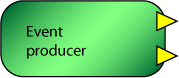
Event producer with two output terminals
The event producer definition element contains details about the definition element itself, a list of output terminals, and a list of relationships to other event producer definitions
Event producer connected to an explicitly modeled channel
Different kinds of event producers encountered in event processing applications
FAQ
What is an event producer in an event processing network?An event producer is something that introduces event objects into the event processing network from outside the network. It is a broad concept and can refer to sensors, software applications, adaptors, feeds, or human-driven interfaces.How is an event producer different from an event processing agent?An event producer has only output terminals and its internal logic is not part of the event processing network definition. An event processing agent, by contrast, has input terminals and its processing logic is explicitly defined within the network.What are the three ways the term “event producer” can be used?It can mean an abstract type of producer, a class of multiple producer instances of the same type, or a single producer instance. The same definition element can represent any of these forms depending on context.What is included in the event producer definition element?The definition element includes producer details, output terminals, and relationships to other producer types. It models abstract types, classes, and instances, but only the interaction with the network, not the producer’s internal behavior.What information is stored in the producer details section?Producer details include an identifier, a category, the definition element type, an optional annotation, and a query-capability flag. These describe the producer and indicate whether it is an abstract type, class, or instance.What are the main attributes of an output terminal?An output terminal has an identifier, one or more event types, and zero or more targets. Targets are references to the input terminals or consumers that receive events from that terminal.What is specialization in event producer relationships?Specialization means one producer definition element is a more specific version of another. The specialized element must have corresponding output terminals with the same or more specific event types, and it may also define additional terminals.What are the main kinds of event producers described in the chapter?The chapter groups event producers into hardware, software, and human interaction categories. It notes that real producers may combine these categories and that the boundary of a producer can sometimes be subjective.What are the main interaction patterns for event producers?The two main interaction patterns are sensor style and detector style. Sensor style reports measured state, while detector style reports specific occurrences or events that happen in the environment or system.How do event producers interface with the event processing network?They interface using either protocol-based mechanisms or API-based mechanisms. Protocol-based approaches use transport protocols, while API-based approaches let the producer submit events or update resources through a programming interface.
pro $24.99 per month
access to all Manning books, MEAPs, liveVideos, liveProjects, and audiobooks!



 Event Processing in Action ebook for free
