This chapter highlights the practical challenges that arise once event processing moves beyond idealized patterns and into real applications. It focuses on three main problem areas: how time should be interpreted, how to cope with uncertainty and imperfect information, and how to handle event retraction and causality. The overall message is that many important behaviors are not fully settled in current tools, so designers need to understand the tradeoffs before building order-sensitive or situation-aware systems.
A major theme is temporal semantics. The text explains that event time is not always a single instant: many real-world events unfold over intervals, which complicates context membership and ordering. It also shows that derived events create semantic questions about what their timestamps should mean, since using detection time, source occurrence time, or an interval-based interpretation can each lead to different results. Because many applications depend on event order, the chapter also examines synchronization problems, out-of-order arrival, buffering, and retrospective compensation as ways to recover correctness when timing cannot be trusted perfectly.
The chapter then turns to inexact processing, where events may be missing, false, imprecise, or only approximately related to the situations they are meant to represent. It notes that probabilistic methods can help model uncertainty, but assigning and propagating those probabilities is still difficult in practice. Finally, it discusses retraction and causality: some event-driven actions must be cancelable, but undoing them is often partial, context-dependent, and hard to automate. Causality is presented as a way to trace why an event or action happened, with distinctions among predetermined, induced, and potential causality, reinforcing the need for careful policy decisions and explicit modeling of event relationships.
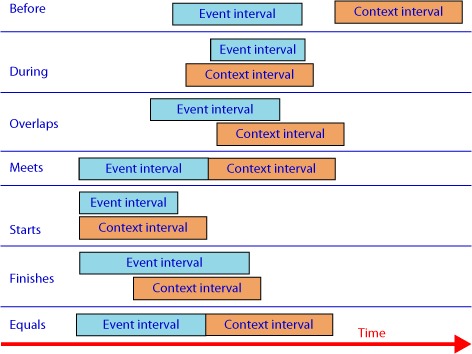
Relationships between the context partition’s time interval and an event occurrence interval
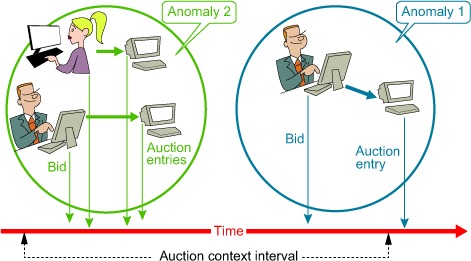
Two anomalies that may stem from setting occurrence time for derived events in a naïve way
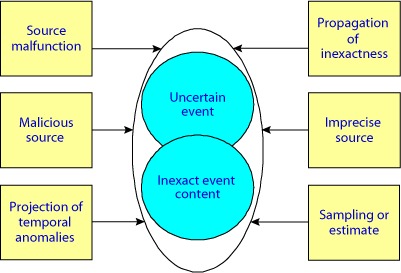
Reasons for uncertainty and inexactness in events.
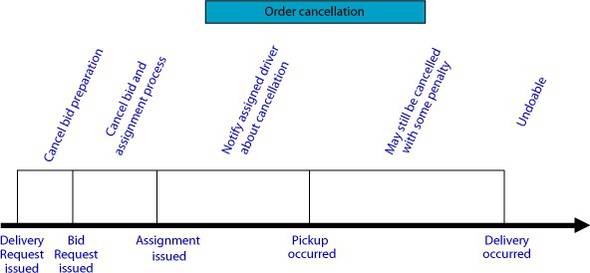
Order cancellation implications over the delivery lifecycle
FAQ
What are the main challenges covered in Chapter 11 of Event Processing in Action?Chapter 11 focuses on three major challenge areas in event processing: temporal semantics, inexact event processing, and event retraction and causality. It explains why these topics are difficult in real systems and discusses possible approaches and their implications.Why is temporal semantics such an important issue in event processing?Time affects almost every event processing application. The outcome of processing can depend on timestamps, event order, context windows, and whether events are treated as occurring at a point in time or over an interval. These temporal details can change results significantly.What is the difference between occurrence time and detection time?Occurrence time is the time an event is believed to have happened in reality, while detection time is the time the system becomes aware of the event. The two may differ, especially in distributed systems or when events are derived rather than raw.Why can an event’s occurrence time be better represented as an interval instead of a single point?Some events are not instantaneous; they unfold over time. Examples include a flight landing, a prolonged medical condition, or a long-running financial crisis. In such cases, a start and end time better represent reality than a single timestamp.Why do derived events create temporal semantic problems?Derived events may be emitted after some processing delay, so their detection time may be later than the time they logically relate to. If their occurrence time is assigned naively, it can create anomalies such as rejecting valid events or producing incorrect ordering in downstream processing.What are the risks of processing events out of order?Out-of-order processing can break order-sensitive logic such as trend detection, queue handling, auctions, and sequence patterns. It may cause the system to miss events, process them too early or too late, or compute incorrect derived results.How can systems mitigate out-of-order event arrival?Common approaches include clock synchronization, using a shared time server, buffering events for a timeout period and then reordering them, or assigning sequence numbers. Each approach has trade-offs in latency, accuracy, and implementation complexity.What is inexact event processing?Inexact event processing deals with uncertainty in whether an event actually occurred, inaccuracies in event content, and imperfect matching between events and the situations they represent. It acknowledges that event processing may not always be fully precise.What are false positive and false negative situation detections?A false positive occurs when the system emits an event for a situation that did not actually happen. A false negative occurs when a real situation happens but no corresponding event is emitted. Both can cause costly or dangerous wrong reactions.What are event retraction and event causality, and why do they matter?Event retraction is the cancellation or withdrawal of an event and its consequences, while event causality describes how one event leads to another. Retraction is hard because not all effects are undoable, and causality matters because it provides traceability and helps explain how outcomes were produced.
pro $24.99 per month
access to all Manning books, MEAPs, liveVideos, liveProjects, and audiobooks!

 Event Processing in Action ebook for free
