Overview

3 Picking evaluation metrics

The chapter explains that evaluation metrics are the tools that turn abstract goals into measurable evidence, but no single metric can capture everything that matters. Because metrics are always tied to assumptions, inputs, computation methods, outputs, and interpretation, choosing them deliberately is crucial for making sound decisions. The core message is to avoid picking metrics simply because they are popular, easy to compute, or familiar, and instead assemble a set of measures that actually fits the task, the context, and the stakeholders who will use the results.

It distinguishes several major metric types and when each is useful. Automatic metrics are fast and scalable but may capture only proxies of quality; judgment-based metrics can better reflect contextual or normative concerns but are slower, costlier, and less scalable; reference-based metrics are easy to compare and benchmark but depend on high-quality ground truth; reference-free metrics work when no single correct answer exists; and execution-based metrics assess end-to-end task completion in realistic workflows. The chapter also stresses that metric names alone are not enough, since different implementations of the same metric can encode very different assumptions.

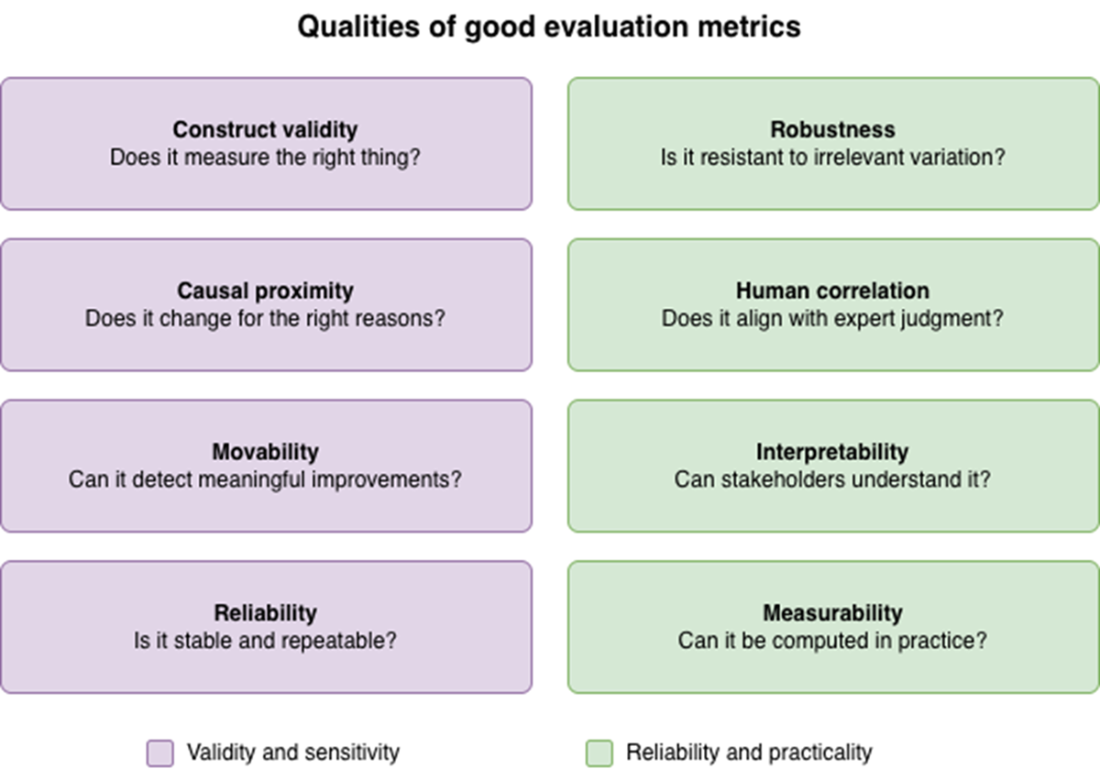
To judge whether a metric is worth trusting, the chapter lays out key quality criteria: construct validity, causal proximity, movability, reliability, robustness, correlation with human judgments, interpretability, and measurability. A good metric should measure the right thing, change for the right reasons, remain sensitive to improvement, produce consistent results, withstand small irrelevant variations, align with expert judgment when appropriate, be understandable to decision-makers, and be feasible to compute. When off-the-shelf metrics do not fit, the chapter recommends designing custom metrics, and it closes by emphasizing that metrics must be versioned, revisited, and maintained over time as systems, users, and goals evolve.

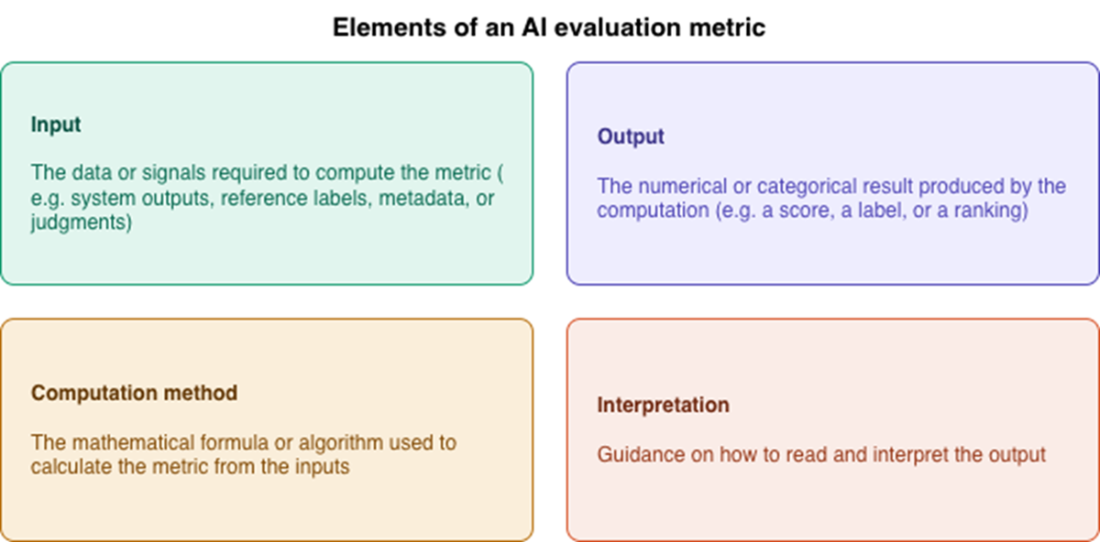
Core elements of an evaluation metric. Every metric transforms inputs into an output through a computation method, but its value depends equally on how the resulting score is interpreted and used in decision-making
Desirable qualities of evaluation metrics. While no metric is perfect, the more of these qualities a metric exhibits, the more confidence you can place in the conclusions it supports.
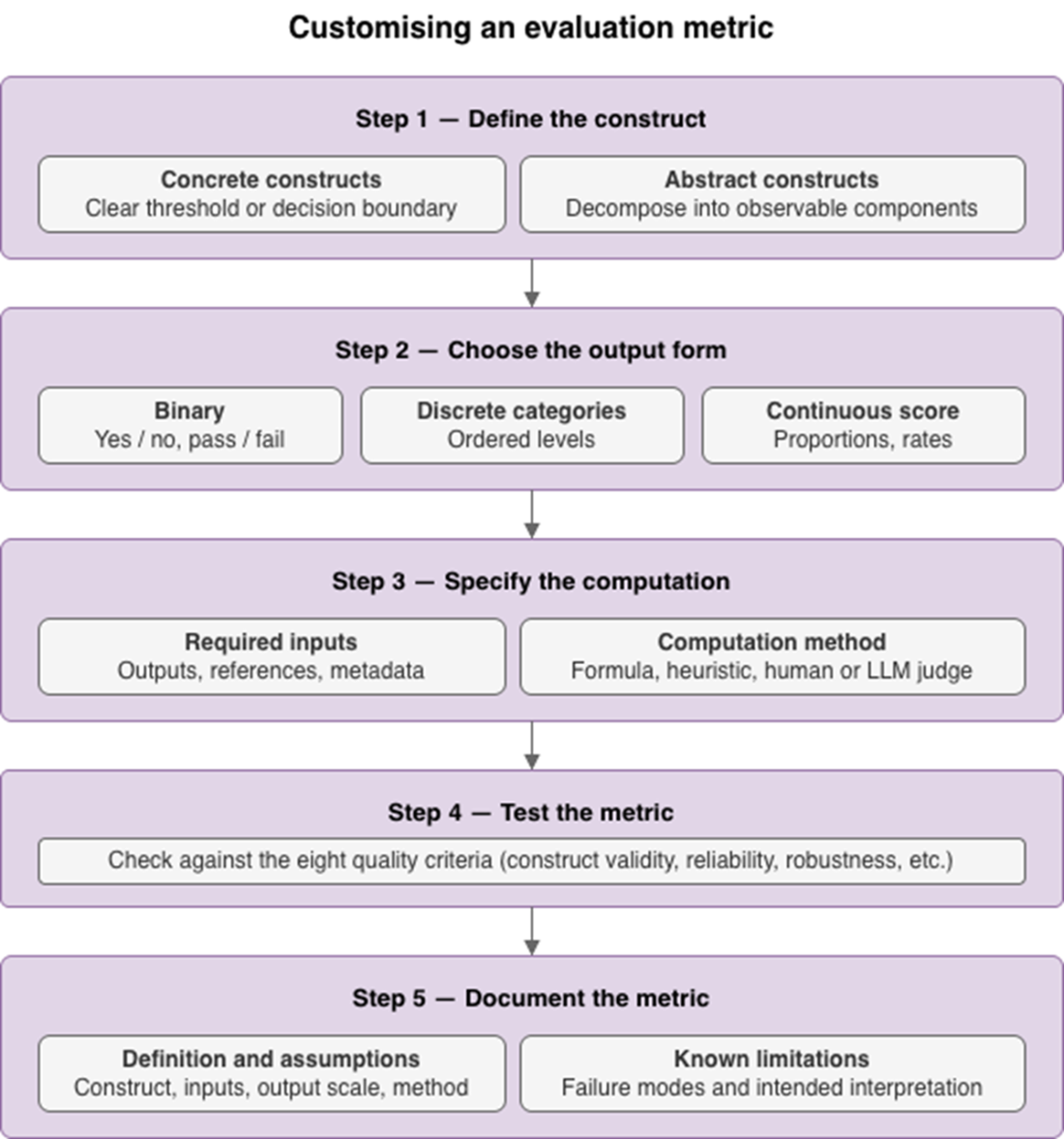
Designing custom metrics when existing metrics are insufficient. Starting from an evaluation goal and construct of interest, the process progressively translates abstract evaluation requirements into a measurable and actionable metric.
Summary

  • Evaluation metrics are measurements that act as operational proxies for decisions, and every metric encodes assumptions about what matters, how it should be measured, and how results should be interpreted.
  • No single metric is sufficient. Effective evaluation relies on selecting multiple complementary metrics that collectively capture different aspects of system behavior and failure modes.
  • You must assess metric quality explicitly. Criteria such as construct validity, causal proximity, movability, reliability, robustness, correlation with human judgment, interpretability, and measurability help you distinguish metrics that will genuinely help you from those that might distract or mislead you.
  • Don’t hesitate to create custom metrics when off-the-shelf metrics are unable to capture your evaluation requirements. Designing a custom metric requires clearly defining the target construct, choosing appropriate output formats, specifying computation procedures, and piloting behavior, and thoroughly documenting assumptions and intended use.

FAQ

What is an evaluation metric in AI systems?An evaluation metric is a quantitative or qualitative measure that turns an abstract evaluation goal into observable evidence. It measures a specific aspect of system behavior, such as accuracy, faithfulness, task success, or safety.
What are the four core elements of a metric?The four core elements are input, computation method, output, and interpretation. Inputs are the data or signals used, computation is the formula or judging process, output is the resulting score or label, and interpretation explains what the result means in context.
When should I use automatic metrics instead of judgment-based metrics?Use automatic metrics when you need fast, inexpensive, repeatable, and scalable measurement, and when the property can be measured objectively. Judgment-based metrics are better when the quality is contextual, subjective, or high-stakes, such as safety, helpfulness, or clinical appropriateness.
What is the difference between reference-based and reference-free metrics?Reference-based metrics compare outputs to ground-truth or exemplar answers, which makes them easier to benchmark and interpret. Reference-free metrics evaluate outputs without a fixed answer, often using intrinsic properties, constraints, context, or judges; they are more flexible but can be harder to validate.
Why is construct validity important when choosing a metric?Construct validity asks whether the metric truly measures the property you care about, rather than a convenient proxy. A metric with low construct validity can mislead development by rewarding the wrong behavior and masking real problems.
What does causal proximity mean in metric design?Causal proximity means the metric changes for the right reasons, in response to meaningful changes in system quality. A metric may be valid in theory, but if it is heavily affected by noise or unrelated factors, it becomes unreliable as feedback for improvement.
What is metric movability?Metric movability is whether a metric can still detect improvement once a system gets better. A metric with low movability may saturate, become too coarse, or stop distinguishing meaningful differences between system variants.
How do reliability and robustness differ?Reliability is about consistency under the same conditions, while robustness is about remaining trustworthy under small, reasonable variations. A metric can be reliable but still fragile to minor changes, so both qualities matter.
Why should evaluation metrics be interpreted alongside human judgments?Because automatic scores may not align with what users or experts actually consider good behavior. Comparing metric scores with human judgments helps reveal whether the metric is measuring the right thing or just a proxy.
When should I design a custom metric instead of using an off-the-shelf one?Design a custom metric when existing metrics operate at the wrong level of detail, encode assumptions that do not fit your domain, or miss important distinctions in your use case. This is especially important in specialized or high-stakes settings where generic metrics can hide critical risks.

pro $24.99 per month

  • access to all Manning books, MEAPs, liveVideos, liveProjects, and audiobooks!
  • choose one free eBook per month to keep
  • exclusive 50% discount on all purchases
  • renews monthly, pause or cancel renewal anytime

lite $19.99 per month

  • access to all Manning books, including MEAPs!

team

5, 10 or 20 seats+ for your team - learn more


choose your plan

team

monthly
annual
$49.99
$499.99
only $41.67 per month
  • five seats for your team
  • access to all Manning books, MEAPs, liveVideos, liveProjects, and audiobooks!
  • choose another free product every time you renew
  • choose twelve free products per year
  • exclusive 50% discount on all purchases
  • renews monthly, pause or cancel renewal anytime
  • renews annually, pause or cancel renewal anytime
  • Evaluating AI Systems ebook for free

choose your plan

team

monthly
annual
$49.99
$499.99
only $41.67 per month
  • five seats for your team
  • access to all Manning books, MEAPs, liveVideos, liveProjects, and audiobooks!
  • choose another free product every time you renew
  • choose twelve free products per year
  • exclusive 50% discount on all purchases
  • renews monthly, pause or cancel renewal anytime
  • renews annually, pause or cancel renewal anytime
  • Evaluating AI Systems ebook for free