7 Description of finite field polynomial math
In this chapter, the author introduces polynomial arithmetic as the practical foundation for finite field extensions used later in elliptic curve pairing work. A field extension is presented as a polynomial with coefficients taken modulo a prime, giving a larger field with \(p^k\) elements while still preserving the familiar operations of addition, multiplication, and inversion. The emphasis is on building an implementation-friendly understanding, where the code used throughout the book is meant to mirror the underlying math closely enough to make later cryptographic routines easier to follow.
The polynomial representation chosen is intentionally simple: a fixed-size structure stores a degree and an array of coefficients, with each array index corresponding directly to a power of \(x\). Basic setup routines initialize and clear every coefficient so that the structure can be used safely without memory leaks. This design trades efficiency for clarity, which the author notes is acceptable because the goal is to explain the mechanics of field extension arithmetic rather than optimize for large-scale software engineering.
Once the representation is in place, the chapter shows how polynomial addition and subtraction work coefficient by coefficient, with special handling for unequal degrees and removal of any leading zeros that would otherwise distort the degree. It then introduces supporting utilities for copying, comparing, printing, and generating random polynomials, each of which is useful for debugging and for later cryptographic algorithms. The print routines are especially practical because they format results in a way that can be checked against external tools, helping validate correctness as the rest of the book builds on this foundation.
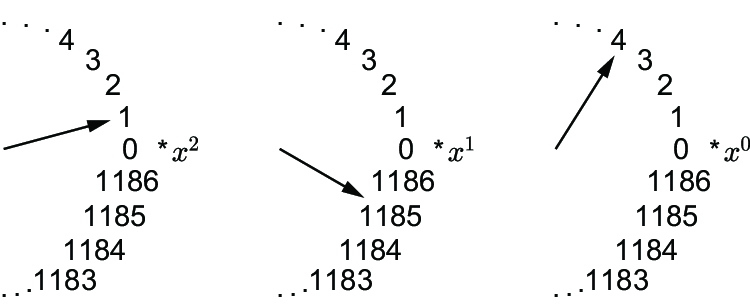
Finite field extension over prime numbers viewed as a clock (\(p=1187\), \(k=3\))
Summary
- A degree \(k\) extension of a finite field \(p\) has \(p^k\) elements.
- Polynomial structure includes integer degree and a fixed number of coefficients.
- Adding two polynomials of different degrees results in the highest degree in the output.
- Care must be taken with output degree if the highest coefficient goes to zero.
- Random polynomials will be one degree less than the irreducible polynomial defining the field.
FAQ
What is a field extension in the context of finite fields?
A field extension is formed by taking a finite field with prime sizep and extending it to a larger field with p^k elements. In this chapter, the extension is represented using polynomials with coefficients modulo p.Why are polynomials used to represent elements of a field extension?
Polynomials provide a convenient indexing method for extension-field elements. Each element can be written as a polynomial in a chosen variable such asx or t, with coefficients taken modulo the base field prime.What is the general form of a polynomial used in this chapter?
The general form isak-1xk-1 + ... + a1x + a0, where each coefficient is reduced modulo the prime p.How do you add two polynomials in a finite field extension?
You add polynomials by summing matching coefficients of the same power ofx. Since all coefficients are taken modulo the field prime, the result stays within the field.Why does polynomial subtraction work the same way as addition in this chapter?
Subtraction is done by negating the second polynomial and then adding it to the first. Because arithmetic is modulo a prime, the result is always brought back into the valid coefficient range.Why is it important to remove leading zeros after polynomial addition?
If the highest-degree coefficients become zero after addition, the polynomial’s degree must be reduced. Otherwise, later routines may treat the polynomial as having the wrong degree and produce bugs.What does the POLY structure store?
The POLY structure stores the polynomial degree and an array of coefficients. The coefficient at index i corresponds to the term x^i.What is the purpose of the polynomial initialization and clearing routines?
poly_init allocates and initializes each coefficient, while poly_clear releases them. These routines prevent memory leaks when polynomials are created and destroyed in code.What does the polynomial comparison routine check?
The comparison routine checks whether two polynomials are exactly equal. It returns1 if the degrees and all coefficients match, and 0 otherwise.Why is the polynomial print routine useful?
The print routine formats a polynomial in a way that is easy to debug and can be copied into PARI/gp. It prints coefficients with their powers ofx, making it easier to verify calculations.
 Elliptic Curve Cryptography for Developers ebook for free
