This chapter introduces the Tate pairing as another elliptic-curve pairing useful for later cryptographic examples, and contrasts it with the Weil pairing. The Tate pairing is bilinear and nondegenerate, but unlike the Weil pairing it is not alternating, so identical inputs do not produce 1 and swapping inputs does not simply yield an inverse. The discussion also emphasizes that the Tate pairing works over a broader set of usable points, which makes it especially interesting when exploring small demonstration curves.
The mathematical definition is presented in terms of a map from points of order m and a quotient of the curve group into the mth roots of unity. The quotient description explains which points are excluded and why points whose orders contain m as a factor can still participate. The practical computation follows Miller’s method: two Miller evaluations are performed, their results are divided, and then the quotient is raised to the exponent (p^k - 1)/m. Because this exponent can be very large in real security settings, the chapter notes that performance comparisons with the Weil pairing are not always straightforward.
The implementation section shows how this formula is translated into code by computing the auxiliary point Q + S, running Miller’s algorithm twice, dividing the results, and applying the final exponentiation. The tiny example then reuses the earlier toy curve to test the pairing experimentally, organize points by order, and randomly select valid inputs from the correct groups. Those tests confirm the expected bilinearity: the pairing of a sum matches the product of pairings, while reversing the roles of the inputs often fails. The examples also illustrate that valid Tate pairing outputs are confined to a small set of roots of unity, so repeated values are expected even across different point choices.
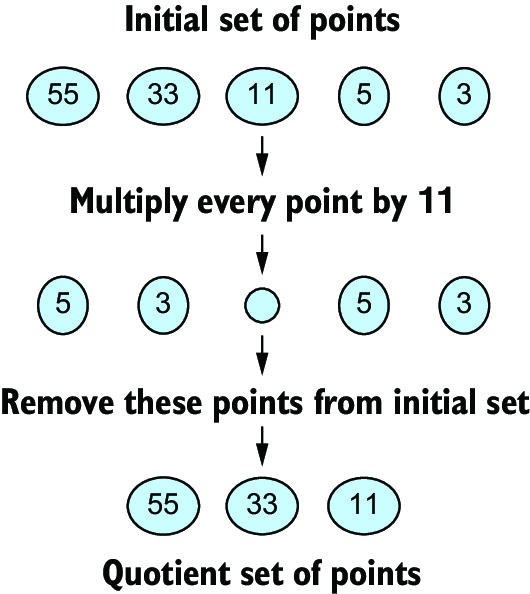
Example of quotient set \(\dfrac{E}{m E}\) for \(m=11\). The first row shows all possible point orders, the second row shows the resulting orders of points after multiplying all points by 11, and the third row shows the first row minus the second row.
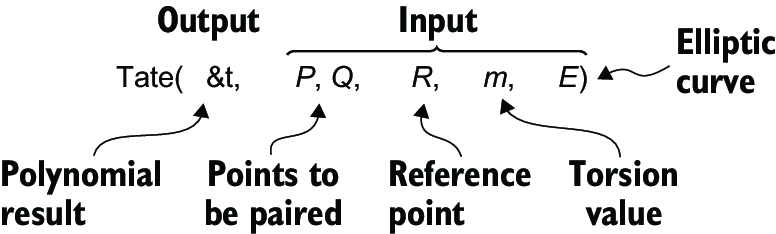
Tate pairing subroutine calling parameters
Summary
The Tate pairing is a bilinear pairing between two points on an elliptic curve defined over a finite field.
The Tate pairing works with points that have a factor \(m\) of large prime order for the second point. The first point must only be of large prime order \(m\). Mathematically, this is written as \[E[m] \times \dfrac{E}{mE} \longrightarrow \mu_m\]
The Tate pairing uses two calls to the Miller algorithm followed by being taken to the power of \((p^k-1)/m\). The formula is \[\tau(P, Q) = \left( \dfrac{f_P(Q+S)}{f_P(S)}\right)^{(p^k-1)\diagup m}\]
FAQ
What is the Tate pairing in elliptic curve cryptography?The Tate pairing is a bilinear map on elliptic-curve points, written as \(\tau: E[m] \times \frac{E}{mE} \to \mu_m\), where \(E[m]\) is the set of points of order \(m\) and \(\mu_m\) is the set of \(m^{th}\) roots of unity.How is the Tate pairing different from the Weil pairing?Unlike the Weil pairing, the Tate pairing is not alternating. In particular, pairing a point with itself does not necessarily give 1, and swapping the inputs does not simply produce the inverse.What does the quotient term \(E/mE\) mean in the Tate pairing formula?It means the set of curve points after removing those that are multiplied by \(m\) into non-infinity points. Points of order \(m\) remain included, and points whose order has \(m\) as a factor may also be included.Why is the exponent \((p^k-1)/m\) always an integer in the Tate pairing?Because the embedding degree \(k\) is chosen so that \(p^k \equiv 1 \pmod m\). Therefore, \(m\) divides \(p^k - 1\), making the exponent an integer.How is the Tate pairing computed from Miller’s function?It is computed using the ratio \(\frac{f_P(Q+S)}{f_P(S)}\), and then raised to the power \((p^k-1)/m\). The point \(S\) is a reference point used in the Miller calculations.What does the Tate pairing routine do step by step?It forms \(Q+S\), runs Miller’s algorithm on \(P\) with \(Q+S\), runs Miller’s algorithm again on \(P\) with \(S\), divides the two results, computes \((p^k-1)/m\), and raises the quotient to that power.What kind of points can be used as inputs to the Tate pairing?The first point must be of order \(m\). The second point only needs to have a factor of \(m\) in its order, so the Tate pairing accepts a broader set of points than the Weil pairing.Why is the reference point \(S\) important in the Tate pairing implementation?\(S\) must not be related to either input point, because it is used as a neutral reference in the Miller calculation. Choosing \(S\) poorly can cause invalid or degenerate results.What did the tiny example show about Tate pairing behavior?The example showed that Tate pairing supports bilinearity: \(\tau(P, Q+T)=\tau(P, Q)\tau(P, T)\). It also showed that the Tate pairing can use more points than the Weil pairing in the same small curve setting.Why are many Tate pairing results duplicates in the tiny example?Because the pairing values must be \(m^{th}\) roots of unity. In the example with \(m=11\), only 11 possible pairing values exist, so repeated outputs are expected.
pro $24.99 per month
access to all Manning books, MEAPs, liveVideos, liveProjects, and audiobooks!

 Elliptic Curve Cryptography for Developers ebook for free
