9 Architecture Changes to Support Scale
Scaling an engineering platform is less about brute-force capacity and more about deliberate architectural and organizational evolution. As usage grows, platform teams must mirror the self-serve, autonomous experience they provide to customers inside the platform organization itself, creating clear domain boundaries and contracts between roles. Business priorities should dictate where and when to scale—sometimes favoring strict isolation across lines of business or regions, other times accelerating extensibility for external API consumers. The north star is a flexible, cost-aware architecture that balances centralized consistency with distributed patterns, reinforced by event-driven releases and contract testing to preserve reliability and trust at scale.
On the infrastructure side, control plane roles scale along two axes: performance (multiple clusters or customized node pools within a role, often across regions) and isolation (duplicated roles for regulatory, contractual, or customer-specific boundaries). This drives ingress and traffic-routing changes—up to geo-aware routing—and often benefits from service mesh capabilities. As cluster counts rise, static, hardcoded pipelines become brittle; dynamic release pipelines generated from a global definition of roles and clusters restore manageability and speed, with matrix-style execution and self-service initiation for new instances when isolation dominates growth. Maintaining a single platform roadmap across duplicated environments avoids fragmentation, while proactively evolving away from low-scale techniques averts operational drag.
For services and extensions, orchestration shifts from monolithic pipelines to per-service lifecycles that update centralized, role-scoped configuration, with lightweight GitOps agents in each cluster pulling and executing deployments locally. This distributed approach scales deployments and reduces cross-cluster blast radius, while centralized observability aggregates health and outcomes. Beyond delivery, platform event streaming becomes a force multiplier: a release API normalizes events from diverse sources via adapters, enabling consumers that open and update work items, trigger conformance tests, enrich observability with deployment signals, and synchronize CMDB and audit data. Combined with automated upgrade watchers (for example, detecting Kubernetes API deprecations and notifying owners), these event-driven patterns deliver decoupling, resilience, and near real-time coordination—making large-scale upgrades and routine operations faster, safer, and more predictable.
Practical examples of evolutionary scaling strategies for engineering platform components.
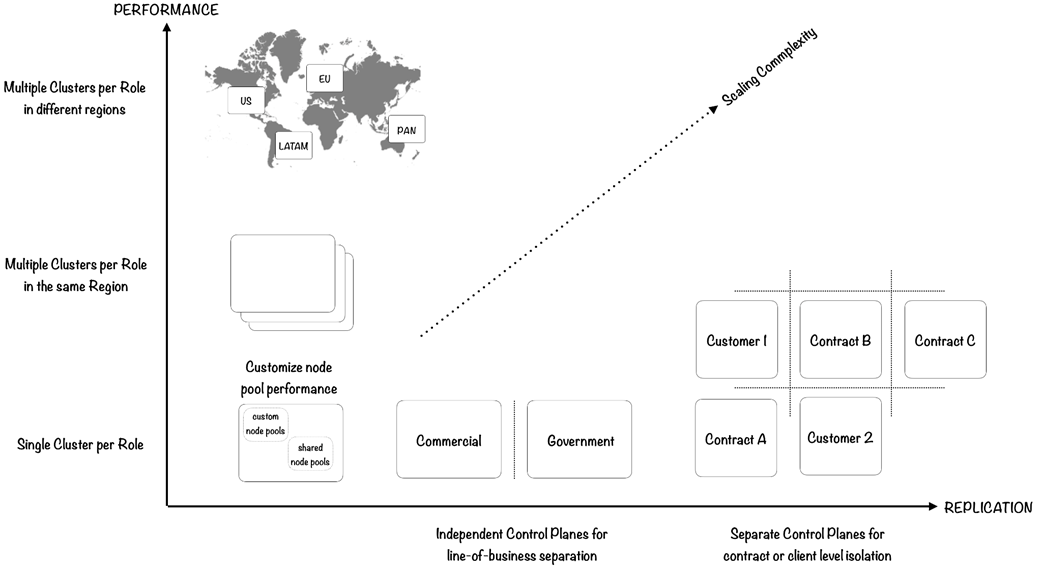
Control plane scaling happens along two general axes. Performance requirements for specific control plane roles will grow, requiring node pool customization capabilities or multiple clusters within a single role. Alternatively, legal requirements or contractual decisions mean that we need multiple isolated instances of the same role.
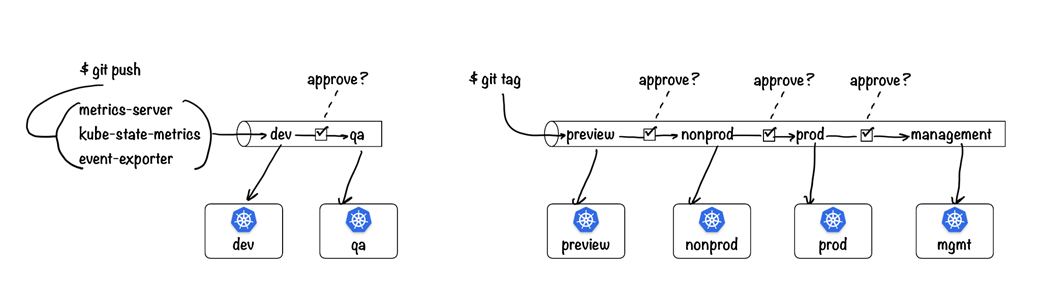
At first, we deploy and test all our Services through a single pipeline. We do the same with Extensions.
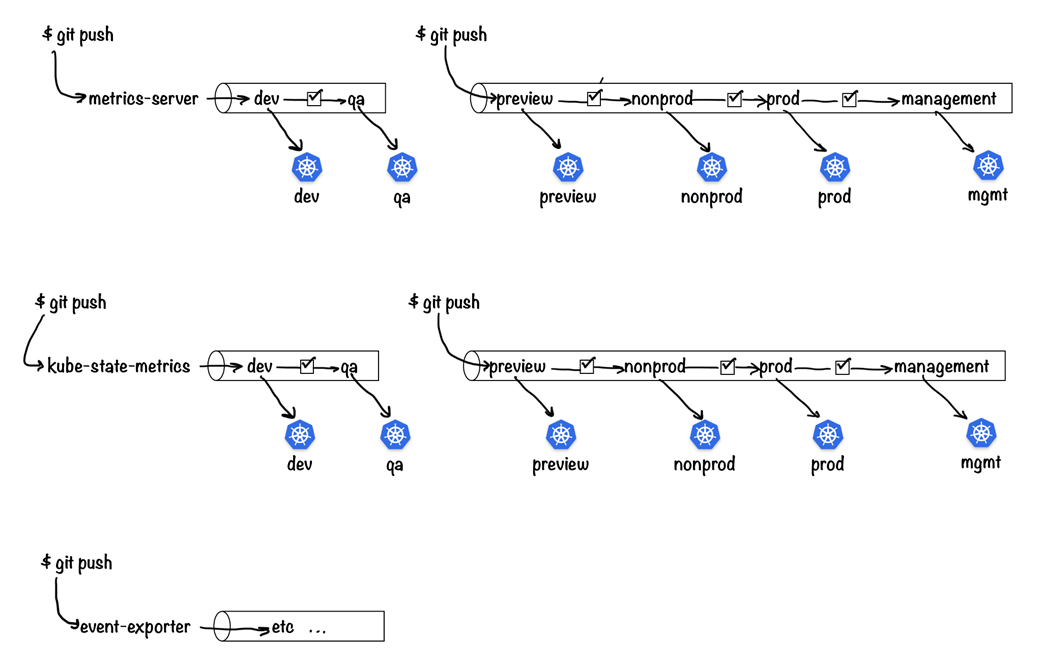
Dedicated software lifecycle pipelines for each service and extension is one of the first modifications we can make to improve the health of our routine operational activities as the scale grows. While necessary, this will aggravate the issues that the scale has created.
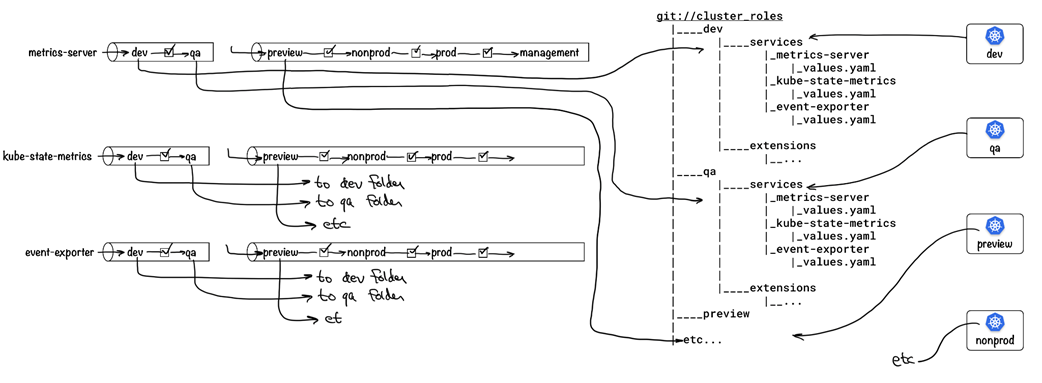
What if we modify our pipeline to make release configuration changes to a code repository rather than performing the deployment? Further, we then deploy a service on each cluster configured to watch for those changes and execute the deployment locally.
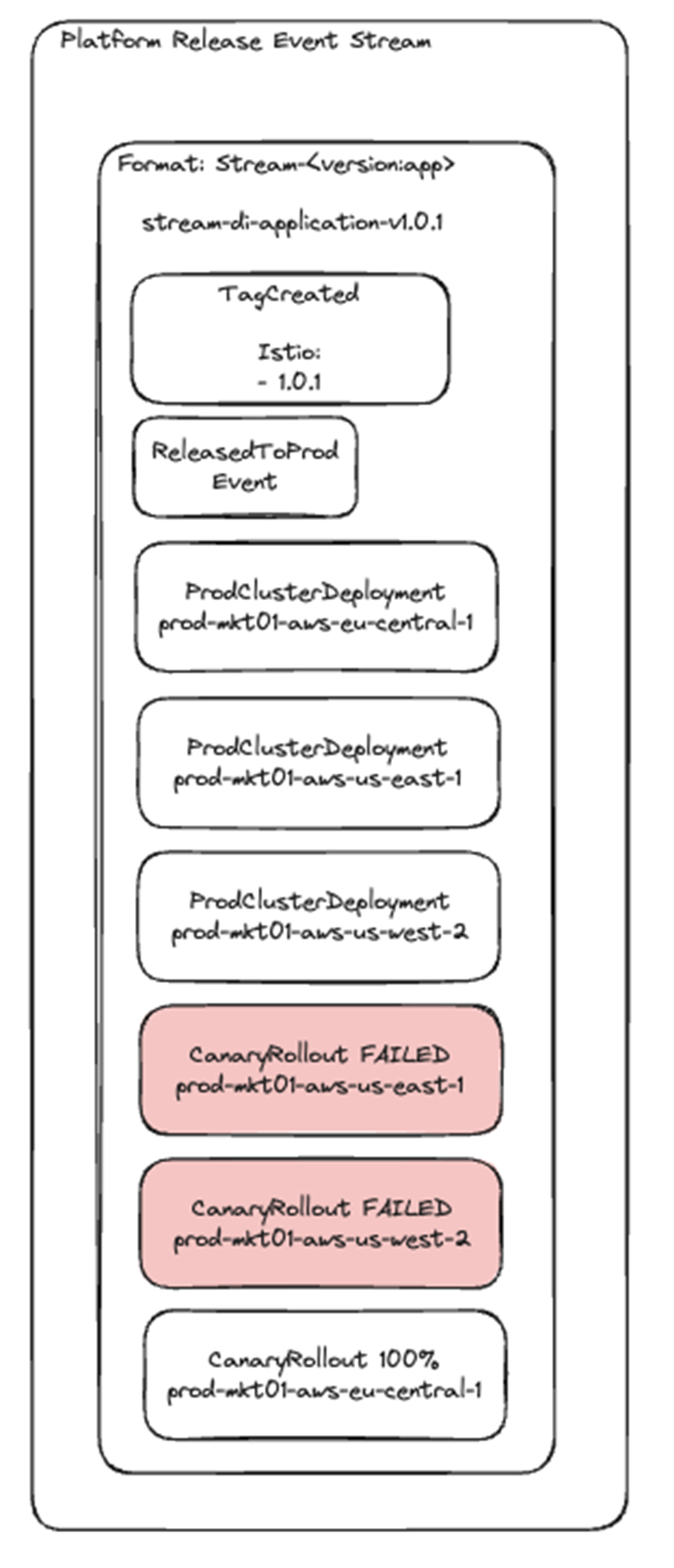
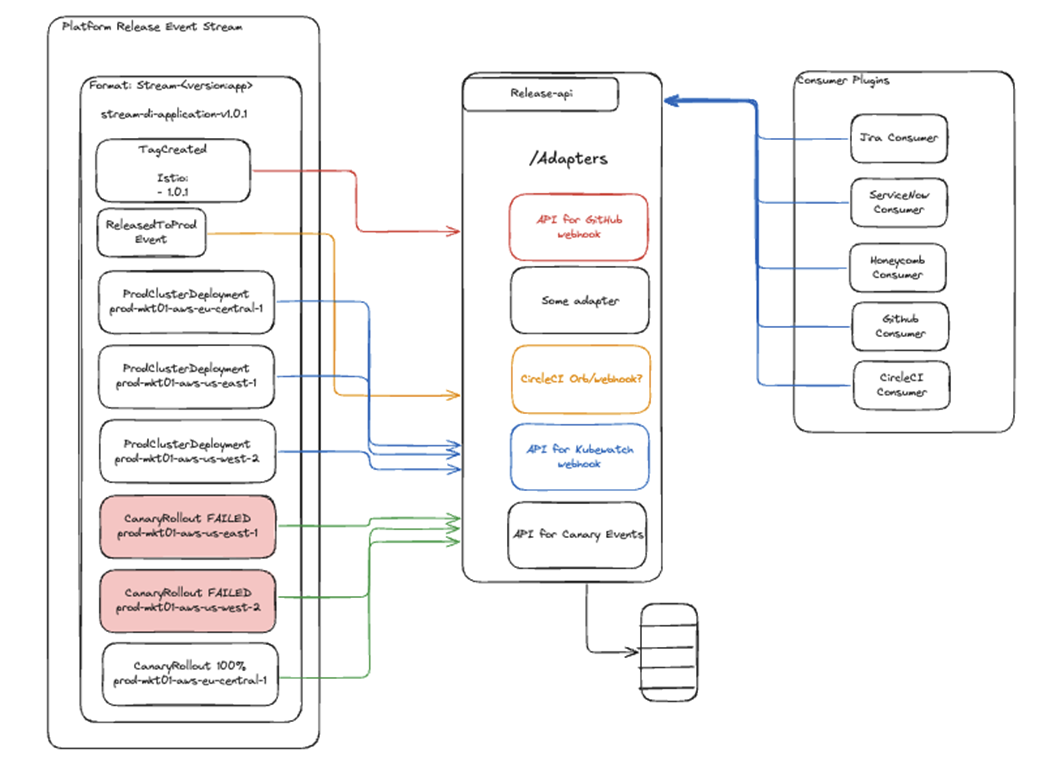
This figure shows a sample of events that represent the rollout of a new version of Istio to our Engineering Platform.
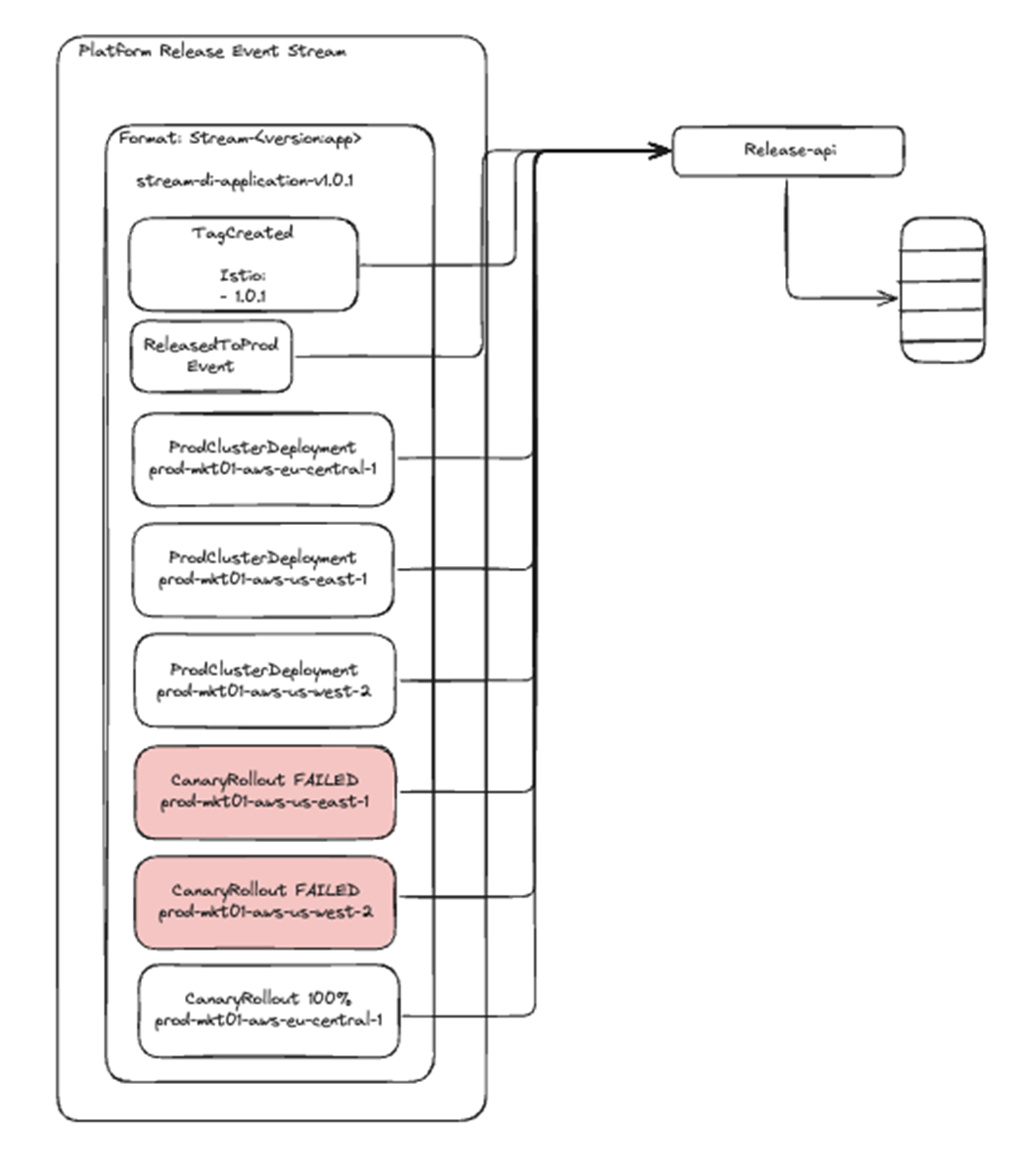
A release-api is proposed to consume the events
To consume the events in our release-api, we’ll need a pattern from the many systems that produce them.
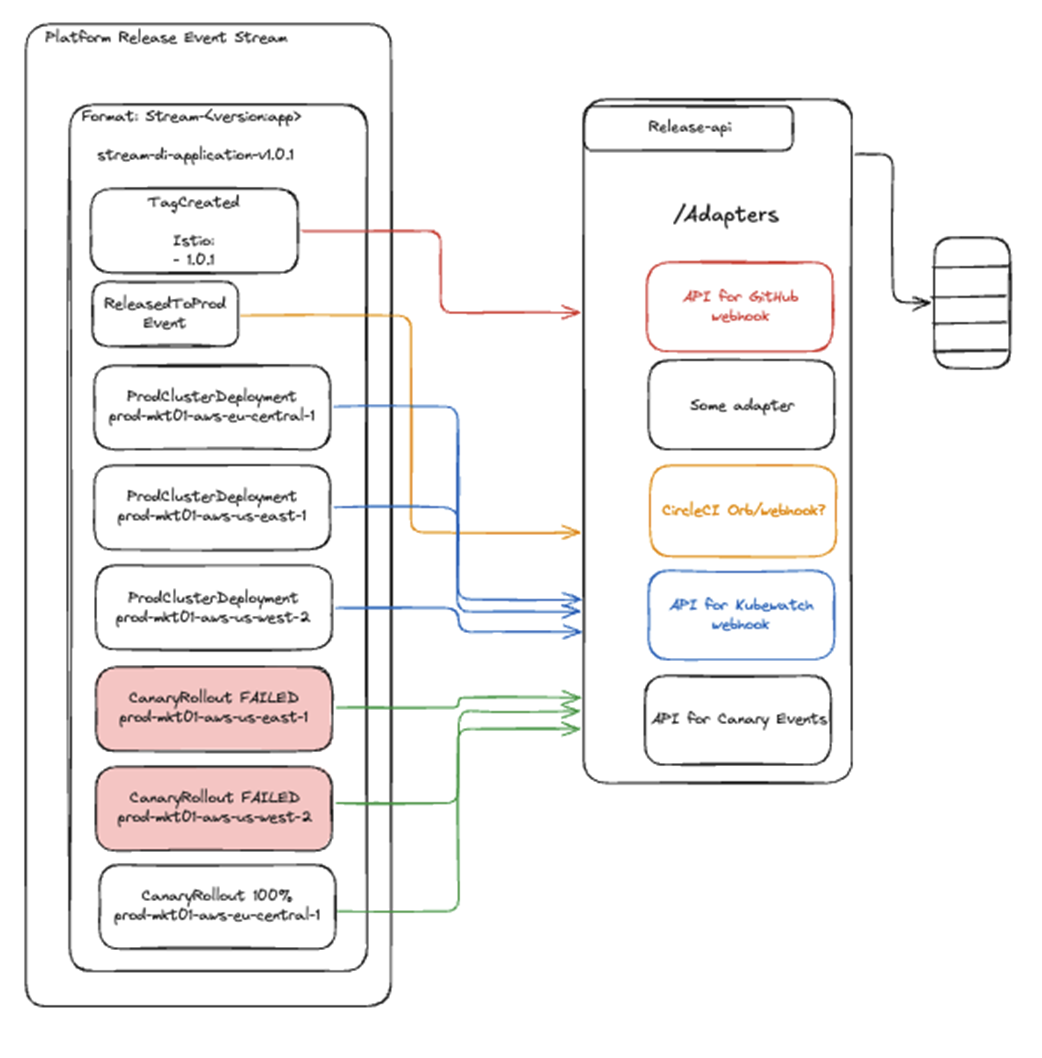
With a consolidated consumption model, consumers can now be developed to talk to the release API and do something with the data. Examples of consumer plugins will be services used for issue tracking, CMDB, source control, and CI/CD.
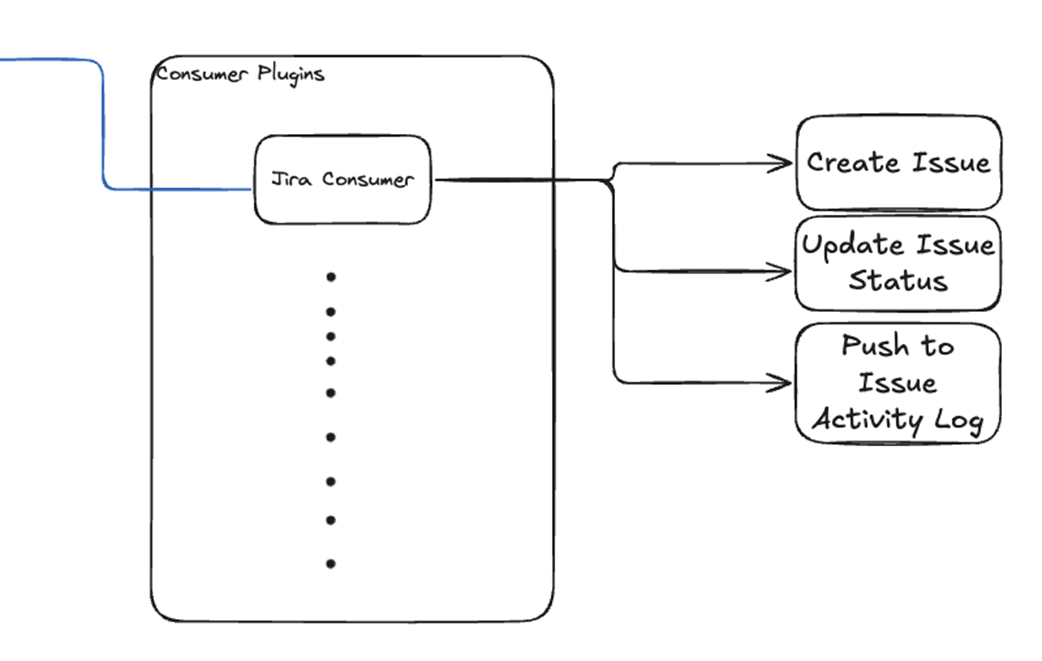
An issue-tracking consumer might create and manage issues in response to specific events.
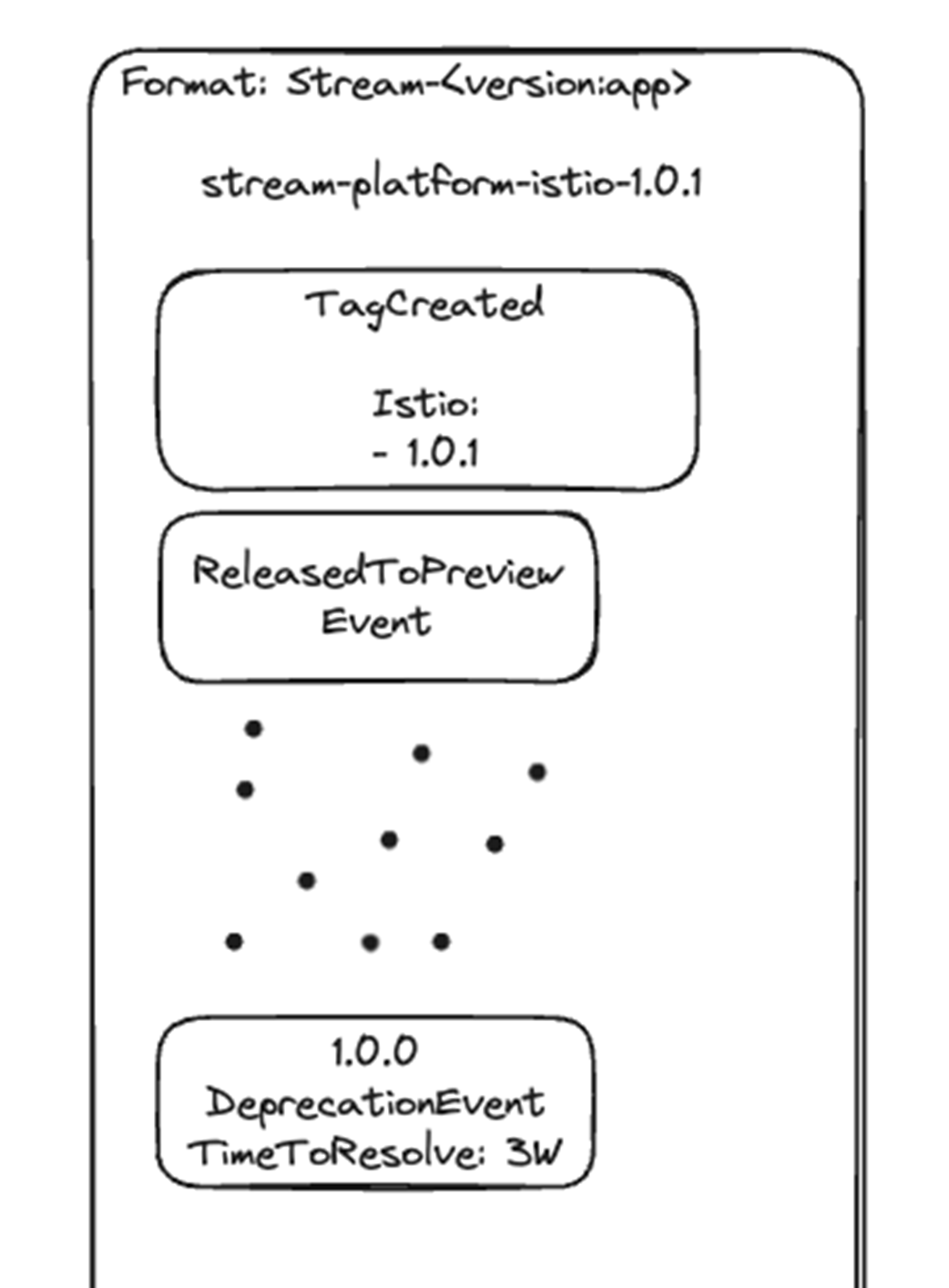
The platform team will continue to publish events regarding the state of the upgrade, including deprecation notices.
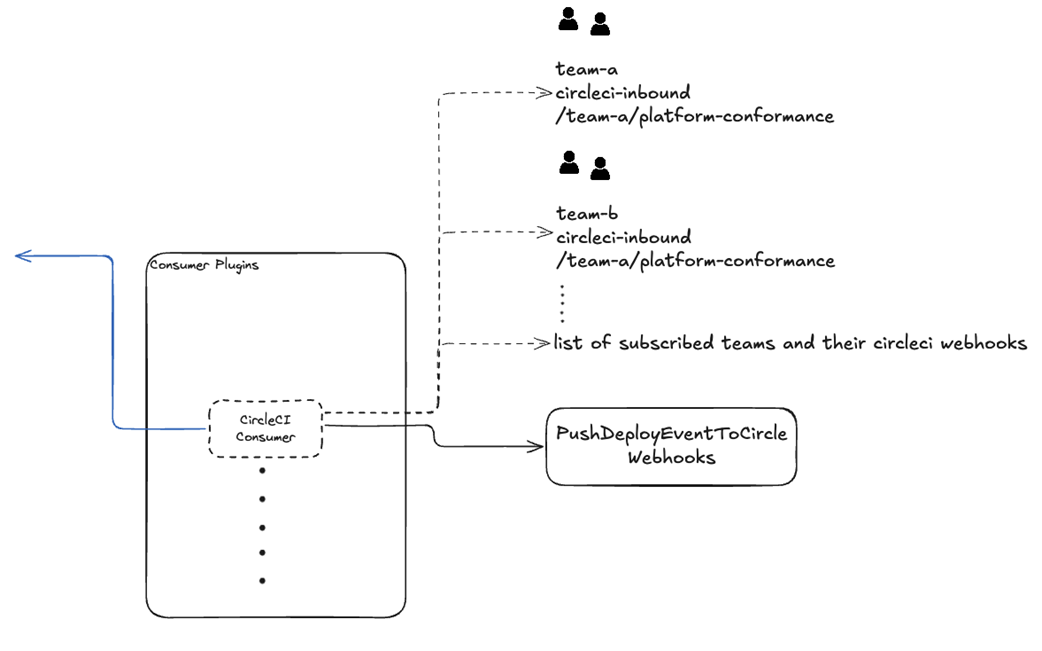
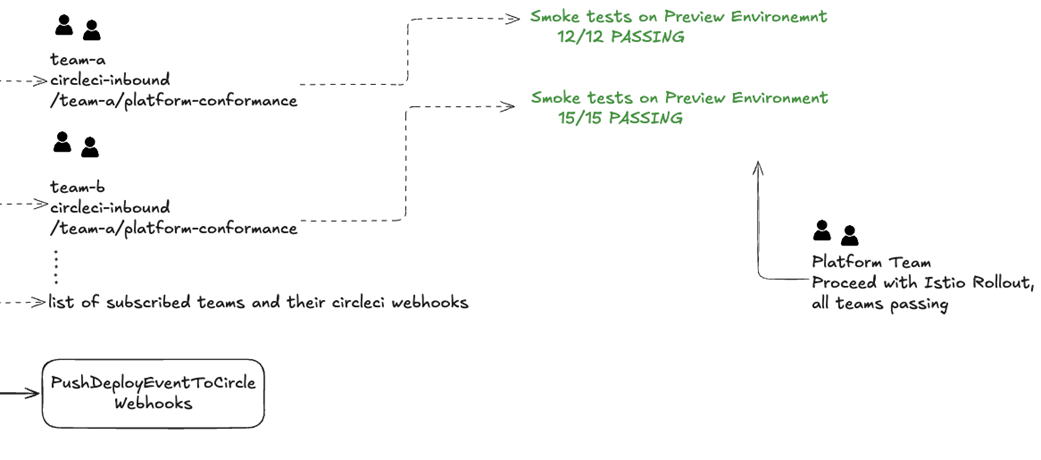
The consumer API can subscribe to specific platform deployment events, and then inbound workflow triggers could be created, allowing a central consumer plugin (e.g., the CircleCI consumer) to trigger and coordinate deployment workflows seamlessly.
The platform team could create a consumer API that watched for the creation of all the Jira upgrade-notice issues and whether they were all auto-closed after successful conformance tests. They could proceed with greater confidence in releasing the changes to production or have a detailed list of the impacted services and the issues found.
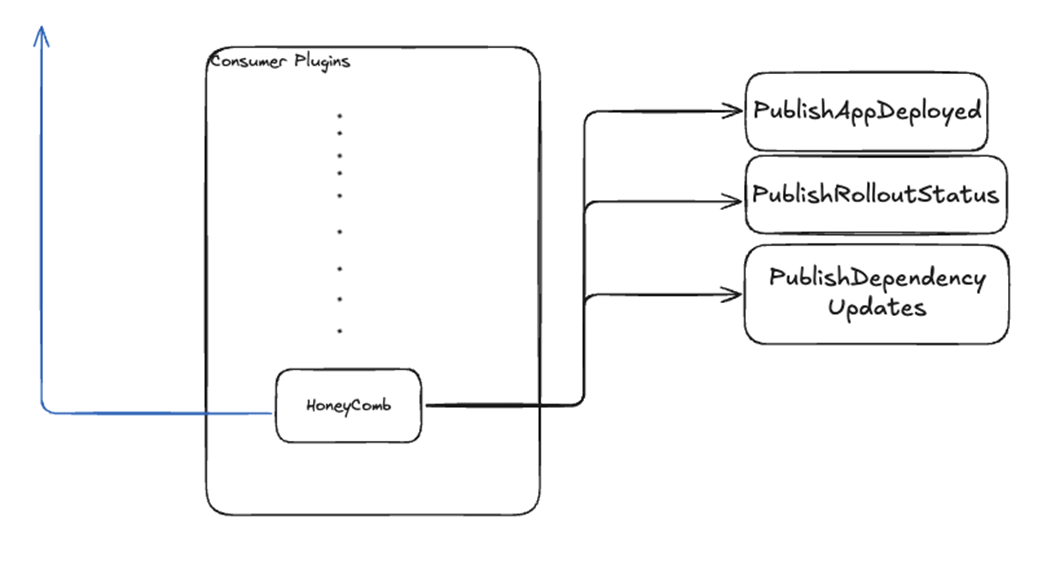
Example of an Observability consumer that pushes deployment events to our metrics platform
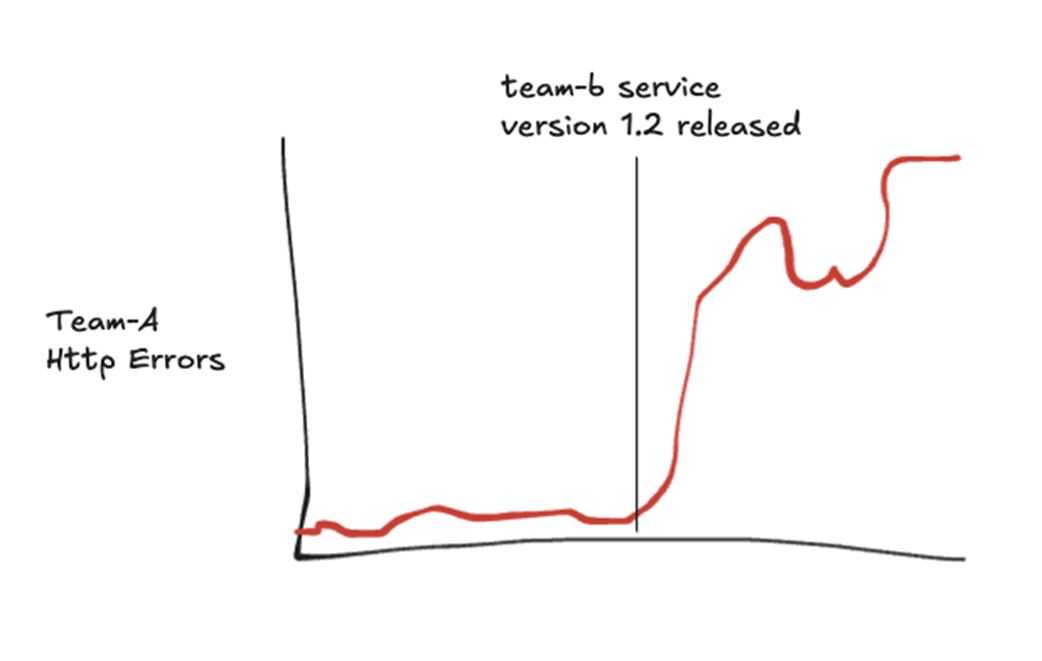
Team-A’s dashboards can show events from internal services on which they depend and make it easier to diagnose remote changes that impact their services.
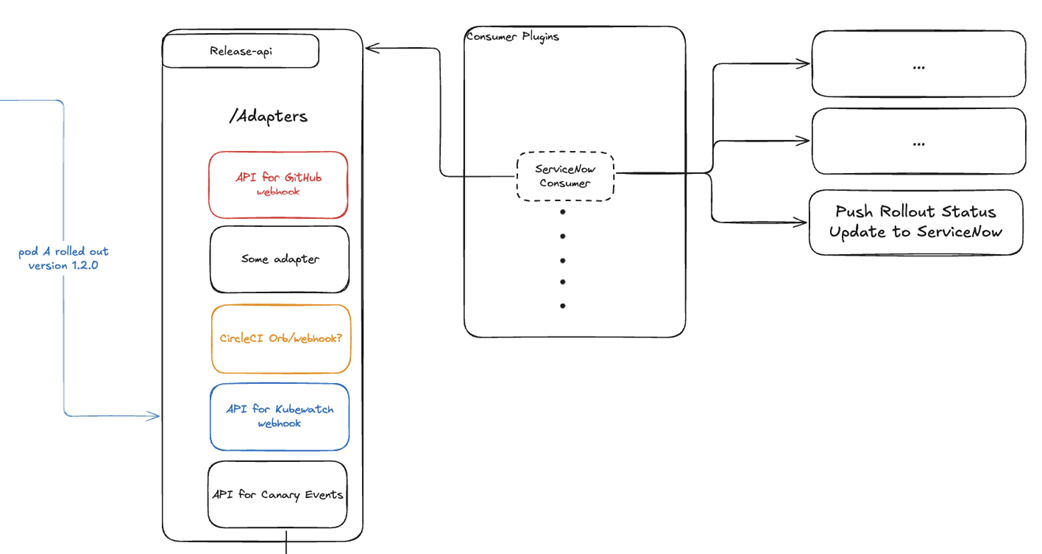
If events are being propagated from our Kubernetes cluster to the release API, then all deployments will generate events. Every single pod event is published. So, when one of the 1.0.1 pods is terminated, that is a unique event. And when one of the 1.2.0 pods successfully deploys and starts taking traffic, that is also an event.
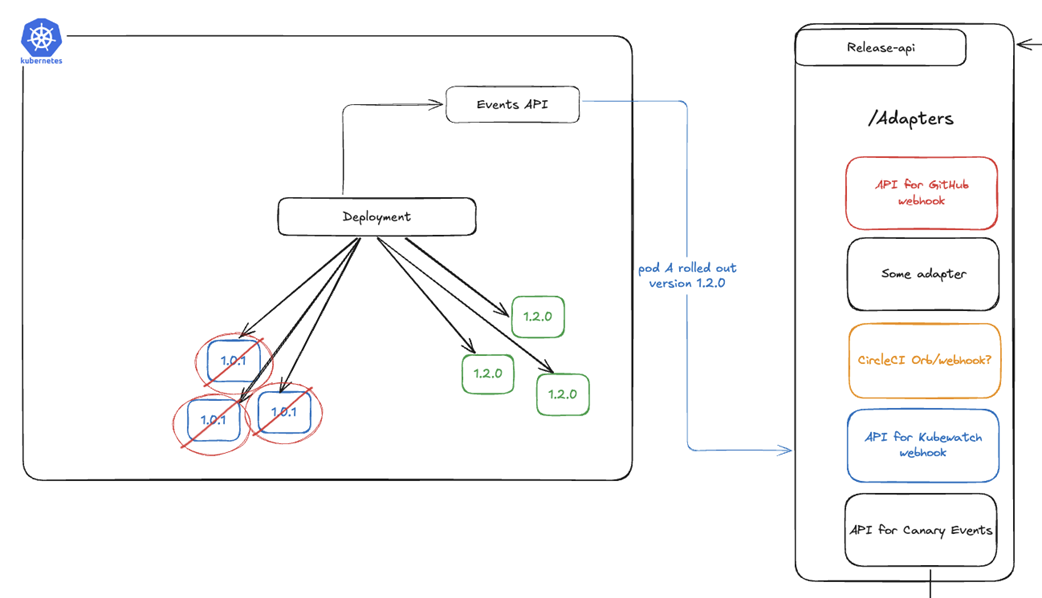
The event for Pod A is sent to the release-api, where our ServiceNow consumer consumes it. Our consumer pushes the update to ServiceNow’s CMDB.
Summary
- Scaling an engineering platform requires intentional architectural changes, not just adding servers.
- Cost assessments, including the cost of delay, are critical to justifying investments in scaling platform capabilities.
- Effective scaling includes aligning platform team structures, roles, and processes to match evolving business needs.
- Establishing domain boundaries and autonomy between teams enables efficient collaboration and scalability.
- Event-driven release architectures enhance reliability and trust by reducing friction between platform and consumer teams.
- Dynamic pipelines that adapt to the number and configuration of clusters improve deployment efficiency at scale.
- Lifecycle pipelines for individual services and extensions improve release quality and remove bottlenecks.
- Distributed deployers at the cluster level reduce centralized orchestration overhead and enable quicker rollouts while reducing blast radius from many kinds of common errors.
- Platform APIs should be the foundation for all capabilities, ensuring seamless integration and extensibility.
- Scaling strategies should prioritize the platform user/consumer experience, reducing wasted time and friction.
- Developer portals like Backstage improve discoverability but must align with API-first principles to avoid creating support burdens.
- Event-driven architectures are a key skill in scaling engineering platforms.
- Adapter patterns standardize data flow across diverse systems, simplifying integration and reducing complexity.
- Observability integrations allow real-time tracking of deployment events, enhancing system visibility and troubleshooting.
- Event-driven notifications ensure platform consumers stay informed about upgrades and deprecations, reducing coordination overhead.
- Integrating release events into CMDBs and audit systems supports compliance while maintaining lightweight, scalable architectures.
FAQ
What does “scaling the engineering platform” mean beyond adding more servers?
It means making intentional architectural, organizational, and process changes that preserve developer velocity and reliability as usage grows. This includes defining clear team and domain boundaries, evolving the control plane topology, adopting distributed delivery patterns, and managing cost and operational complexity as the number of developers, clusters, and services increases.How do we decide when and where to scale first?
Let business priorities drive it. Regulatory or contractual requirements may force earlier isolation (e.g., per line of business or customer), while product goals (e.g., exposing internal APIs to third parties) may push control plane extensions to the top of the queue. Keep one platform product roadmap even when replication is required across business units.What are the two main axes of scaling control plane roles?
- Performance/throughput scale: add node pool customization and/or multiple clusters within a role (possibly per region).- Isolation scale: create multiple isolated instances of the same role to satisfy legal, regulatory, customer, or market segmentation needs.
How should ingress and traffic routing evolve for multi-cluster and multi-region setups?
- Add a global/load-balancing layer in front of cluster ingress.- Use regional strategies (round‑robin, rebalancing, lease/request routing) and geo‑routing across regions.
- Extend self‑serve ingress so developers can deploy the same service version to multiple clusters and shape inter‑cluster traffic.
- Leverage a service mesh for dynamic routing and traffic policy management.
When do static pipelines break down, and how do dynamic release pipelines help?
Once a single orchestration pipeline must manage roughly 20–30+ and growing clusters, hardcoded targets become brittle. Dynamic pipelines generate deploy/test steps at runtime from a global roles-and-clusters definition (often via matrix-style execution), reducing maintenance, errors, and lead time. If your CI tool lacks dynamic generation, use a generator/CLI or move to a “cluster‑engine” that applies CRDs per role instead of per‑cluster steps.How can we scale orchestration for control plane services and extensions across many clusters?
- Give each service/extension its own lifecycle pipeline, but have it update a central, role‑scoped configuration repo rather than deploying to every cluster directly.- Run a lightweight deploy agent (e.g., Flux or Argo CD core) on each cluster to pull desired state and perform local deploys/tests.
- Centralize visibility of deployment status and health via observability tooling, so ops remains coherent while execution is distributed.
What prerequisites and outcomes come with the distributed deploy (GitOps) model?
- Prerequisites: a centralized observability datastore; standardized, role‑scoped deploy configuration; cluster‑local deploy agents; consistent health checks.- Outcomes: faster cumulative deployments, reduced blast radius from failures, and decoupled lifecycles between clusters and administrative services without per‑cluster pipeline edits.
How do we scale identity and permissions like OIDC assumable roles at large scale?
Move from ad hoc Terraform executions in pipelines to an operator-based provisioner. Extensions request roles via custom resources; the operator reconciles and manages lifecycle/updates. This reduces pipeline complexity and simplifies upgrades at scale.What is platform event streaming, and how does a release API help?
Platform event streaming applies event-driven patterns (publish/subscribe, decoupling, async scalability) to platform operations. A release API ingests a normalized event stream (e.g., tags from source control, CI workflow updates, cluster rollout states, canary progress) via adapters per source, then enables consumers to automate coordination, compliance, and insights without tight coupling to any one tool.Which event-driven consumers add the most value, and what do they automate?
- Issue tracking (e.g., Jira): auto-create/triage upgrade tasks per team from deprecation/upgrade events; escalate as deadlines near; close on success.- CI hooks: auto-trigger conformance tests on preview upgrades; gate production readiness on real results.
- Observability: publish deployment/rollout/dependency events to metrics/logs to correlate incidents with changes and speed RCA.
- CMDB/audit (e.g., ServiceNow): update service inventories and versions from deployment events for continuous change tracking and compliance.

 Effective Platform Engineering ebook for free
