9 Creating conversational magic: harnessing context for adaptive virtual assistant experience
This chapter explains how to create adaptive, human-centered virtual assistants by weaving together three pillars: context, modality, and retrieval‑augmented generation (RAG). It argues that assistants deliver “conversational magic” when they understand situational and historical signals, choose the right channel for the moment, and enrich replies with up-to-date knowledge. The result is higher relevance, accuracy, and trust—experiences that feel proactive, personalized, and seamless across devices and interaction styles.
Context is presented as the core driver of personalization, elevating interactions from generic to genuinely helpful. Through examples like Emma’s banking journey, the chapter shows how integrating account data, remembering session and persistent histories, and recognizing cues such as location, time zone, device type, preferences, and behavioral patterns reduces repetition, speeds resolution, and enables proactive assistance. Modality further shapes usability: text favors detail and reviewability; voice demands brevity, clarity, and robust error handling; visual elements can clarify complex steps; and multimodal flows combine strengths to match the user’s situation. Good design adapts tone, pacing, and content to the channel, supports accessibility, and anticipates needs to build consistency, satisfaction, and loyalty.
RAG expands an assistant’s competence by retrieving the right external information and composing contextually rich responses, transforming static scripts into adaptive flows. The chapter contrasts rigid interactions with responsive ones that learn from history, tailor recommendations, and adjust intents in real time—while cautioning that RAG alone may return correct facts without fully meeting user intent. It recommends hybrid architectures that blend RAG with context-aware frameworks, triage simple versus complex queries to balance cost and quality, and continuously update knowledge sources and conversation state. Ongoing monitoring, feedback loops, and dynamic context management keep experiences current, coherent, and scalable as user needs evolve.
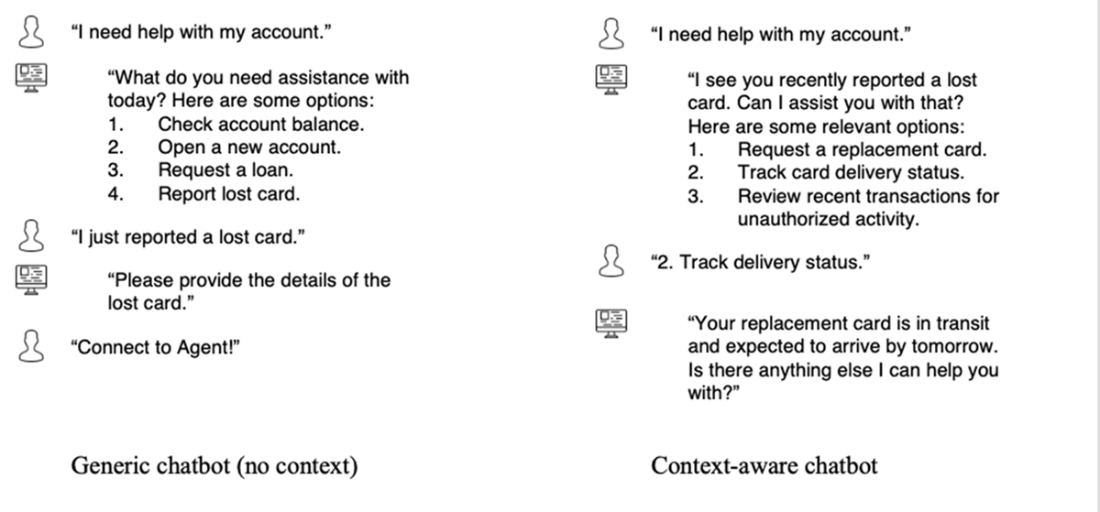
Generic chatbot design does not consider user context but always offers the same options. While context-awareness enhances the overall user experience.
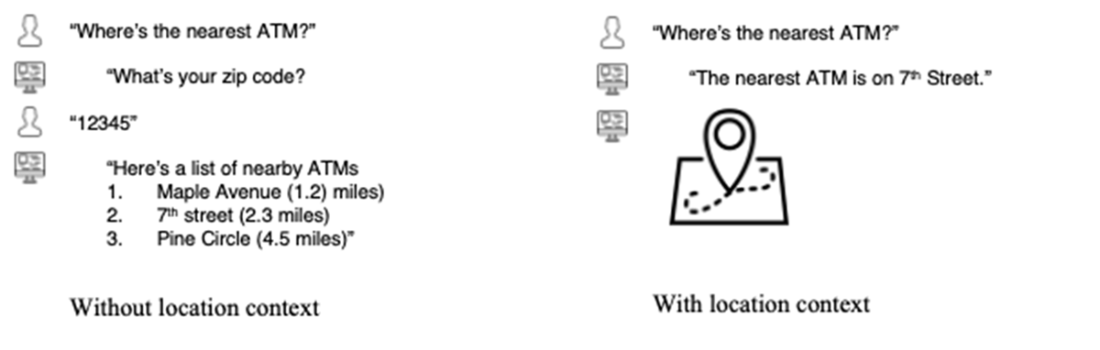
Typical chatbot responses do not consider user location, but when location context is considered, they show the most appropriate response(s).
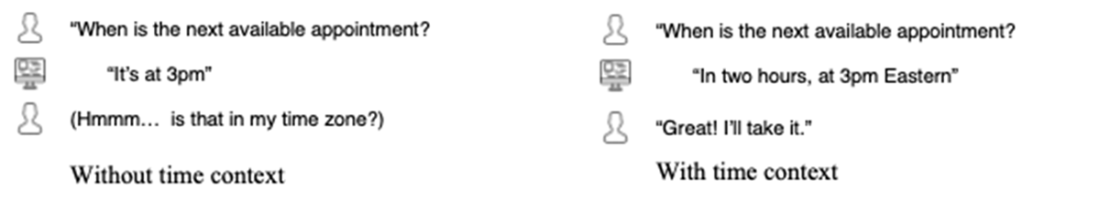
Many chatbot responses do not consider user time zone context. When it is considered, the response is more useful.
Summary
- Understanding and utilizing contextual information such as user location, past interactions, and preferences is crucial for delivering personalized and relevant responses and enhancing overall user satisfaction.
- Designing virtual assistants that effectively handle text, voice, visual, and multimodal interactions ensure a more engaging and versatile user experience. Tailoring the interaction design to the strengths of each modality is key to meeting diverse user needs.
- Combining Retrieval-Augmented Generation (RAG) with adaptive flow design allows virtual assistants to retrieve accurate information and generate contextually appropriate responses. This hybrid approach enhances the assistant's ability to manage both simple and complex queries effectively.
- Implementing robust mechanisms for dynamic context management allows virtual assistants to maintain and update context throughout interactions. This capability is essential for providing coherent, relevant responses and adapting to users' evolving needs in real time.
- Regular monitoring, feedback integration, adaptive learning, and performance optimization are vital for maintaining the accuracy and relevance of adaptive flows. Ensuring RAG responses remain accurate and contextually appropriate as conversations evolve is critical for sustaining high user satisfaction.
FAQ
What does “context” mean in conversational AI, and why does it matter?
Context is the situational and historical data used to tailor interactions (for example, location, time, device, preferences, past interactions). Using context improves relevance and accuracy, enables personalized guidance, speeds up problem solving, supports proactive help (alerts, reminders), and builds trust and loyalty through consistently helpful answers.What are the three pillars of personalization in this chapter, and how do they work together?
- Context: Shapes what to say by using user history, status, and goals.- Modality: Shapes how to say it (text, voice, visual, multimodal) to fit the situation.
- Retrieval-Augmented Generation (RAG): Supplies up-to-date, domain-specific facts to ground responses.
Together, they turn generic chat into adaptive, timely, and accurate assistance.
Which contextual signals should I use, and how do I collect them responsibly?
- Location: Geolocation APIs; obtain consent, store securely, delete when no longer needed.- Time zone: Convert times to the user’s local zone (for reminders, scheduling).
- Device type: Detect via user agent/device APIs to tailor UI and response length.
- Preferences: Let users set channels/formats; store and apply consistently.
- Behavioral patterns: Analyze interaction logs to anticipate needs (e.g., bill reminders).
- Previous interactions: Persist history per user to ensure continuity and reduce repetition.
What’s the difference between session history and persistent user history?
- Session history: The current conversation only; helps with immediate follow-ups and disambiguation. Discarded after the session (but may be logged).- Persistent user history: Spans sessions and modalities; enables deeper personalization and proactive support. It also helps evaluate “true containment” by spotting repeated questions after an answer.
How does modality (text, visual, voice, multimodal) change conversation design?
- Text: Precise, skimmable; good for details and references. Add autosuggestions and concise responses.- Visual: Buttons, images, carousels, video; clarifies complex steps (setup/tutorials). Requires clean, responsive UI.
- Voice: Hands-free, natural; prioritize brevity, error handling, and clarity; handle noise/accents.
- Multimodal: Combine strengths (e.g., voice to gather info, visuals to compare options). Choose modality by task and context.
What pain points arise when assistants ignore context or modality, and how can I fix them?
Common issues: generic advice, no account linkage, repeated stock responses, single-channel limitations. Fixes: integrate account data (with consent), use context-aware advice and adaptive intents, personalize based on history and goals, and pick the right modality per task (chat for recommendations, email for reports, notifications for quick updates).What are the top design principles for effective voice bots?
- Provide incremental steps and confirmations.- Design robust error handling (clarify, re-prompt, simplify).
- Adapt response timing and speaking pace.
- Confirm before impactful actions.
- Support varied speech patterns (accents, dialects) and offer multimodal handoffs (e.g., send a map or video).

 Effective Conversational AI ebook for free
