6 Enhancing responses with retrieval augmented generation (RAG)
This chapter tackles the “chatbot doesn’t understand me” problem by moving beyond brittle, intent-only designs. Intents work well for the common “short head” of questions but struggle with the long tail of varied, nuanced requests and are costly to maintain. The chapter introduces search and, especially, retrieval-augmented generation (RAG) as practical ways to expand coverage without continuously adding intents. Unlike traditional search that returns links or snippets, RAG retrieves relevant passages and synthesizes a cohesive, grounded answer, letting teams update knowledge by editing documents rather than retraining intent logic—improving both developer efficiency and user experience.
RAG combines retrieval (keyword, semantic, or vector search) with generation to produce answers grounded in trusted sources, complementing intent flows via confidence thresholds. Benefits include higher relevance, adaptability to user tone and context, localization, and up-to-date answers driven by the underlying content. The approach also mitigates hallucinations by grounding and can explicitly defer when evidence is weak—offering “I don’t know” or handing off to a human agent. The chapter cautions against using an LLM alone (stale knowledge, poor traceability, hallucinations) and shows how RAG keeps scope defined, answers explainable, and conversations smoother. RAG can be combined with other genAI capabilities (e.g., sentiment, translation) and with transactional actions to complete tasks after informational answers.
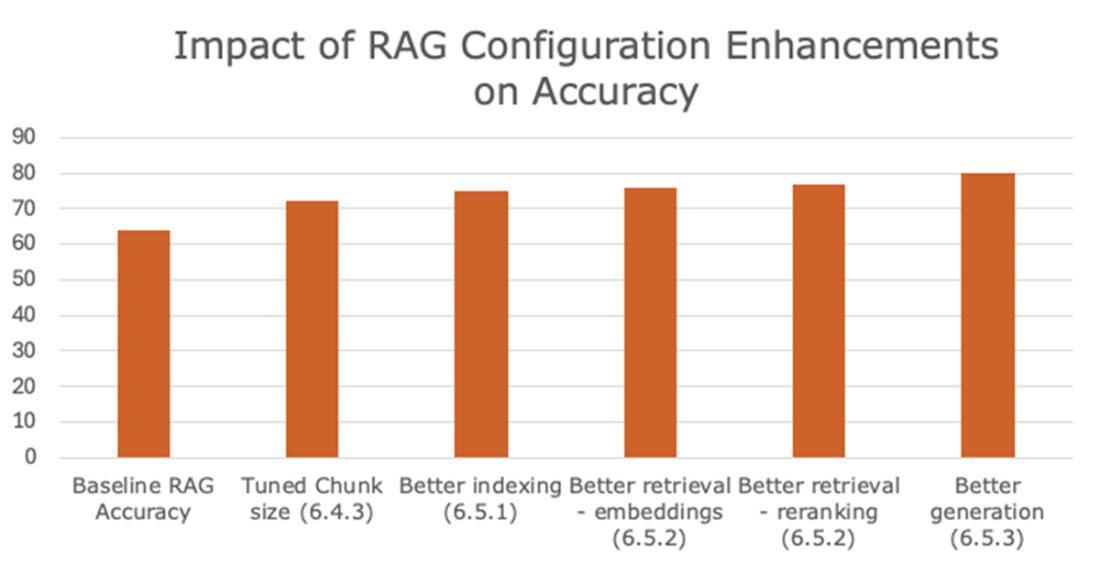
Implementation guidance covers preparing a robust ingestion pipeline (document extraction, structure preservation, chunking strategies, embeddings), indexing in vector databases, and hybrid retrieval options. Practical considerations include prompt design, re-ranking, latency management (efficient vector stores, streaming, caching), and clear fallback policies. Evaluation spans three layers: indexing (throughput, scalability, recall of stored vectors), retrieval (precision/recall, nDCG, context precision/recall, parameter tuning, filtering), and generation (faithfulness to sources, answer relevance, fine-tuning, model blending, SSA, hallucination checks). The chapter emphasizes benchmarking and continuous monitoring—expecting initial accuracy around 50–60% and iteratively optimizing toward 80%+—to select the right RAG techniques for business goals and sustain reliable, grounded conversational performance.
An intent-based chatbot first detects an intent and then maps it to an answer.
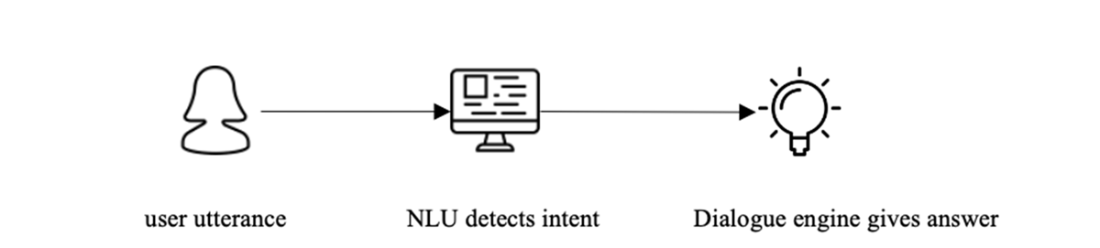
Intent-based systems identify the main theme of an utterance and often give a static or generic answer.

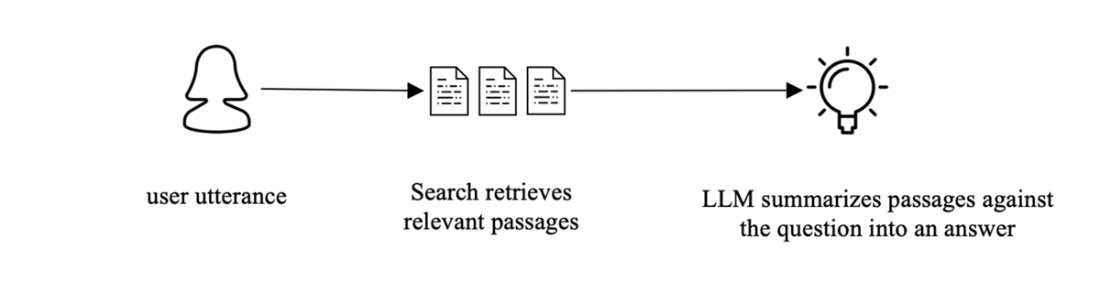
Retrieval-augmented generation finds relevant passages and summarizes them, giving a targeted answer.

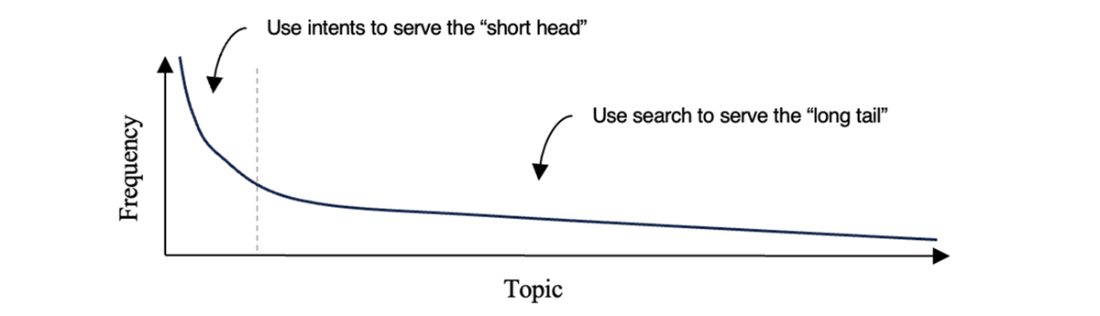
Distribution of user questions. Intents address the most common, high-volume questions, while low-volume, unique questions may necessitate search integration.
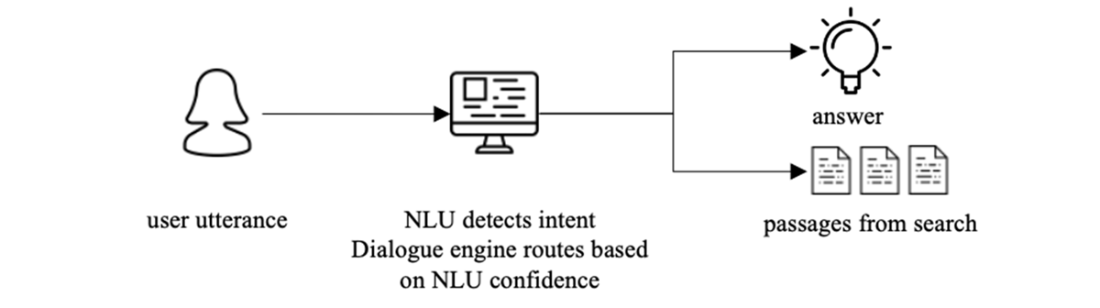
Search finds relevant passages and displays those directly to the user, often with links to the source documents.

Intents and searches have complementary functions. A search-augmented bot uses intent-based answers when it recognizes the utterance with high confidence, else it defers to search.Using intents and search together improves chatbot capabilities. However, this approach still has some limitations.
RAG retrieves relevant passages and then augments by generating an answer grounded in those passages.
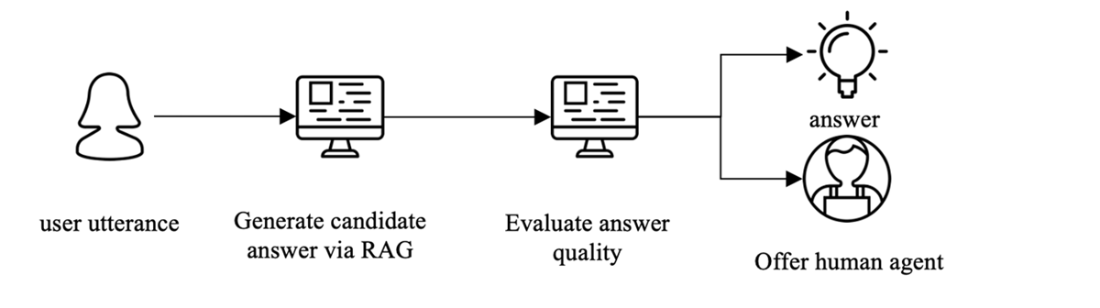
Supplementing RAG with human agents. If the answer has poor semantic overlap with the retrieved documents, send the user to a human agent instead..
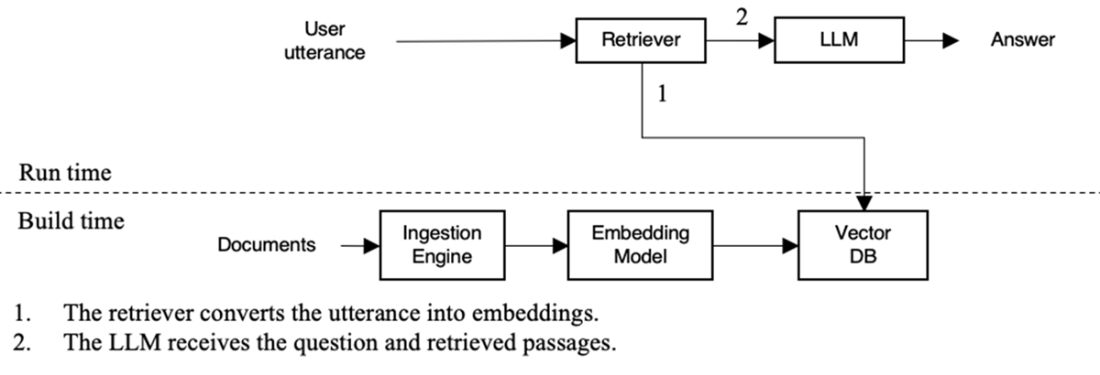
RAG uses a vector database during build time and runtime.
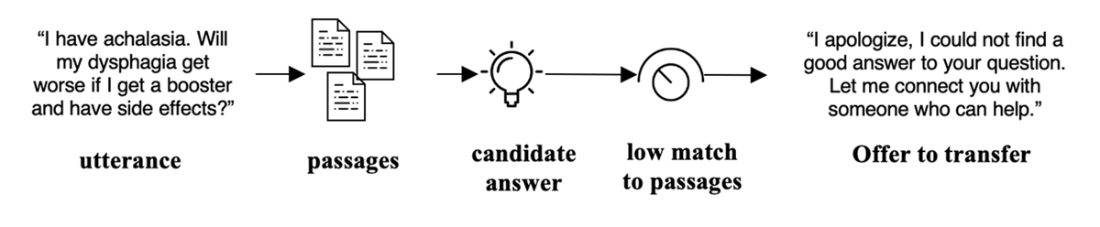
When the answer from RAG does not match the retrieved passages, it can be better to offer a human agent instead.
Different configurations and enhancements improve the accuracy of the RAG system.
Summary
- Traditional intent-based chatbots can be greatly enhanced by integrating search functionality.
- Intents are great for answering common “short-head” questions, and search is great for the “long-tail”.
- Traditional search returns links or document passages instead of an answer.
- RAG extends search capability by generating an answer from the documents retrieved by the search.
- By leveraging RAG, chatbots can provide contextually appropriate responses in real-time, reducing user frustration and enhancing the conversational experience. Grounding answers in the organization’s domain also solves intent maintenance and enhancement for developers.
- RAG implementations must consider several issues, from latency handling to providing fallback mechanisms or handover to human agents to prevent hallucinations.
- Evaluation of RAG must consider the different components of indexing, retrieval, and generation.
FAQ
What is Retrieval-Augmented Generation (RAG), and why use it for chatbots?
RAG retrieves relevant passages from your knowledge sources and then uses a generative model to synthesize a cohesive, conversational answer grounded in those passages. Unlike intent-only bots (fixed answers) or traditional search (links/snippets), RAG handles long-tail, nuanced questions, reduces user effort, keeps answers current by updating documents instead of code, and lowers hallucination risk by grounding responses in your content.
When should I use intents, traditional search, or RAG?
Use intents for the “short head” of common, high-volume questions your NLU recognizes with high confidence. If confidence is low, fall back to retrieval: traditional search returns links/snippets for users to review, while RAG goes further by generating a grounded answer from those passages. Many teams route via an NLU confidence threshold: high → intent answer; else → search/RAG.
How does a typical RAG flow work end to end?
1) User asks a question. 2) NLU checks confidence; if low, route to retrieval. 3) Retrieve and rank passages from trusted sources (keyword, semantic, or vector search). 4) Send the original question plus retrieved context to an LLM to generate a concise, grounded answer (and optionally re-rank). 5) Return the answer (and optional citations) to the user.
What are the benefits and drawbacks of traditional search in chatbots?
Benefits: broad coverage across a document repository, easy maintenance by updating documents, mature technology, and reasonable speed. Drawbacks: keyword brittleness (missed nuance), limited chat window real estate, disruptive link-outs, poor voice UX, and most importantly—no single cohesive answer; users must assemble it themselves.
How do I prepare and index my content for RAG?
Preprocess documents (e.g., convert PDFs to text, add metadata), then chunk content into semantically coherent pieces. Embed chunks using an embedding model and store them in a vector database. At runtime, embed the user query and retrieve the most similar chunks to ground answer generation. Note: RAG can also be built with non-embedding retrieval (e.g., Lucene/SQL) plus generation.
How does RAG reduce hallucinations, and when should the bot hand off to a human?
RAG grounds answers in retrieved passages, which inherently reduces hallucinations. You can compare the generated answer to the retrieved context; if the overlap is low or no relevant documents were found, avoid answering—say “I don’t know” or transfer to a human agent. This maintains trust and prevents misleading responses.
Why not just send the user’s question to an LLM without retrieval?
LLMs trained on internet-scale data can be outdated, lack your private or domain-specific knowledge, and are hard to trace to sources—leading to potential hallucinations. RAG keeps answers current by retrieving from your latest documents, provides traceability to sources, and constrains generation to your domain, improving accuracy and trust.
How can I keep answers current, relevant, and trustworthy with RAG?
Keep your knowledge sources fresh—RAG reflects updates immediately via retrieval. Ground answers in specific passages (with optional links) for transparency. Define domain boundaries so the system can appropriately say “I don’t know” when content is missing, and differentiate between “I don’t understand” vs. “I can’t find an answer in our resources.”
How do I manage latency in a RAG-based chatbot?
Select an efficient vector store (e.g., FAISS, Chroma, Milvus, Pinecone, Weaviate; or Elasticsearch with vector search), curate and deduplicate content, and stream LLM tokens so users see answers forming. Inform users before slow actions, and consider caching recent vectors and conversations to reduce repeated computation.
How do I evaluate and improve a RAG system?
Measure: indexing (e.g., vector DB performance, recall rate), retrieval (precision, recall, context precision/recall, nDCG), generation (faithfulness, answer relevancy, SSA), plus latency/throughput aligned to business goals. Benchmark embeddings and indexes on representative queries, tune parameters, apply filtering/re-ranking, and use tools (e.g., ANN-Benchmark, VectorDBBench, RAGAS, or Arize) with periodic re-evaluation to push accuracy beyond 80%.

 Effective Conversational AI ebook for free
