Process-oriented chatbots often become overly complex as teams try to satisfy every stakeholder and edge case, which burdens users and increases failure rates. This chapter shows how generative AI can reduce that complexity: it helps design leaner process flows, replaces rigid disambiguation branches with LLM judgments when appropriate, and accelerates iteration by quickly proposing, critiquing, and refining alternatives. The outcome is simpler experiences that collect only what’s essential, minimize steps, and improve task completion.
At build time, LLMs can draft end-to-end dialogue flows and rationales from concise prompts, but their outputs are sensitive to prompt wording and formatting, so designers should compare variants and validate with subject matter experts. Generative AI can also streamline slot-filling by removing low-value questions and combining inputs when safe, while still accepting partial answers. At run time, teams can let an LLM decide the next question or even choose a target entity (for example, selecting the correct account from context) to avoid disambiguation dialogues. Because this trades control for speed, the chapter emphasizes guardrails: pre-classify inputs, define opt-outs and error handling, and separate LLM judgments from API execution so the model furnishes only safe parameters.
For testing, the chapter inverts the pattern and uses an LLM as the “user” to probe static flows. A lightweight harness feeds scenario guidance and the live transcript to generate realistic and diverse user inputs, then alternates calls between the LLM and the bot to surface gaps, brittleness, and unforeseen paths. Sampling-based decoding increases variety, and explicit boundaries prevent hallucinated test data. Across design, execution, and testing, the guidance is to balance flexibility with safety, apply LLMs where their reasoning removes complexity, and rely on thorough validation before production.
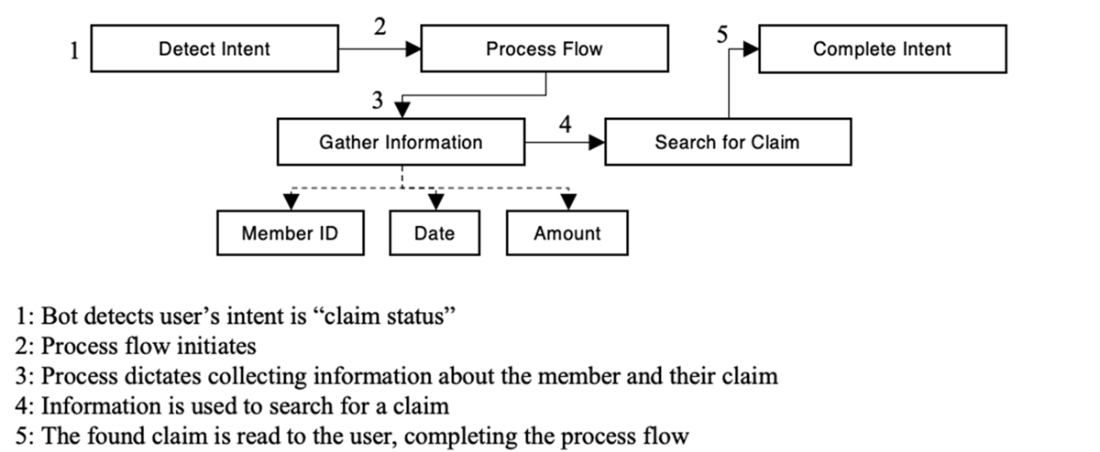
High-level view of a process flow. They are initiated by recognition of a specific intent, include one or more sequential steps, ending with completion of the process flow (satisfying the intent).
Visualizing a claims status process flow.
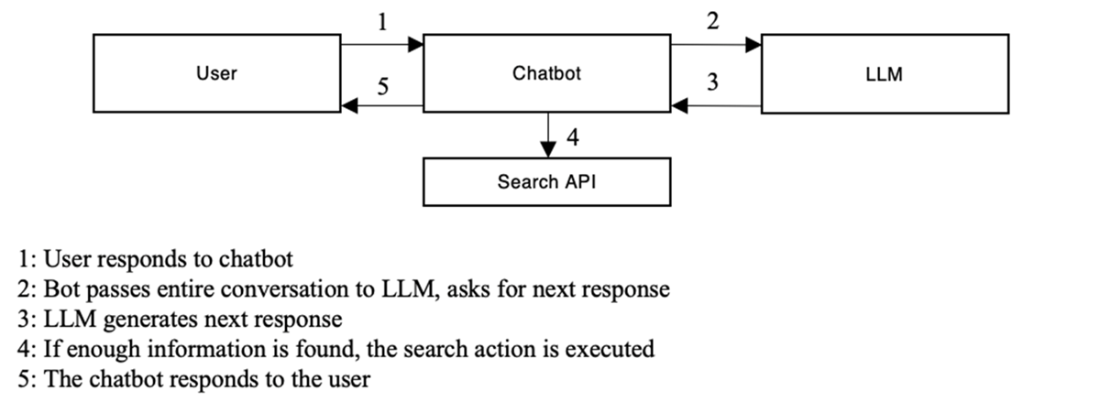
How a conversational AI can use LLM to decide what question to ask next.
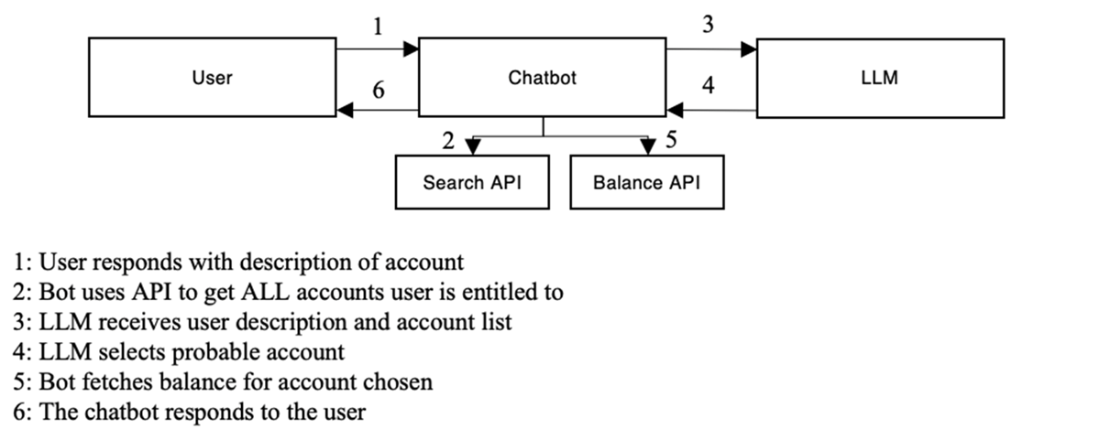
Using LLM to handle user responses.
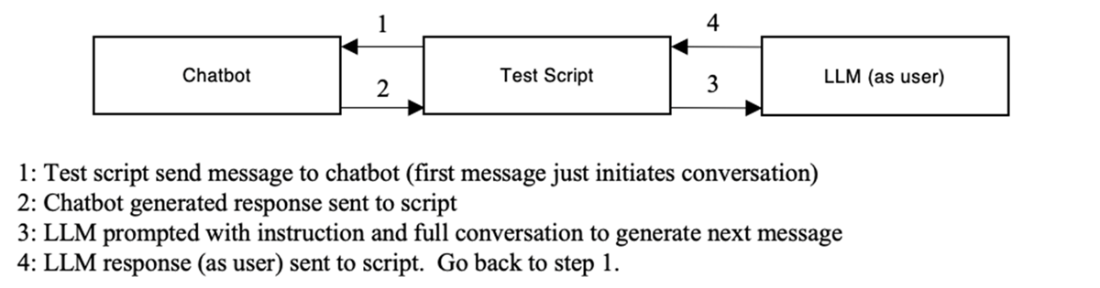
Flow diagram of how test script invokes an LLM as a "user" of the chatbot.
Summary
LLMs can design a process flow for you from scratch. With a little prompting, they can generate example conversational flows and justify their design choices. This process flow can then be implemented in traditional conversational AI.
LLMs can also take an existing process flow and improve it. A typical improvement is simplifying the process flow.
You can use generative AI to execute an entire conversation. There is a tradeoff between implementation speed and control. This is especially noticeable on error paths.
You can replace some “slot-filling” process flows with an LLM judgement. This can be much more flexible than strictly matching to API parameters.
Considering the cost of being wrong when letting LLMs make judgments. Look for cases where “mistakes” are not critical. Be careful which APIs the LLM is allowed to influence.
LLMs can simulate users of your conversational AI. Use them to generate test conversations that show how your system may behave in certain scenarios.
FAQ
What does “reducing complexity with generative AI” mean in this chapter?It means using LLMs to design, streamline, and test conversational process flows so users face fewer steps and less friction. The chapter shows how to simplify slot-filling, replace some disambiguation logic with LLM judgment, and use an LLM as a test “user” to uncover issues early.How can I use an LLM to design a dialogue/process flow from scratch?Provide the model with: 1) scenario/background (what the bot does and what data exists), 2) clear instructions and constraints (brief, easy, goal-focused), and 3) an output cue. The model can draft end-to-end flows, often with rationale, that you can adapt and implement.Why do small prompt changes (like extra new-lines) cause big differences?LLMs are sensitive to formatting and structure. Minor changes can shift how they parse instructions, leading to different flow structures (e.g., interleaved rationale, confirmation steps). Mitigate by versioning prompts, testing variants, and locking in formats that yield consistent outputs.How do I simplify a slot-filling flow like “claim status”?Ask for fewer inputs (e.g., member ID + claim date, dropping claim amount) and, when appropriate, accept multiple fields in one turn. Ensure the bot still handles users who only provide one piece at a time and avoid making combined input a strict requirement.When should I trust LLM suggestions vs consult subject matter experts (SMEs)?Use LLMs to ideate quickly and generate alternatives; rely on SMEs before production to validate requirements, compliance, and edge cases. LLMs accelerate exploration; SMEs ensure feasibility, safety, and alignment with policy.What are the risks of letting an LLM drive turn-by-turn questioning at run time?Common issues include repetitive questions, weak error handling when users don’t know answers, and endless loops. Add guardrails: explicit opt-outs, max turns, “I don’t know” handling, clearer instructions, and handoff back to deterministic logic when enough data is gathered.How can I safely replace disambiguation flows with an LLM judgment?Let the LLM choose a safe, limited variable (e.g., which account ID among the user’s own accounts), but keep the actual API call deterministic. This separation limits the impact of hallucinations and keeps sensitive parameters (like user IDs) out of the model’s control.Is using an LLM to pick an account like retrieval-augmented generation (RAG)?It’s similar. You provide structured data as textual context (passages) and ask the LLM to reason over it. Purists may not call it RAG, but the pattern is comparable and useful—especially when choices are few and stakes are low.How do I test my chatbot with an LLLM acting as the user?Create a prompt that: 1) instructs the model to behave as the user, 2) adds scenario-specific guidance (what the user knows/doesn’t), and 3) includes the live transcript. A harness then alternates: send LLM “user” reply to the bot, append the bot response, and repeat. Use sampling to generate varied inputs.What practical best practices does the chapter recommend?- Structure prompts with background, instructions, and an output cue
- Add guardrails (pre-classifiers, validation, max turns, opt-outs)
- Separate LLM judgment from API execution
- Handle ambiguity (default choices, or sentinel values like “n/a”)
- Test widely, including LLM-as-user scenarios, and iterate with SMEs
pro $24.99 per month
access to all Manning books, MEAPs, liveVideos, liveProjects, and audiobooks!


 Effective Conversational AI ebook for free
