3 End-to-end Transformer Fine Tuning
This chapter presents an end-to-end example of adapting a very small GPT-like language model to a narrow generative coding task: producing Manim Python code from natural-language instructions. It uses GPT-2 small as the baseline to show that even a limited model can acquire useful domain expertise when trained on a curated, task-specific dataset. The workflow begins with preparing the manim_python dataset, which pairs English instructions with corresponding Manim implementations, then formatting each example into an instruction/output text pattern, tokenizing it, padding and truncating sequences, and setting labels for causal language modeling.
The fine-tuning process relies on Hugging Face Transformers and includes automated hyperparameter search with Optuna. A fresh GPT-2 model is initialized for each trial, training arguments are configured for checkpointing, evaluation, logging, mixed precision, and best-model selection, and part of the training split is reserved for validation. The search space includes learning rate, batch size, weight decay, number of epochs, warmup steps, and gradient accumulation. After selecting the best run by minimizing evaluation loss, the model is retrained with the chosen hyperparameters and saved with its tokenizer for later testing and generation.
The chapter then explains how to test and evaluate the fine-tuned model by generating Manim code for held-out prompts and storing results for analysis. Example outputs show that the model often captures the intended structure and API usage but may produce minor hallucinations, such as extra invalid lines or incorrect numeric arguments. Because generic text metrics are not sufficient for code-generation quality in a specialized domain, the chapter proposes domain-specific evaluation steps: Python syntax checking, static analysis of Manim imports and scene structure, execution through the Manim CLI, and optional rendering-based comparison. It also emphasizes safe evaluation practices, including sandboxing, timeouts, and resource limits when running generated code.
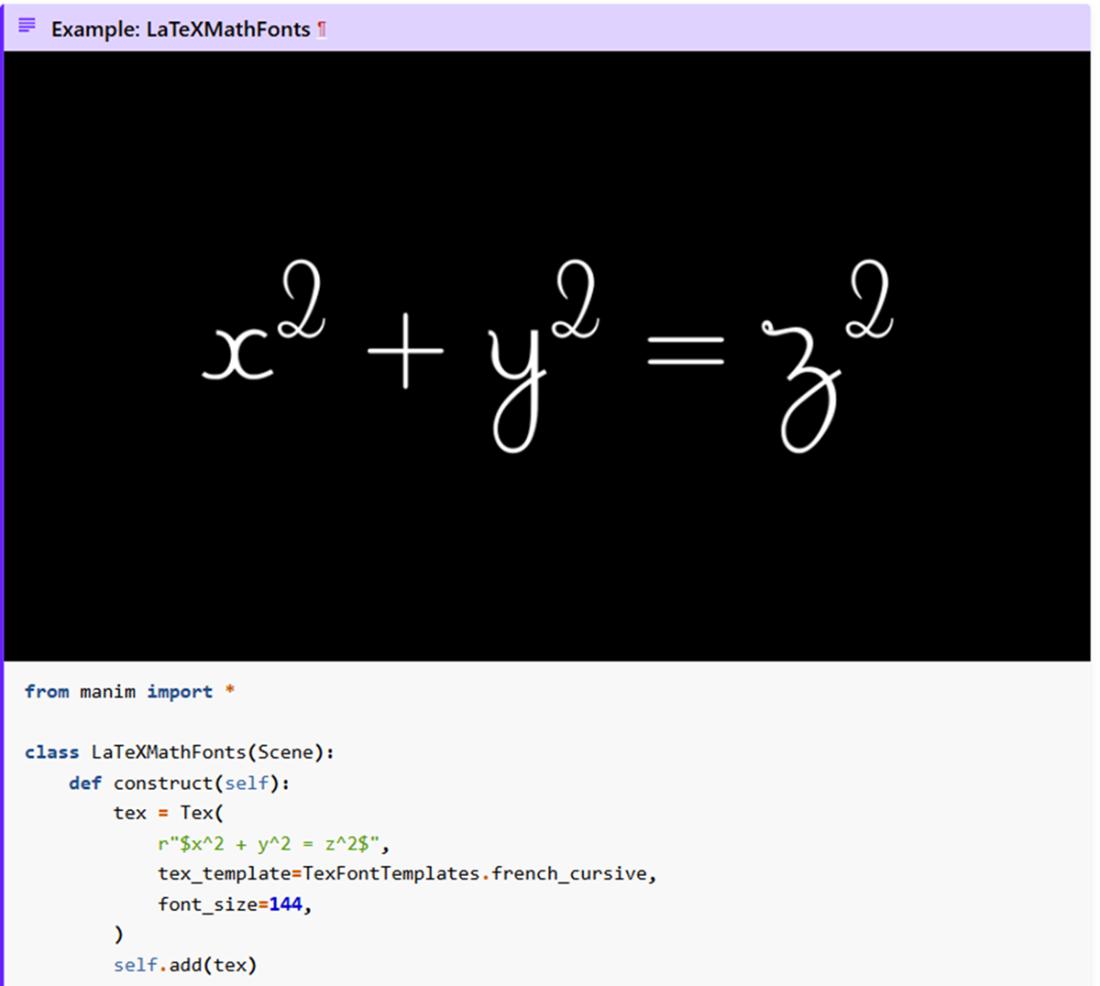
An example of Manim code (bottom) and the corresponding rendering (top).
Summary
- GPT-2 small models can be fine-tuned on domain-specific tasks using relatively small datasets of hundreds of samples.
- Manim is a Python animation engine that creates mathematical visualizations through programmatic code.
- Data preprocessing requires concatenating instruction and output fields before tokenizing for language model training.
- Optuna provides automated hyperparameter search capabilities that integrate with Hugging Face Transformers library.
- Model initialization functions create fresh model instances for each hyperparameter trial during search.
- Training arguments configure evaluation strategies, logging intervals, checkpoint saving, and mixed precision training.
- Early stopping callbacks prevent overfitting by halting training when validation loss stops improving.
- Hyperparameter search spaces define ranges for learning rate, batch size, weight decay, epochs, and other parameters.
- Generated code can be evaluated using Python's ast module to check syntax validity.
- Static analysis techniques verify domain-specific API usage patterns in generated code.
- Custom NodeVisitor classes extend ast functionality to analyze framework-specific code structures.
- Execution testing runs generated code through command-line tools to verify functional correctness.
- Rendering validation compares generated outputs against reference images using similarity metrics.
- Sandboxing and timeouts provide safety measures when executing generated code automatically.
- Small language models achieve good performance on specialized tasks with curated domain-specific datasets.
- Automated evaluation pipelines reduce the burden on subject matter experts for code quality assessment.
FAQ
What is the main goal of chapter 3, “End-to-end Transformer Fine Tuning”?
The chapter demonstrates a complete end-to-end workflow for fine tuning a very small GPT-like language model, specifically GPT-2 small, to generate working Manim Python code from natural-language instructions. It covers data preparation, hyperparameter tuning, model training, testing, and domain-specific evaluation of generated code.
Why does the chapter use GPT-2 small as the baseline model?
GPT-2 small is used to show that even a very small language model, which initially does not have strong capability to generate Manim code, can be specialized effectively when trained on a curated domain-specific dataset. The example demonstrates that small language models can gain useful task expertise without starting from a large model.
What dataset is used to fine tune GPT-2 small for Manim code generation?
The chapter uses the manim_python dataset from the Hugging Face Hub: https://huggingface.co/datasets/Edoh/manim_python. The dataset contains two fields: instruction, which is a natural-language prompt, and output, which is the corresponding Manim Python code. It has 599 training samples and 51 test samples.
How is the Manim dataset preprocessed before fine tuning?
Each sample is converted into a single text sequence by concatenating the natural-language instruction and the target code using a format such as Instruction: ... Output: .... This text is then tokenized with the GPT-2 tokenizer, truncated to a maximum length of 512 tokens, padded to a fixed length, and copied into the labels field so the model can learn causal language modeling.
Why is the GPT-2 tokenizer’s padding token set to the end-of-sequence token?
GPT-2 does not define a padding token by default. Since batch training requires padded sequences, the chapter sets tokenizer.pad_token = tokenizer.eos_token. This allows the model to use the existing end-of-sequence token as the padding token during preprocessing and training.
What libraries are used for fine tuning and hyperparameter search?
The chapter uses Hugging Face Transformers for model loading, training, tokenization, and the Trainer API. It also uses Hugging Face Datasets to load and process the dataset. For hyperparameter tuning, it uses Optuna as the backend through the Transformers hyperparameter search integration.
Why is a model_init function defined during hyperparameter tuning?
The model_init function ensures that a fresh instance of GPT-2 small is initialized for each hyperparameter search trial. This is important because each trial must start from the same pretrained baseline rather than continuing from a model already modified by a previous trial.
Which hyperparameters are searched during fine tuning?
The chapter defines a search space for several training hyperparameters: learning rate, per-device training batch size, weight decay, number of training epochs, warmup steps, and gradient accumulation steps. These ranges are chosen partly with the constraints of a free-tier Colab GPU environment, such as an NVIDIA Tesla T4, in mind.
How is the fine-tuned model tested after training?
After training, the model and tokenizer are saved to disk and then reloaded for testing. For each instruction in the test split, a custom generate_output function builds a prompt in the same Instruction: and Output: format, tokenizes it, generates Manim code using decoding parameters such as beam search, temperature, nucleus sampling, and repetition penalty, and then extracts the generated output text. The results are written to a CSV file together with the instruction and reference output.
How does the chapter recommend evaluating generated Manim code?
The chapter recommends domain-specific evaluation in addition to general language-model metrics. A complete automated evaluation pipeline can include Python syntax checking with ast.parse, static analysis for Manim API usage using a custom ast.NodeVisitor, execution correctness by running the generated code through the Manim CLI, and optionally rendering correctness by comparing generated videos or images against references using metrics such as SSIM or LPIPS. It also recommends sandboxing, timeouts, and resource limits when executing generated code.

 Domain-Specific Small Language Models ebook for free
