3 Sensing the real world
Digital twins depend on continuous sensing to stay synchronized with the physical world, transforming real-world changes into timely data that enables monitoring, optimization, and ultimately autonomous control. The chapter explains how sensors bridge this gap by converting physical phenomena into digital signals through a signal chain—physical change, transduction, conditioning, conversion, processing, and communication—and frames the sensing challenge around building a pragmatic, end‑to‑end architecture. Using a home deployment as a relatable example, it illustrates how clear objectives drive what to measure, how frequently to measure it, and how to ensure the twin remains an accurate reflection of reality.
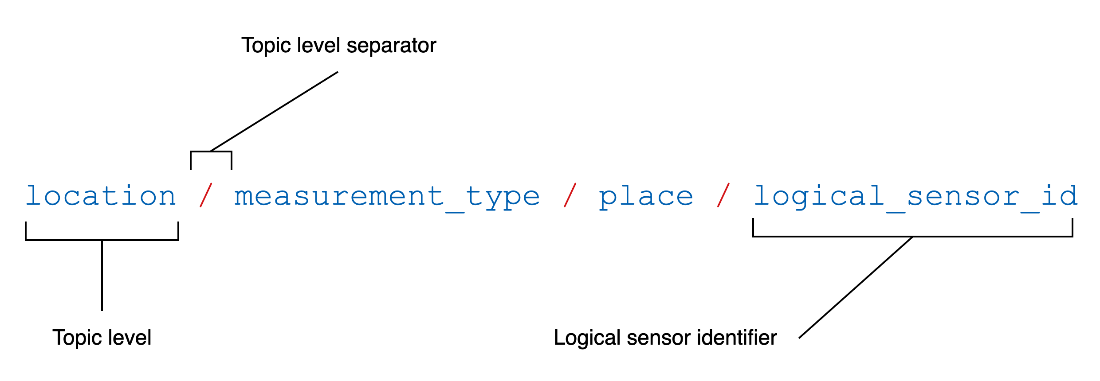
Designing an effective sensing system starts by working backward from decisions: define the parameters that best indicate desired outcomes or failure modes, establish operating ranges and rates of change, and then select sensors with appropriate temporal resolution, range and sensitivity, accuracy and precision, environmental tolerance, and power profile. Practical constraints—power availability, installation and maintenance access, integration compatibility, data formats, and calibration needs—often dominate choices. Communication technologies are matched to range, data rate, and power trade-offs, from short‑range WiFi, BLE, and Zigbee/Thread to long‑range LoRaWAN, cellular, and satellite; hybrid networks are common. MQTT serves as a universal, decoupled transport with topic hierarchies that simplify integration across heterogeneous devices. Beyond electronic sensors, the chapter advocates blending edge processing, manual collection, file-based imports, and third‑party data to cover cost, bandwidth, and feasibility gaps.
Turning raw readings into useful information requires decoding heterogeneous payloads, standardizing structures, preserving metadata, and handling IoT’s characteristic volume, velocity, variety, veracity, and value variability—often with event‑driven, serverless processing. Techniques such as sensor fusion (for example, Kalman filtering) improve accuracy under noise and uncertainty, while edge AI can extract compact insights on-device to save bandwidth and power. Operating at scale introduces fleet management challenges: battery health, firmware updates, physical and logical asset tracking, calibration drift, and security posture, mitigated by automated monitoring, standardization, and bulk operations. The chapter closes with a layered blueprint—collect, connect, transport, and process—and guiding principles: embrace diverse collection methods, converge on open standards, design for evolution, balance automation with pragmatism, and build for resilience in the face of inevitable real‑world failures.
The sensor signal chain by which a change in the physical environment makes its way to the digital twin representation via an electronic sensor.

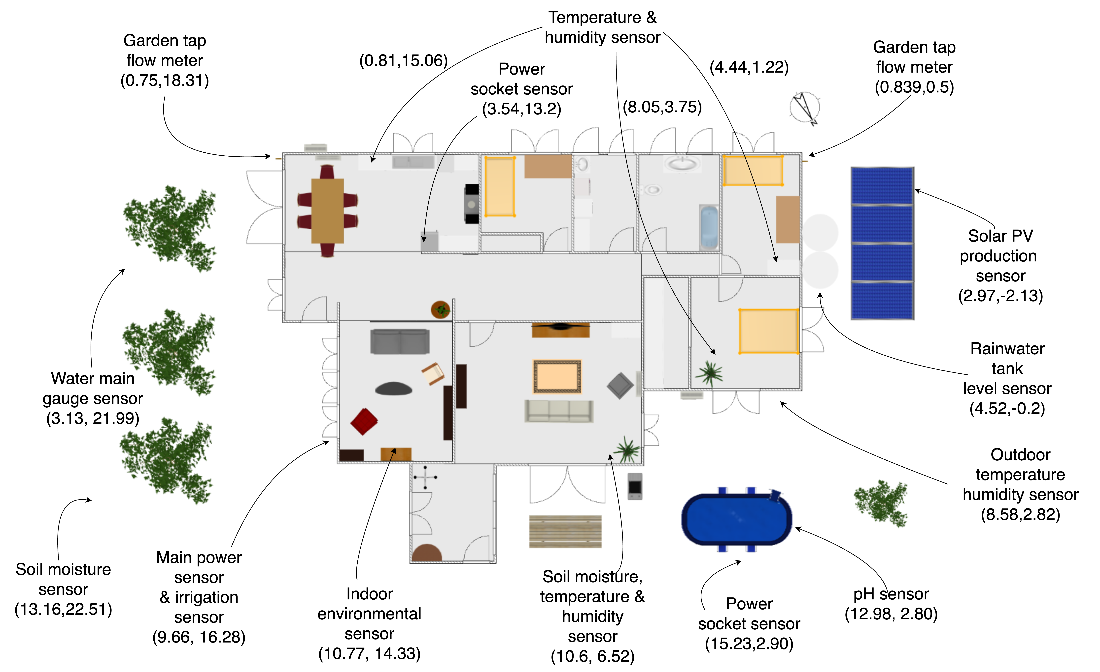
Using a floor plan to select the optimal placement of sensors based on what parameters need to be measured, as well as the location of power outlets and taps. The local coordinates of each sensor relative to the origin point (close to the compass symbol at the top right of the image) in meters are also shown.
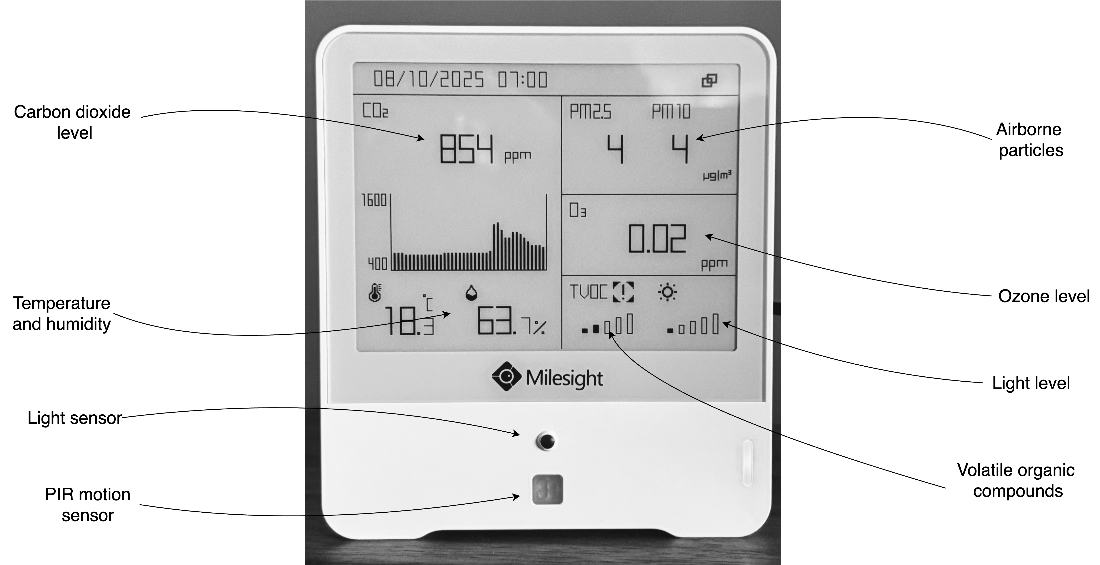
An environmental sensor that measures nine different parameters, displaying some on an E Ink display, as well as transmitting them over LoRaWAN.
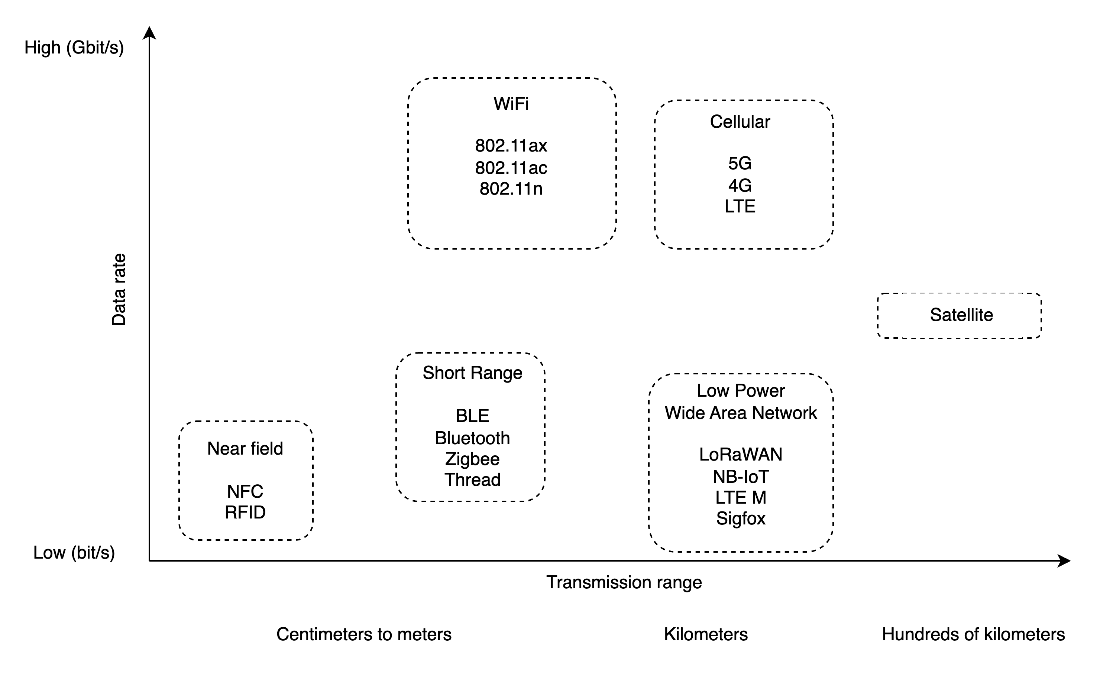
Wireless communication technology exists on a spectrum of data rate, transmission range, and cost. Higher data rates work over shorter distances and require more power, whereas longer range communication typically means accepting lower data rates.
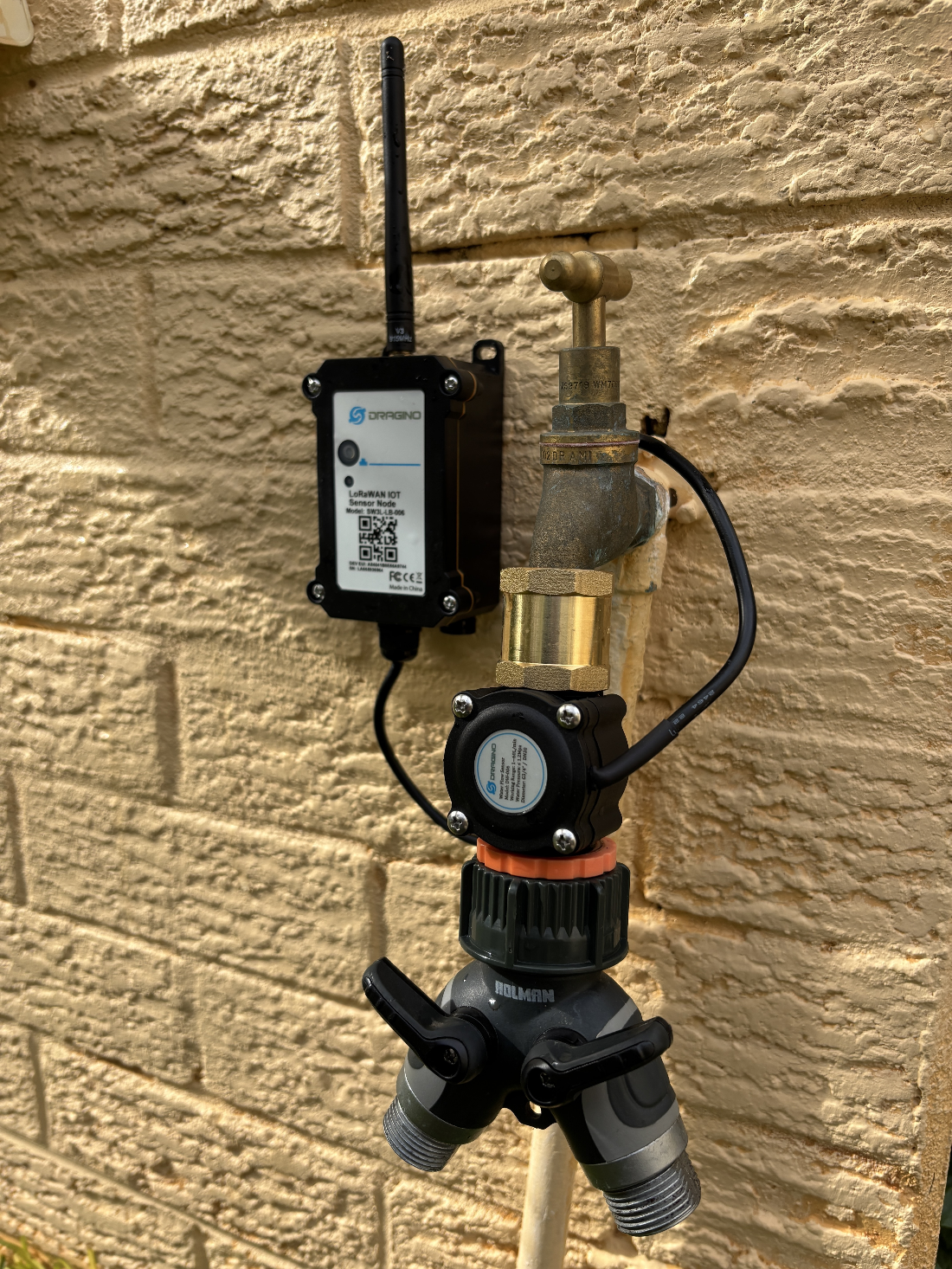
A battery powered LoRaWAN flow meter installed on a garden tap and sending data to my home digital twin.
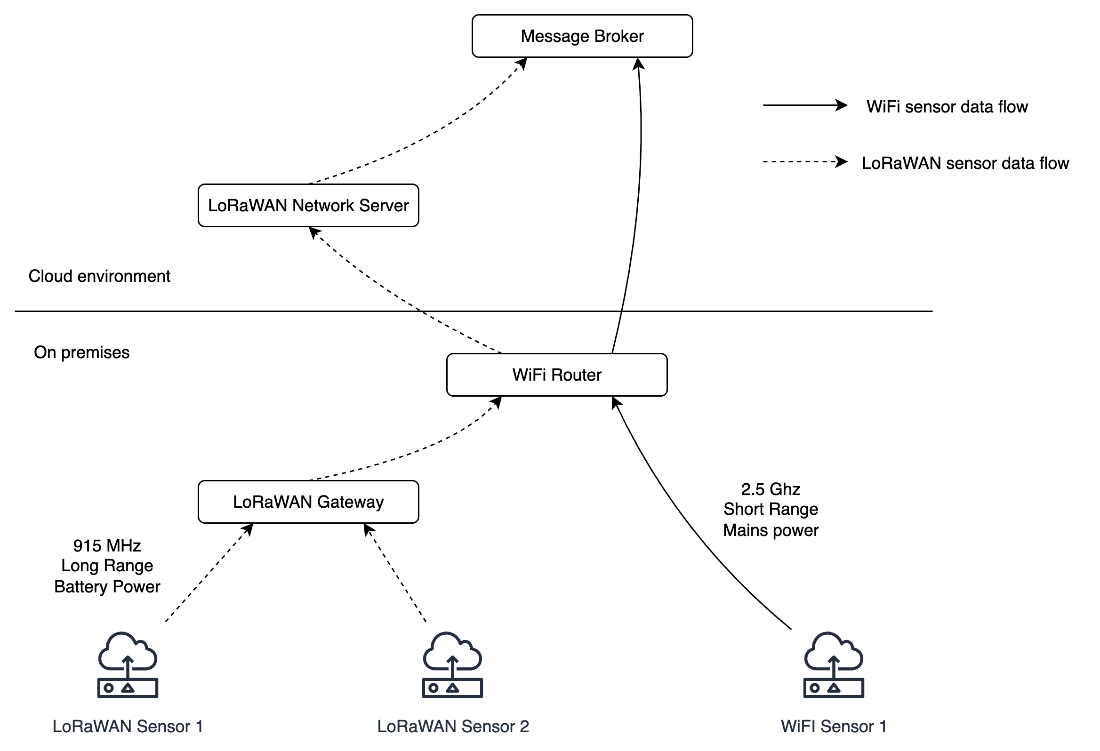
A hybrid sensor network that uses LoRaWAN and WiFi to send electronic sensor readings to a common message broker.
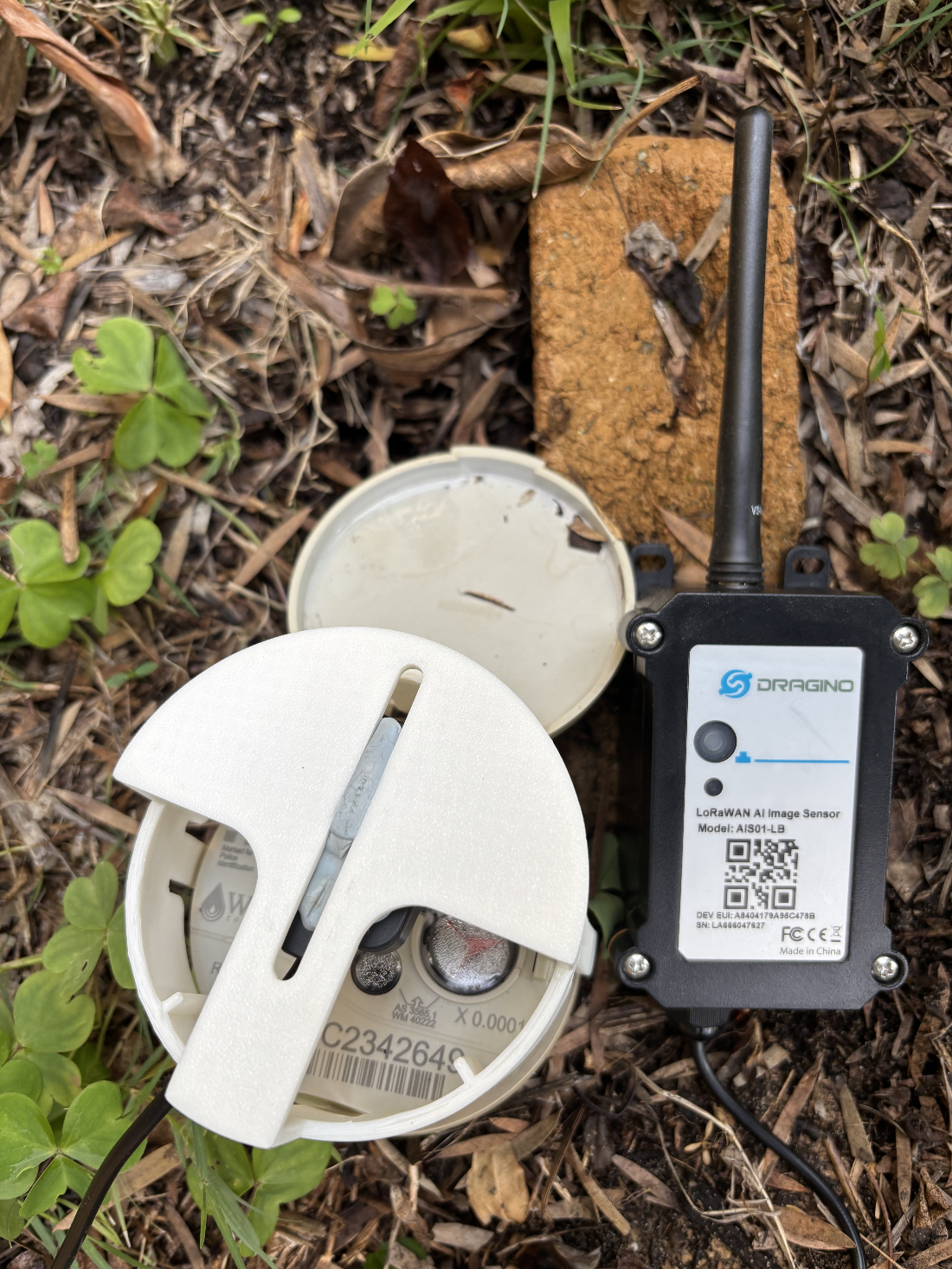
An edge AI camera installed on my main water meter and sending data to my home digital twin
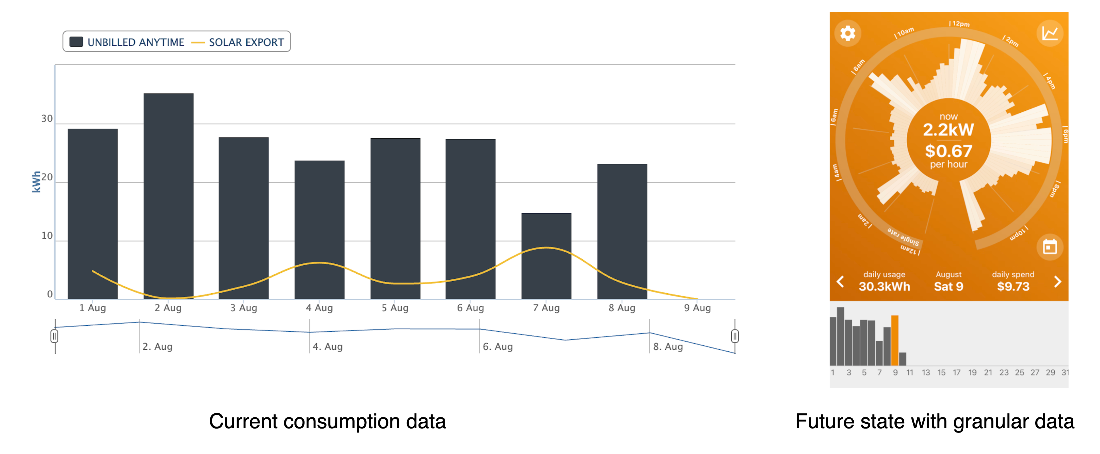
The electricity consumption data that I currently have available from my provider on the left, compared with the fine grained data I will obtain with an optical sensor, right.
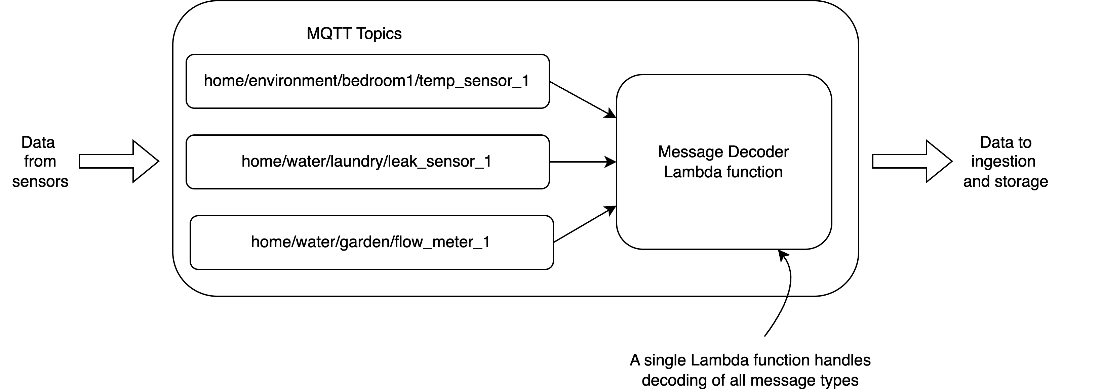
The sensor data collection hub architecture where messages from multiple types of sensor are collected, decoded, and routed for storage.
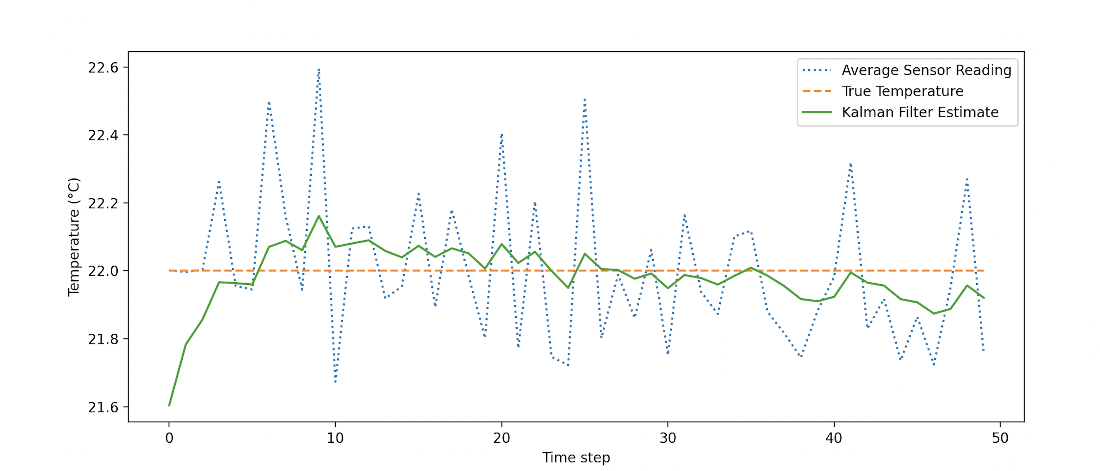
Output of the simple Kalman filter running against five noisy temperature sensors as shown in listing 3.5.
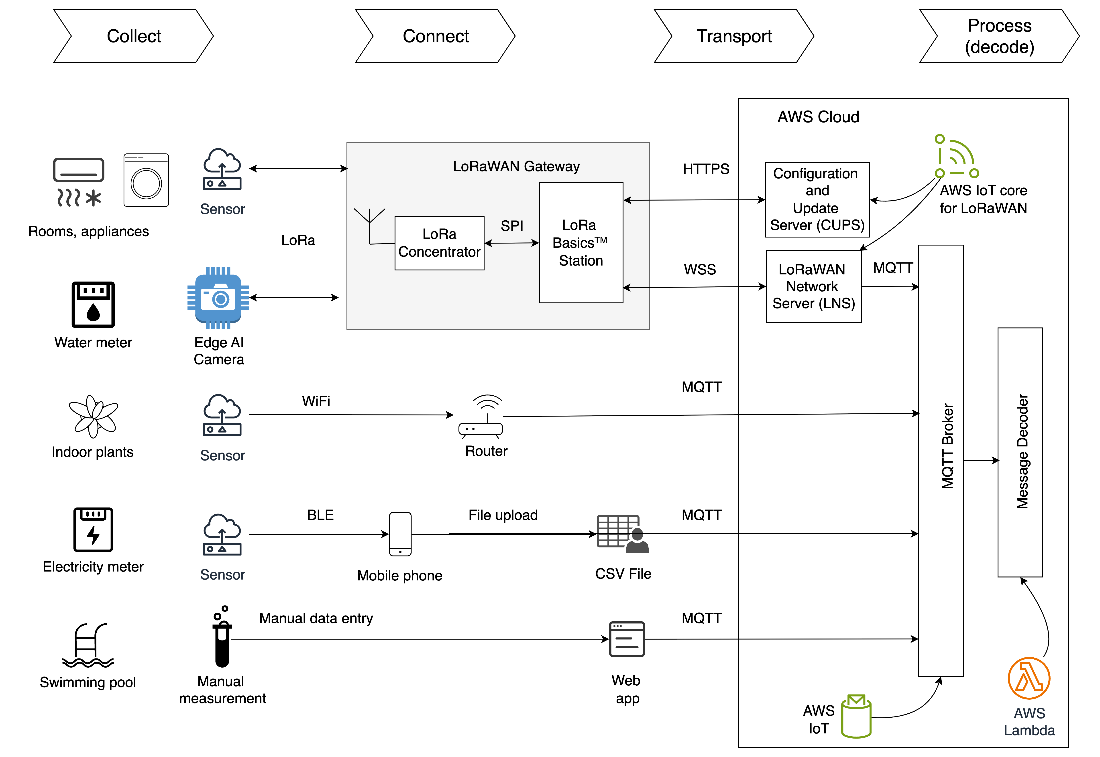
Complete sensing system architecture showing collect, connect, and transport layers.
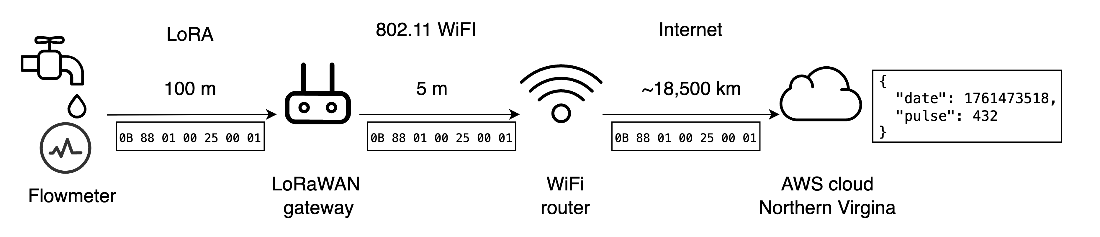
The route travelled by a reading from the LoRaWAN flowmeter attached to my garden tap.
Summary
- Sensors are the bridge between the physical and digital worlds, and update a digital twin with changes detected in the real world.
- There are many types of sensors with different characteristics of resolution, sensitivity and accuracy and precision.
- Consider carefully what you need to measure, the performance you require and practical constraints such as where you must measure and what infrastructure you need when selecting sensors for your digital twin.
- Not every measurement that you need to take can be economically or practically captured by electronic sensors and manual sensing or integrating data that has been sensed by third parties is a critical aspect of capturing changes in the real world.
- Sensors need to communicate their readings at differing rates and distances and there are a variety of communication technologies to choose from.
- Sometimes you may not find the sensor that you require available off the shelf and will need to build your own.
- Operating sensors reliably at scale brings challenges related to battery management, firmware updates, calibration and physical asset tracking that can be addressed by automated health monitoring, standardization and documentation.

 Digital Twins in Action ebook for free
