9 Convnet architecture patterns
This chapter emphasizes that a model’s architecture defines the hypothesis space it can explore and should embed useful priors about the task. Good architectures reduce search complexity for gradient descent and can be the difference between failure and strong performance, especially with limited data. The guiding recipe is Modularity–Hierarchy–Reuse: organize layers into reusable blocks, stack them into deep hierarchies, and progressively increase feature abstraction while shrinking spatial size. Convnets commonly follow this pattern with repeated blocks and pyramid-like feature hierarchies; deeper models tend to work better, but require care to avoid vanishing gradients.
Three core convnet patterns anchor the chapter. Residual connections create information shortcuts around potentially destructive blocks, enabling stable training at greater depth; when shapes differ, a 1×1 projection aligns the residual. Batch normalization normalizes intermediate activations, typically placed before the activation and often with biases disabled; it improves gradient flow and should generally be frozen during fine-tuning. Depthwise separable convolutions factor spatial and channel-wise learning, drastically cutting parameters and FLOPs while preserving representational power; even though GPU kernels may blunt raw speed gains, they still improve data efficiency, convergence, and robustness.
Combining these ideas yields an Xception-like design built from repeated blocks that use SeparableConv2D, batch normalization, ReLU, pooling, and residual projections, culminating in global average pooling and a compact classifier head. Such a model can outperform larger vanilla convnets on tasks like cats vs. dogs while using fewer parameters, illustrating the impact of architecture best practices: block modularity, increasing filters with depth, deep-and-narrow stacks, residuals, batch normalization, and separable convolutions. The chapter also advocates for ablation studies to identify which components truly matter and discusses Vision Transformers as a rising alternative that excels at scale but often underperforms on small datasets, where convnets remain the pragmatic choice; further gains come from systematic hyperparameter tuning.
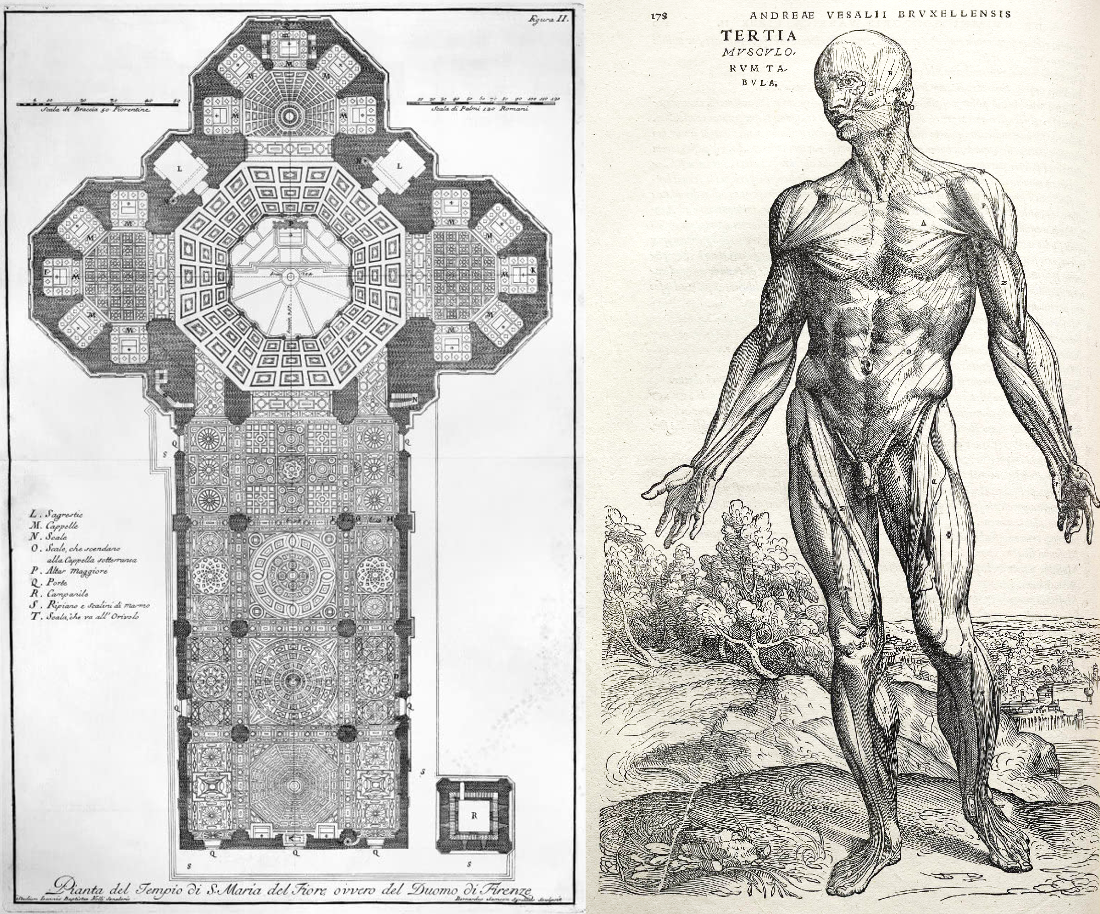
Complex systems follow a hierarchical structure and are organized into distinct modules, which are reused multiple times (such as your four limbs, which are all variants of the same blueprint, or your twenty fingers)
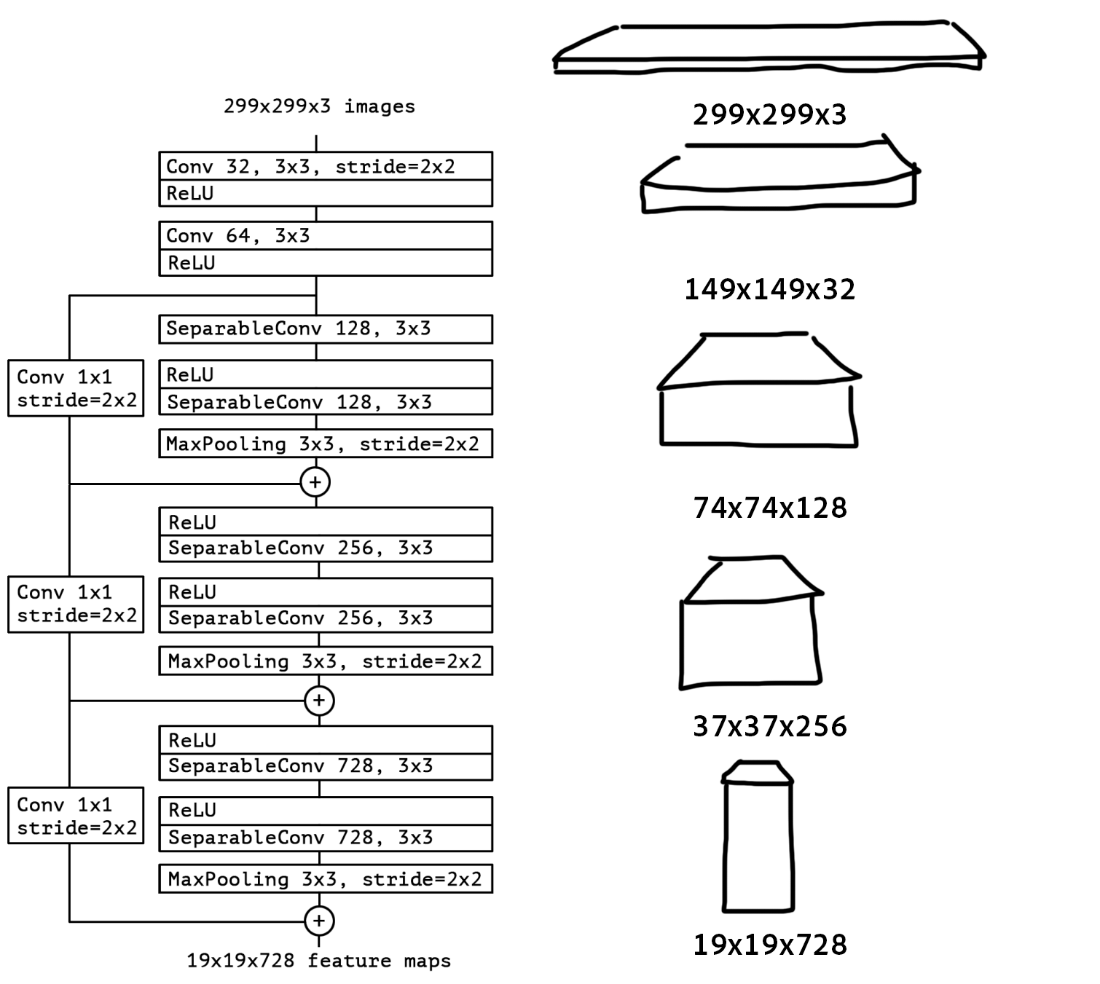
The “entry flow” of the Xception architecture: note the repeated layer blocks and the gradually shrinking and deepening feature maps, going from 299x299x3 to 19x19x728.
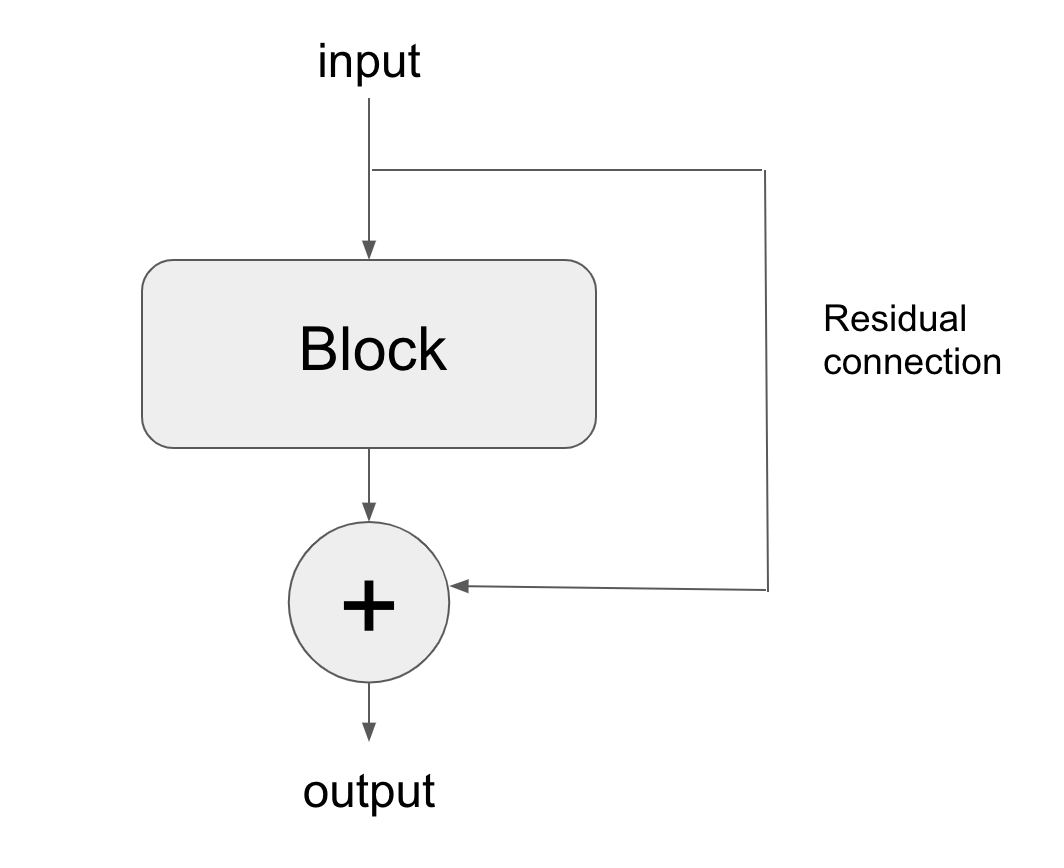
A residual connection around a processing block
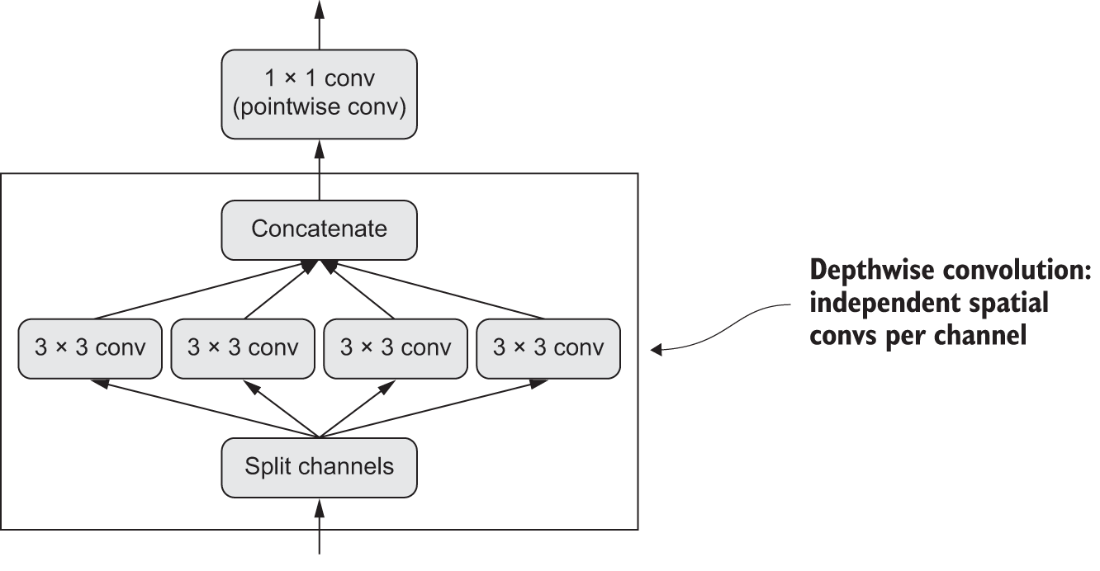
Depthwise separable convolution: a depthwise convolution followed by a pointwise convolution
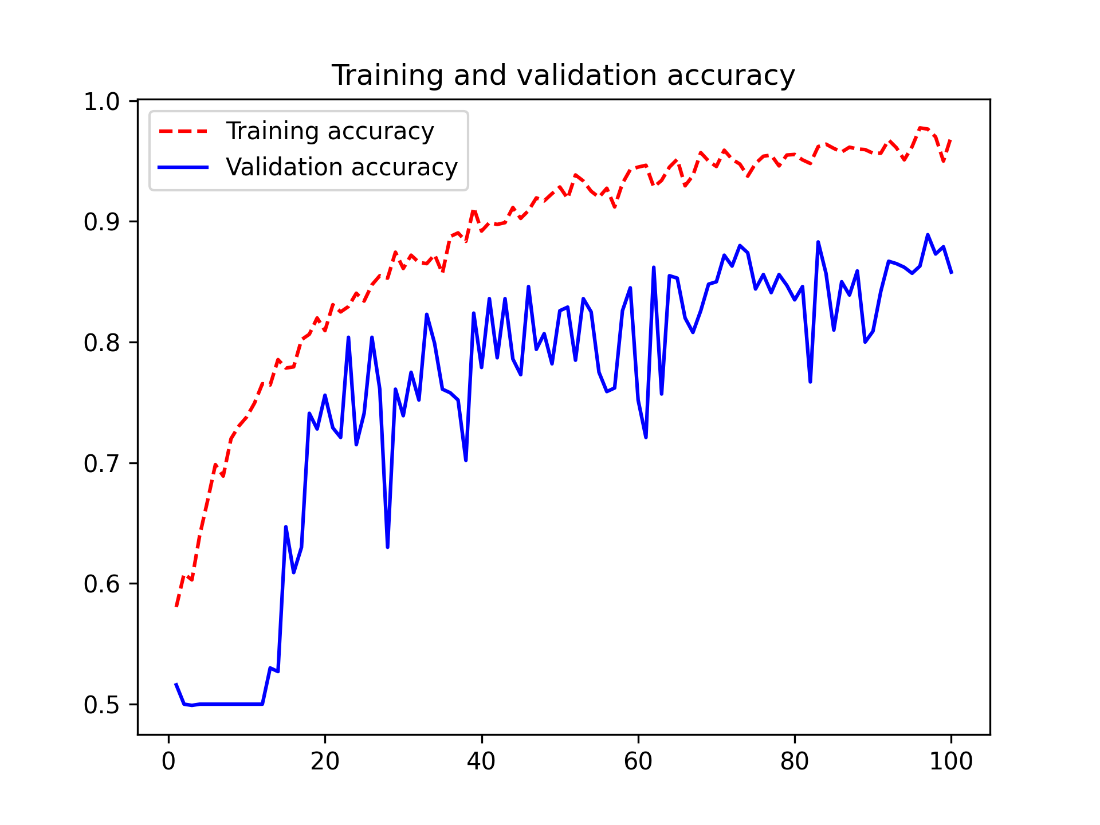
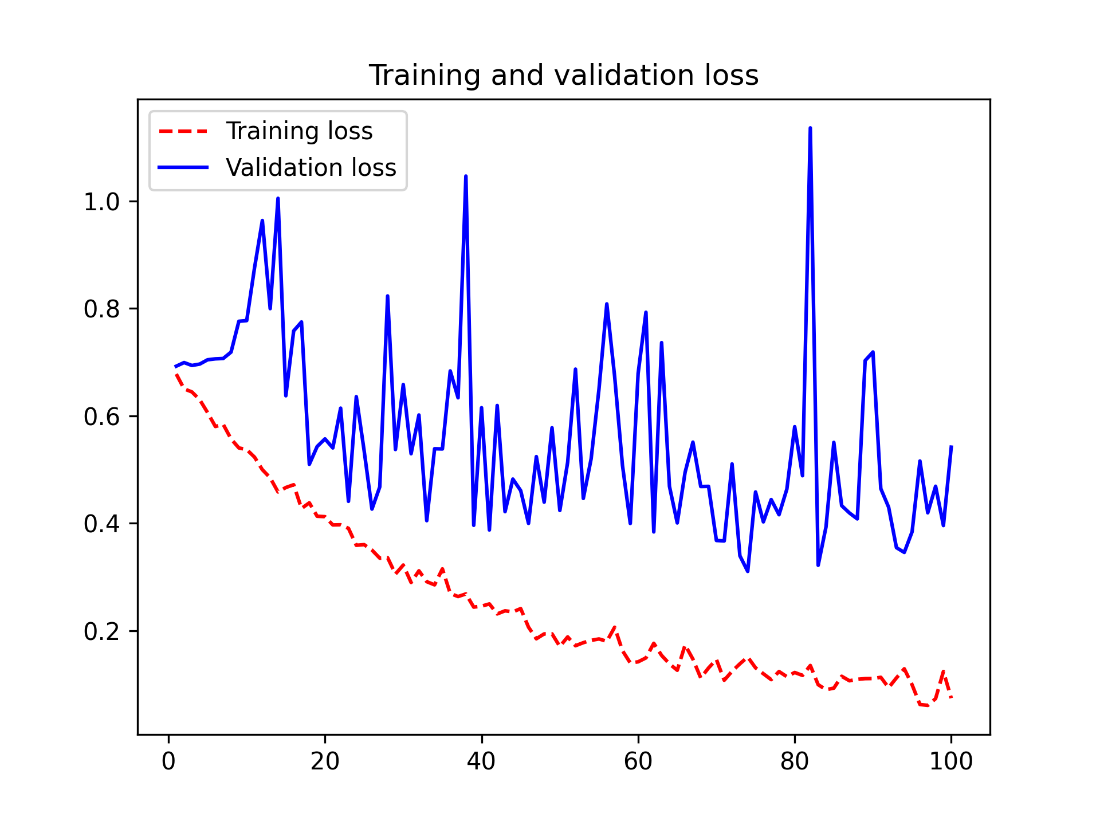
Training and validation metrics with a Xception-like architecture
Chapter summary
- The architecture of a deep learning model encodes key assumptions about the nature of the problem at hand.
- The Modularity-Hierarchy-Reuse formula underpins the architecture of nearly all complex systems – including deep learning models.
- Key architecture patterns for computer vision include Residual connections, batch normalization, and depthwise separable convolutions.
- Vision Transformers are an up-and-coming alternative to convnets for large-scale computer vision tasks.
FAQ
What is the Modularity–Hierarchy–Reuse (MHR) formula, and how does it guide convnet design?
The MHR formula says: break a complex system into reusable modules, organize them in a hierarchy, and reuse the same modules across the system. In convnets, this means building repeated “blocks” of layers, arranged in a feature hierarchy where spatial size shrinks and channel depth grows. It constrains the hypothesis space in a helpful way, speeding convergence and making better use of data.Why are deep-and-narrow convnets often better than shallow-and-wide ones, and what limits depth?
Deeper hierarchies encourage feature reuse and abstraction, which generally improves performance. However, very deep sequential stacks suffer from vanishing gradients: error signals degrade as they pass through many nonlinearities. Without mitigation, very deep models can fail to train.What are residual connections, and how do I handle shape changes in a residual path?
A residual connection adds a block’s input back to its output, creating an information shortcut that preserves gradient flow and combats vanishing gradients. If the block changes shape (e.g., more filters or downsampling), project the skip path with a 1×1 Conv2D (no activation) to match channels, and use strides on the projection to match any spatial downsampling. Use padding="same" in the main path to control spatial size.Where should BatchNormalization go relative to activations and biases?
Place BatchNormalization after the linear operation and before the activation, e.g., Conv2D/SeparableConv2D → BatchNormalization → Activation. Because normalization centers outputs, set use_bias=False on the preceding layer—the bias becomes unnecessary.How should I handle BatchNormalization when fine-tuning a pretrained model?
Freeze BatchNormalization layers (trainable=False) during fine-tuning. Otherwise their moving statistics will keep updating, which can interfere with the small, precise updates you want in surrounding layers.What are depthwise separable convolutions, and why might they outperform regular Conv2D?
They factor convolution into a depthwise spatial convolution (per channel) followed by a pointwise 1×1 convolution (channel mixing). This slashes parameter count and FLOPs while retaining representational power, often yielding faster convergence, less overfitting, and better accuracy—especially in small models or limited-data regimes. Xception is built around this idea.Will SeparableConv2D actually run faster on my GPU?
Not necessarily. Although separable convolutions do far fewer FLOPs, mainstream GPU kernels (cuDNN) are extraordinarily optimized for standard Conv2D and less so for depthwise/pointwise ops. You may see clear speedups on CPU, but on GPU the runtime can be similar. The parameter-efficiency and generalization benefits still make them worthwhile.What are the core convnet architecture best practices highlighted in this chapter?
- Build repeated blocks of layers (e.g., conv–conv–pool).- Increase filters as spatial resolution decreases (feature pyramid).
- Prefer deep-and-narrow over shallow-and-wide.
- Add residual connections around blocks to enable depth.
- Insert BatchNormalization after linear ops, then apply activation.
- Replace Conv2D with SeparableConv2D when possible to gain parameter-efficiency.

 Deep Learning with Python, Third Edition ebook for free
