4 Evaluating external technologies
Choosing external technology is not a small tactical move but a long-term commitment that can shape an entire system, so the chapter argues for a disciplined, staged evaluation process. It begins with the risk of accidental adoption and shows that teams should treat libraries, frameworks, services, and vendors as candidates for a job, just as they would hire people. The first goal is to qualify candidates by sourcing likely options and then screening them quickly and strictly against real requirements, rather than getting distracted by polished demos or feature lists.
The chapter then explains how to narrow the field using practical signals: curated trend reports, analyst research, and community attention can help reveal which technologies are mature enough to investigate further. Once candidates survive that initial pass, deeper evaluation starts with voice-of-developer research, direct conversations with experienced users, and focused proof-of-concepts built around the hardest questions, not around generic happy paths. The text stresses that prototypes should be designed to answer specific uncertainties, and that useful evidence comes from patterns across independent sources rather than from any single review or story.
For open source, the key concerns are usage, maintainability, community health, governance, licensing, and whether the free version will still fit when production needs grow. For commercial products, the focus shifts to references, trial access, pricing dynamics, renewal risk, product continuity, exit costs, and contract terms such as liability and auto-renewal. Throughout, the chapter recommends running technical, commercial, and legal evaluation in parallel so surprises surface early, and it ends with the broader lesson that the best choice is the one that fits the organization’s real context, cost, risk, and long-term ability to leave if needed.
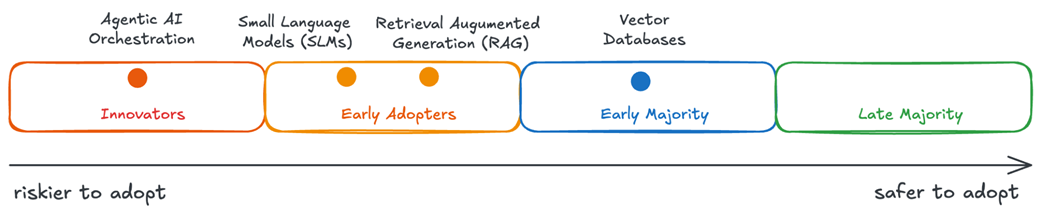
Example of several technologies in InfoQ AI Trends Report 2025
Example of several technologies in Volume 34 (April 2026) Technology Radar

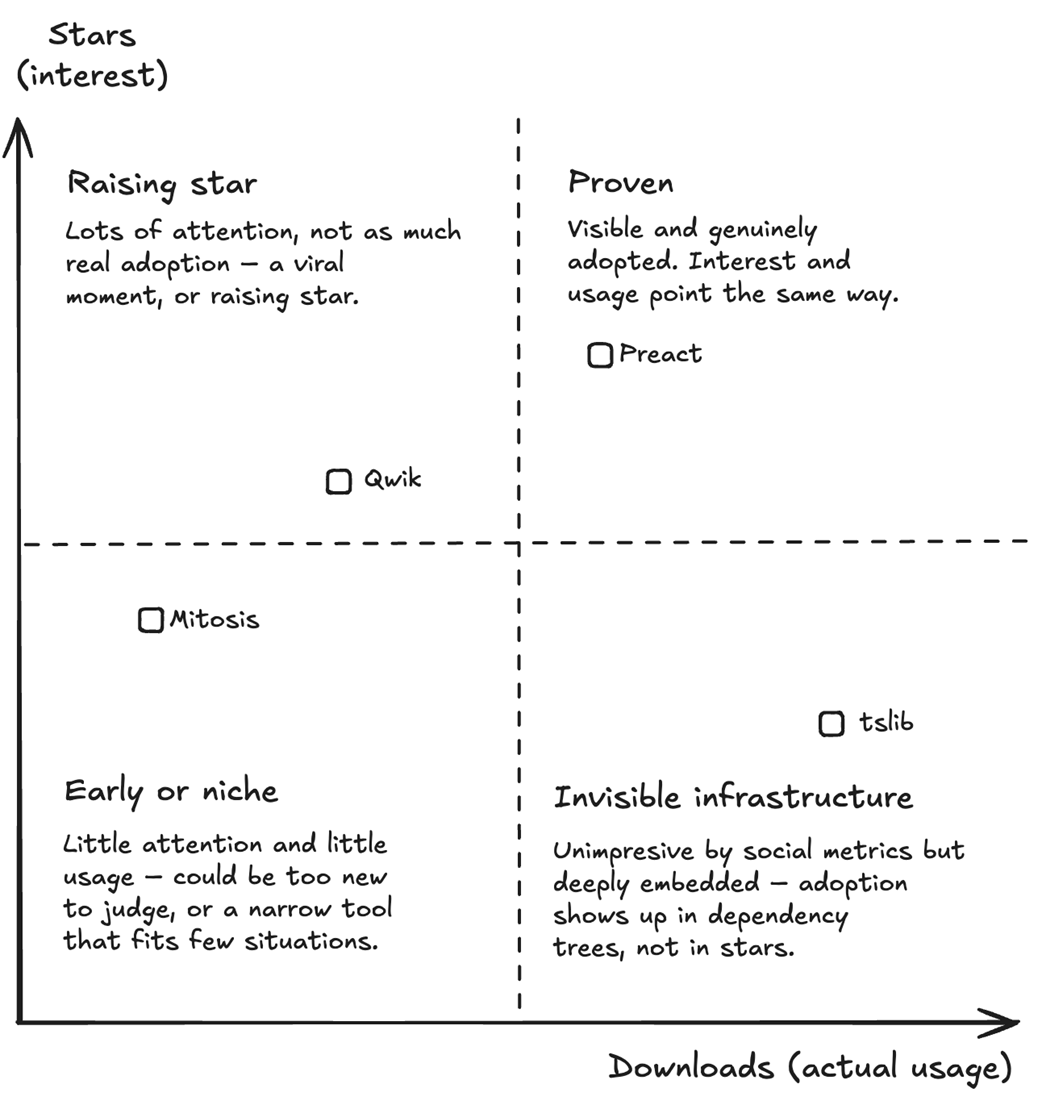
Plotting interest (stars) against actual usage (downloads).
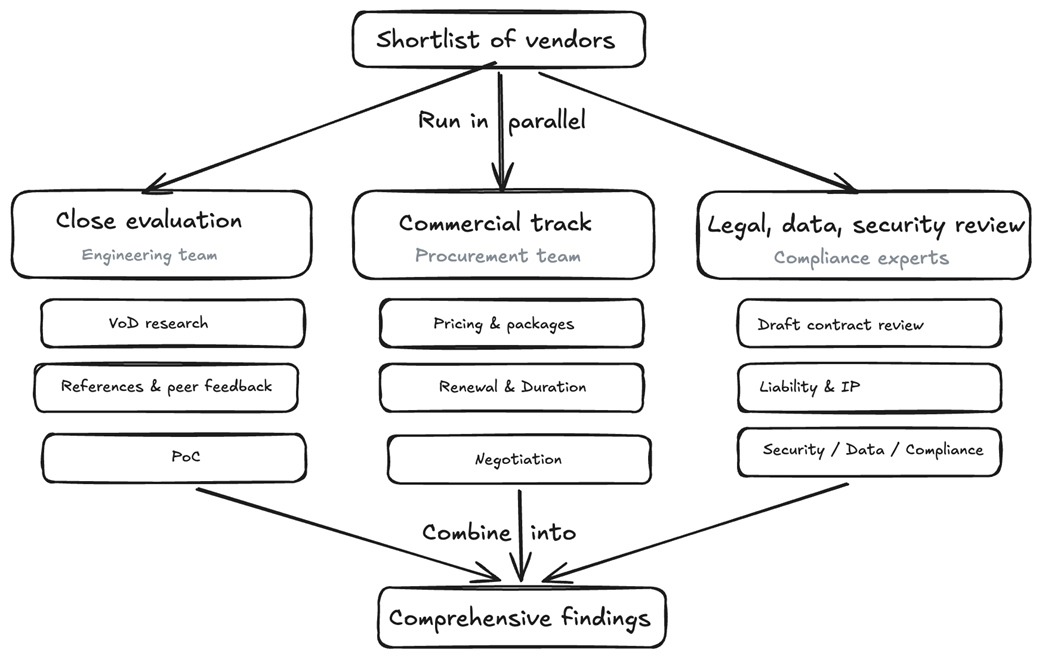
Approaching evaluation in parallel tracks.
Summary
- Most high-stakes technical decisions are about what we adopt, not what we invent, and an external technology choice commits us for years even when it installs in a single command. A structured evaluation, calibrated to the stakes, is what keeps these decisions from happening by accident.
- Adopting external technology is very close to hiring: we define the role first, source candidates from curated trend reports and analyst research, screen them against our requirements, and reserve deep evaluation for the few that go through successfully.
- Curated trend reports like the ThoughtWorks Technology Radar and the InfoQ Trend Report read industry maturity quickly, but a ring placement is general calibration we adjust for our own company stage and risk appetite.
- Screening tests each candidate against the architecturally significant requirements, service tiers, compliance constraints, and system, team, and company context established in chapters 2 and 3. Checking the decisive requirements first lets us drop a candidate before spending days on deeper investigation.
- Closer evaluation draws on three key sources that each reveal something new: VoD analysis of public community experience, direct conversations with people who have run the technology in production, and a focused proof of concept that stresses our real make-or-break questions.
- AI has made prototyping cheap enough to evaluate several candidates hands-on rather than just the front-runner, but a proof of concept is only as useful as the questions it was designed to answer, and it should be discarded rather than promoted to production.
- Open-source evaluation weighs adoption, maintainability, community health, governance, free-version limits, and licence fit, with maintainability as the foundation because an unmaintained dependency drifts out of sync with its ecosystem regardless of how popular it once was.
- The same signals mean different things across ecosystems, so a modest GitHub star count may indicate a healthy foundation-backed Java library or an early-stage JavaScript project depending on where we see it.
- Commercial evaluation has to close an information gap that open source doesn't have, drawing signals from references, trials, and the nature of the sales process itself, which previews the relationship to come.
- A commercial adoption begins a relationship governed by business incentives, so pricing and renewal dynamics, product continuity, exit cost, and contract terms deserve weight in addition to product technical capabilities.
- Running the technical, commercial, and legal tracks in parallel rather than in sequence surfaces slow, surprise constraints while we still have leverage and runner-up vendors in the game.
- No single signal decides any adoption, open source or commercial; the signals form a weighted picture whose weights shift with how deeply the dependency will sit in our systems and how costly it would be to replace.
FAQ
Why is it risky to choose an external technology without a formal evaluation process?
Because the commitment is often much larger and longer than it first appears. A tool may look easy to adopt, but it can create long-term integration, operational, financial, and dependency costs if it is chosen casually.
What is the first step when qualifying external technology candidates?
The first step is sourcing candidates: identifying technologies worth considering through research sources such as curated trend reports, analyst reports, and practitioner signals. After that comes screening against the requirements already established for the decision.
Why should initial screening be “cheap and harsh”?
Because the goal is to eliminate candidates that clearly cannot meet decisive requirements before spending significant time on deeper evaluation. This saves effort and keeps the focus on technologies that are actually viable.
What do curated trend reports like InfoQ and ThoughtWorks help with?
They provide an early sense of a technology’s maturity and industry readiness. InfoQ shows adoption stages, while the ThoughtWorks Technology Radar gives a practical recommendation such as Adopt, Trial, Assess, or Caution.
Why are analyst reports useful, and what are they not good for?
Analyst reports are useful for mapping the vendor landscape and identifying serious players in a market. They are less useful as final decision guidance because their evaluation criteria may not match your team’s actual technical fit or constraints.
What requirements should be used during screening?
Screening should check architecturally significant requirements, service tiers, compliance needs, system context, team context, and company context. A candidate that fails a decisive requirement should usually be rejected early.
What three things should a proof of concept try to prove?
A PoC should focus on: a key use case under realistic conditions, features whose maturity is uncertain, and concerns surfaced in Voice of Developer research. It should not be a generic “hello world” that proves little about real-world adoption.
What signals show that an open-source project may be unhealthy?
Signs include inactive maintainers, long gaps between releases, unanswered issues, weak community discussion, and unclear governance. Popularity alone does not guarantee maintainability.
What should teams watch for in commercial vendor evaluations?
Teams should examine pricing and renewal terms, product continuity risk, exit costs, data portability, contract clauses, and whether the vendor is likely to keep investing in the product. A strong demo is not enough.
Why should technical, commercial, and legal evaluation happen in parallel?
Running them in parallel surfaces surprises earlier, when there is still leverage. If legal, procurement, or pricing issues are discovered only after technical selection, the team may already be emotionally committed and have fewer alternatives.

 Decision Engineering ebook for free
