3 Reading the context
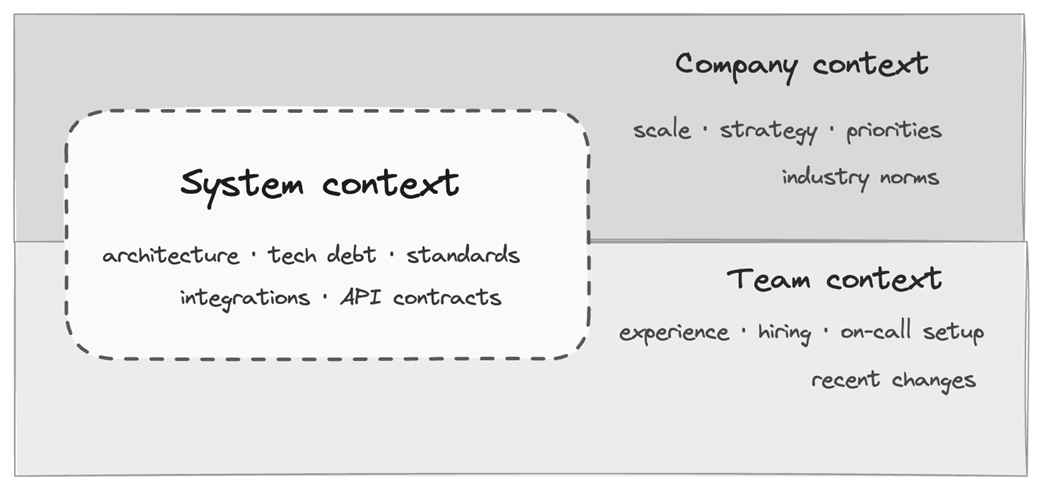
The chapter explains that good technical decisions depend on more than requirements: the same problem can lead to different correct answers depending on the surrounding context. It introduces a practical way to read that context in three layers: the system being changed, the team that will own the result, and the broader company forces that shape what is realistic.
For system context, the chapter recommends investigating what exists, where it is used, when and why it was built, and who knows it best. The aim is to understand coupling, hidden dependencies, blast radius, and the reliability of the evidence being used, with primary sources such as runtime data, code, and original design records weighted more heavily than diagrams or summaries. This helps avoid assumptions and clarifies how risky or costly a change really is.
The team and company layers then show why even a technically sound option may not fit. Team knowledge, hiring reality, on-call structure, recent change load, and preferences affect whether the team can operate a choice well, while company scale, business strategy, technology strategy, and industry norms determine what kinds of decisions make sense at all. In the worked example, these layers point toward a managed, mainstream ingestion solution rather than a custom, operations-heavy build, demonstrating how context narrows the option space before final evaluation begins.
Decisions context composition – system, company, team context.
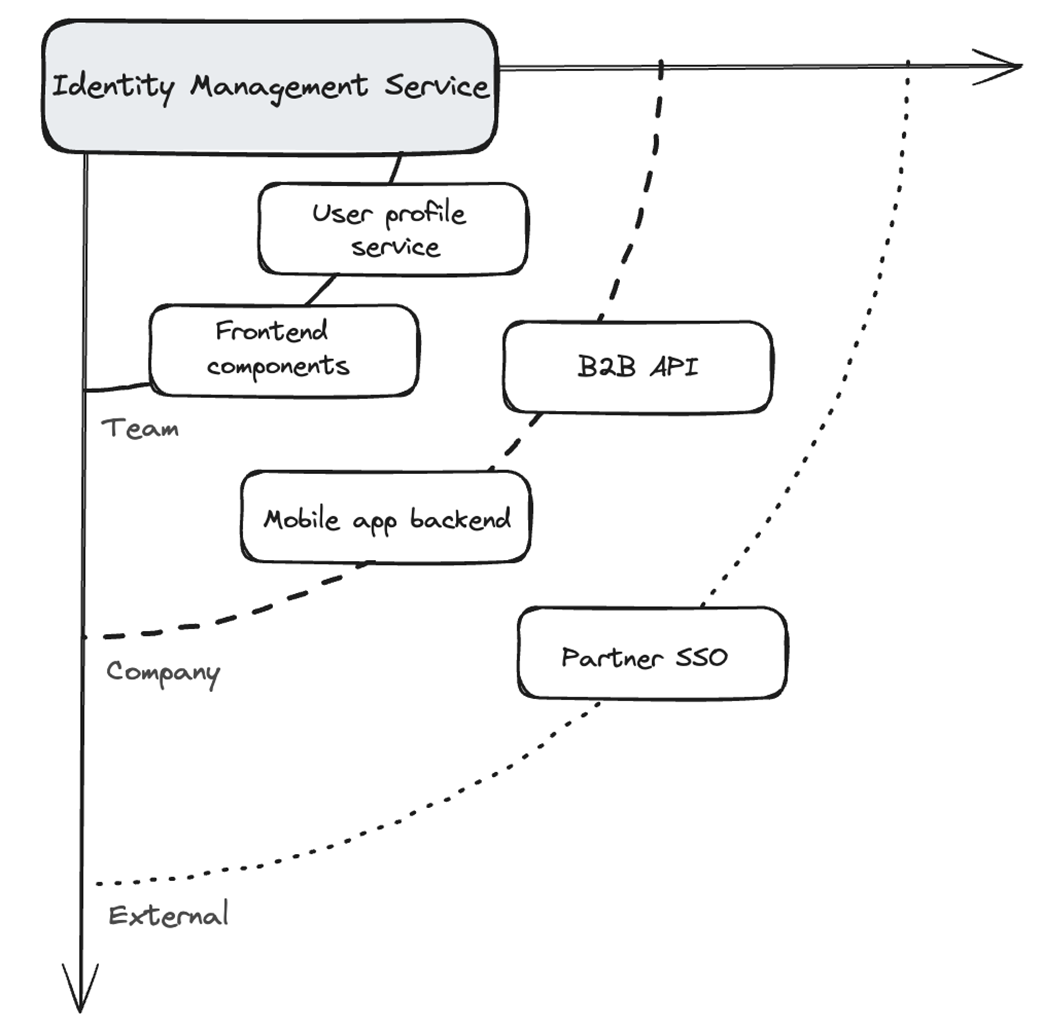
Decisions blast radius showing that the illustrative Identity Management service change is affecting our immediate team, other teams in the company and other external organisations.
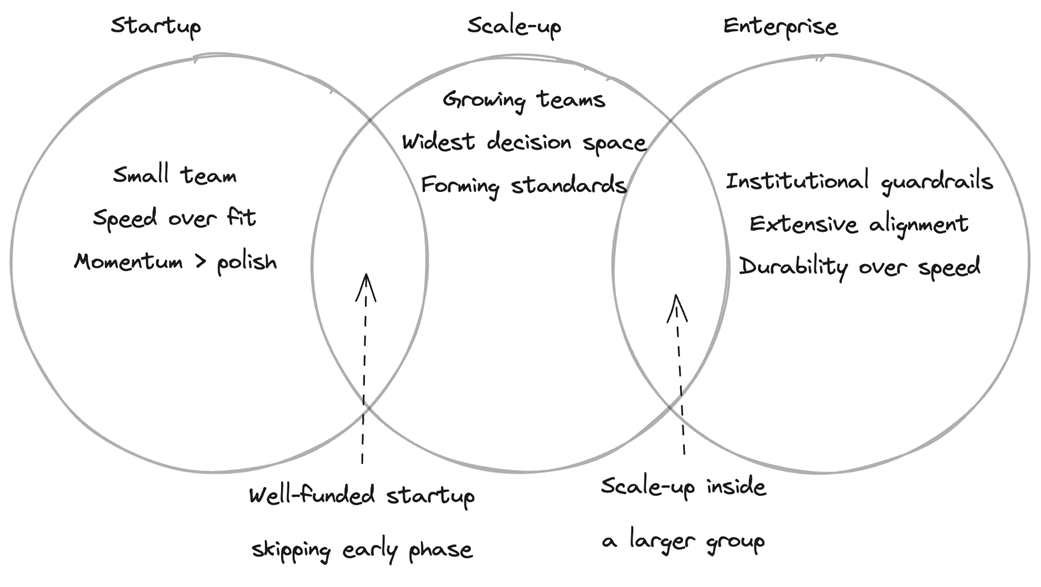
Company scale archetypes.
Summary
- Context shaping the decision is impacted by the system being changed, the team that will own the result, and the company forces shaping what is realistic. Considering all three dimensions helps us identify constraints that requirements alone may miss.
- Understanding the system before changing it is investigative work. Working through five questions – what exists, where is it used, when was it built, why is it the way it is, and who knows it – gives a structured picture of an unfamiliar system.
- Team context shapes how a decision will be received and executed. Operational capability, on-call structure, the talent pool, and recent change experience each act as forces that can bind a decision.
- Company context calibrates what good means for a decision. Scale, business priorities, technology strategy, and industry norms layer on each other, and analyzing them together is what distinguishes a decision that fits the organization from one that fights it.
- The three company archetypes – startup, scale-up, and enterprise – are patterns to recognize. Real organizations sometimes sit between them or hold traits from more than one, and the more useful question is which dynamics are at play in the specific decision context.
- Different decisions are differently shaped by different forces. Reading context well is less about scoring every dimension and more about identifying which ones are actually impactful.
FAQ
What is the main idea of chapter 3, “Reading the context”?
The chapter explains that requirements alone are not enough to choose a good technical solution. The right decision also depends on context: the system being changed, the team that will own it, and the company environment it must fit into.
Why can two teams with the same requirements choose different solutions?
Because they may operate in very different contexts. A team with deep platform experience and shared infrastructure may choose a custom build, while a smaller team with limited capacity and knowledge may do better with a managed SaaS solution.
What are the three main parts of decision context in this chapter?
The three parts are system context, team context, and company context. System context is the code and infrastructure being changed, team context is the people who will operate it, and company context is the broader organizational forces that shape realistic choices.
What are the 5W questions used for in system context?
The 5W questions help investigate an existing system before making a change. They are: what exists, where it is used, when it was built, why it is the way it is, and who owns or knows it deeply.
Why is blast radius important when evaluating a change?
Blast radius shows how widely a change can affect systems, teams, and even external users. A small, contained blast radius can usually be handled with lighter process, while a large or unclear blast radius suggests a higher-risk, more heavyweight decision.
What is the difference between primary and secondary sources in system analysis?
Primary sources are direct evidence such as code, telemetry, incident reports, and ADRs. Secondary sources are summaries or interpretations such as diagrams or wiki pages. Primary sources are more trustworthy, and secondary sources should be treated as leads rather than final answers.
What team factors shape a technical decision?
The chapter highlights team knowledge, talent availability, on-call setup, team preferences, and recent change load. These determine what the team can realistically adopt, operate, and support over time.
How does company strategy affect technology choices?
Company strategy sets guardrails and priorities. It can define supported platforms, preferred clouds, common standards, and whether the main priority is speed, reliability, or cost efficiency.
Why does company scale matter in decision-making?
Different stages of company growth favor different kinds of decisions. Startups value speed and reversibility, scale-ups need decisions that support growth, and enterprises need durability, governance, and alignment across many teams.
What does the worked example in the chapter show?
The example shows how a data ingestion decision can lead to different outcomes depending on context. In one company, managed SaaS tools are the better fit; in another with broader internal capability and infrastructure, extending existing platforms may be more attractive.

 Decision Engineering ebook for free
