Technical organizations make many important choices that shape how products are built, how quickly teams move, and whether business goals are met. The chapter argues that these choices are rarely solved by a single “correct” answer, especially now that AI can speed up coding while increasing the number and frequency of decisions. Because the hardest part is often deciding what to build, not just building it, technical decision-making should be treated as a discipline of its own for architects, tech leads, senior engineers, and engineering managers.
A good decision is defined as one made deliberately, using the available information and risks, to serve a specific business outcome. That outcome may favor short-term momentum, long-term maintainability, or some balance between the two. The chapter emphasizes that good decisions are not judged only by results, because uncertainty is unavoidable; a well-reasoned choice can still fail if conditions change. It also distinguishes between low-stakes, reversible choices that should be made quickly and high-impact, hard-to-reverse choices that deserve structured analysis, stakeholder involvement, and careful attention to the cost of change and organizational impact.
To make these ideas practical, the chapter introduces a decision lifecycle with three phases: framing the problem, evaluating options, and making the decision stick. Using a frontend component-library migration as an example, it shows how teams must clarify context and constraints, compare alternatives through experimentation and trade-off analysis, and then ensure the choice is adopted through documentation, communication, and business alignment. The broader message is that effective engineering requires not only technical expertise, but also repeatable decision-making habits that help teams navigate uncertainty, avoid common cognitive traps, and turn decisions into durable outcomes.
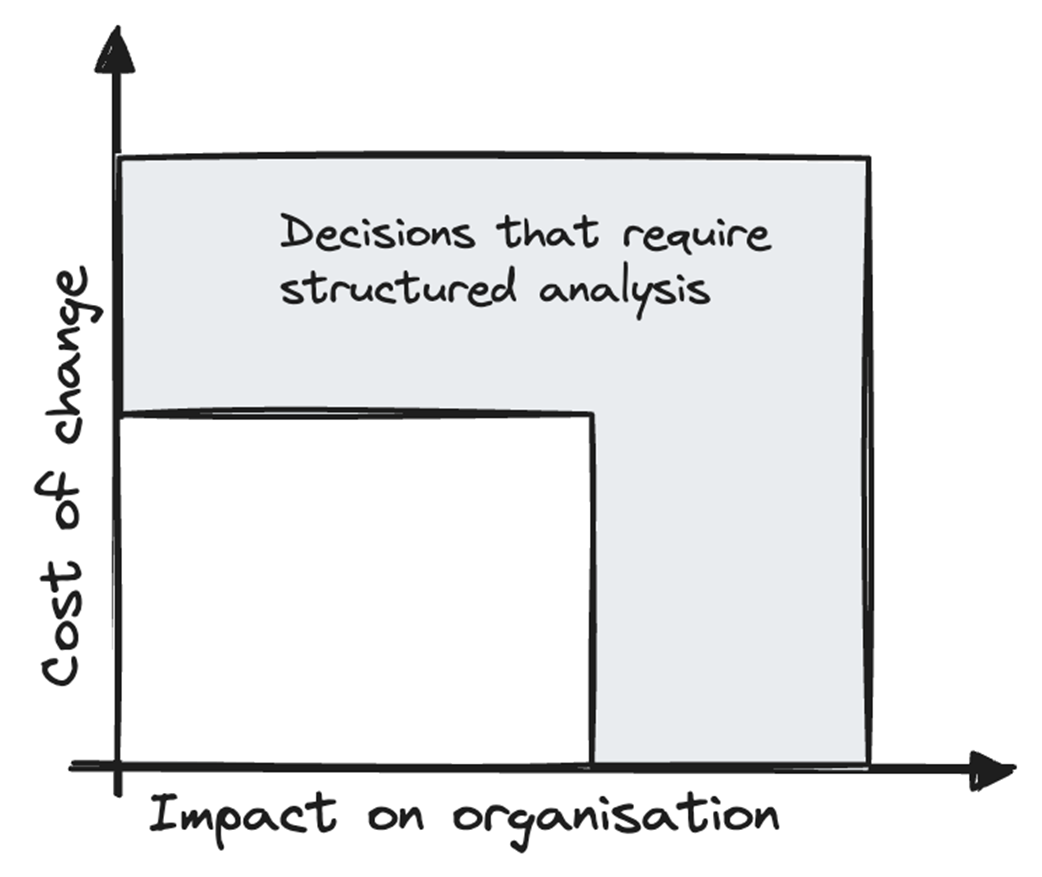
Decisions that require structured analysis sit in the upper quadrants: high cost of change or high organisational impact.
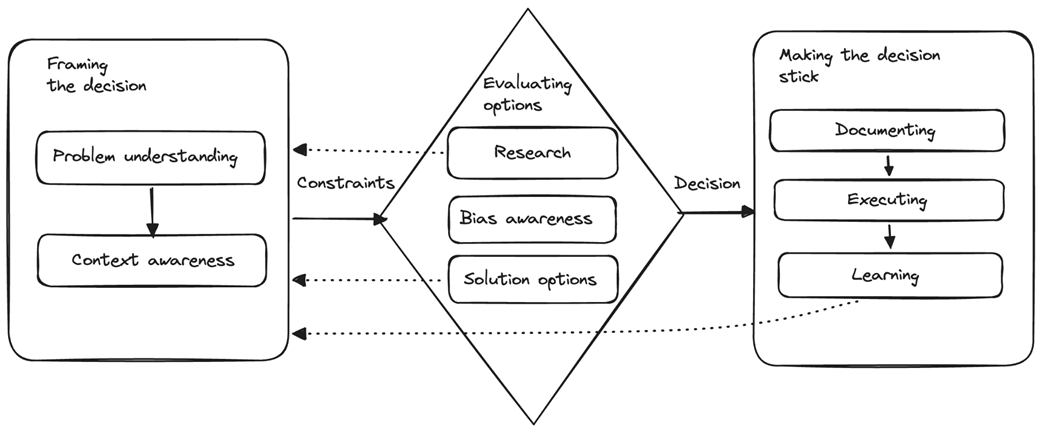
The decision lifecycle: framing and making the decision stick each move through mandatory steps, while evaluation widens the option space before narrowing it to a single choice
Summary
A good technical decision is one that deliberately, across the full spectrum of options and with all known risks at hand, was chosen to serve a specific business outcome.
Good decisions can be unpopular, can be reversed when circumstances change, and do not always produce the best outcome – but they follow a thoughtful process.
Uncertainty is a permanent feature of architectural decision-making, not a temporary condition to be eliminated through more research.
Decision quality must not be solely evaluated by outcomes – a well-reasoned bet that doesn't pay off is still a good decision.
One-way-door decisions deserve careful analysis and broad stakeholder involvement. Two-way-door decisions benefit from speed.
Decision-making is a distinct discipline that can be learned and improved systematically, separate from implementation skill.
The cost of poor decisions often is felt by organisations for years, exceeding the cost of investing more time in the decision-making.
The decision lifecycle – framing the decision, evaluating and choosing options, and making decisions stick – provides a repeatable structure for approaching technical decisions.
Good decisions often require loops: a failed prototype or a surfaced constraint can send a team back to reframing, and a decision that does not stick in execution may need to return to evaluation.
FAQ
```html
What is a technical decision in the context of decision engineering?A technical decision is a choice that shapes what engineers build, how they build it, and whether the business gets what it needs. It is usually made under uncertainty and depends on context, constraints, and people rather than having a single textbook answer.What makes a technical decision “good”?A good technical decision deliberately serves a specific business outcome using the known options, risks, and information available at the time. It balances short-term and long-term needs, is clearly reasoned, and is actually carried through into action.Should technical decisions always prioritize long-term scalability?No. A good decision is not always the one that maximizes scalability or architectural elegance. Sometimes short-term survival, speed to validation, or business momentum matters more, depending on what the organization needs most.Why can a decision be good even if the outcome is poor?Because decision quality and decision outcome are not the same thing. A decision can be well-framed, well-reasoned, and transparent, yet still lead to a poor result if circumstances change or hidden uncertainty is later revealed.How do one-way door and two-way door decisions differ?Two-way door decisions are easy to reverse and usually do not need heavy analysis. One-way door decisions are hard or expensive to reverse, have larger consequences, and therefore deserve structured analysis and stakeholder involvement.Which technical choices usually deserve deeper analysis?Choices with high cost of change or high organizational impact deserve the most care. Examples include data storage architecture, company-wide standards, multi-year SaaS contracts, framework changes, and building an internal platform instead of buying one.Why is decision-making considered a skill of its own?Because software engineering is not only about implementing solutions. Teams also need to frame problems, compare options, manage uncertainty, involve the right people, and make sure decisions actually stick and produce results.How has AI changed the role of decision-making in engineering?AI has made implementation faster, which shifts more attention toward deciding what to build and how to build it. The number of decisions has not decreased, but the time available to think about each one often has.What are the three phases of the decision lifecycle?The decision lifecycle consists of framing the decision, evaluating and choosing options, and making the decision stick. These phases help teams move from understanding the problem to selecting a solution and then turning it into durable outcomes.Why do technical decisions often fail in practice?They often fail because the process is weak, not because the technology is bad. Common problems include decisions staying on paper, overengineering, lack of team buy-in, management resistance, and framing the choice as if only one or two options exist.
```
pro $24.99 per month
access to all Manning books, MEAPs, liveVideos, liveProjects, and audiobooks!

 Decision Engineering ebook for free