This chapter introduces Dask-ML as the scalable, parallel counterpart to Scikit-learn within the Dask ecosystem and demonstrates end-to-end model building at cluster scale. Building on prior data preparation work, it frames a concrete goal: train a sentiment classifier on the Amazon Fine Foods reviews that predicts positive vs. negative without using star ratings. The narrative emphasizes how familiar Scikit-learn patterns—estimators, train/test splits, scoring—carry over in Dask-ML, while also highlighting Dask’s strengths for large, out-of-core arrays, lazy execution, and interoperability with NumPy and Pandas.
The workflow proceeds from labeling reviews (positive/negative) to text preprocessing (tokenization and stopword removal), then transforms text into machine-amenable features via binary vectorization. To keep the example fast while remaining scalable, it limits the corpus to the top 100 tokens, creates feature/target vectors in Bags, and efficiently reduces them into Dask Arrays by concatenating partition-wise arrays. Data is persisted to disk with Zarr and sensible rechunking to minimize I/O overhead. With data ready, a Dask-ML logistic regression is trained using a randomized train/test split and attains roughly 80% accuracy on held-out data. As a challenger, a Naive Bayes model from Scikit-learn is trained in parallel using Dask-ML’s Incremental wrapper (leveraging partial_fit), scoring slightly worse than logistic regression, illustrating the champion–challenger evaluation approach.
After establishing a baseline, the chapter covers model evaluation and systematic improvement via hyperparameter tuning. Using GridSearchCV, it explores combinations of penalty (L1/L2) and regularization strength (C) with cross-validation, finding that the defaults (e.g., L2, C=1) remain competitive here, while noting that Dask can distribute grid searches across workers to shorten run time. The discussion closes with practical guidance on persisting trained models for deployment: serialize estimators with dill/pickle, store them in a repository, and load them on lighter-weight machines for inference—provided the necessary libraries are installed. Together, these steps form a reproducible, scalable pipeline for text classification with Dask-ML, from data prep and feature engineering through training, validation, tuning, and model publishing.
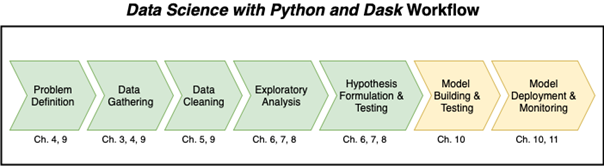
Having thoroughly covered data preparation, it’s time to move on to model building
A review of the API components of Dask
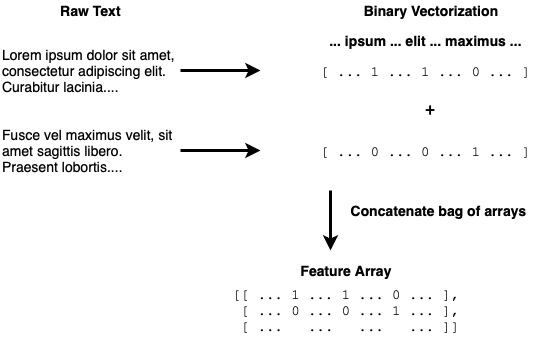
An example of binary vectorization
Vectorizing the raw data into a bag of arrays, then concatenating to a single array
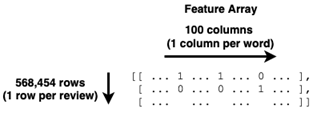
The shape of the feature array
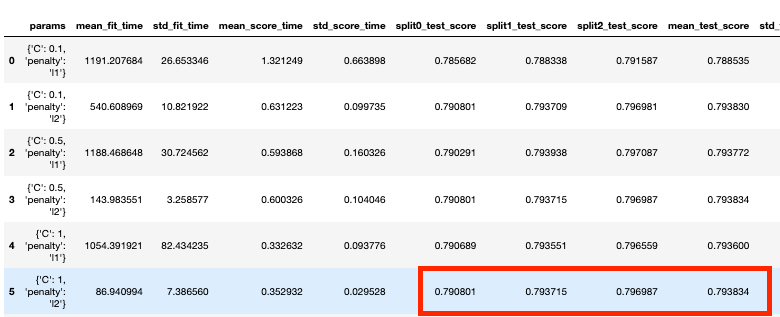
The GridSearchCV results
Summary
In this chapter you learned
Binary vectorization is used to relate the existence of a word in a chunk of text to some predictor (e.g. sentiment)
Machine learning uses statistical and mathematical methods to find patterns that relate features (inputs) to predictors (outputs).
Data should be split into training and testing sets to avoid overfitting.
When trying to decide which model to use, select some error metrics and use the champion-challenger approach to objectively find the best model based on your selected metrics.
GridSearchCV can be used to automate the selection and tuning processes of your machine learning models.
Trained machine learning models can be saved using the dill library in order to reuse later to generate predictions.
FAQ
What is Dask-ML and how does it relate to Scikit-learn?Dask-ML provides parallel and distributed learning utilities with an API that mirrors Scikit-learn. If you already know Scikit-learn’s estimators, model_selection, and metrics, the Dask-ML equivalents feel familiar but operate lazily on Dask collections and can scale across cores or clusters.How do I turn raw review text into numeric features usable by Dask-ML?Typical steps are: tokenize text, remove stopwords, build a corpus, and apply binary vectorization (1 if a token appears in a review, 0 otherwise). In the chapter, tokens are extracted with NLTK, stopwords filtered, top-N frequent tokens are chosen, and NumPy’s isin is used to create 0/1 vectors per review.Why would I limit the corpus to the top N tokens instead of using all unique words?Using all unique tokens can create massive, wide arrays that are costly to compute and store. Limiting to the top N frequent tokens keeps the feature matrix manageable, speeds experimentation, and still captures much of the predictive signal. You can scale N up later once the pipeline is working.How do I convert a Dask Bag of per-review vectors into a single Dask Array for modeling?Map each feature vector to a 1×N Dask Array, then use a reduction with a concatenate step to stack rows across partitions. This avoids a detour through DataFrames and keeps things efficient for very wide data.Why rechunk before writing arrays to disk, and what format should I use?After concatenation the chunks may be tiny (e.g., 1 row per chunk), which would create a huge number of small files and poor I/O performance. Rechunk to larger row groups (e.g., thousands of rows per chunk) and write with Dask Array’s to_zarr. Zarr stores one file per chunk and is fast and convenient for later reads.How do I split data and train a logistic regression with Dask-ML?Use dask_ml.model_selection.train_test_split to create train and test sets, set a random_state for reproducibility, then fit dask_ml.linear_model.LogisticRegression on the training arrays. Score on the test arrays to estimate generalization performance.What is overfitting and how do I detect it in this workflow?Overfitting happens when a model learns patterns that don’t generalize beyond the training data. Hold out a test set and compare predictions to true labels with score (accuracy for classifiers). A large train score but poor test score is a red flag for overfitting.Can I use Scikit-learn estimators that aren’t in Dask-ML (e.g., Naive Bayes)?Yes. Wrap any Scikit-learn estimator that implements partial_fit with dask_ml.wrappers.Incremental. Fit it on Dask Arrays, providing the list of classes for classification. This enables parallel, out-of-core training with familiar Scikit-learn models.How do I tune hyperparameters at scale with Dask-ML?Use dask_ml.model_selection.GridSearchCV. Provide the estimator and a dict of parameter grids (e.g., penalty and C for logistic regression). Dask will evaluate parameter combinations across workers. Be mindful of grid size: more combinations mean more models and longer runs.How do I save and reload trained models for deployment?Serialize the fitted estimator to disk using pickle-compatible tools such as dill. Later, load it and call predict without retraining. Ensure the deployment environment has the same library versions the model depends on (e.g., Dask, Scikit-learn, NumPy).
pro $24.99 per month
access to all Manning books, MEAPs, liveVideos, liveProjects, and audiobooks!



 Data Science with Python and Dask ebook for free
