3 Fine-tuning methods
The chapter introduces fine-tuning as the process of adapting a pretrained language model to a new task by continuing training from existing weights rather than starting from scratch. It explains the core machinery behind this adaptation: how Transformer architectures replaced slower recurrent designs, how tokenization and positional information prepare text for processing, and how self-attention, feed-forward layers, residual connections, and normalization work together to produce contextual representations. It also grounds fine-tuning in gradient descent, showing how loss functions, backpropagation, learning rates, and optimizers like SGD, Adam, AdamW, and Adafactor drive parameter updates during training.
Building on that foundation, the chapter surveys traditional fine-tuning strategies, from supervised fine-tuning with labeled input-output pairs to full-parameter fine-tuning, where every weight is updated, and layer-wise or partial approaches that update only selected parts of the network. These methods are presented as trade-offs between flexibility, cost, and stability: full fine-tuning offers maximum adaptability but risks catastrophic forgetting and heavy compute demands, while selective freezing and layer-wise training reduce memory use and preserve pretrained knowledge. The text emphasizes that the best choice depends on task requirements, dataset size, available hardware, and how much of the model’s general capability must remain intact.
The chapter then turns to parameter-efficient fine-tuning methods that avoid changing the entire model. LoRA adds low-rank adapter matrices to approximate weight updates with far fewer trainable parameters, QLoRA combines this idea with 4-bit quantization and memory-saving optimizers to fit large models on limited hardware, and DoRA refines LoRA by separating weight magnitude from direction for more precise adaptation. NEFTune is introduced as a simpler but effective regularization method that injects noise into embeddings during training to improve instruction-following and reduce overfitting. The chapter closes by broadening the view to unsupervised fine-tuning through domain-adaptive and task-adaptive pretraining, showing how unlabeled text can prepare a model for downstream specialization before any labeled supervision is applied.
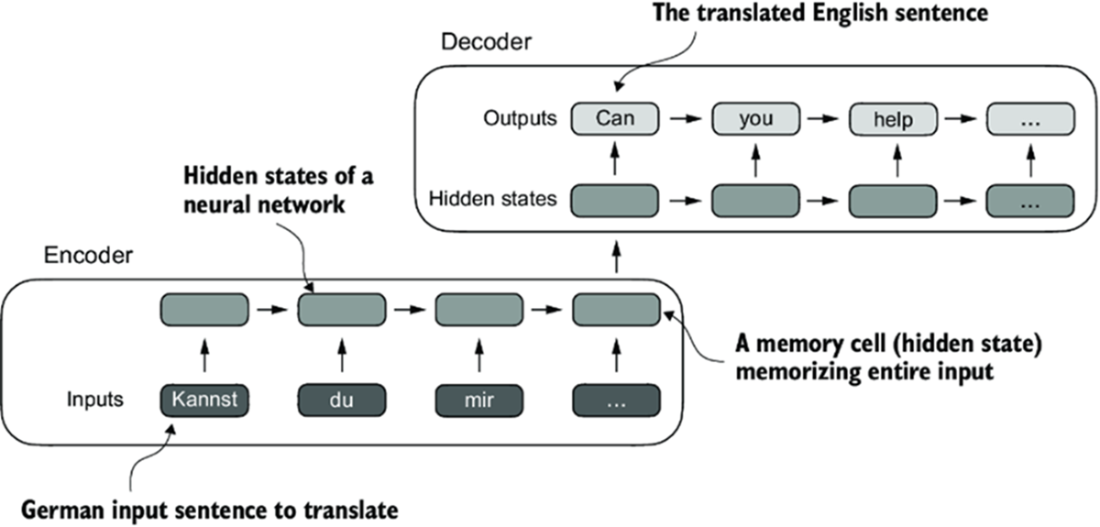
```Encoder-decoder RNN architecture for language translation. The encoder processes the input sequence sequentially, compressing all information into a single hidden state. The decoder then uses this bottleneck representation to generate the output. A key limitation is that the decoder cannot directly access earlier encoder states. It relies entirely on the compressed final hidden state, which can lead to information loss in longer sequences. Image from Sebastian Raschka’s book Build a Large Language Model (From Scratch) [8].
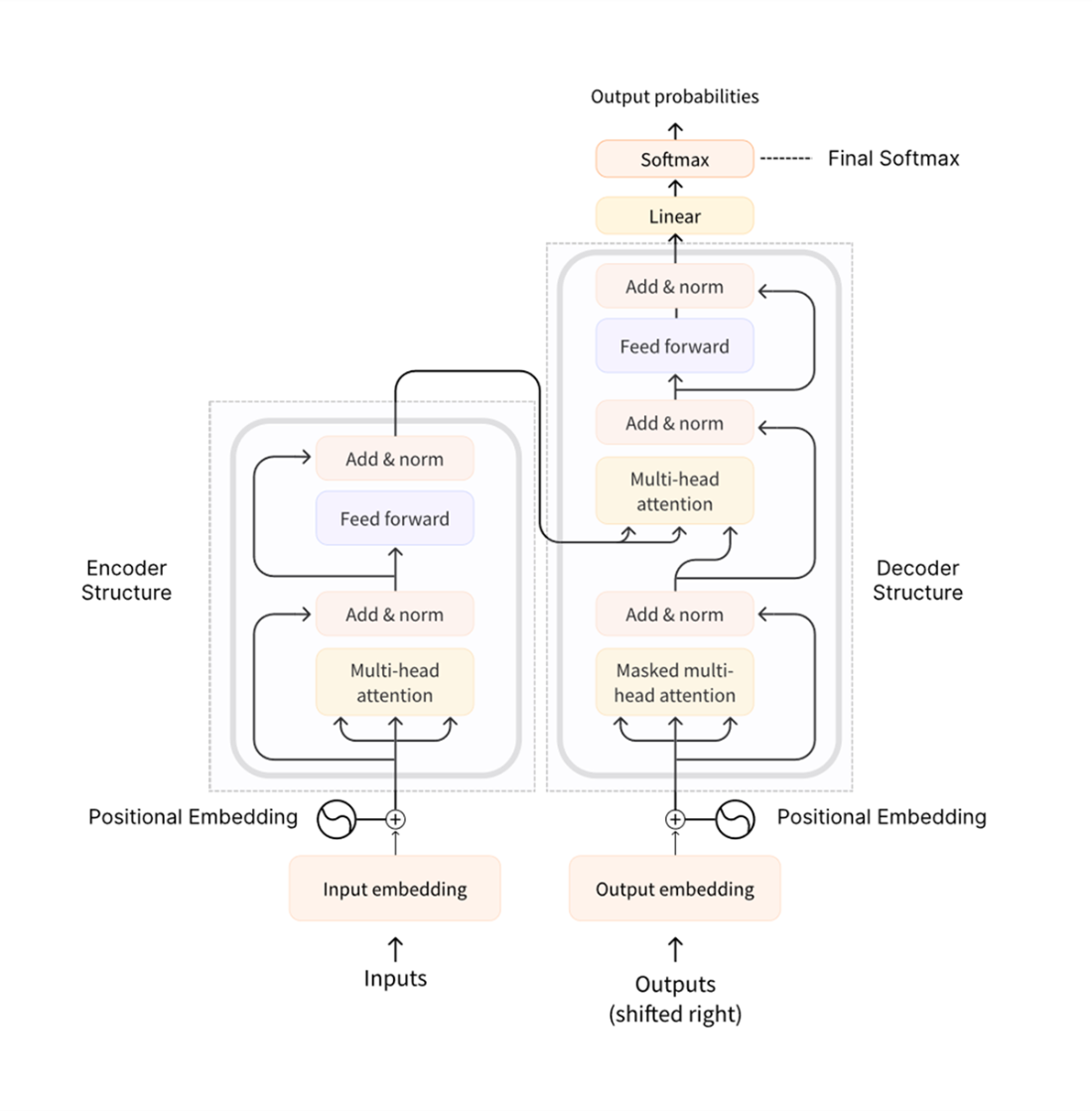
Transformer model architecture. It consists of an encoder stack (left) and a decoder stack (right). The encoder processes the input sequence using multi-head self-attention (MSA) and multi-layer perceptron (MLP) blocks with residual connections and layer normalization (Add & LN). The decoder processes the target sequence using masked multi-head self-attention (MMSA) and multi-head cross attention (MCA) to integrate encoder features, then projects the output to probabilities through a linear layer and softmax. Source: [9]
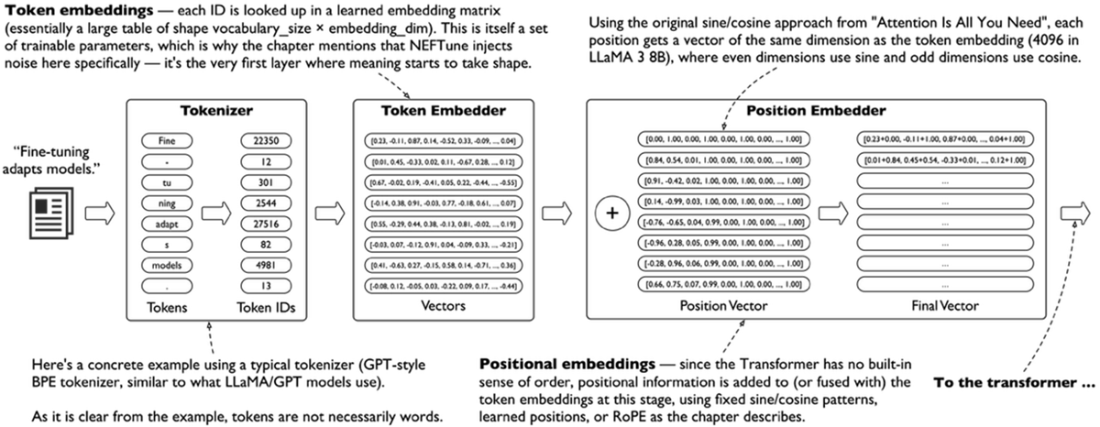
The input pipeline before the Transformer block including the positional embedding. Raw text is tokenized into subword units and mapped to integer IDs, which are then looked up in a learned embedding matrix to produce dense token vectors. Positional embeddings encoding each token's position in the sequence are added to the token embeddings, producing the final input matrix passed to the first Transformer block.
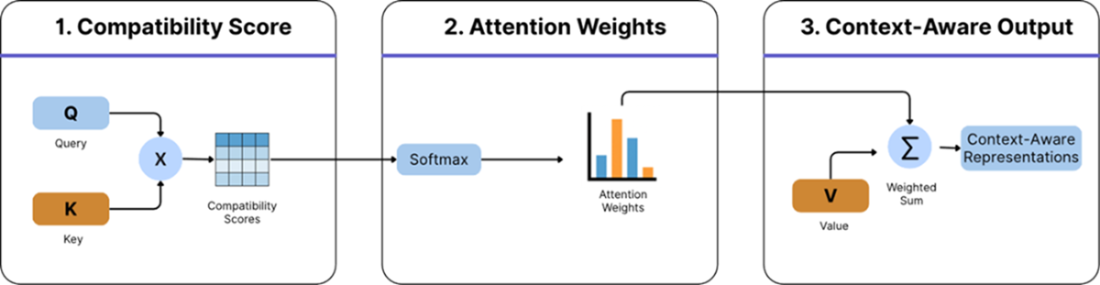
The computation is visualized in three stages: (1) Compatibility Scores are generated by multiplying the Queries and Keys; (2) these scores are normalized with a softmax function to produce Attention Weights; (3) the final Context-Aware Output is derived by computing the weighted sum of the Values based on the calculated attention weights.
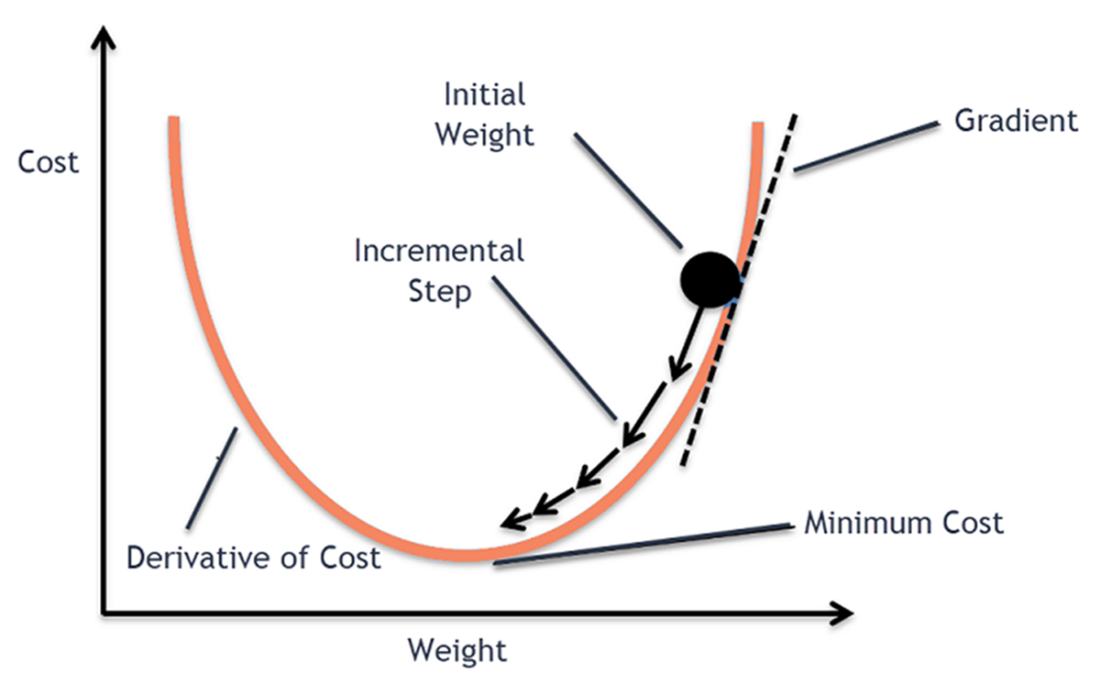
Gradient descent principle illustrated with a single weight variable. For LLMs, the same principle applies to billions of parameters.
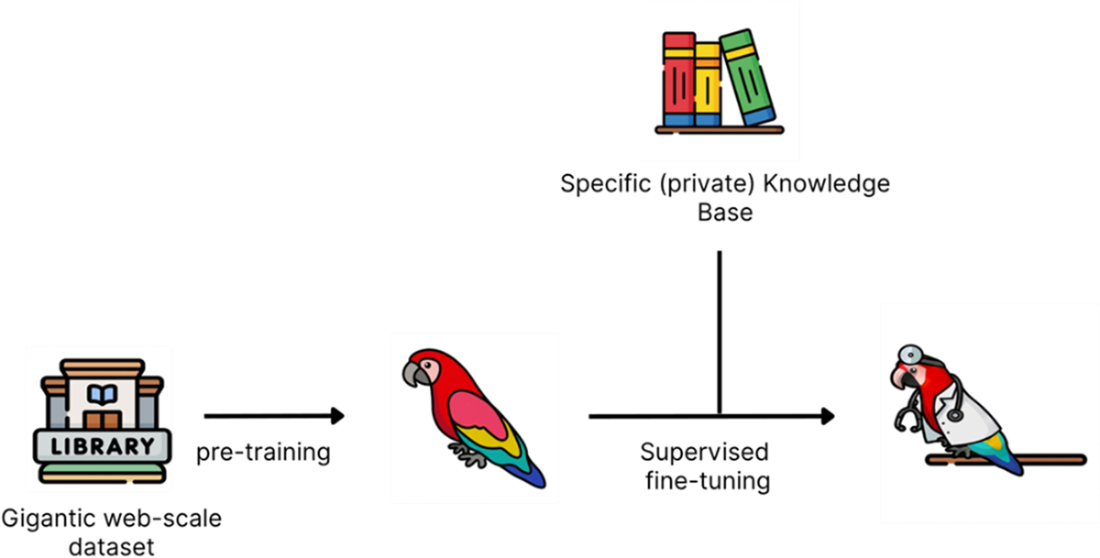
Basic elements of supervised fine-tuning. Starting from a pretrained LLM (the base model), fine-tuning generates a new model using specific knowledge.
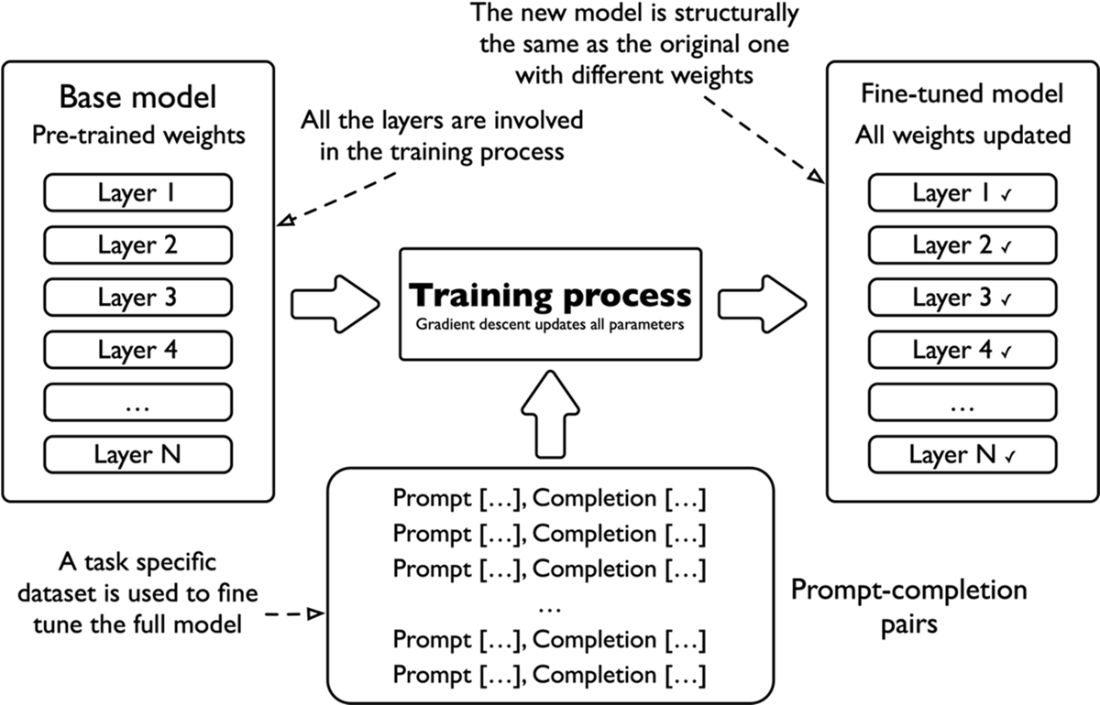
Full parameter fine-tuning. The base model is adapted using a domain-specific training dataset, with gradient descent propagating through all layers. The resulting fine-tuned model retains the original architecture but has every weight updated — unlike LoRA or other PEFT methods, nothing is frozen.
In layer-wise fine-tuning, instead of adjusting all the parameters at once, training focuses on one layer at a time. This makes the adaptation more controlled and focused. In the end, all the parameters are tuned.
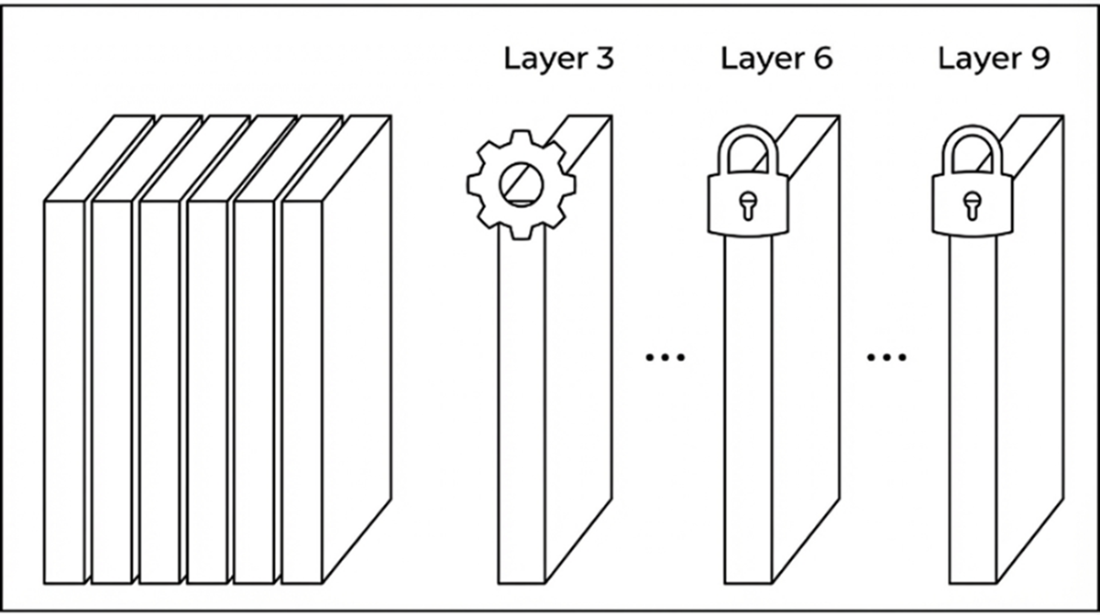
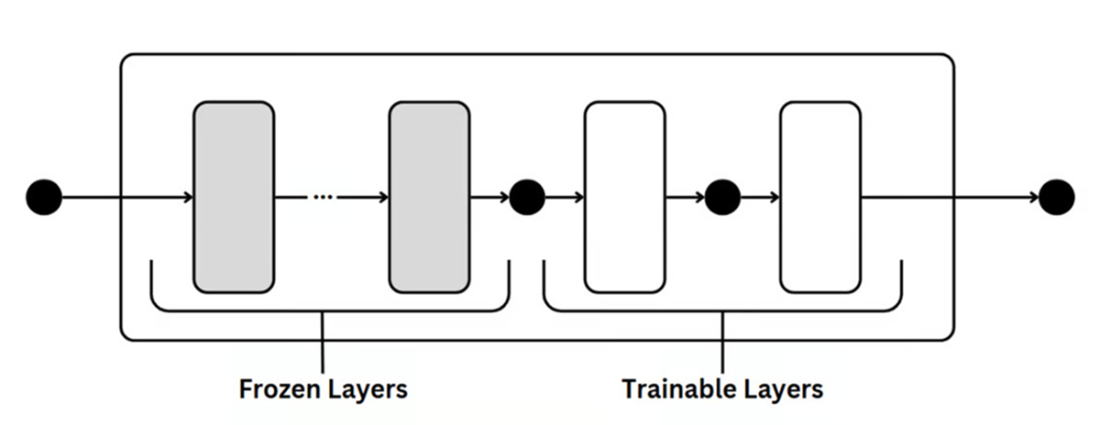
Only half of the layers are fine-tuned; the others are frozen during training.
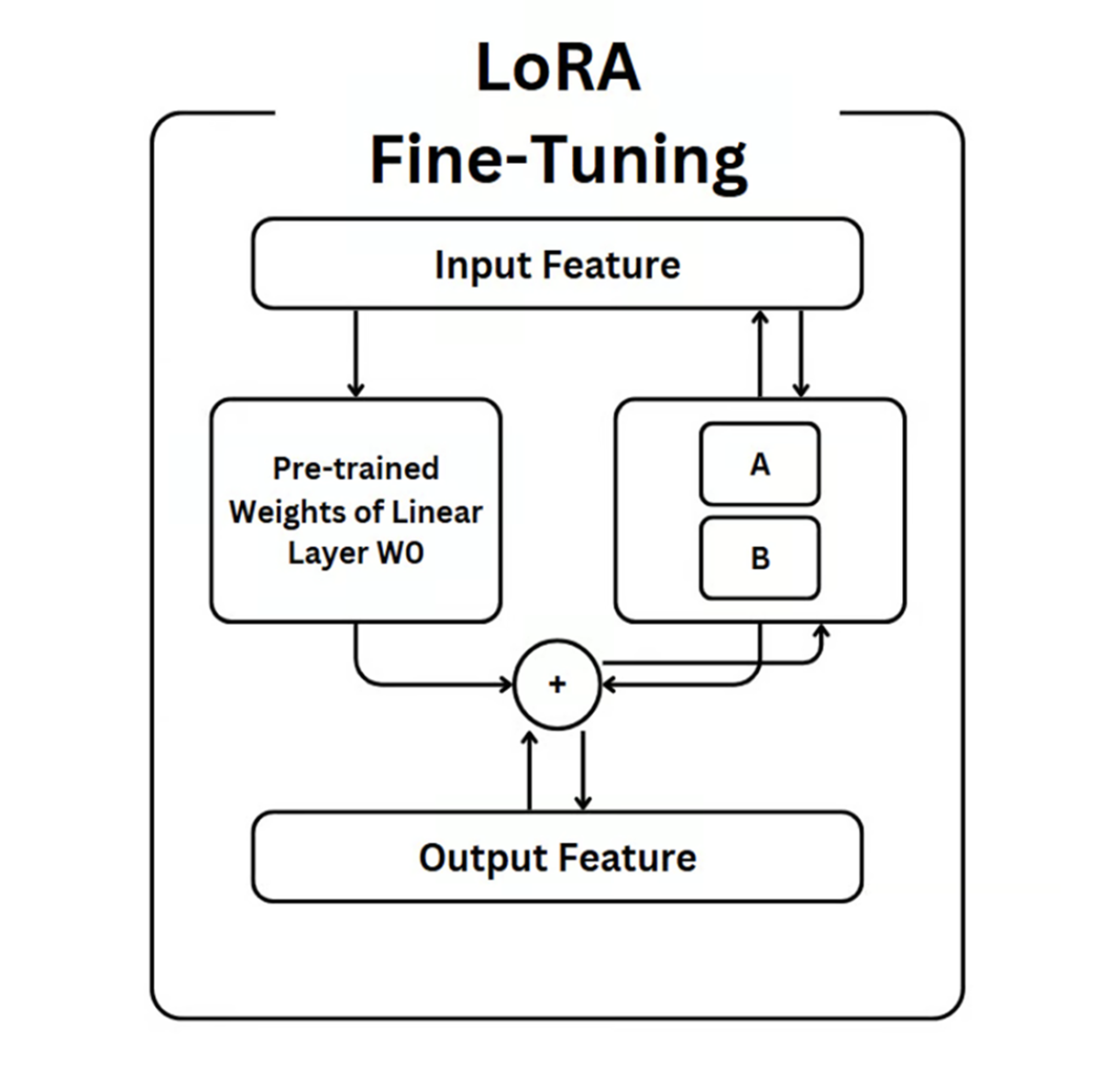
LoRA architecture, where the low-rank matrices A and B are fine-tuned while the pre-trained model remains untouched.
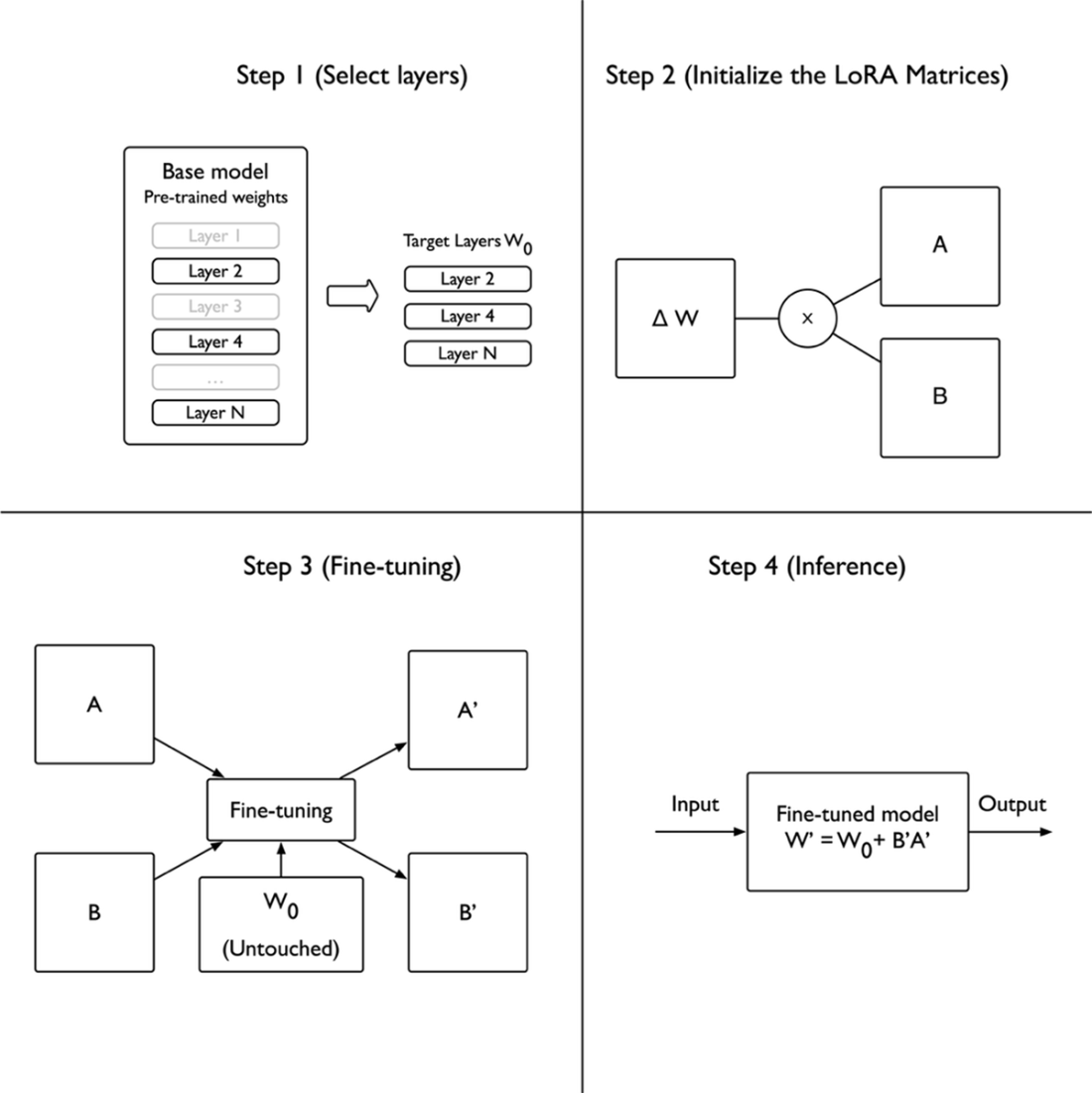
The LoRA workflow. Visual breakdown of the fine-tuning process: selecting target layers in a pretrained model, decomposing weights, training low-rank adapters (A′, B′), and merging them back into the final model architecture.
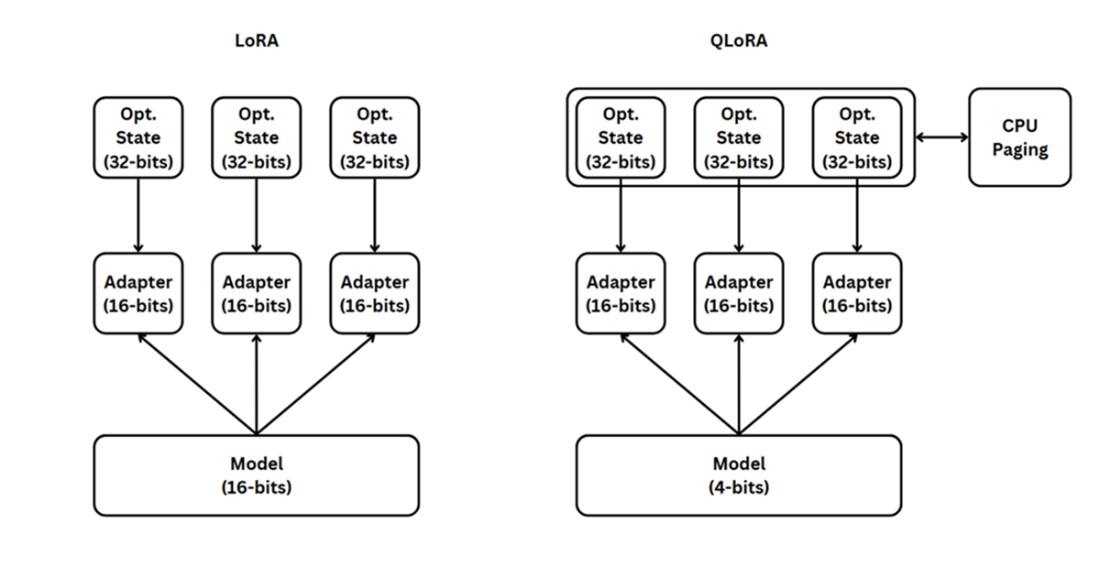
compares LoRA and QLoRA side by side. QLoRA uses a quantized model instead of the original model. It can also offload optimizer states to CPU memory when GPU memory is tight.
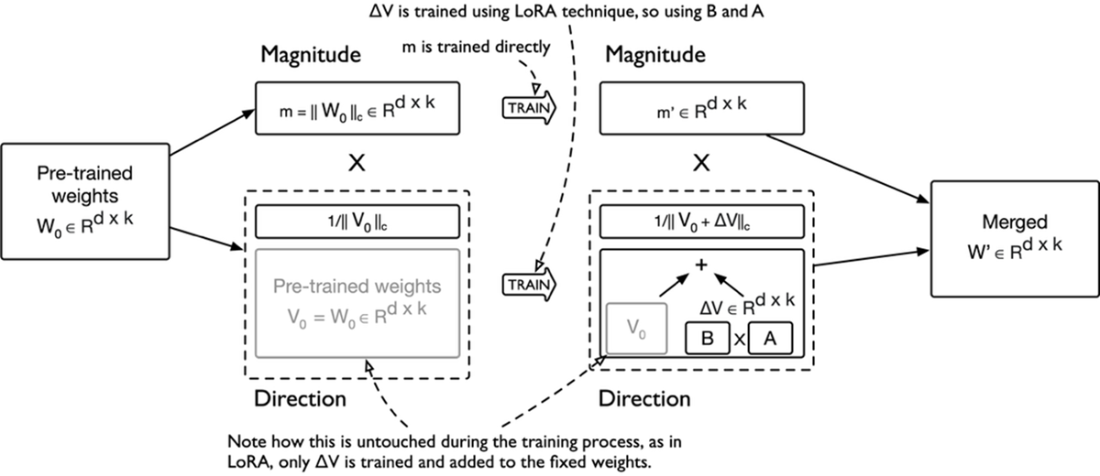
DoRA architecture. DoRA improves on standard LoRA by decomposing the pre-trained weight into magnitude and direction components for fine-tuning. LoRA is then applied to efficiently update the direction component. Note that || ||c denotes the vector-wise norm of a matrix across each column vector.
Summary
- The Transformer architecture is the backbone of modern language models. It uses self-attention to capture complex contextual dependencies and to build robust pre-trained representations that are later adapted during fine-tuning.
- Gradient descent is the fundamental algorithm behind all fine-tuning. It uses loss functions, backpropagation, and optimizers such as SGD and Adam to iteratively update model parameters.
- Supervised fine-tuning adapts pre-trained models using labeled examples that pair inputs with desired outputs, providing a clear adaptation signal.
- Full-parameter fine-tuning updates every parameter in the model, offering maximum specialization but requiring substantial computational resources and risking catastrophic forgetting.
- Layer-wise fine-tuning (LIFT) progressively tunes one layer at a time, providing controlled adaptation that respects the hierarchical structure of deep networks.
- Half fine-tuning (HFT) and selective layer freezing reduce compute costs by updating only strategic portions of the network (typically the upper layers) while preserving foundational knowledge in the frozen layers.
- Parameter-efficient fine-tuning (PEFT) adds small trainable components instead of updating existing parameters, reducing resource requirements while maintaining performance.
- LoRA decomposes weight updates into low-rank matrices, enabling efficient adaptation with fewer than 1% of the parameters being trainable.
- QLoRA combines LoRA with 4-bit quantization, making large-model fine-tuning feasible on consumer-grade hardware.
- DoRA further refines LoRA by decomposing weights into magnitude and direction, focusing updates where they matter most.
- NEFT adds controlled noise to embeddings during training, improving generalization and reducing overfitting on small datasets.
- Unsupervised fine-tuning uses abundant unlabeled text through domain-adaptive pretraining (DAPT) and task-adaptive pretraining (TAPT), preparing models for specific domains without requiring labeled data.
- All fine-tuning methods involve fundamental trade-offs between depth of adaptation, computational cost, and preservation of the model's original pretrained knowledge.
FAQ
What is the main goal of fine-tuning a pretrained language model?
The main goal is to adapt a pretrained model to a specific task or domain by updating its parameters so it produces better outputs for that use case, rather than learning from scratch.
How is fine-tuning different from training a model from scratch?
In fine-tuning, training starts from pretrained weights, which already contain general language knowledge. Training from scratch starts with random parameters and must learn everything from the beginning.
Why does the Transformer architecture work better than RNNs for fine-tuning large language models?
Transformers process tokens in parallel, handle long-range dependencies more effectively, and provide flexible layouts for generation, representation learning, and sequence-to-sequence tasks. This makes them much more scalable and easier to adapt than sequential RNN-based models.
What happens during gradient descent in fine-tuning?
Gradient descent measures how wrong the model is using a loss function, computes gradients that show how to reduce the error, and updates the parameters step by step to improve performance on the target task.
Why are learning rates usually smaller during fine-tuning than during pretraining?
Fine-tuning uses smaller learning rates to avoid overwriting useful pretrained knowledge. Large steps can destabilize training or cause catastrophic forgetting, while smaller steps make adaptation more controlled.
What is supervised fine-tuning?
Supervised fine-tuning uses labeled examples where each input is paired with the desired output. The model learns by matching its predictions to these correct outputs, making it one of the most intuitive fine-tuning approaches.
What is the difference between full-parameter fine-tuning and layer-wise fine-tuning (LIFT)?
Full-parameter fine-tuning updates every parameter in the model at once. Layer-wise fine-tuning updates layers sequentially, typically freezing most layers while training one layer or group of layers at a time to improve stability and control.
Why do practitioners use selective layer freezing or half fine-tuning?
Selective layer freezing reduces compute and memory use while preserving pretrained knowledge. Half fine-tuning updates only part of the network, often the upper layers, to strike a balance between adaptability and stability.
How does LoRA reduce the cost of fine-tuning?
LoRA keeps the pretrained weights frozen and adds small low-rank matrices that learn the task-specific update. This means only a tiny fraction of parameters are trained, greatly reducing memory and compute requirements.
What makes QLoRA, DoRA, and NEFTune different from standard LoRA?
QLoRA adds 4-bit quantization to reduce memory further, DoRA decomposes weights into magnitude and direction for finer adaptation, and NEFTune adds noise to embeddings during training to improve instruction-following and reduce overfitting.

 Building Specialized AI Systems ebook for free
