1 The rise of specialized models
General-purpose large language models are powerful, but the chapter argues that their breadth becomes a liability in mission-critical settings that require precision, consistency, privacy, and domain expertise. It explains that LLMs derive their capabilities from massive scale, yet that same scale brings high costs, infrastructure demands, stylistic sameness, stale knowledge, and weaker performance on narrowly defined tasks. As a result, organizations that need reliable outcomes in areas like customer support, finance, healthcare, law, or internal operations often need something more focused than a general chatbot.
The chapter then examines why prompt engineering and retrieval-augmented generation help, but do not fully solve these problems. Prompting can improve results, yet it is brittle, sensitive to formatting, and unable to overcome the model’s underlying knowledge ceiling or nondeterministic behavior. RAG adds access to external information and can improve factuality, but it does not create true domain reasoning or fix the gap between having information and using it well. The central limitation in both approaches is that they mostly adjust inputs to a general model rather than changing the model’s learned behavior.
To address that gap, the chapter introduces specialized language models built through fine-tuning, which adapt a foundation model to a specific domain or task. It outlines how fine-tuning works, from choosing a base model and curating high-quality training data to training, evaluation, deployment, and ongoing monitoring, and highlights efficient methods such as LoRA and QLoRA that reduce the compute burden. The chapter concludes with a decision framework showing when to use prompting, RAG, fine-tuning, or combinations of them, emphasizing that specialization is most valuable when accuracy, consistency, privacy, scale, or strategic differentiation matter most.
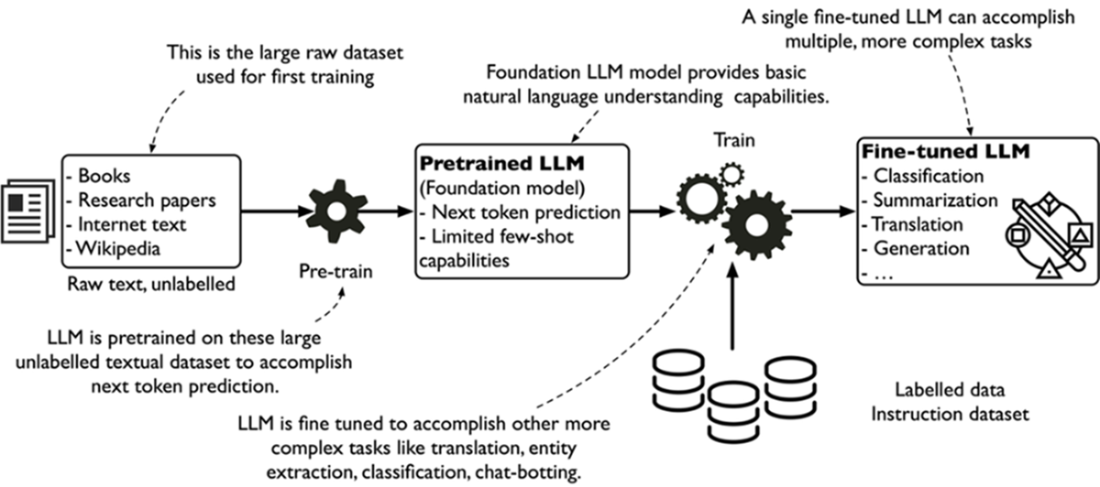
Training process for general-purpose LLMs. Phase 1 (pre-training) ingests massive raw text corpora to build foundational language understanding; Phase 2 (instruction tuning/RL) uses curated labeled datasets to align the model toward helpful, accurate behavior.
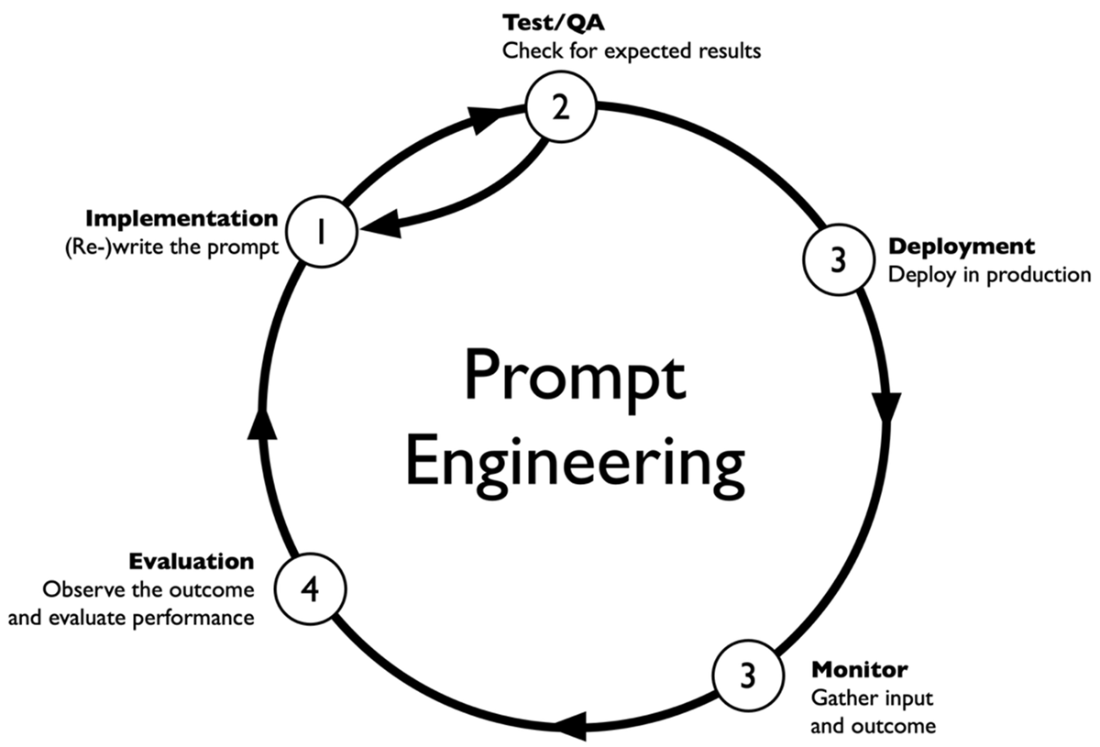
Prompt engineering. The process is iterative: you try different configurations, test them in QA environment, deploy to production, gather outcome, evaluate the results, and improve the prompt with each iteration.
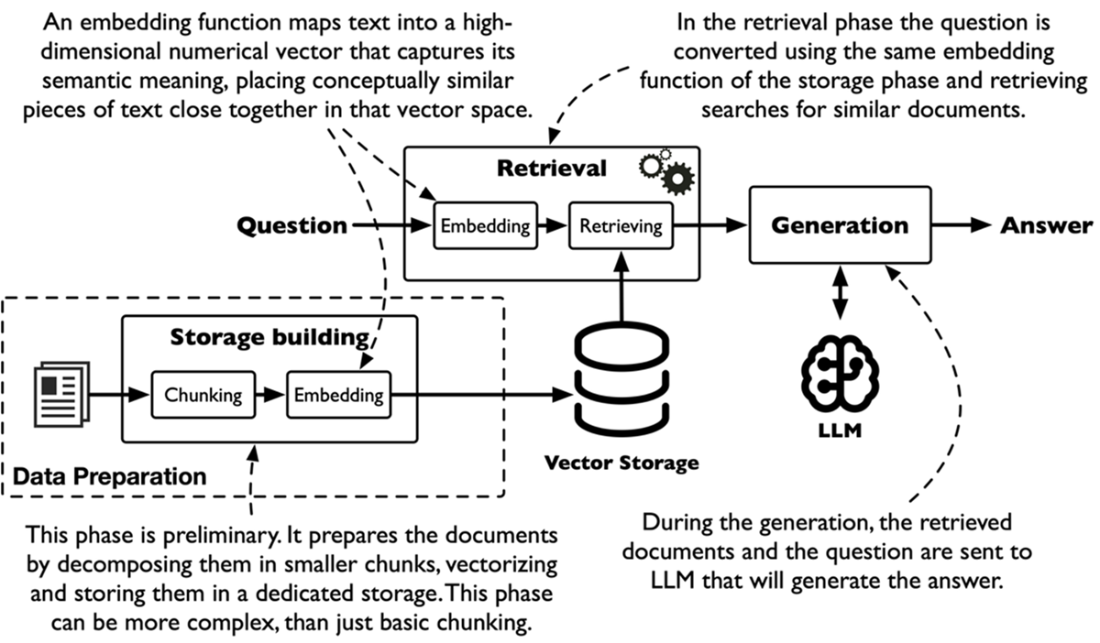
RAG process. It requires preprocessing the documents and storing them in a vector store, where chunks are paired with their vector representations and other metadata. The answering process is split into two phases: retrieval and generation. The first searches for chunks like the question; the second generates an answer by passing the retrieved documents to the LLM.
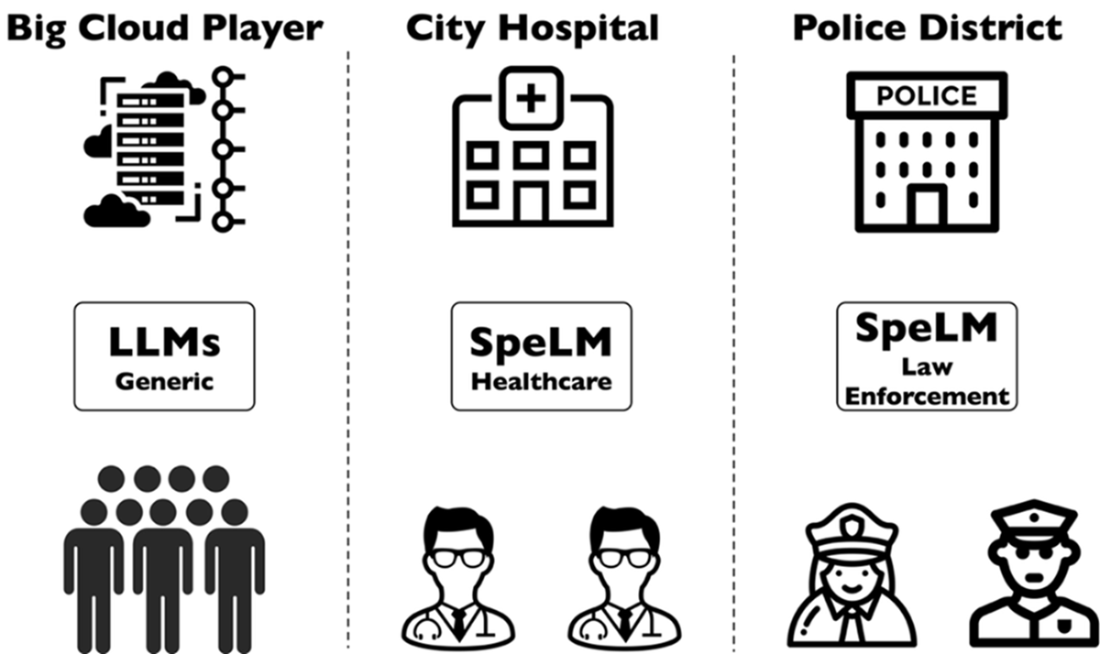
Examples of LLM specialization in mission-critical use cases. While generic LLMs support multiple use cases for a broader set of users, specialized language models can serve very specific needs in particular domains.
Transfer learning illustrated: a model's knowledge, acquired during pretraining on a broad task, is carried forward and adapted for a more specific downstream task. Fine-tuning is the practical application of this principle in the context of LLMs — the mechanism by which a general-purpose foundation model becomes a SpeLM.

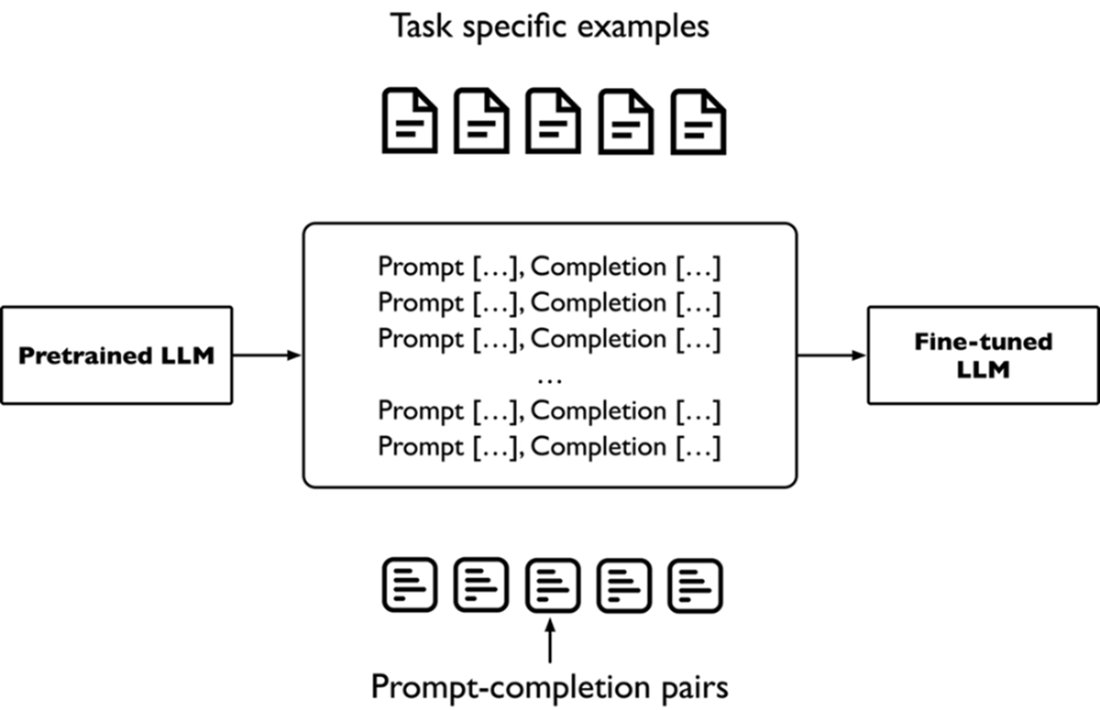
A schematic representation of supervised fine-tuning (SFT): a pretrained LLM is adapted for downstream tasks using labeled prompt-completion pairs, where each pair teaches the model to associate a given input context with the desired output behavior.
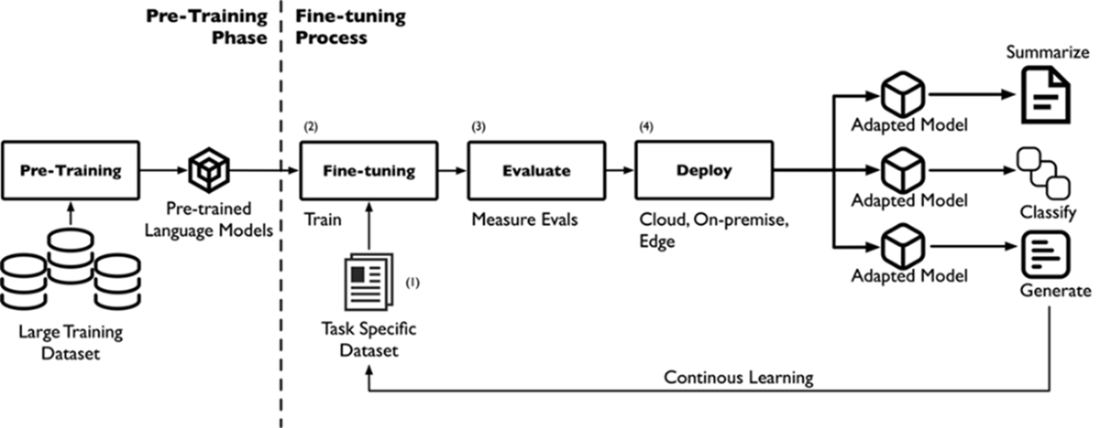
Task-specific fine-tuning process. Pretraining creates a base model that is then further trained to perform multiple, more complex tasks, such as summarization, classification, and code or text generation.
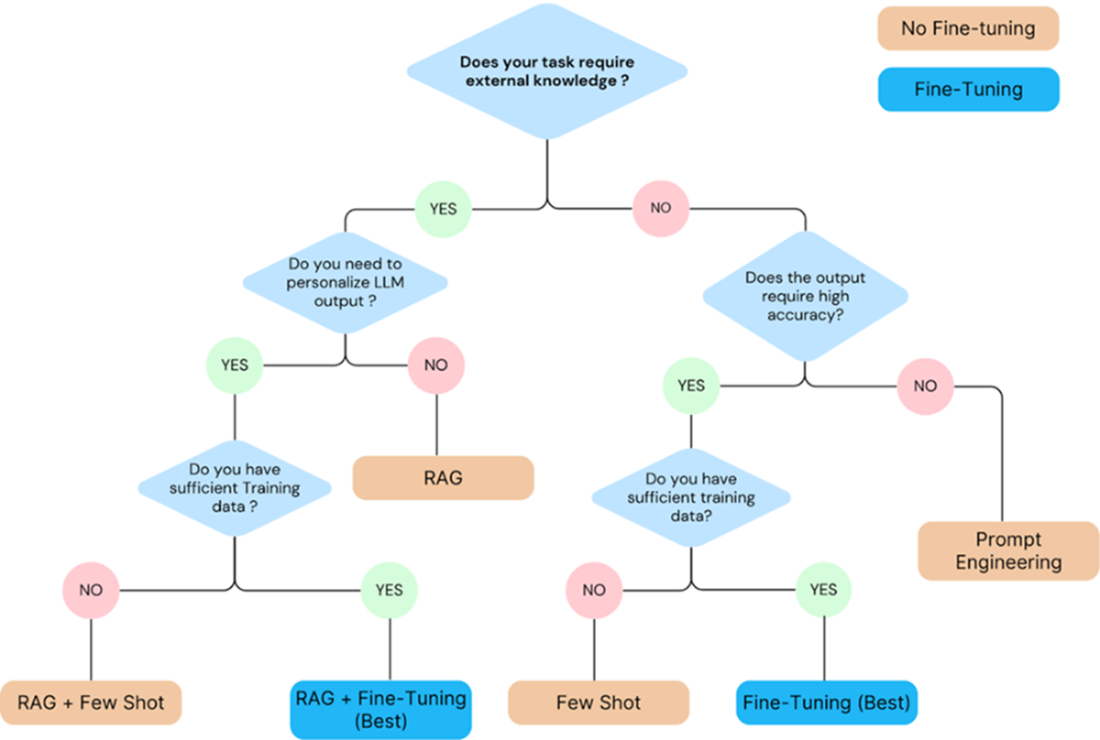
Decision tree showing when to fine-tune. It provides high-level guidance on which approach best fits your needs. In many scenarios, RAG or prompt engineering is the right choice, or the best place to start.
Summary
- General-purpose LLMs face fundamental limitations in mission-critical applications, including accuracy trade-offs (models optimized for everything excel at nothing), privacy constraints that require cloud processing, and prohibitive costs at scale, making them unsuitable for precision-demanding business scenarios.
- Prompt engineering and RAG systems cannot overcome the "knowledge ceiling problem"
- No amount of clever prompting or information retrieval can provide the deep, interconnected domain expertise that comes from specialized training on curated datasets guided by subject-matter experts.
- Specialized Language Models (SpeLMs) deliver measurable competitive advantages
- Significant performance improvements in domain-specific tasks, substantial cost reductions for high-volume applications, consistent outputs aligned with professional standards, and proprietary capabilities that competitors cannot easily replicate.
- Fine-tuning uses transfer learning to adapt pre-trained foundation models to specific domains through a systematic five-step process
- Selecting foundation models, curating high-quality training data, configuring training with parameter-efficient techniques like LoRA/QLoRA, evaluating results, and deploying to production.
- The decision to specialize depends on a framework
- Tasks requiring high accuracy without external knowledge benefit from fine-tuning alone; applications needing both domain expertise and dynamic information require RAG plus fine-tuning; and low-stakes, creative tasks are well served by prompt engineering or few-shot learning.
FAQ
What are specialized language models (SpeLMs) and why are they important?
Specialized language models are AI systems adapted for specific domains or tasks through fine-tuning. They trade broad generalization for deeper expertise, making them especially valuable for mission-critical applications that require precision, consistency, and reliability.
Why can’t general-purpose LLMs always handle mission-critical business tasks well?
General-purpose LLMs are powerful, but they often fall short when applications demand high accuracy, stable outputs, deep domain knowledge, or compliance with strict business requirements. In these cases, their broad design can lead to inconsistent or suboptimal results.
What are the main limitations of prompt engineering?
Prompt engineering can improve model behavior, but it is limited by the model’s original training, can be brittle across small prompt changes, and does not guarantee consistent outputs. It also requires ongoing maintenance as models, tasks, and user inputs change.
What does RAG solve, and where does it still fall short?
Retrieval-Augmented Generation helps models access current or external information by injecting retrieved content into the prompt. However, RAG does not fix the model’s underlying reasoning ability, and it can still fail when retrieval is poor, context windows are limited, or domain-specific synthesis is required.
How does fine-tuning differ from prompt engineering and RAG?
Fine-tuning changes the model’s weights using training data, while prompt engineering changes only the instructions and RAG adds retrieved context. Fine-tuning is better when you need the model itself to learn specialized behavior, reasoning patterns, style, or domain expertise.
What are SFT, RLHF, LoRA, and QLoRA?
Supervised Fine-Tuning (SFT) trains a model on labeled examples. RLHF uses human feedback to align behavior. LoRA fine-tunes only a small set of added parameters, making training efficient. QLoRA further reduces memory use through quantization, enabling fine-tuning on less powerful hardware.
When should an organization choose a specialized model instead of a general-purpose one?
Choose a specialized model when the task requires high accuracy, strong consistency, domain expertise, sensitive data handling, or significant scale where cost matters. Specialized models are especially useful for regulated industries, proprietary workflows, and repetitive production tasks.
What benefits do specialized models offer over general-purpose LLMs?
They can deliver higher performance on targeted tasks, lower inference costs, better privacy through local deployment, and more consistent outputs. They also create proprietary capabilities that can be difficult for competitors to replicate.
How should you decide between prompt engineering, RAG, and fine-tuning?
If the task is low-stakes and needs no external knowledge, prompt engineering may be enough. If external knowledge is needed, RAG is useful. If you need both external knowledge and specialized behavior, combine RAG with fine-tuning when sufficient training data is available.
What is the basic workflow for building a fine-tuned specialized model?
The process usually includes selecting a foundation model, preparing high-quality domain data, configuring and running fine-tuning, evaluating performance with both automated and human review, and deploying the model with ongoing monitoring and retraining as needed.

 Building Specialized AI Systems ebook for free
