8 Multi-Agent Systems
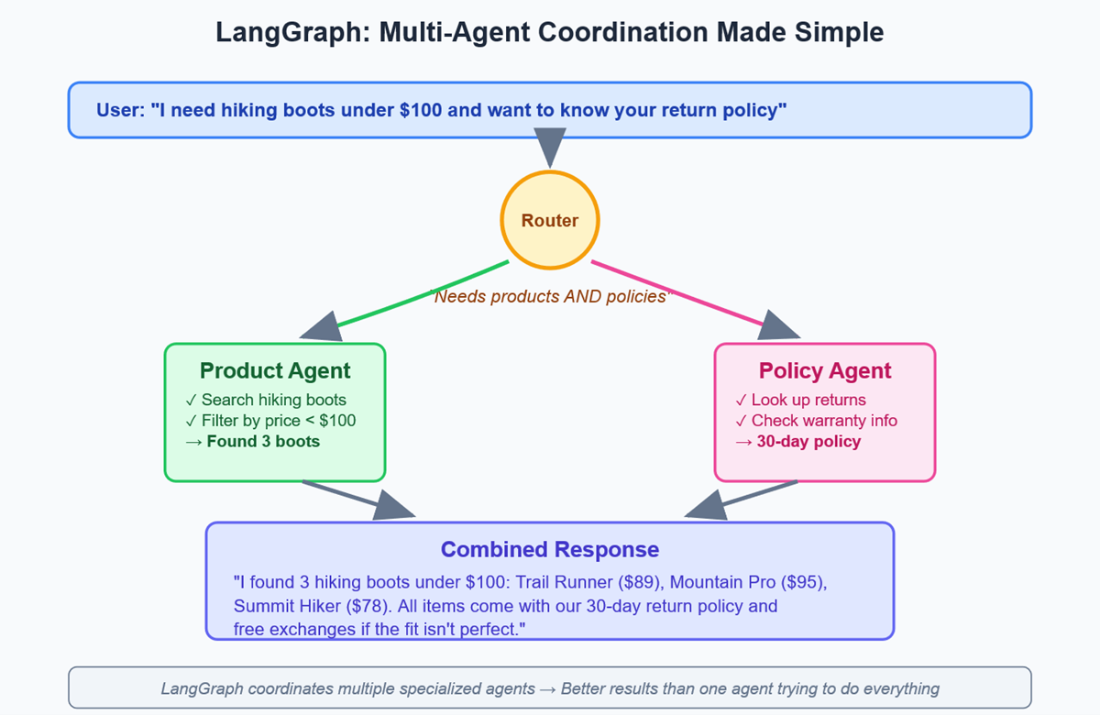
This chapter explains why reliable AI applications often need multi-agent architectures instead of a single monolithic LLM. Real customer interactions may combine product search, policy questions, images, constraints, and follow-ups in one request, which can overload a single agent and make behavior inconsistent. The chapter presents the multi-agent approach as a way to divide responsibility among specialized agents—such as search, policy knowledge, vision processing, and response coordination—while using an orchestrator to route work and synthesize a coherent final answer.
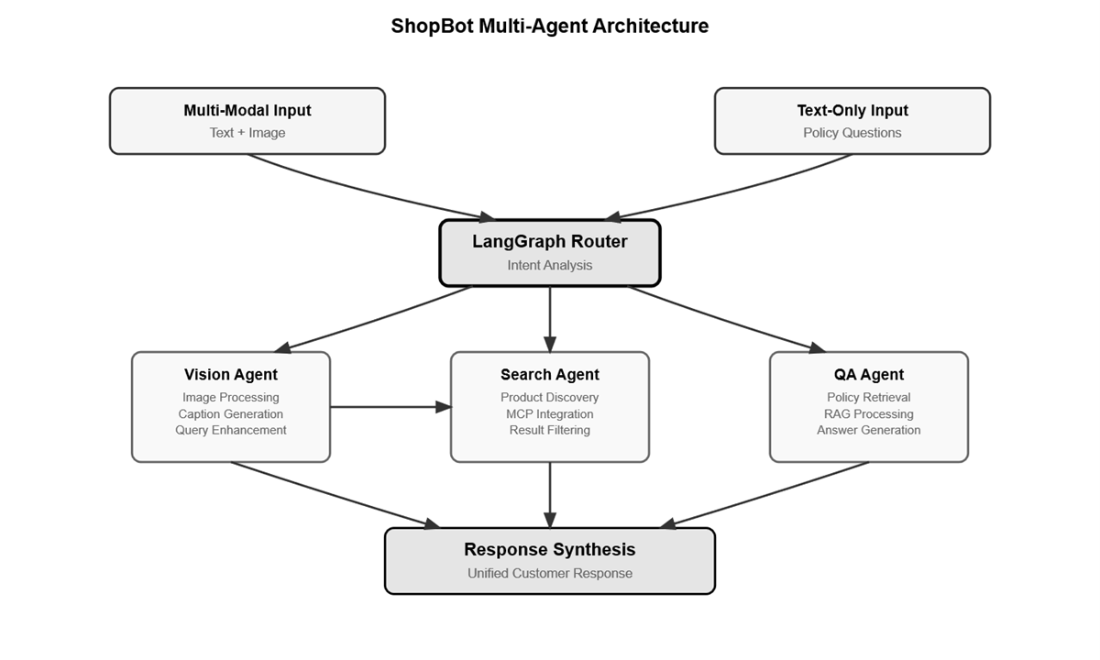
The main implementation example is ShopBot, a production-style shopping assistant built with LangGraph. LangGraph provides shared state, nodes, edges, conditional routing, error handling, and observability, making it well suited for workflows where agents must coordinate across multiple steps. ShopBot uses intent analysis to decide whether a query needs product search, policy retrieval, vision-based processing, or some combination of these. Its SearchAgent handles product discovery, its QAAgent uses RAG to answer grounded policy and business-knowledge questions, and its VisionAgent turns image context into searchable text that can be reused by the existing search flow. A synthesis step then combines all agent outputs into a single customer-facing response.
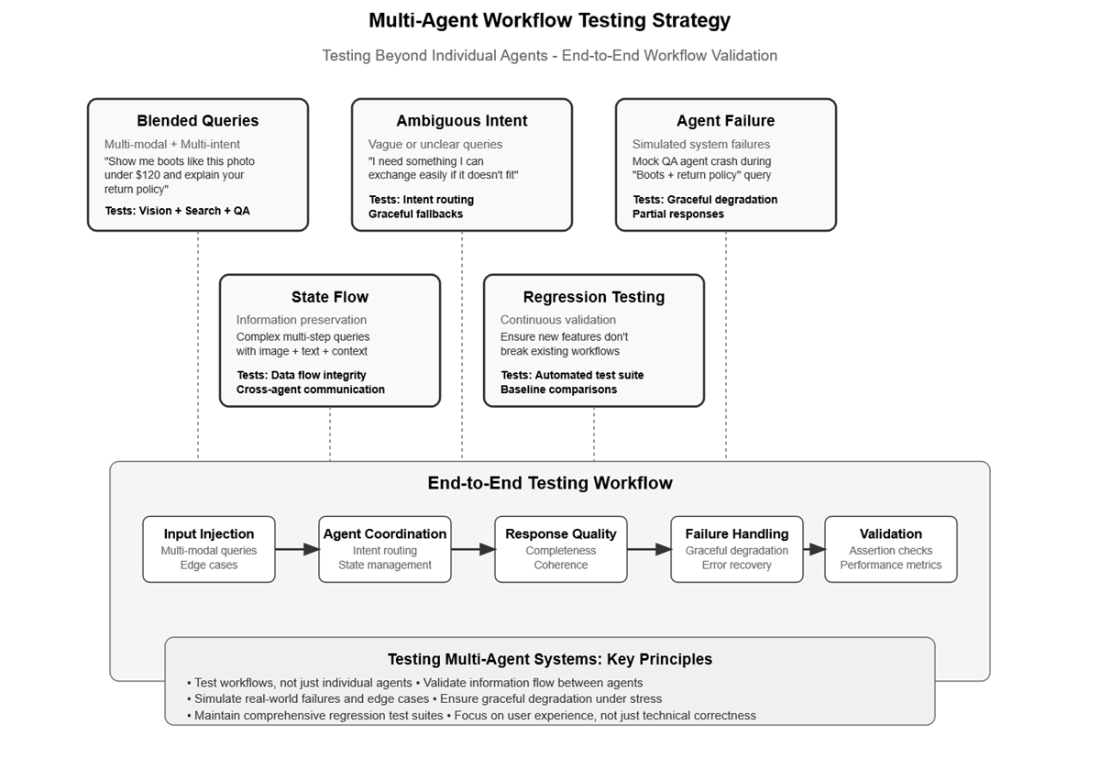
The chapter also emphasizes that multi-agent systems must be tested as complete workflows, not just as isolated agents. Important test categories include blended multimodal queries, ambiguous intent routing, agent failure resilience, state preservation across agents, and regression testing as new capabilities are added. Finally, it compares LangGraph with CrewAI: LangGraph offers explicit control over state and routing for complex workflows, while CrewAI provides a higher-level, role-based model that is useful for faster prototyping and simpler sequential tasks. The core lesson is that frameworks may vary, but reliable multi-agent systems depend on the same patterns: specialization, orchestration, state management, graceful failure handling, and response synthesis.
Complete ShopBot Multi-Agent Architecture - A production-ready e-commerce AI assistant that coordinates specialized agents through LangGraph orchestration
ShopBot Multi-Agent Architecture with Vision Capabilities - LangGraph orchestrates three specialized agents to handle complex customer queries
Multi-Agent Workflow Testing Strategy - Comprehensive testing approach for multi-agent systems that goes beyond individual agent validation.
Summary
- Multi-agent architecture solves the monolithic agent problem by dividing responsibilities among specialized agents, each excelling in its domain (search, policy Q&A, or vision processing).
- LangGraph is a workflow framework for building multi-agent systems using shared state, conditional routing, and node-based orchestration. It serves as the conductor, deciding which agents to run and preserving information between steps.
- State management in LangGraph ensures all agents can read from and write to a shared data structure, preserving context across the entire workflow.
- Conditional routing enables intelligent decisions about which agents to invoke based on analyzed user intent, allowing dynamic adaptation to each query.
- RAG-powered agents ground responses in real business knowledge, preventing hallucinations about policies, procedures, and product information.
- Vision capabilities enable multimodal interactions where users can upload images and combine visual context with text queries.
- Testing multi-agent workflows requires validating coordination, not just individual agents, focusing on blended queries, ambiguous intent, failure handling, and state continuity.
- Agent failure resilience ensures the system degrades gracefully when individual components encounter problems, maintaining helpful responses even during infrastructure issues.
- CrewAI offers an alternative approach using role-based agents with goals and backstories instead of explicit state graphs, choose the framework that matches your mental model and requirements.
- Production-grade multi-agent systems prioritize reliability over novelty, implementing comprehensive testing frameworks and systematic approaches to debugging agent interactions.
- The future of AI lies in orchestrated multi-agent systems that can reason, collaborate, and act independently while maintaining consistency, accuracy, and trustworthiness at enterprise scale.
FAQ
Why do multi-agent architectures outperform monolithic AI systems?
Multi-agent architectures avoid the “monolithic agent problem,” where one LLM tries to handle product search, policy knowledge, image understanding, routing, and response synthesis all at once. A single agent can become mediocre at everything because its context fills with unrelated information and its behavior becomes harder to maintain. Multi-agent systems instead use specialized agents, such as a SearchAgent, PolicyAgent, VisionAgent, and Coordinator, so each component can focus on one domain while an orchestrator combines their outputs into a coherent answer.
What is the role of the orchestrator in a multi-agent system like ShopBot?
The orchestrator acts as the system’s conductor. It analyzes the user’s intent, decides which agents should run, manages shared state, routes the workflow through the correct steps, handles errors, and synthesizes the final customer-facing response. In the chapter’s ShopBot example, LangGraph is used as the orchestrator to coordinate product search, policy Q&A, vision-based search, and final response generation.
What are the main specialized agents used in ShopBot?
ShopBot uses several specialized agents:
- SearchAgent: Finds and filters relevant products from the catalog.
- QAAgent or PolicyAgent: Answers business-policy and product-knowledge questions using RAG.
- VisionAgent: Converts image-derived captions plus user text into searchable product queries.
- Coordinator or synthesis step: Combines agent outputs into one helpful, natural response.
How does LangGraph help build reliable multi-agent workflows?
LangGraph provides the core workflow structure for multi-agent systems. It supports shared state, nodes, edges, conditional routing, cycle management, error handling, and observability. These features let developers define explicit workflows where each agent reads from and writes to shared state, while routing logic determines which agent should run next based on the user’s intent or intermediate results.
What are LangGraph’s core concepts?
LangGraph’s core concepts are:
- State: A shared data structure available across the workflow.
- Nodes: Agents or processing steps.
- Edges: Connections that define the flow between nodes.
- Conditional edges: Dynamic routes chosen based on state or agent outputs.
- Graph: The complete orchestrated workflow.
Why use LLM function calling for intent analysis?
Function calling provides a more reliable way to parse user intent than brittle keyword matching. Instead of guessing from simple words, the LLM produces structured outputs such as whether product search is needed, whether policy Q&A is needed, and why. This structured intent analysis allows the orchestrator to route queries dynamically to the right agents.
How does the QAAgent use RAG to answer policy questions?
The QAAgent uses Retrieval-Augmented Generation to ground its answers in real business documents. The chapter’s RAG system loads business knowledge, splits it into chunks, tags chunks by type such as return policy, shipping, product care, or sizing, embeds them into a FAISS vector store, retrieves relevant context, and then generates an answer based on that context. This reduces hallucination and keeps policy answers accurate and testable.
How does the VisionAgent support image-based product search?
The VisionAgent acts as a lightweight bridge between visual input and product search. A separate captioning model, such as GPT-4V or BLIP, first converts the image into text, for example “trail hiking boots.” The VisionAgent combines that caption with the user’s text, such as “waterproof under $120,” and sends the combined query to the existing SearchAgent. This avoids duplicating search logic while enabling multimodal product discovery.
What should be tested in a production multi-agent system?
The chapter emphasizes testing complete workflows, not just individual agents. Important test categories include blended multimodal queries, ambiguous intent handling, agent failure and resilience, state flow and information preservation, and regression testing. These tests validate that agents communicate correctly, shared state is preserved, routing decisions are robust, and the system degrades gracefully when one component fails.
When should you use LangGraph instead of CrewAI?
LangGraph is best when you need precise control over state, routing, branching, cycles, and complex workflows. It suits teams that want explicit graph-based orchestration and typed shared state. CrewAI is better for rapid prototyping and more linear, role-based workflows where agents behave like a team with assigned roles and goals. LangGraph gives more control and debuggability, while CrewAI reduces boilerplate and abstracts coordination details.

 Building Reliable AI Systems ebook for free
