5 Fine-Tuning LLMs for Improved Performance
This chapter explains how fine-tuning helps adapt large language models when prompting and retrieval-augmented generation are not enough. Prompting is best for quick, low-cost improvements, while RAG is better when answers depend on frequently changing or verifiable external information. Fine-tuning is most useful when a model must consistently follow a specialized style, format, workflow, or domain vocabulary, such as in legal, medical, financial, coding, or customer support applications. The chapter also emphasizes that hybrid systems often combine fine-tuning for stable behavior with RAG for fresh or source-backed knowledge.
A major focus is the fine-tuning workflow: preparing high-quality data, choosing the right model and method, training, validating, and monitoring results. The text stresses that fine-tuning success depends heavily on representative, accurate, well-structured examples, with careful attention to formatting, coverage, bias, privacy, validation splits, token limits, and data leakage. It then compares closed-source fine-tuning through managed APIs with open-source approaches using tools such as Hugging Face, PEFT, LoRA, and QLoRA. Full fine-tuning offers maximum adaptation but requires substantial compute, while LoRA and QLoRA reduce memory and cost by training only small adapter components, making large-model customization feasible on more modest hardware.
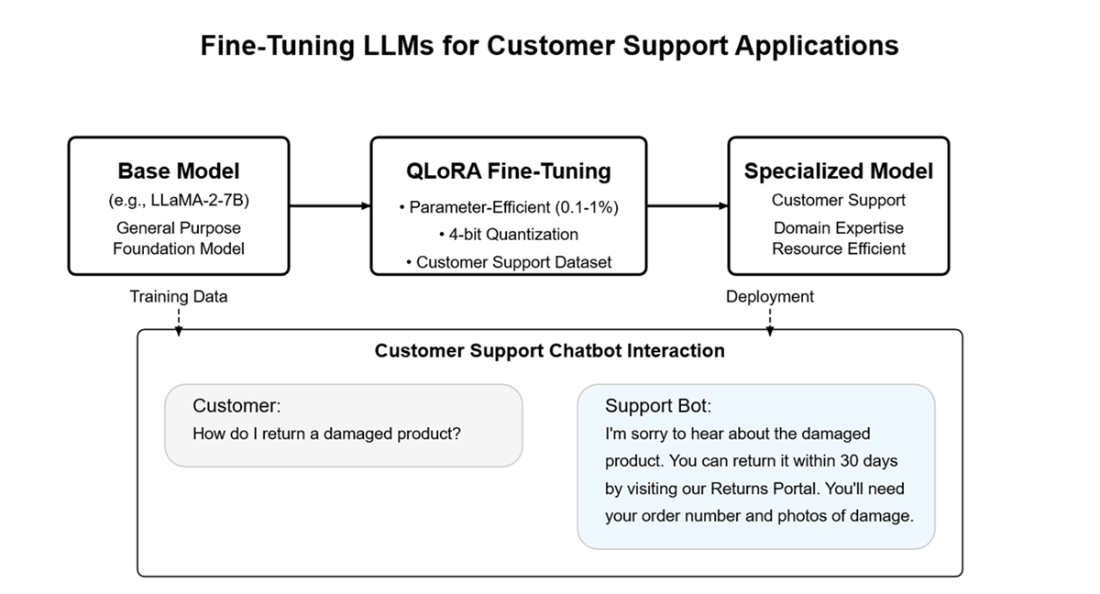
The chapter walks through building a customer support assistant by fine-tuning a LLaMA-based model with QLoRA, covering dataset preparation, quantization, LoRA adapter configuration, training settings, model-specific prompt formatting, evaluation, saving, and deployment. It highlights expected improvements such as better domain knowledge, more consistent tone, structured responses, and fewer hallucinations. Finally, the chapter introduces knowledge distillation as a production strategy: using a powerful teacher model to generate high-quality examples, then fine-tuning a smaller student model to imitate its behavior. This preserves much of the teacher’s quality while reducing cost, latency, and infrastructure requirements for scalable real-world deployment.
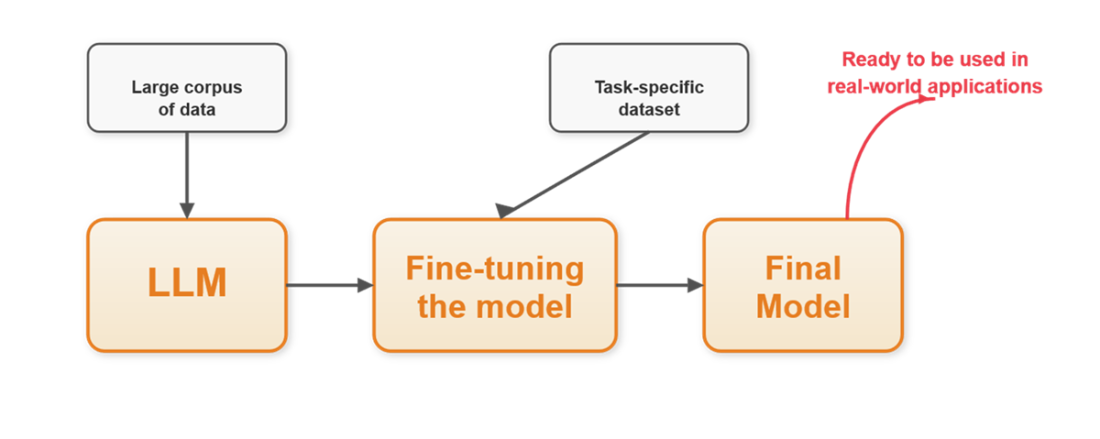
The Fine-Tuning Process - Training a pre-trained model on specialized data to adapt its behavior for specific domains or tasks.
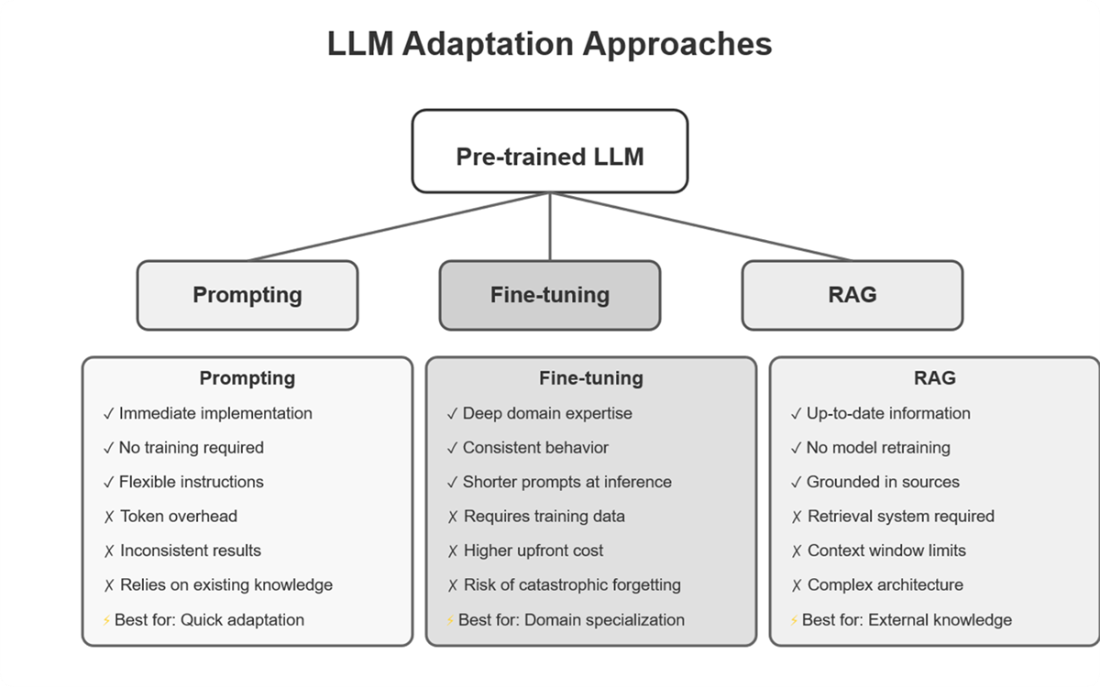
The Different Approaches: Prompting, Fine-Tuning, RAG (Retrieval Augmented Generation) - A comparison of techniques for adapting LLMs to specialized tasks.
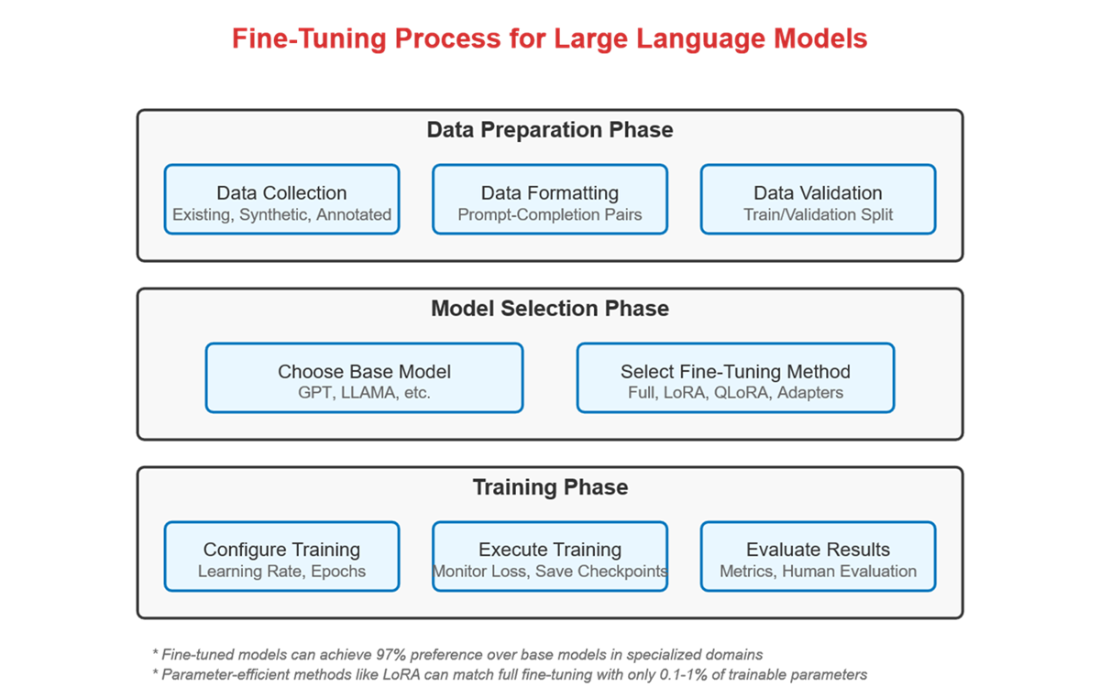
The Fine-tuning process for LLMs: Data Preparation, Model Selection, and Training
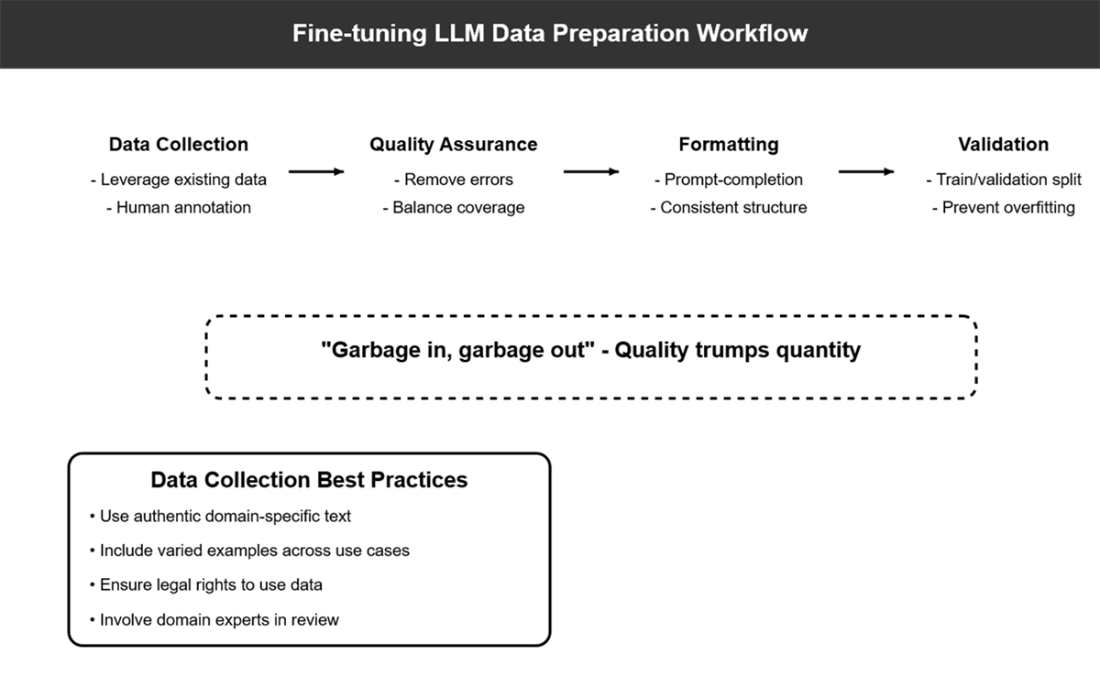
The Fine-Tuning LLM Data Preparation Workflow: the steps needed to successfully prepare your data for finetuning
Our Fine-tuning setup for building a customer support chatbot
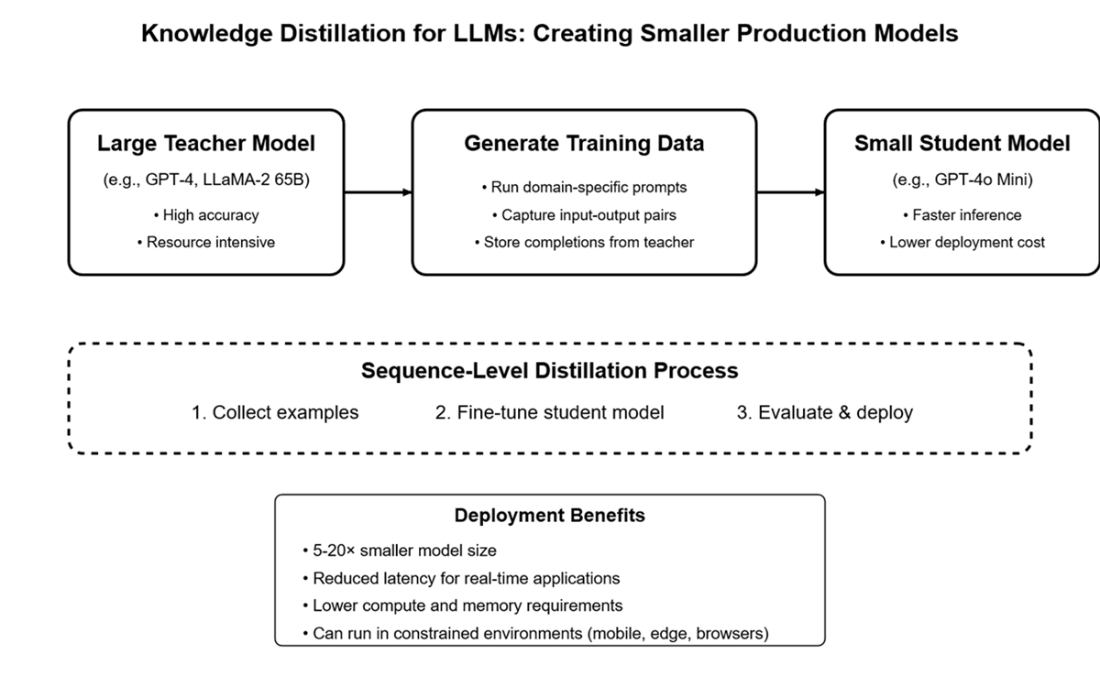
The Knowledge Distillation Process
Summary
- Fine-tuning is a powerful method for adapting LLMs to specialized tasks when prompting and RAG alone aren’t sufficient.
- Prompting is quick and easy for basic tasks, while RAG is ideal for dynamic, factual information retrieval. Fine-tuning provides deep domain customization by updating the model’s weights.
- A hybrid of RAG + fine-tuning often provides the best of both worlds: live knowledge access and consistent reasoning.
- Successful fine-tuning depends on high-quality, well-formatted training data. Use prompt-completion pairs or structured chat examples.
- Parameter-efficient techniques like LoRA and QLoRA allow you to fine-tune large models on modest hardware with strong results.
- You can fine-tune both open-source models (e.g., LLaMA 2) and proprietary ones (e.g., OpenAI’s flagship models) depending on your use case.
- Knowledge distillation enables you to train a smaller model to mimic a larger fine-tuned model, reducing cost and latency for deployment.
- Fine-tuning opens the door to building domain-aware assistants, structured generation tools, and highly customized LLM applications.
FAQ
What is fine-tuning, and why is it useful for LLMs?
Fine-tuning is the process of further training a pre-trained LLM on domain-specific or task-specific data so it adapts its behavior to a particular use case. It updates the model’s weights, turning a general-purpose model into a specialist. This is useful when a model needs to understand specialized terminology, follow a consistent style, handle internal workflows, or reduce subtle errors in domains such as medicine, law, finance, or customer support.
When should I use prompting, RAG, or fine-tuning?
Start with prompting because it is the fastest and cheapest option. If a better prompt produces acceptable results on real examples, you may not need anything else.
Use RAG when the task depends on information that changes frequently, such as inventory, pricing, regulations, or current policies. RAG retrieves fresh information at query time.
Use fine-tuning when you need consistent behavior, precise formatting, domain expertise, or a specific tone across many interactions. Fine-tuning is best for stable knowledge and repeatable workflows.
Why is RAG better than fine-tuning for frequently changing information?
Fine-tuning locks knowledge into the model at training time. If facts change after training, the model may confidently give outdated answers unless it is retrained. RAG avoids this problem by retrieving current information from external sources, such as databases, documents, or APIs, each time the user asks a question.
For example, a support bot that needs live inventory levels should use RAG rather than fine-tuning, because stock availability can change daily or even hourly.
Can RAG and fine-tuning be used together?
Yes. Many production systems combine both. Fine-tuning can teach the model stable behavior, domain reasoning, tone, and workflows, while RAG supplies fresh and verifiable information.
For example, a financial advisor bot might be fine-tuned to follow a company’s planning principles and risk framework, while using RAG to retrieve current interest rates, tax rules, or market data. This hybrid approach provides both consistency and freshness.
What kind of data is needed for successful fine-tuning?
Fine-tuning requires high-quality, representative, accurate, and consistently formatted examples. The data should closely match the inputs and outputs expected in production.
Good sources include human support conversations, FAQs, legal documents, clinical guidelines, annotated examples, or expert-written question-answer pairs. Quality matters more than quantity: a smaller set of accurate, domain-reviewed examples is often better than a large noisy dataset.
How should fine-tuning data be formatted?
Fine-tuning data is usually formatted as input-output examples. For generative models, this often means a prompt and completion pair, or a chat-style list of messages with roles such as system, user, and assistant.
The format should be consistent across all examples. If one example uses “User:” and “AI:”, the rest should follow the same pattern. For structured outputs, examples should show the exact desired format, such as JSON, bullet lists, or “Yes/No” answers.
Why is a validation set important in fine-tuning?
A validation set is a portion of the data that is not used for training. It is used to measure how well the model performs on unseen examples and to detect overfitting.
A common split is to reserve 10–20% of the data for validation. If validation loss starts increasing while training loss continues decreasing, the model may be memorizing the training data instead of learning general patterns.
What is the difference between full fine-tuning, LoRA, and QLoRA?
Full fine-tuning updates all parameters in the model. It can provide the highest adaptation potential, but it requires large amounts of GPU memory and compute, and it can increase the risk of catastrophic forgetting.
LoRA is a parameter-efficient fine-tuning method that freezes the base model and trains small adapter layers instead. It often trains only about 0.1% to 1% of the model’s parameters while preserving much of the performance of full fine-tuning.
QLoRA builds on LoRA by loading the model in 4-bit quantized form during training, greatly reducing memory usage. It allows large models, such as 7B parameter models, to be fine-tuned on consumer-grade GPUs.
What are the key steps in building a fine-tuned customer support assistant with an open-source model?
The chapter’s hands-on workflow uses LLaMA-2-7B with QLoRA. The main steps are:
- Install libraries such as Transformers, PEFT, Accelerate, Datasets, BitsAndBytes, and TRL.
- Load a customer support dataset, such as the Bitext customer support dataset.
- Load the base model with 4-bit quantization for memory efficiency.
- Configure LoRA adapters, including rank, alpha, target modules, dropout, and task type.
- Set training arguments such as batch size, gradient accumulation, learning rate, precision, and epochs.
- Format examples using the model’s expected instruction format.
- Train with an SFT trainer.
- Test, evaluate, save, and deploy the fine-tuned model or adapters.
What is knowledge distillation, and why is it useful for production LLM systems?
Knowledge distillation transfers the behavior of a large, powerful teacher model into a smaller, faster student model. In modern LLM workflows, this often means collecting input-output examples from the teacher and fine-tuning the student to imitate those responses.
Distillation is useful because large fine-tuned models can be expensive, slow, or impractical to deploy at scale. A distilled student model can reduce cost, lower latency, and run on more modest hardware while preserving much of the teacher’s behavior, tone, and task performance.

 Building Reliable AI Systems ebook for free
