11 Bias, Privacy and Responsible AI
This material explains why responsible AI is essential for production LLM systems, not merely an ethical add-on. It shows how AI can amplify historical inequalities in training data, leading to discriminatory outcomes in hiring, healthcare, finance, criminal justice, and customer support. The chapter frames the main risks as four recurring failure modes: unfair treatment, harmful content generation, privacy violations, and opaque failures that remain hidden until damage occurs. Regulatory pressure, user distrust, reputational risk, and insurance concerns all make fairness, safety, privacy, and transparency core requirements for reliable AI deployment.
The chapter presents a defense-in-depth approach for responsible AI. At the data level, teams must detect and mitigate bias before fine-tuning, using audits, balanced sampling, counterfactual augmentation, and filtering of biased examples. At the model level, fairness must be actively enforced during training through techniques such as fairness-aware loss functions and constitutional-style critique loops. At the safety level, systems should combine fast keyword filters, ML-based classifiers, moderation APIs, and response checks to block harmful outputs before users see them. At the privacy level, systems must detect and sanitize sensitive information, defend against LLM-specific leakage risks, and account for compliance obligations such as HIPAA and GDPR.
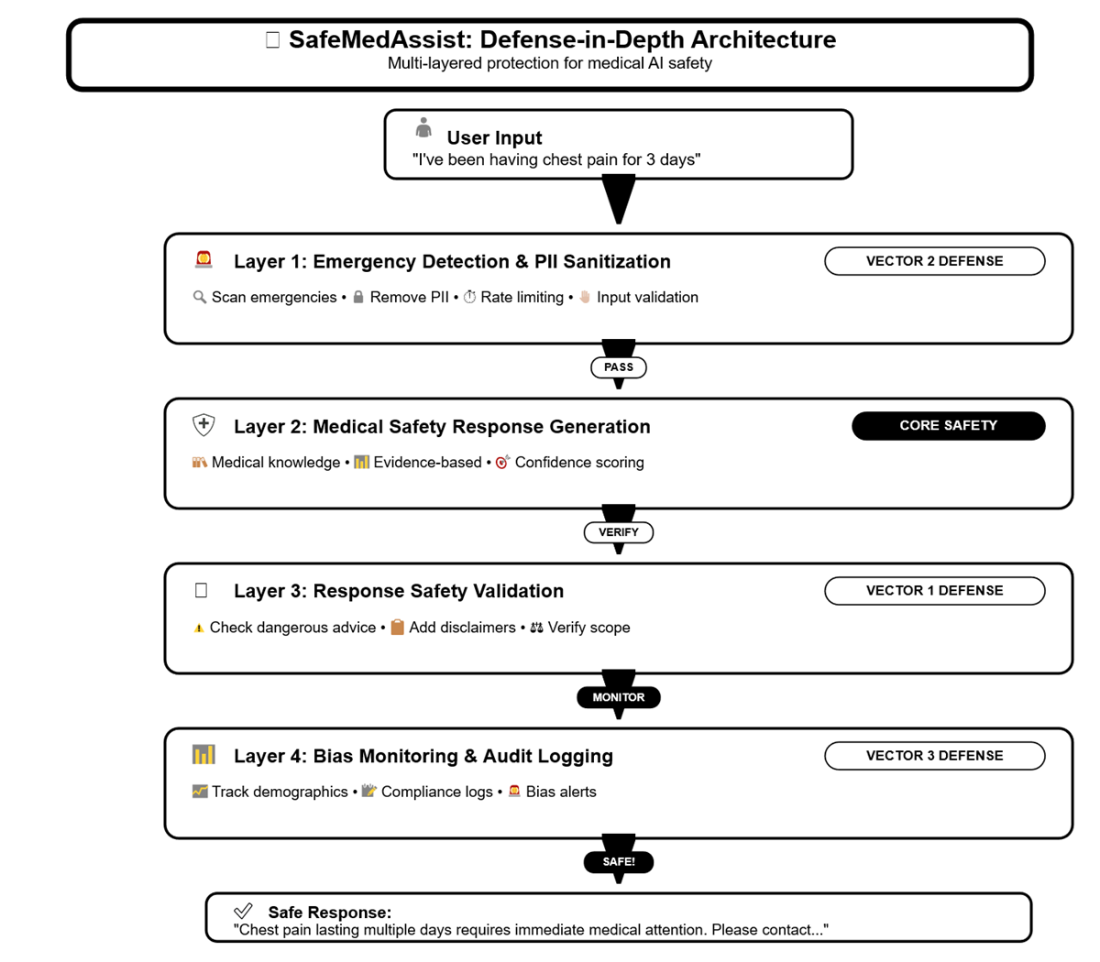
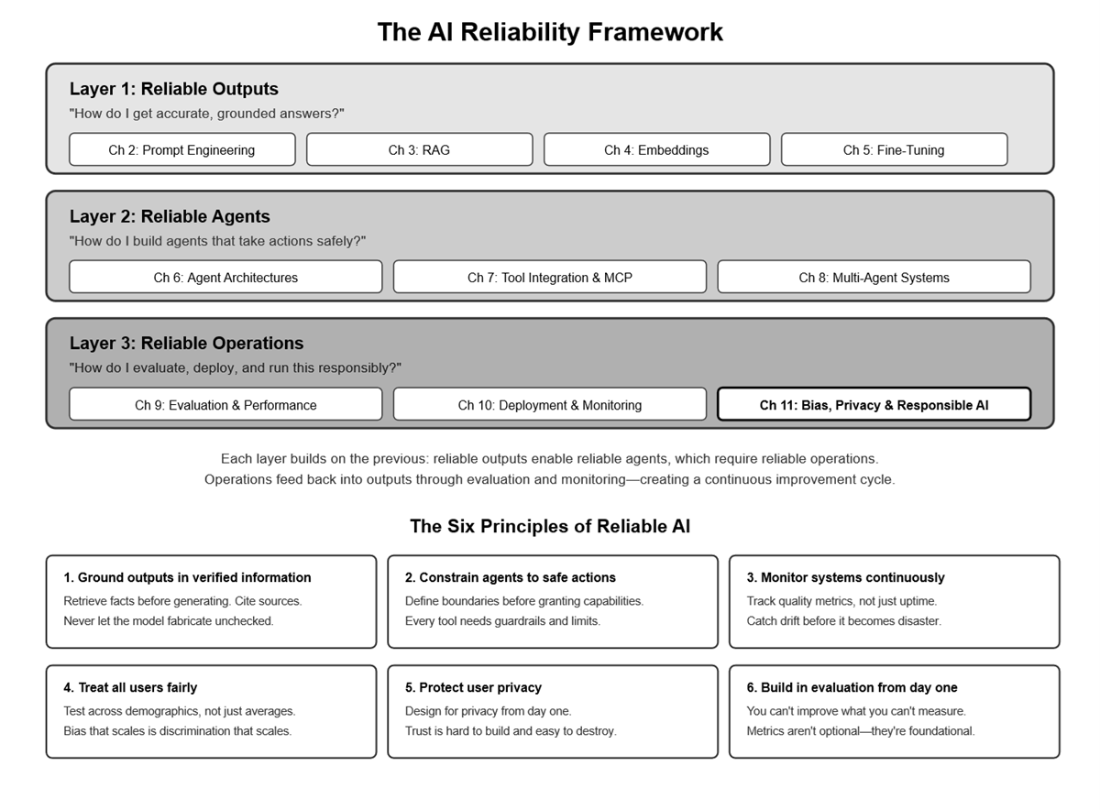
The material then brings these ideas together in a medical AI assistant example that uses emergency detection, PII sanitization, medical safety checks, bias monitoring, audit logging, and automated testing to demonstrate responsible AI in a high-stakes domain. It emphasizes that production systems also require human oversight, monitoring, legal review, clear scope limits, and continuous improvement based on real interactions. The closing message broadens the lesson into durable principles for reliable AI: ground outputs in verified information, constrain agents to safe actions, monitor continuously, treat users fairly, protect privacy, and build evaluation from the start. Responsible AI is presented as both a trust-building strategy and a practical foundation for systems that remain reliable over time and at scale.
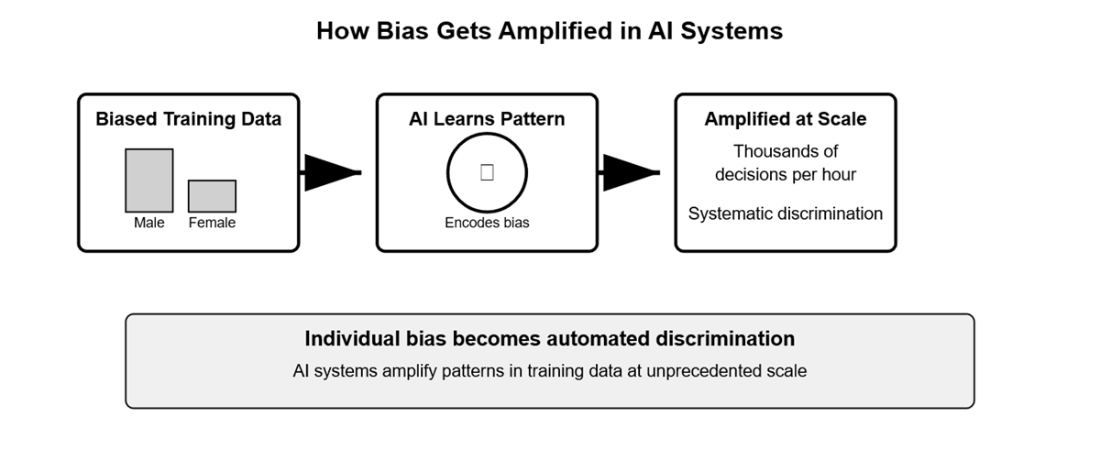
How bias gets amplified in AI systems
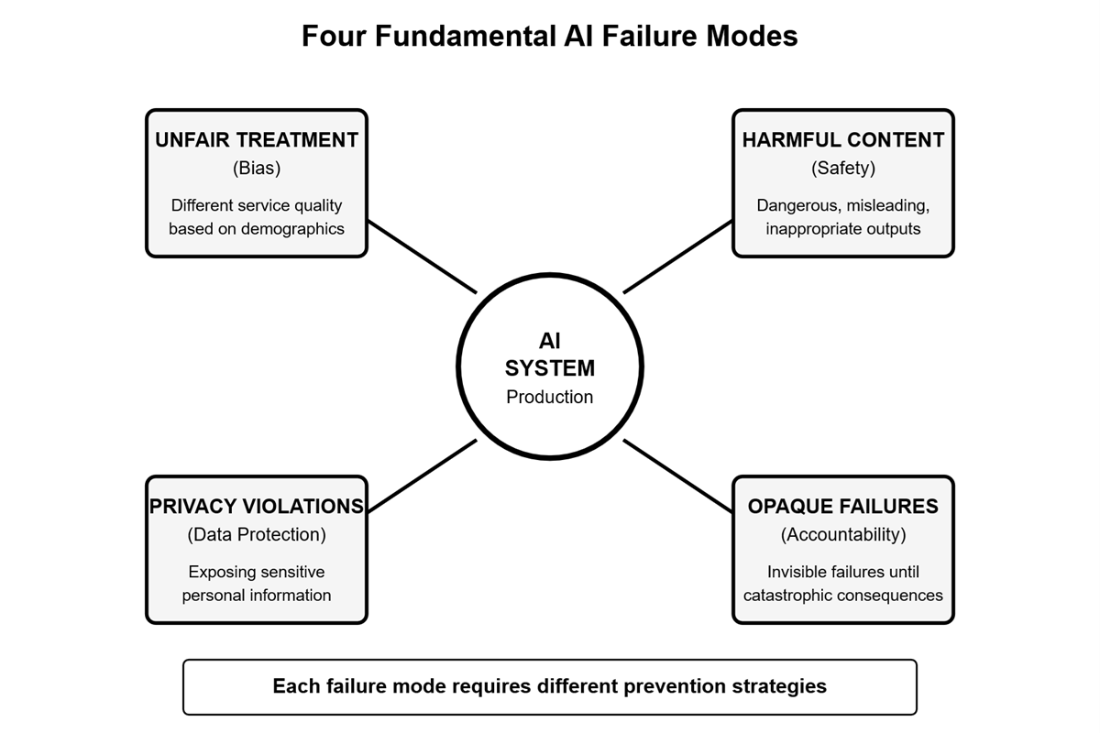
The four fundamental AI failure modes described. Each failure requires different prevention strategies
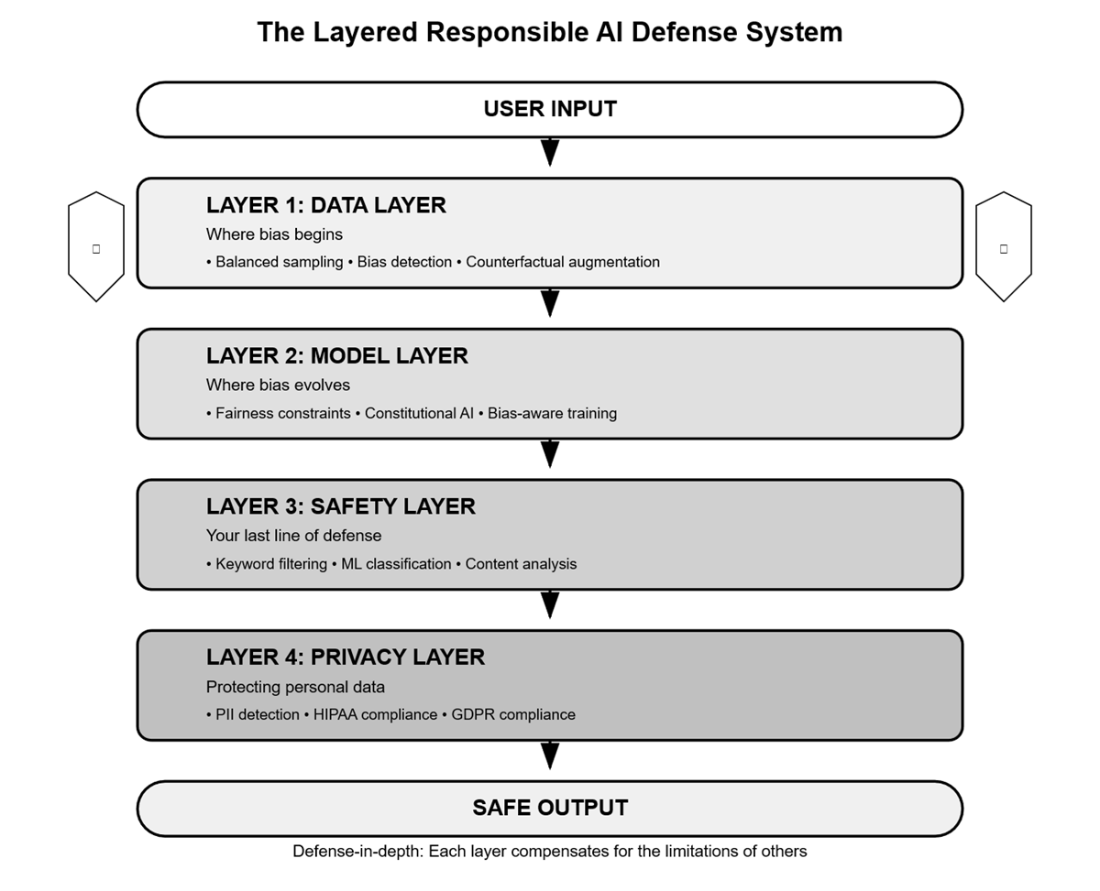
The layered responsible AI defense system: Each layer serves a different purpose to protect users
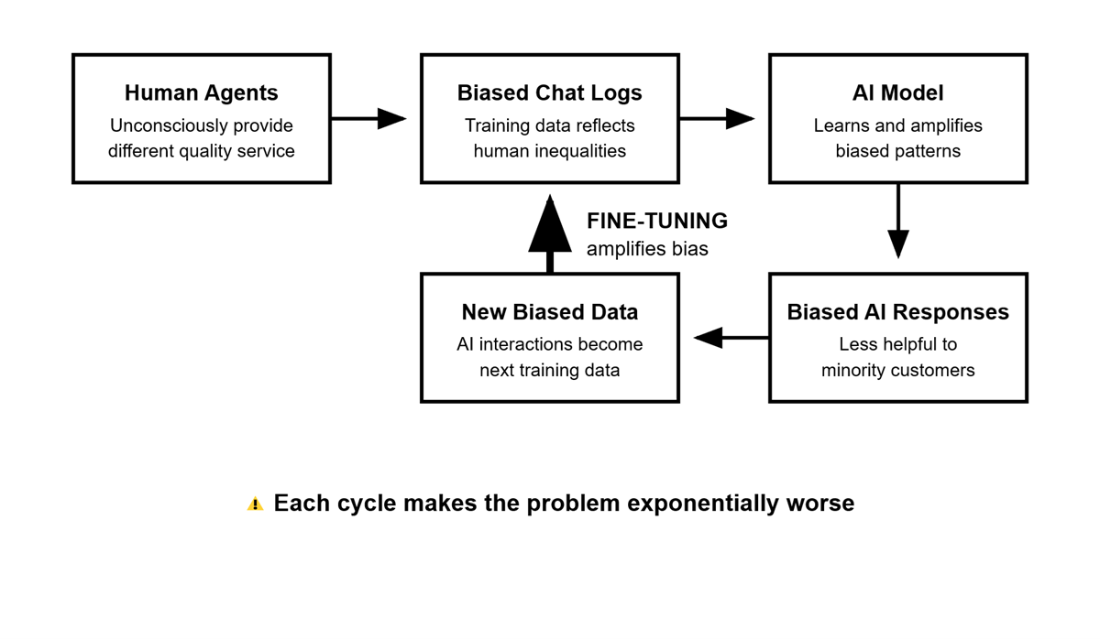
How repeated fine-tuning on user interactions amplifies bias
A multi-layered security framework for medical AI systems showing the four-tier validation process
The complete AI Reliability Framework showing how all three layers connect
Summary
- LLM systems amplify bias and safety risks at unprecedented scale. Unlike traditional software, LLMs learn patterns from data and can perpetuate harmful biases or generate dangerous content across millions of interactions.
- Four critical failure modes threaten every production LLM system. These include unfair treatment across demographic groups, harmful content generation, privacy violations through data leakage, and opaque decision-making that users cannot understand or trust.
- Defense-in-depth architecture provides comprehensive protection through multiple coordinated layers. The data layer prevents bias through balanced sampling, the model layer embeds fairness constraints during training, the safety layer filters dangerous outputs in real-time, the privacy layer protects PII with regulatory compliance, and the application layer provides transparency through explainable responses.
- Constitutional AI scales human oversight by training models to follow ethical principles. This technique moves beyond simple output filtering by embedding constitutional principles directly into the model's training process, using millions of AI-generated constitutional reviews during gradient updates to shape model behavior.
- Privacy compliance requires comprehensive technical and legal frameworks. HIPAA mandates removing 18 specific identifier types from healthcare data, while GDPR demands "right to be forgotten" capabilities and explicit consent mechanisms, often forcing companies to avoid processing personal data entirely rather than risk violations.
- Production responsible AI systems require active monitoring and human oversight. Real-world deployment demands 24/7 monitoring for bias detection, safety violations, and privacy breaches, combined with human professionals who can handle edge cases and update safety rules as new risks emerge.
FAQ
What are the four fundamental failure modes that threaten production LLM systems?
The chapter identifies four major failure modes:
- Unfair treatment or bias: The system gives different outcomes based on protected characteristics such as race, gender, or age.
- Harmful content generation or safety failures: The system produces dangerous, misleading, or inappropriate outputs.
- Privacy violations: The system exposes sensitive personal information through memorization, logging, user input leakage, or mishandling data.
- Opaque failures: The system fails in ways operators cannot detect until harm has already occurred.
These failures often overlap, which is why responsible AI systems need multiple layers of defense.
Why is responsible AI no longer optional for production systems?
Responsible AI has become essential because of regulatory, user, and business pressures. Laws such as the EU AI Act classify AI systems by risk level and impose strict obligations on high-risk applications like healthcare, hiring, credit scoring, and critical infrastructure. Users are also more skeptical after high-profile AI failures, and surveys show widespread distrust of companies using AI responsibly. From a business perspective, biased or unsafe AI can cause legal exposure, reputational damage, lost development investment, and even insurance coverage issues.
How does bias get amplified in AI systems?
AI systems learn patterns from training data, including unfair or historically biased patterns. When those patterns are deployed at scale, the system can automate and amplify discrimination. For example, Amazon’s recruiting tool learned from historical hiring data that reflected a male-dominated tech workforce, so it penalized signals associated with women, such as women’s colleges or activities. Similar amplification has appeared in criminal justice, healthcare, financial services, and image recognition systems.
What is the four-layer responsible AI defense architecture?
The chapter presents responsible AI as a defense-in-depth architecture with four layers:
- Data Layer: Prevents bias from entering through training or fine-tuning data.
- Model Layer: Encourages the model to learn fair and safe behaviors during training.
- Safety Layer: Catches harmful or dangerous outputs before they reach users.
- Privacy Layer: Protects personal information and supports compliance with regulations such as HIPAA and GDPR.
No single layer is sufficient; each compensates for weaknesses in the others.
What is the fine-tuning bias trap?
The fine-tuning bias trap occurs when organizations fine-tune models on real user interactions such as chat logs, support tickets, or customer service conversations without auditing them for differential treatment. If human agents gave shorter, less helpful, or lower-quality responses to certain demographic groups, the model can learn and amplify those patterns. This creates a feedback loop: biased human interactions create biased training data, biased models generate biased outputs, and those outputs become more biased data for future training.
How can teams detect and mitigate bias in training or chat log data?
Teams can detect bias by comparing metrics across demographic groups, such as response length, resolution time, escalation rate, and satisfaction score. The chapter demonstrates a chat log bias detector that calculates these metrics and flags concerning gaps.
Once bias is found, three mitigation strategies are recommended:
- Balanced sampling: Ensure demographic groups are represented equally in the dataset.
- Counterfactual data augmentation: Create alternate versions of examples by swapping demographic markers such as names.
- Bias-aware filtering: Remove examples containing stereotypes or clearly problematic content.
The chapter also warns that name-based demographic inference is simplified and risky in production; voluntary self-reported demographics or validated probabilistic tools should be used with legal review.
How does the model layer reduce bias during training?
The model layer reduces bias by enforcing fairness during the training process, not just by cleaning data beforehand. For open-source models or models trained with controlled fine-tuning loops, developers can modify loss functions, datasets, and evaluations directly. The chapter gives an example of adding a fairness loss to a LoRA fine-tuning loop. This loss combines normal cross-entropy loss with a penalty for differences in output distributions across demographic groups. A higher fairness weight enforces stricter fairness, although it may slightly reduce overall accuracy.
What is Constitutional AI, and how does it relate to LLM-as-judge techniques?
Constitutional AI uses the same basic pattern as LLM-as-judge evaluation, but during training instead of after deployment. One model generates a draft response, and another model evaluates it against a set of constitutional rules or safety principles. If the response violates the rules, the training system forces a rewrite or adjusts learning. The key insight is scale: instead of judging outputs only after the fact, millions of evaluations can happen during training so the model internalizes safe and responsible behavior patterns.
What does a multi-layered safety architecture look like?
The chapter describes a three-layer runtime safety system:
- Layer 1: Keyword filtering. Fast pattern matching blocks obvious harmful requests, such as instructions for violence, explosives, or self-harm.
- Layer 2: ML-based classification. A specialized model or LLM evaluates input or output for contextual safety risks.
- Layer 3: Content analysis and commercial moderation APIs. More comprehensive checks, such as OpenAI moderation, safety-focused system prompts, and built-in model constraints.
This layered approach ensures that obvious threats are blocked quickly while more subtle or contextual risks receive deeper analysis.
Why are LLM privacy failures uniquely dangerous?
LLM privacy failures are dangerous because models can memorize, recombine, and reproduce sensitive information in unpredictable contexts. The chapter highlights three major attack vectors:
- Training data extraction: Attackers craft prompts to recover memorized data such as API keys, passwords, or personal information.
- User input leakage: Sensitive user data leaks through poor session management, logging, caching, or fine-tuning processes.
- Context window manipulation: Attackers use prompt injection, role-playing, or context confusion to reveal previous conversation content or system prompts.
Unlike a traditional database breach, an LLM can amplify leaked information across many interactions, making privacy protection a proactive requirement.
How do HIPAA and GDPR affect responsible AI system design?
HIPAA applies mainly to U.S. healthcare data and requires strict protection of protected health information. Its safe harbor method requires removing 18 types of identifiers, including names, dates, phone numbers, email addresses, medical record numbers, and special handling for ages over 89.
GDPR applies to all personal data of EU residents, regardless of where the organization is located. It emphasizes principles such as data minimization, purpose limitation, storage limitation, accuracy, consent, DPIAs, and the right to be forgotten.
For LLM systems, these regulations require privacy-by-design practices such as PII detection, redaction, consent management, deletion workflows, audit logging, and clear explanations of how user data is processed.

 Building Reliable AI Systems ebook for free
