10 Deploying and Monitoring
This chapter explains that deploying LLM applications is fundamentally different from deploying traditional software because language models are non-deterministic, sensitive to prompts and context, costly to run at scale, and capable of failing silently while still appearing operational. It frames production readiness as an LLMOps discipline: building systems that manage not only uptime and latency, but also output quality, safety, user satisfaction, cost, routing, retrieval, validation, monitoring, and continuous improvement.
A major focus is deployment strategy, especially the tradeoff between hosted APIs and self-hosted open-source models. Hosted APIs offer fast prototyping, strong capabilities, and minimal infrastructure burden, but they can create cost surprises, dependency risks, limited control, compliance concerns, and exposure to provider-side model changes. Self-hosted models provide more control over privacy, cost, tuning, observability, and deployment environment, but require serious infrastructure investment in GPUs, serving stacks, scaling, load balancing, and model management. The chapter recommends hybrid architectures for many production teams, using local models for simpler or sensitive requests, hosted models for complex tasks, and intelligent routing plus fallbacks to balance cost, reliability, and capability.
The chapter also emphasizes that production LLM monitoring must go beyond HTTP errors and response times. Effective systems track token usage, cost per request, model and prompt versions, retrieval and inference latency, quality signals, user feedback, escalation patterns, and business impact. It describes layered quality assurance using content filters, statistical drift detection, LLM-as-judge evaluation, golden datasets, prompt versioning, automated scoring, shadow testing, and feedback loops that turn user behavior into improvements. Tools such as Langfuse are presented as practical observability platforms for tracing prompts, model calls, costs, latency, evaluations, and regressions, helping teams move from reactive debugging to reliable, continuously improving AI operations.
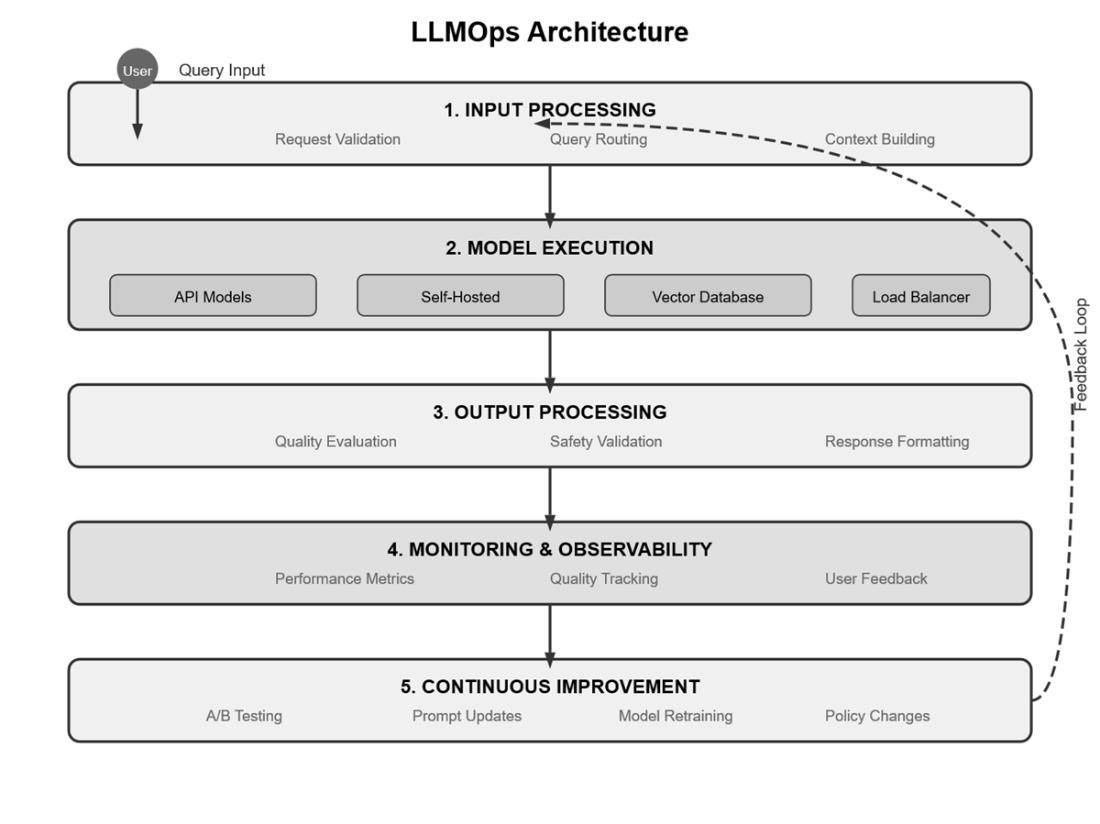
Complete LLMOps Architecture for Production AI Systems
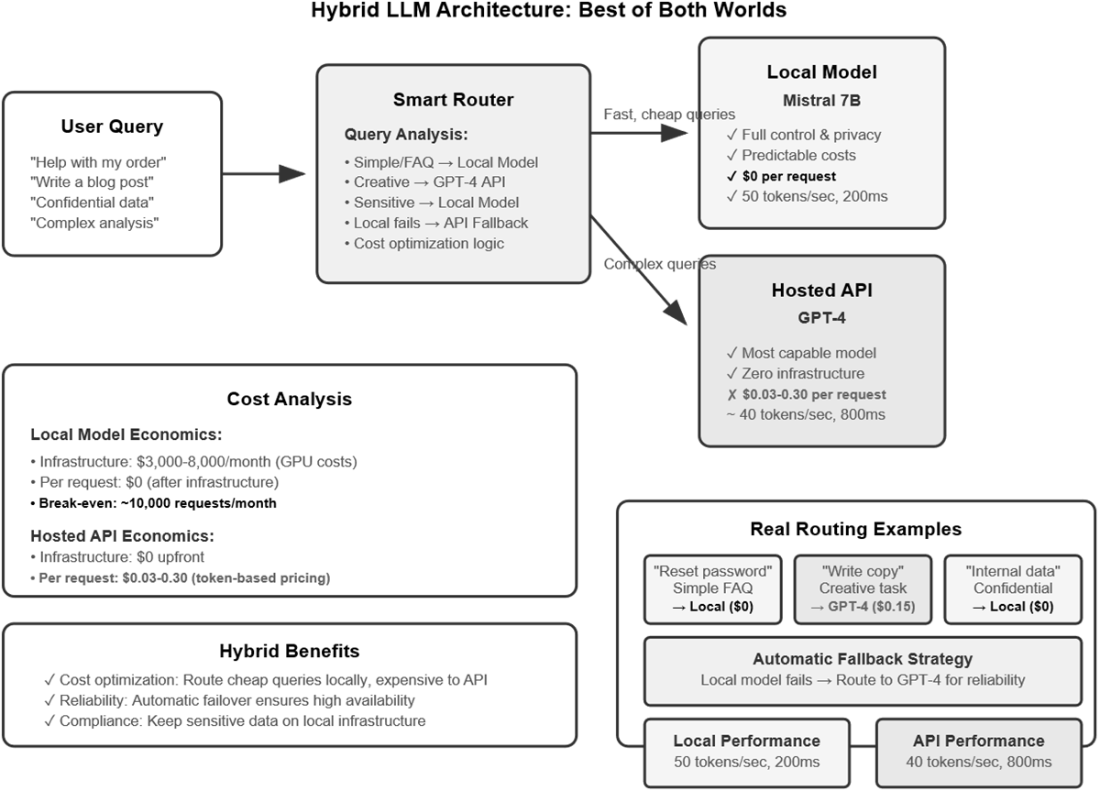
Hybrid LLM Architecture combining local and hosted models for optimal cost, performance, and control. The smart router analyzes query characteristics to direct simple questions to cost-effective local models while routing complex or creative tasks to more capable hosted APIs, with automatic fallback ensuring reliability.
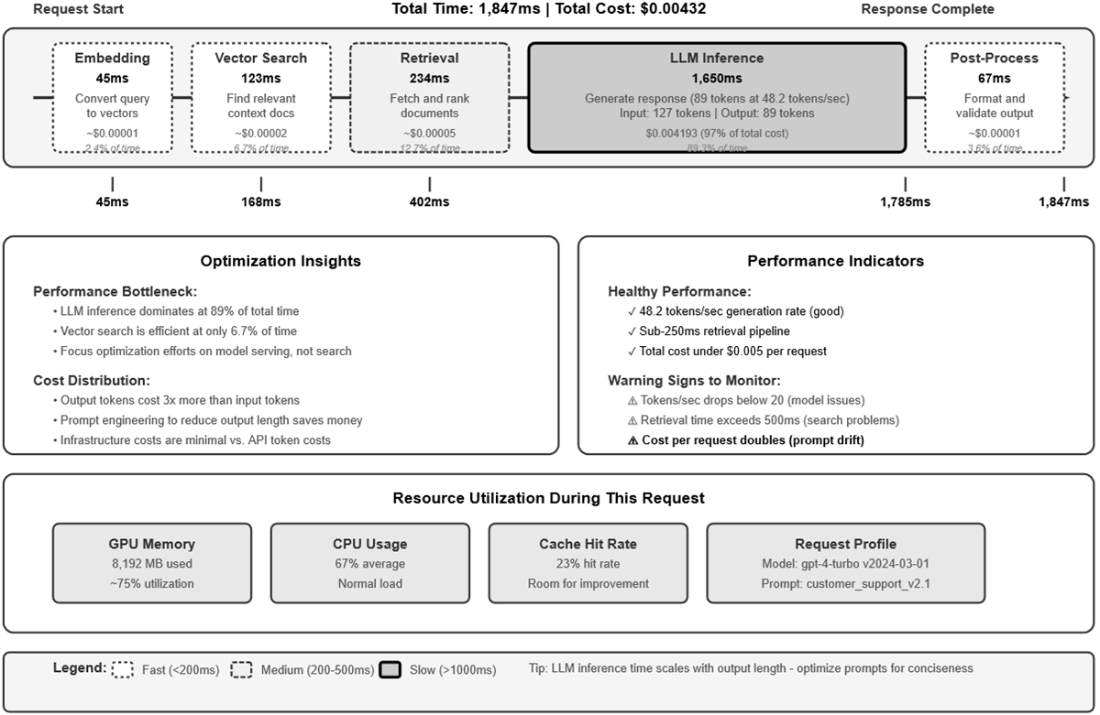
LLM Request Lifecycle Timeline showing where time and cost are spent during a typical customer support query. The diagram reveals that LLM inference dominates both execution time (89.3%) and costs (97%), making model optimization the highest-impact area for performance improvements.
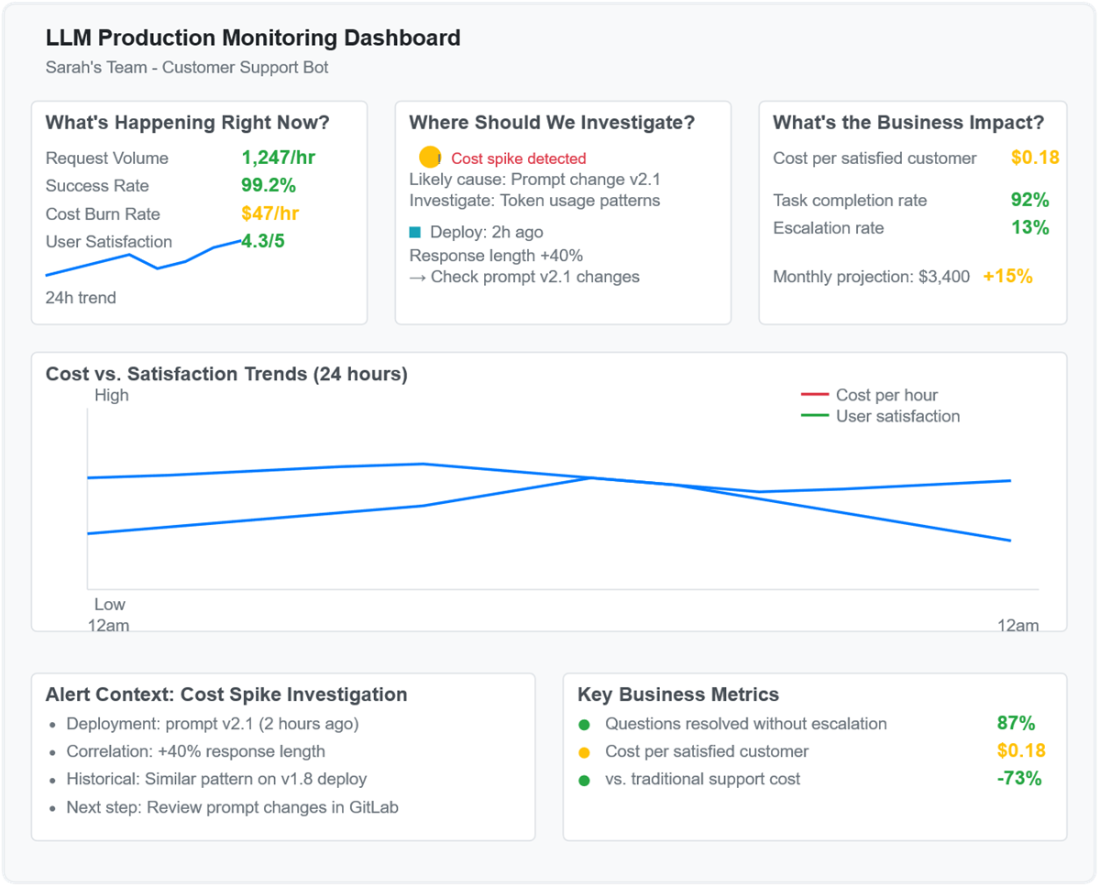
Production LLM monitoring dashboard showing real-time operational metrics, cost analysis, and business impact for Sarah's customer support bot. The dashboard connects technical performance to business outcomes, enabling data-driven optimization decisions and rapid incident response.
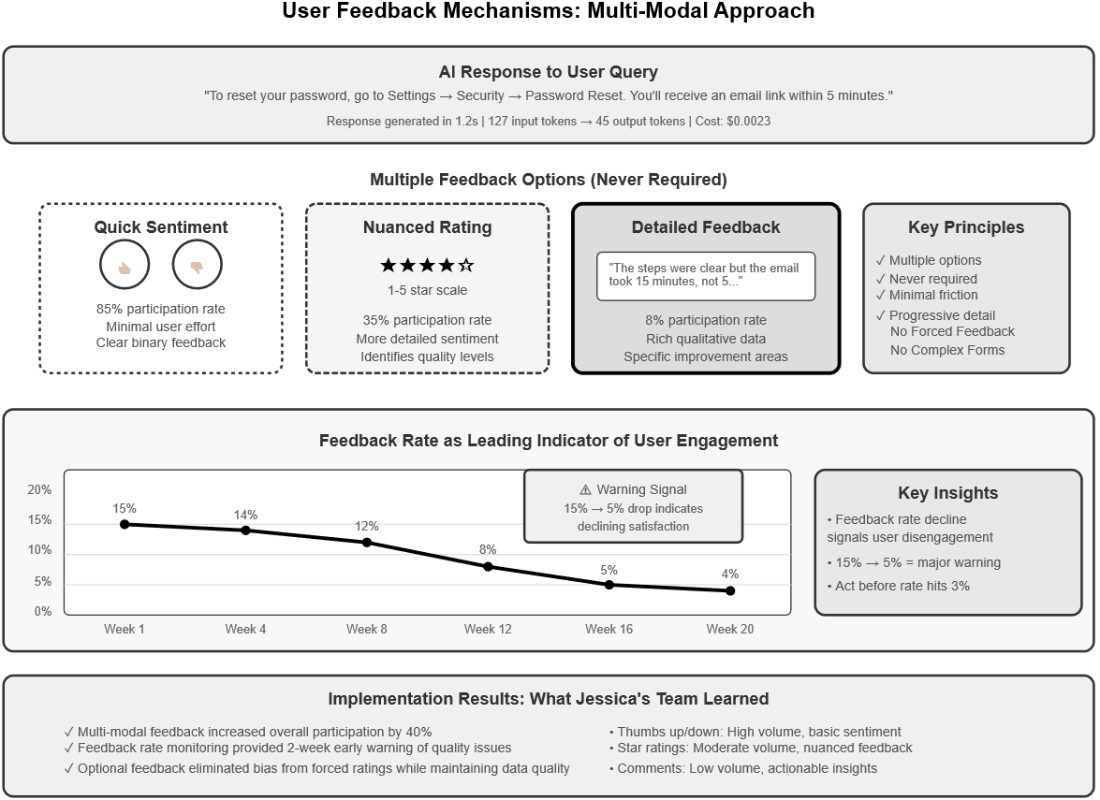
Multi-modal user feedback system showing three complementary mechanisms with varying participation rates and data richness. The declining feedback rate trend serves as an early warning indicator of user disengagement, typically preceding drops in overall satisfaction by 2-3 weeks.
Summary
- LLMOps is a specialized discipline for managing large language models in production, addressing unique challenges like non-deterministic behavior, cost volatility, and subtle failure modes that traditional monitoring can't detect
- Hosted APIs offer rapid deployment with state-of-the-art models but sacrifice cost control and data privacy, while self-hosted models provide full control at the expense of infrastructure complexity
- Hybrid architectures balance trade-offs by routing simple queries to cost-effective local models and complex requests to premium APIs, with intelligent fallback systems ensuring reliability
- LLM monitoring requires specialized metrics including token usage, cost per interaction, response quality scores, and user satisfaction patterns rather than just traditional uptime and latency measurements
- Quality assurance operates through three pillars: prevention via prompt engineering and input validation, detection through automated testing and behavioral monitoring, and correction via systematic improvement processes
- User experience monitoring captures both explicit feedback (ratings, comments) and implicit signals (session patterns, escalation rates) to measure whether AI systems truly help users accomplish their goals
- Cost control prevents financial disasters through real-time monitoring of token usage, efficiency trends, and automated alerts that catch runaway expenses before they impact budgets
- Production readiness requires systematic approaches to prompt versioning, shadow testing, and continuous quality evaluation that transform unpredictable AI demonstrations into reliable business assets

 Building Reliable AI Systems ebook for free
