Legacy code is presented as a safety problem rather than an age problem: it is any codebase people cannot change confidently without fear of breaking hidden behavior. The chapter urges readers to treat unfamiliar code as an investigation, starting with runtime behavior, then tests, and only then source code, so that undocumented business rules and constraints become visible before any refactoring begins. It also warns against the two biggest mistakes in legacy work: the all-at-once rewrite, which is slow and risky, and speculative AI-generated complexity, which can create new legacy faster than humans can manage it.
To make improvement practical, the chapter reframes code smells as forms of Lean waste. Long methods, duplicated logic, dead code, tight coupling, excessive branching, poor naming, and missing tests are not just style issues; they are sources of overprocessing, overproduction, inventory, waiting, motion, defects, and extra processing that slow down delivery. The key question is not whether code is “clean,” but how often it changes and how much friction each change adds. By using measures like churn, developer frustration, review cycles, and manual testing time, teams can focus on the files and modules that create the greatest economic drag.
The design guidance follows the same Lean logic: apply only the structure that real demand pulls into existence. YAGNI becomes a pull-based design principle, where abstractions are introduced only when actual requirements create friction, and removed when they no longer serve the value stream. Patterns and SOLID principles are treated as tools, not defaults; they help only when they reduce friction on a hot path, not when they add inventory to a cold one. The chapter closes with a systematic approach to taming one module at a time: observe it, characterize its current behavior with tests, assess the debt by frequency and friction, make one small improvement, and repeat continuously instead of attempting a heroic rewrite.
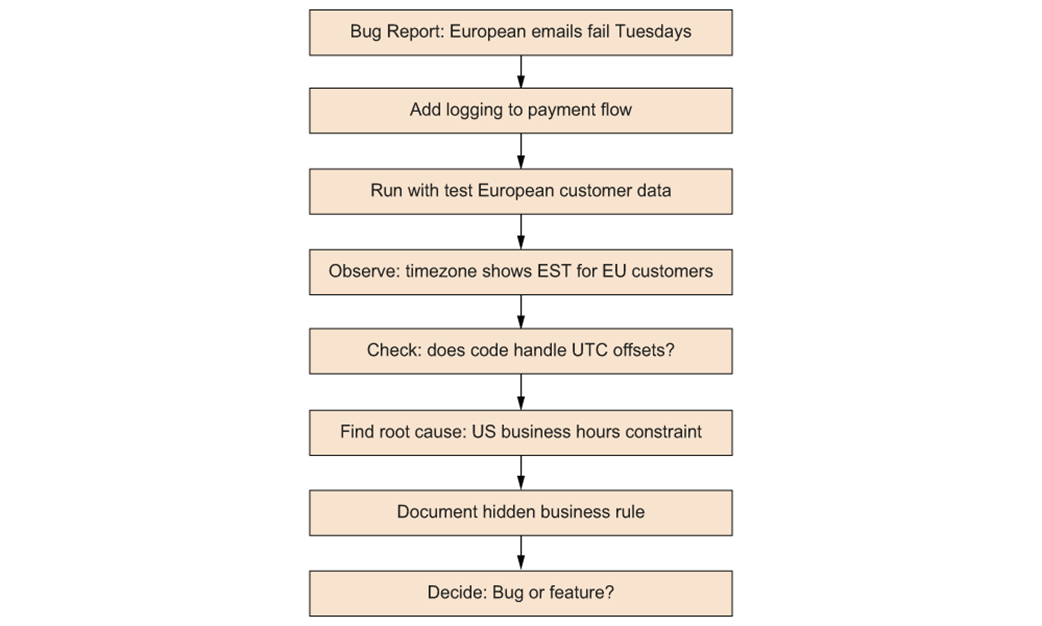
An example flow identified through targeted debugging of a legacy system.
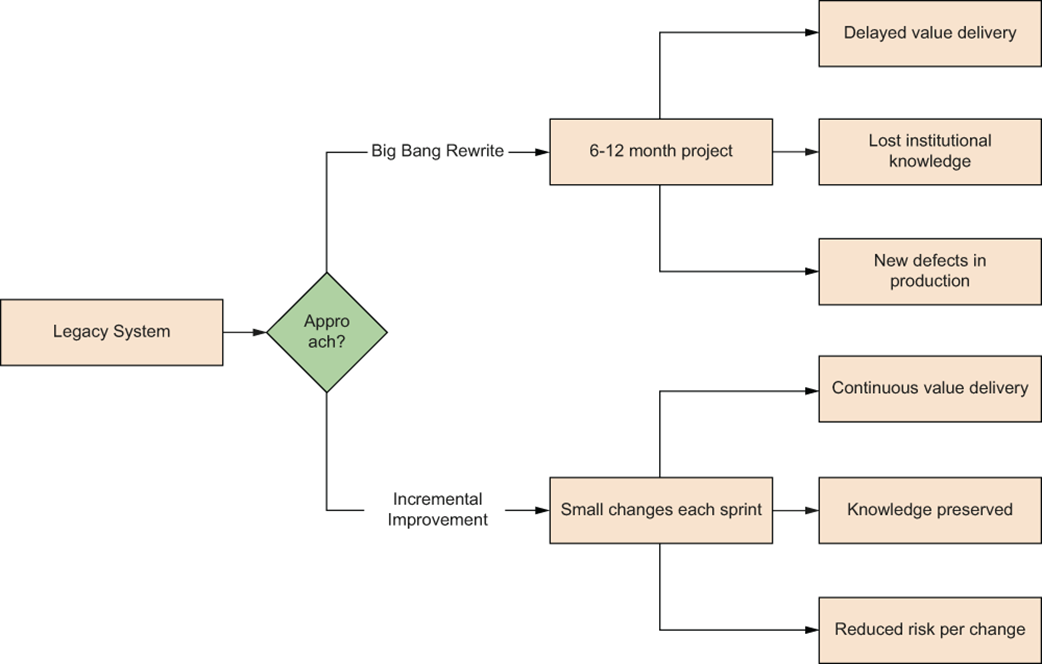
A Lean-centric approach to modernize incrementally without compromising flow.
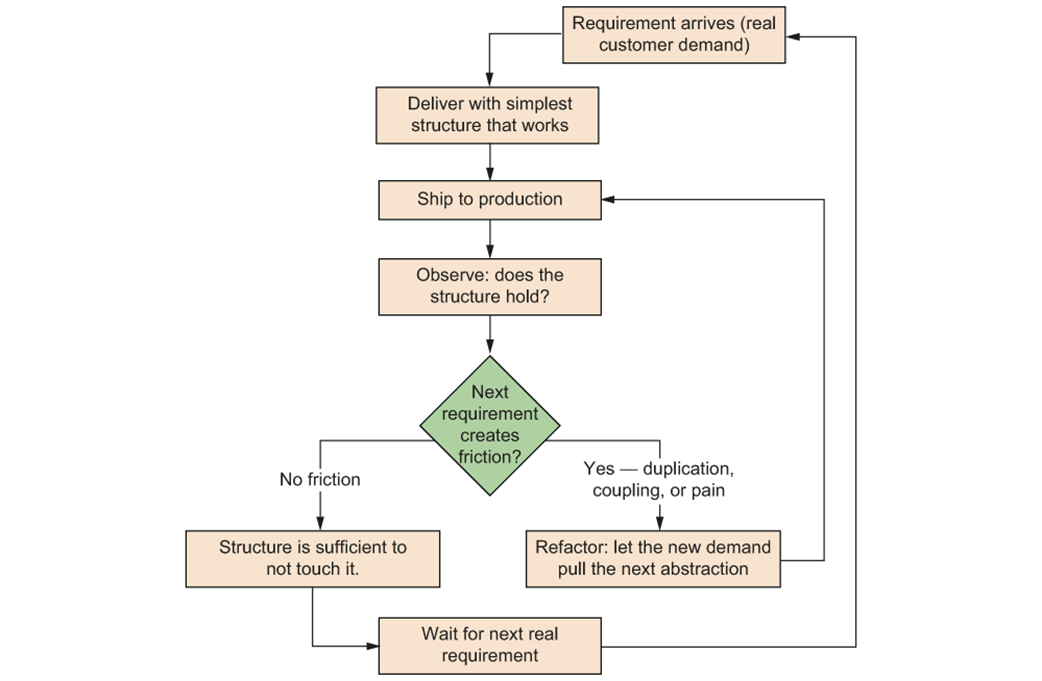
Lean YAGNI flow for evaluating a requirement in a legacy system.
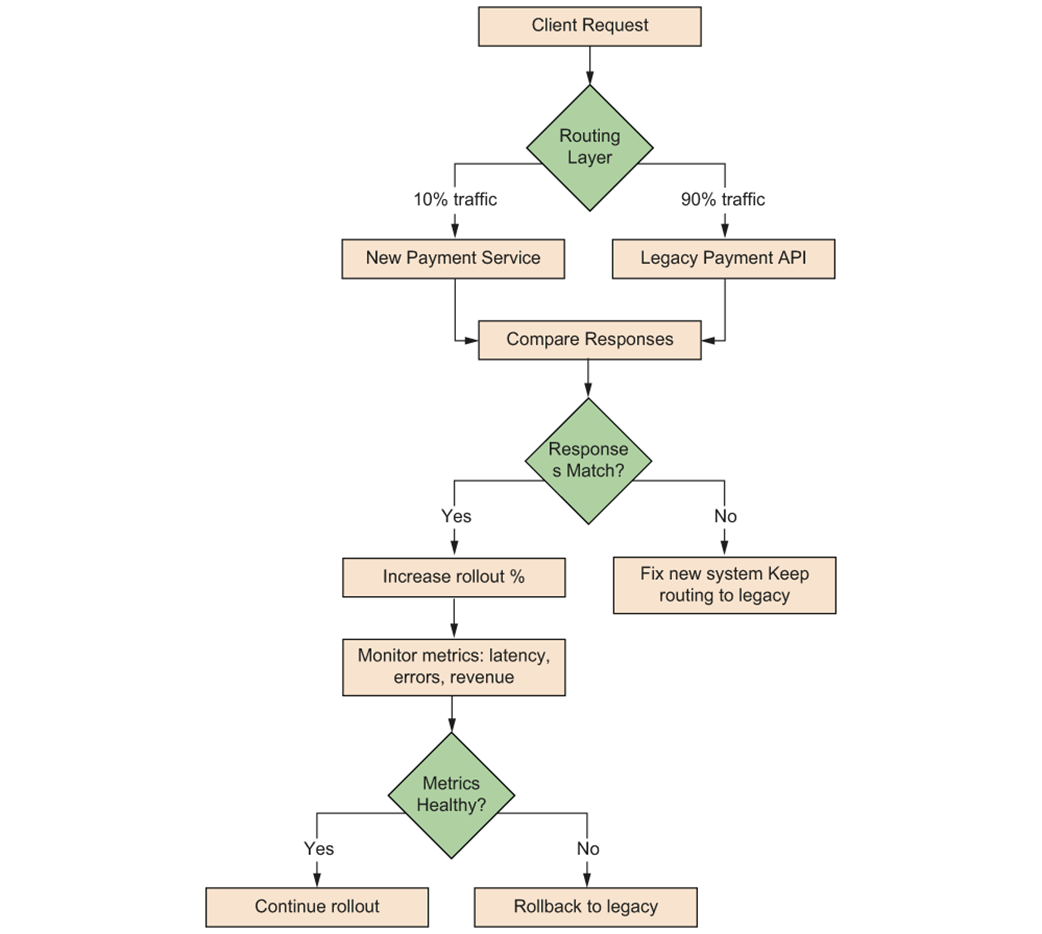
Strangler Fig decision matrix for evaluating the safe progression of modernizing.
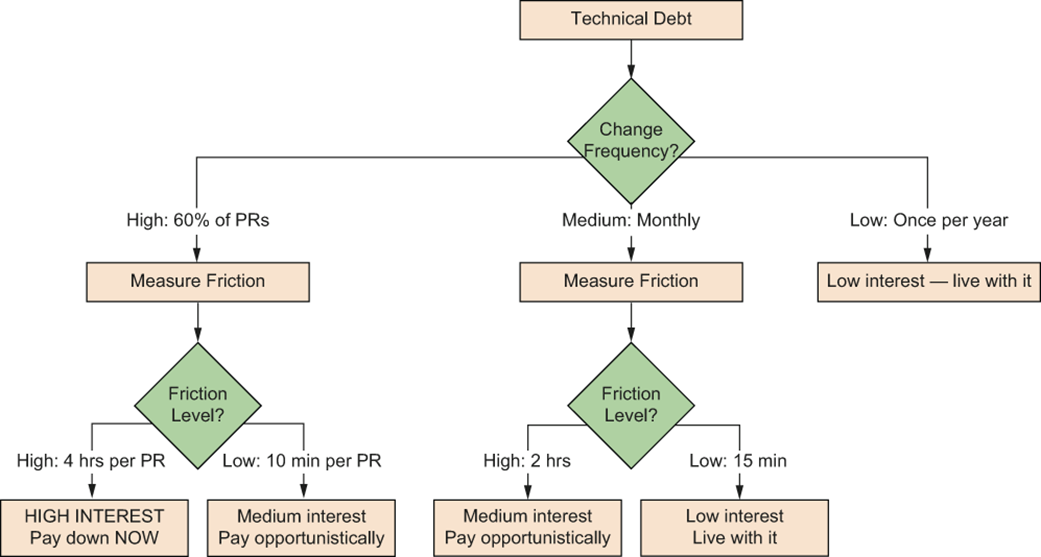
Technical debt evaluation approach flow.
Summary
Legacy code is working code without safety nets; it's the default, not a failure.
The code is the gemba: observe behavior before reading structure.
Map code smells to TIMWOODS, so prioritization becomes economic.
Prioritize by change frequency x friction per change.
When organizational forces shift, patterns can become inventory; Lean principles help you decide whether to replace, simplify, or remove them.
YAGNI is a pull system: real demand pulls the next abstraction.
The Strangler Fig replaces legacy systems in small batches, not big-bang rewrites.
Characterization tests lock current behavior so you can change the structure safely.
Pay high-interest technical debt now; live with low-interest debt indefinitely.
Five minutes of Kaizen per PR compounds faster than any refactoring sprint.
FAQ
What does “legacy code” mean in this chapter?Legacy code is code without enough safety to change confidently. It is not defined by age or quality alone; even a well-designed or recent system becomes legacy if the team cannot modify it without fear.How should you approach unfamiliar legacy code?Treat it as an active investigation. First observe runtime behavior with logging and real inputs, then read tests to learn intent, and only then trace the code backward from symptoms to causes. Avoid refactoring before you understand the business rules.Why is a full rewrite usually a bad idea?Rewrites typically take much longer than expected, reintroduce bugs, lose hidden business knowledge, and delay value delivery for months. The chapter argues for incremental improvement instead of batching all change into one risky move.How does the chapter use TIMWOODS to think about code smells?It maps code smells to Lean waste types. For example, long methods become overprocessing, duplicate code becomes overproduction, dead code becomes inventory, excessive branching becomes defects, tight coupling becomes waiting, and poor naming becomes motion.How should you prioritize which code smells to fix first?Use the formula: Priority = Change Frequency × Friction Per Change. Fix high-churn, high-friction code first because it slows the value stream the most. Low-frequency, low-friction code can often be left alone.What is the Lean view of technical debt?Technical debt is a tradeoff, not a moral failure. The key question is which debt has the highest interest cost, measured by how often the code changes and how much friction each change creates. High-interest debt should be paid down first.What is YAGNI in a Lean design context?YAGNI is treated as a pull-based design principle. You should add abstractions only when real demand creates friction, not because you anticipate future needs. The next requirement should pull the next structure into existence.When should you use design patterns or SOLID principles in legacy code?Use them only when they reduce real friction on a path that changes often. A pattern that solved an old organizational problem may now create unnecessary inventory, indirection, and maintenance cost if the original constraint no longer exists.What are characterization tests and why are they useful?Characterization tests capture the current behavior of legacy code exactly as it exists today, including quirks or bugs. They create a safety net so you can refactor structure without accidentally changing outcomes.What is the Strangler Fig approach to modernizing legacy systems?It is an incremental replacement strategy. New functionality is built alongside the old system, traffic is routed gradually to the new implementation, and rollback remains easy. This reduces risk compared with a big-bang rewrite.
pro $24.99 per month
access to all Manning books, MEAPs, liveVideos, liveProjects, and audiobooks!

 Build High Value Software Systems ebook for free
