This chapter argues that meaningful improvement in software teams is driven less by formal authority and more by visible, measured action. Developers can influence practices by improving their own work first, sharing the results, and letting voluntary adoption follow. The core idea is simple: act, measure, and share. When a change is local, reversible, and low risk, it can usually be tried without permission; when it works, the evidence builds credibility for larger changes later.
The chapter also shows that coaching can happen in tiny, everyday interactions. A short PR comment, Slack reply, or pairing conversation can teach not just what to fix, but why it matters, how to address it, and the broader pattern to apply next time. This approach helps knowledge spread across the team, reduces repeated mistakes, and turns individual reviewer insight into shared standard work. In the same spirit, small wins should be made visible so the team can see progress accumulating and feel momentum rather than treating each improvement as isolated.
As change spreads, the chapter emphasizes adapting practices to context instead of copying them mechanically. What works for one team may not fit another, so principles like reducing context switching or improving flow must be co-designed locally and tested as experiments. Resistance to change is treated as useful information: experience-based resistance reveals hidden constraints, fear-based resistance calls for reversibility, and identity-based resistance—especially when AI changes roles—needs reframing so people see their expertise as more valuable, not less. Finally, production incidents and delivery experiences should be turned into learning by updating standard work, so the organization gets better over time instead of merely recovering from problems.
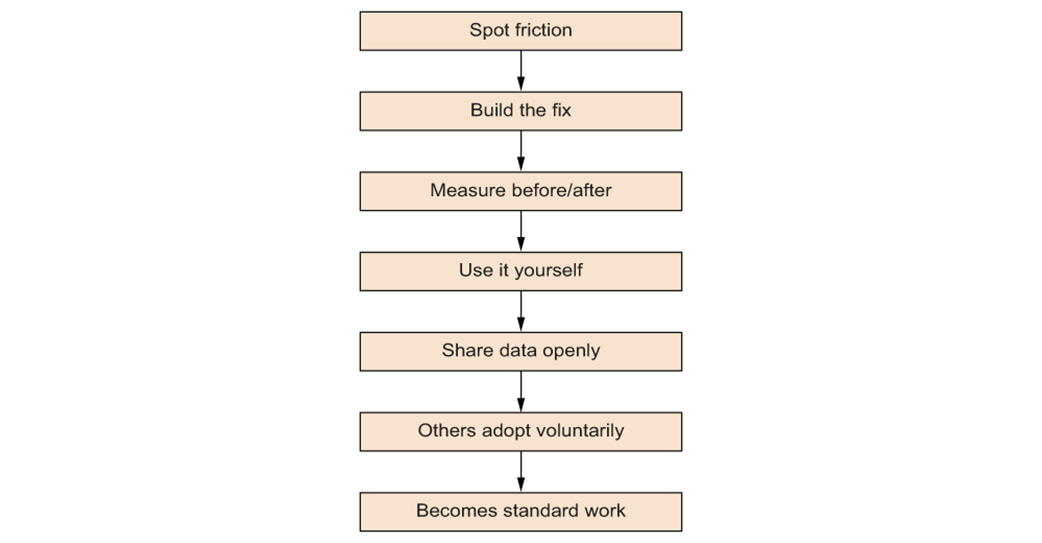
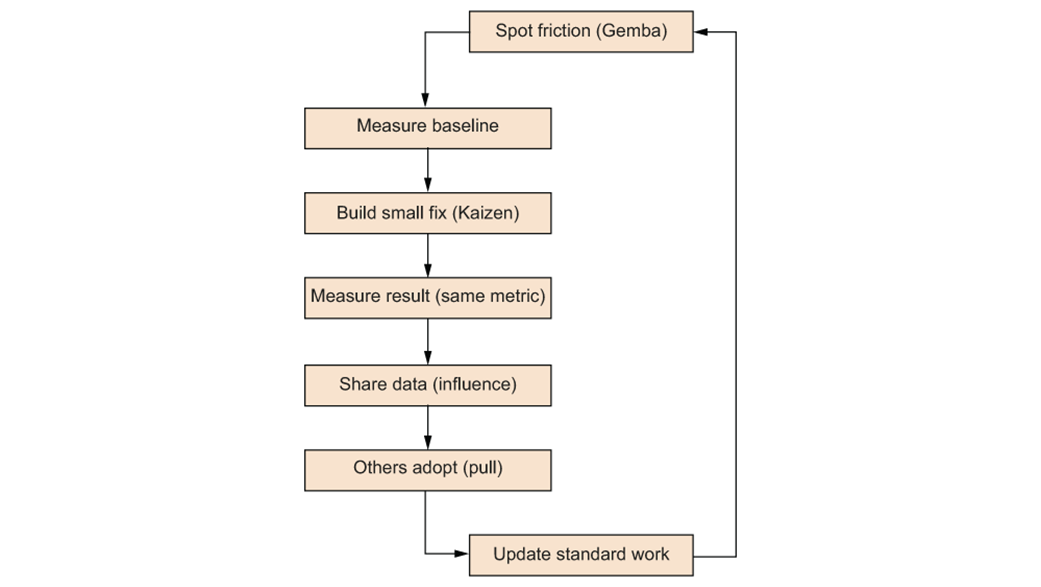
The influence without authority cycle: act first, share data, let adoption happen.
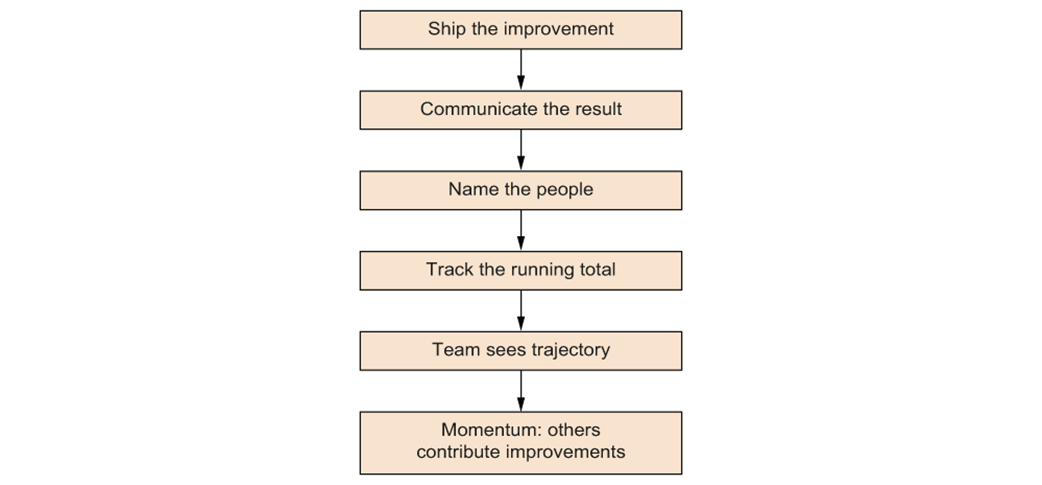
The communication cycle that turns isolated wins into team momentum.
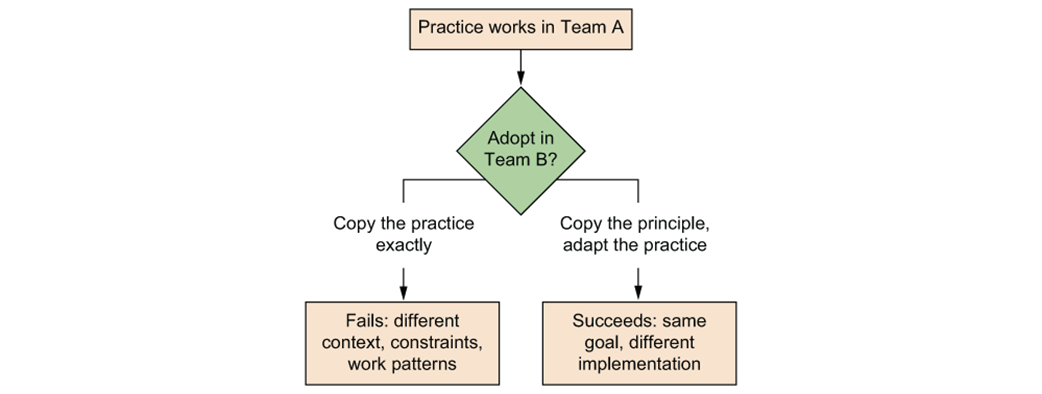
Copy the principle, not the practice.
Working through identity-based resistance without burning trust.
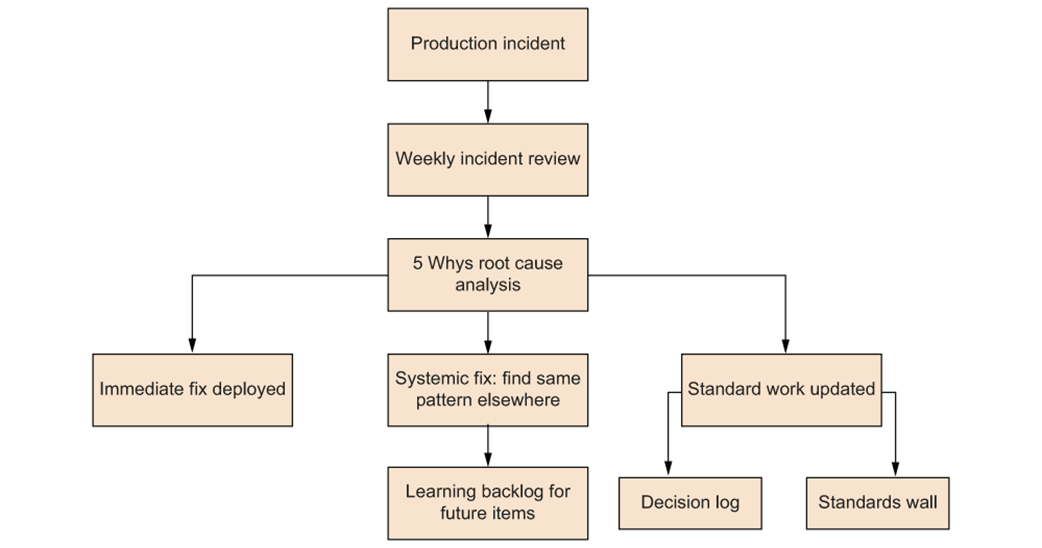
From incident to updated standard work: the learning cycle
The change agent's cycle: Lean tools applied to organizational change.
Summary
Influence without authority follows a simple pattern: act, measure, share. Let voluntary adoption make it standard.
The Coaching Kata: what, why, how, pattern, maps micro coaching to Lean principles and compounds skill transfer.
Small wins compound into momentum only when you communicate them. A weekly wins message with a running total, naming the people behind the changes, builds a team identity around continuous improvement.
Resistance comes in three types: experience-based, fear-based, and identity-based. AI is the largest current source of identity-based resistance.
Incident reviews that update standard work convert individual debugging into team-wide learning. Post-feature retros and code archaeology sessions extend that learning beyond failures.
The long game unfolds in three phases: prove it works, others adopt, it becomes how we work.
FAQ
What does “leading Lean change” mean for a developer without a manager title?It means improving your own work, measuring the result, and sharing the evidence so others voluntarily adopt the better practice. Influence comes from visible value, not positional authority.Why is asking permission often a barrier to improvement?Because permission creates gates, waiting, and decay. If a change is reversible, local to your own workflow, and does not affect others, the book suggests you should usually just do it and share the result later.What is the “act, measure, share” pattern?First, make a small improvement. Second, measure the before-and-after result. Third, share the data with the team in a low-pressure way so adoption can happen naturally.How did Eimear influence her team without authority?She automated most of a staging deploy, measured the time saved, used it for a week, and then shared the results in Slack without pressuring anyone. The data made the change persuasive, and the team adopted it voluntarily.What is micro coaching in software teams?Micro coaching is short, high-impact guidance given in places like PR comments, Slack replies, or pairing sessions. It teaches not just what to do, but why, how, and the general pattern to apply in the future.What is the four-part micro coaching framework?It is: what, why, how, pattern. “What” makes the problem visible, “why” explains the consequence, “how” gives a concrete fix, and “pattern” updates the general rule or standard work.How do small wins create momentum for bigger change?Small improvements that are measured and communicated build credibility over time. As the team sees repeated evidence that change helps, they become more willing to try larger changes.Why should teams celebrate reverts as well as successes?Because failed experiments still produce learning. Sharing a revert normalizes experimentation and shows that the team values learning over pretending every change must work.What is the difference between standard work and standardized work?Standard work is the best-known method for a specific team in its own context. Standardized work is one method forced onto every team regardless of context, which limits improvement instead of enabling it.How should teams handle resistance to change?By treating resistance as useful signal. Experience-based resistance should be explored, fear-based resistance should be reduced with reversible experiments, and identity-based resistance should be reframed so the change builds on people’s expertise rather than replacing it.
pro $24.99 per month
access to all Manning books, MEAPs, liveVideos, liveProjects, and audiobooks!



 Build High Value Software Systems ebook for free
