This chapter argues that personal effectiveness in software work is a Lean problem: developers often spend their best attention on interruptions, routine fixes, and low-value coordination instead of on the judgment-heavy work that compounds over time. The remedy begins with noticing where cognitive value actually goes, then using simple daily habits to capture context, track friction, and separate useful work from busywork. Rather than relying on willpower alone, the chapter frames personal improvement as a system that can be observed, measured, and improved one practice at a time.
A major theme is converting recurring mistakes into standard work. By writing checklists from real failures, keeping them short, and pruning items once automation takes over, a developer gradually turns fragile habits into reliable process. The same logic applies to learning: reading incident reports, extracting the underlying pattern, searching one’s own codebase for similar risks, and fixing the category rather than the one-off bug creates a durable feedback loop. In this model, failures become lessons, lessons become checklists, and checklists eventually become automation.
The chapter also stresses managing all forms of work in progress, not just tickets. Mentoring, reviews, meetings, and learning all consume cognitive space, so capacity planning must include them honestly or deep work will be fragmented and shallow. Finally, it argues that AI should be used as an accelerator anchored to specs and verification, not as a brittle dependency on tool behavior; as tools change, the stable part is the desired outcome, while prompts and workflows evolve around it. Over time, this discipline helps developers grow into broader, deeper practitioners who can combine domain expertise with a second area of strength and continuously improve their own system.
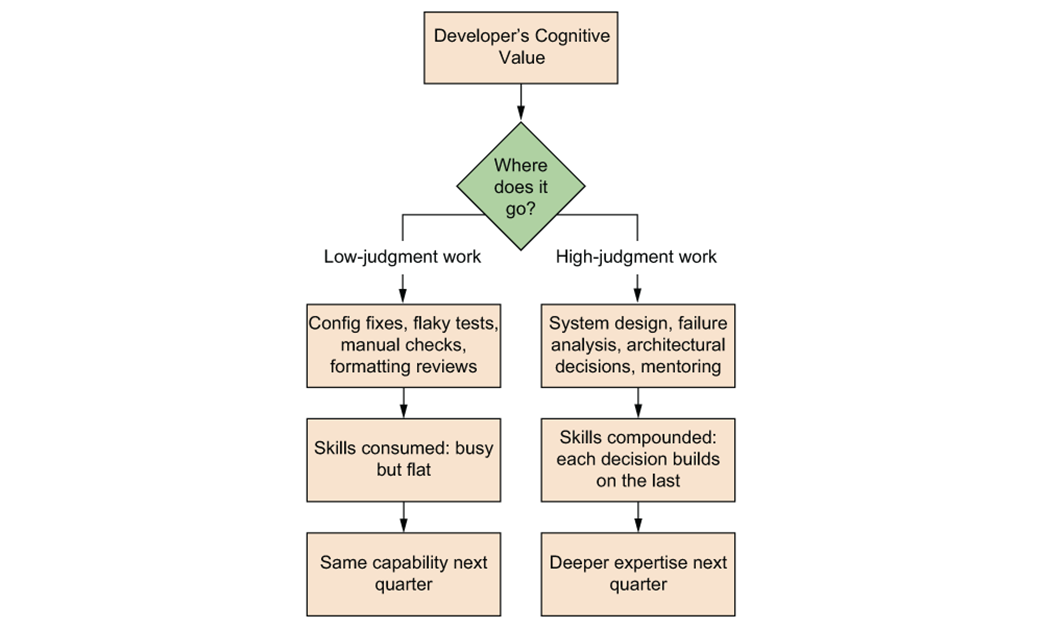
Where cognitive value gets spent versus where it compounds.
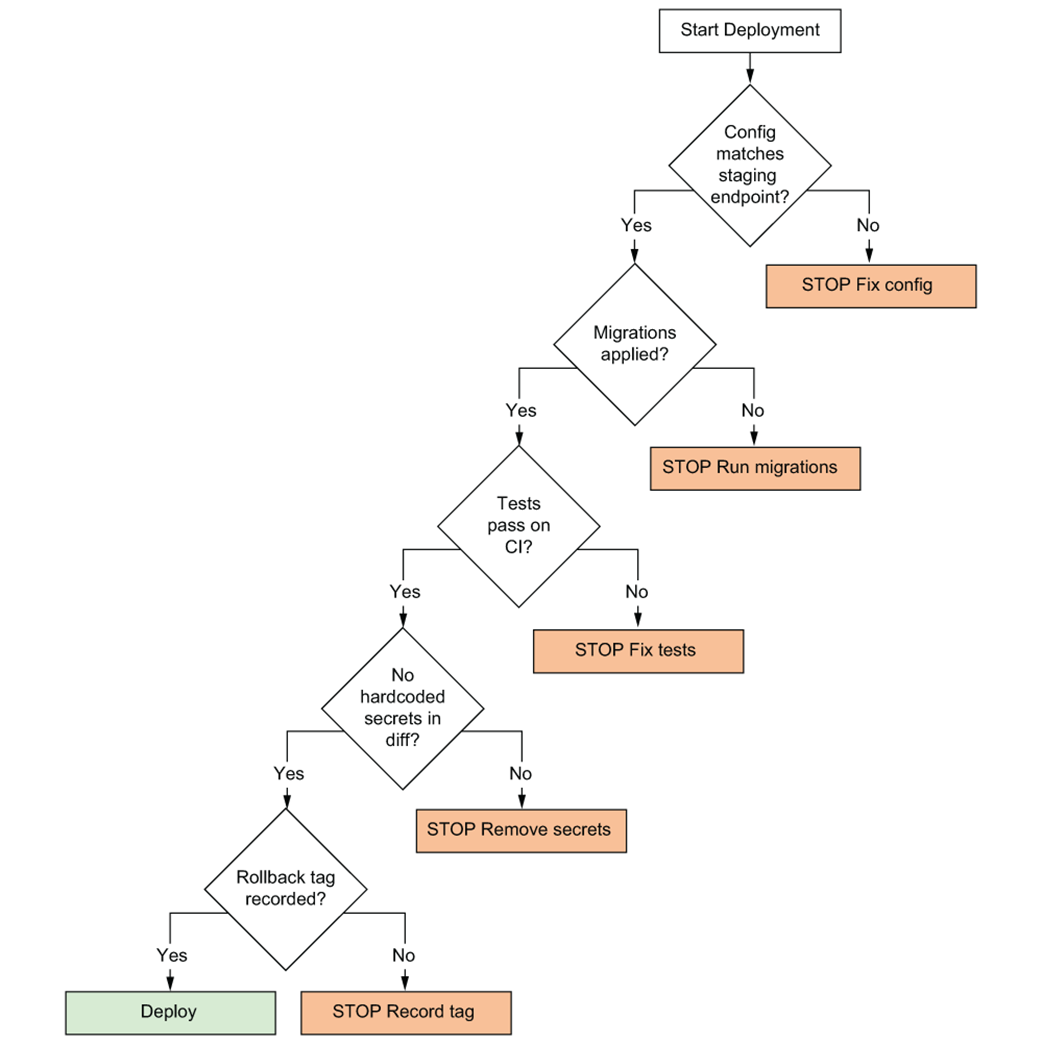
Pre-deployment checklist as a gate; each failed check stops the deployment before damage compounds.
The incident-driven learning loop: each cycle converts a specific bug into a prevented category of bugs.
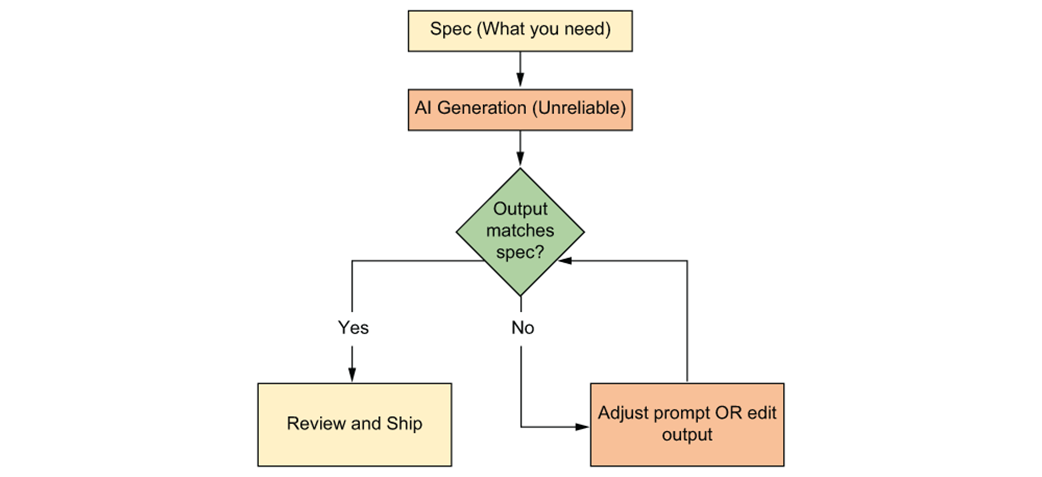
The spec as the stable anchor in an AI-assisted workflow: the AI varies, the acceptance criteria don't.
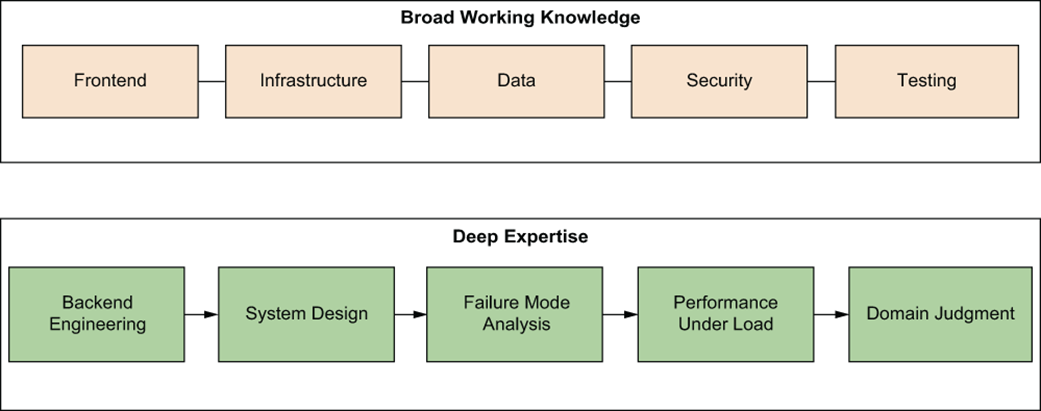
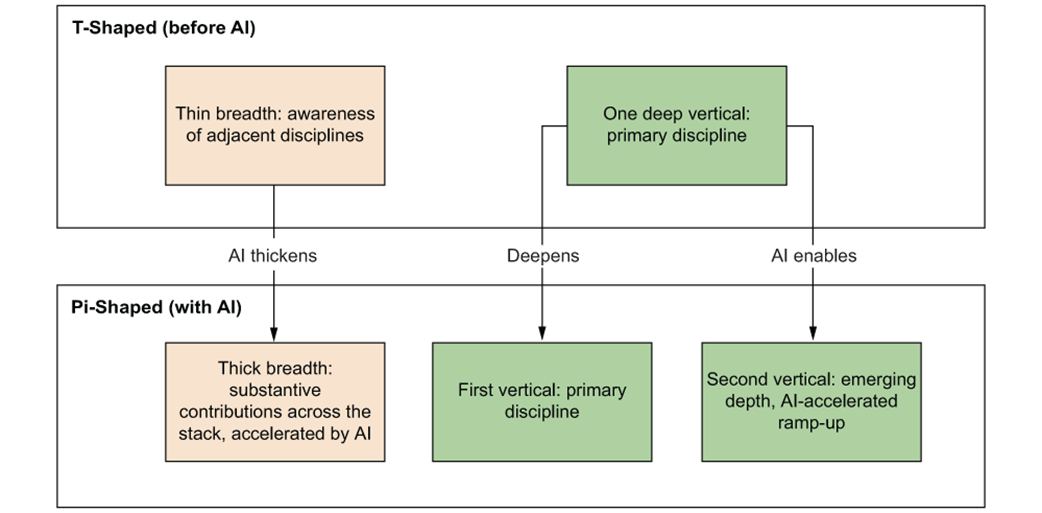
The T-shaped developer has deep expertise in one discipline and broad working knowledge across adjacent ones.
From T to Pi, AI thickens the breadth and makes a second vertical realistic.
Summary
The eighth waste operates at the personal level: skilled judgment spent on config fixes, flaky tests, and formatting reviews is talent that compounds nowhere.
A cognitive value log, tagging what required your judgment versus what just consumed your time, reveals your personal eighth waste quickly.
Personal standard work checklists prevent skilled developers from skipping steps under pressure.
Learning loops turn incidents into permanent skill upgrades by extracting patterns from specific bugs and searching your own code for the same class of defect.
WIP isn't just tickets; meetings, mentoring, learning, and team events all consume cognitive space, and a WIP limit that ignores them overloads the person
Know when you do your best thinking and defend that time; teams that cluster meetings into specific windows create protected blocks where deep work is the default, not the exception.
Documentation now serves two audiences: humans who skim and AI assistants that ingest.
AI-resilient workflows treat the AI as an unreliable supplier and use specs as incoming quality checks, so model upgrades change the tool's behavior without breaking your process.
AI evolves the T-shaped developer toward Pi: it thickens the breadth from awareness to contribution, makes a second vertical of deep expertise realistic, and compresses the ramp-up that used to make Pi-shaped developers rare.
Your personal standard work guide is a living document that you follow today and improve tomorrow; a guide that never changes is a guide that stopped working months ago.
FAQ
What is the main idea of Personal Lean in this chapter?The chapter applies Lean thinking to your own work habits. It focuses on observing how your time and attention are actually spent, then improving one habit at a time with checklists, logs, and feedback loops so your effort compounds instead of getting lost in busywork.What does “unused talent” mean at the personal level?Unused talent means spending your best judgment on low-value tasks that do not require your skills, such as repetitive triage, manual verification, or formatting-only reviews. Personal Lean helps you notice where your cognitive value goes so you can redirect it toward work that actually benefits from your expertise.How do you build a personal cognitive value log?At the end of each work session, save your state, write where to start tomorrow, and tag today’s work into two buckets: what required your judgment and what merely consumed your time. Over time, the log reveals recurring drains on your attention and shows which tasks are candidates for automation or system change.Why should personal checklists be built from failures?Because failures expose the real risks in your workflow. A checklist derived from mistakes is specific, practical, and tied to the way your system actually breaks under pressure. Each new item encodes a lesson, and over time the checklist grows from lived experience instead of abstract guesses.When should a checklist item be automated?When the system can reliably enforce it better than a person can remember it. The chapter treats checklist items as a kaizen backlog: first check manually, then automate the check, and eventually remove it from the checklist once the workflow itself prevents the failure.What is the learning loop in this chapter?The learning loop is: read an incident or post-mortem, extract the underlying pattern, search your own codebase for the same pattern, and apply judgment to fix or prevent it where it matters most. It turns one failure into a broader skill and helps you learn from classes of problems, not just isolated bugs.How does the weekly learning review help skill growth?It creates a regular cadence for reflection. By recording what incident you studied, what pattern you extracted, where you found it in your code, what you fixed, and what skill gap it exposed, you build a personal curriculum grounded in real work rather than generic tutorials.Why should personal WIP include non-ticket work?Because your brain carries more than the ticket board shows. Meetings, mentoring, reviews, learning, and other commitments all consume cognitive space and affect your ability to do deep work. Making them visible prevents overloading yourself and gives a truer picture of your actual capacity.What is a holistic WIP limit?A holistic WIP limit is a limit on all the work competing for your attention, not just active tickets. It means tracking non-ticket commitments, accounting for blocked work honestly, and planning capacity based on the full week—not on an unrealistic assumption that all hours are available for coding.How should developers adapt their workflow as AI tools change?They should anchor their workflow to stable specs, not to the behavior of a particular model version. Save prompts as reusable templates, version them, keep a changelog, define acceptance criteria before generating, and verify AI output before integrating it. That makes the workflow resilient when AI behavior changes.
pro $24.99 per month
access to all Manning books, MEAPs, liveVideos, liveProjects, and audiobooks!


 Build High Value Software Systems ebook for free
