Overview

13 Lean team culture

The chapter argues that a lean team culture is built on respect for people, not slogans or perks, and that respect must show up in the way a team writes code, reviews work, shares knowledge, and responds to problems. It opens with a cautionary example of a critical system failing because one person held the essential knowledge and an AI could not recover the missing context. From there, the text explains that psychological safety is what makes improvement practices work: when people can raise concerns without fear, teams learn faster, surface defects earlier, and avoid the quiet drift into hidden waste and brittle systems.

A major theme is the shift from silos and order taking toward collective ownership and problem solving. The chapter shows how overly concentrated knowledge, hostile reviews, and approval-heavy processes create single points of failure and train developers to stay silent or do the minimum required. In contrast, cross-review, rotating through components, executable tests, pre-commit checks, CI pipelines, and feature flags spread knowledge and quality responsibility across the team. AI is treated as a powerful pairing partner that can accelerate understanding and help with implementation, but it cannot replace human judgment, architectural context, or mentoring about priorities and tradeoffs.

The chapter also focuses on onboarding and growth as indicators of culture. It argues that long, documentation-heavy onboarding is mostly waste, and recommends automated environment setup, day-one shipping tasks, rotating buddies, and living documentation so new hires can contribute quickly. As teams scale, the same principles must be sustained through explicit habits: problem-framed tickets, protected improvement time, visible feedback on outcomes, and shared learning across the organization. The chapter closes by proposing a maturity assessment that helps teams identify the weakest part of their culture, treat it as the constraint, and improve it with the same disciplined, measurable approach used for technical systems.

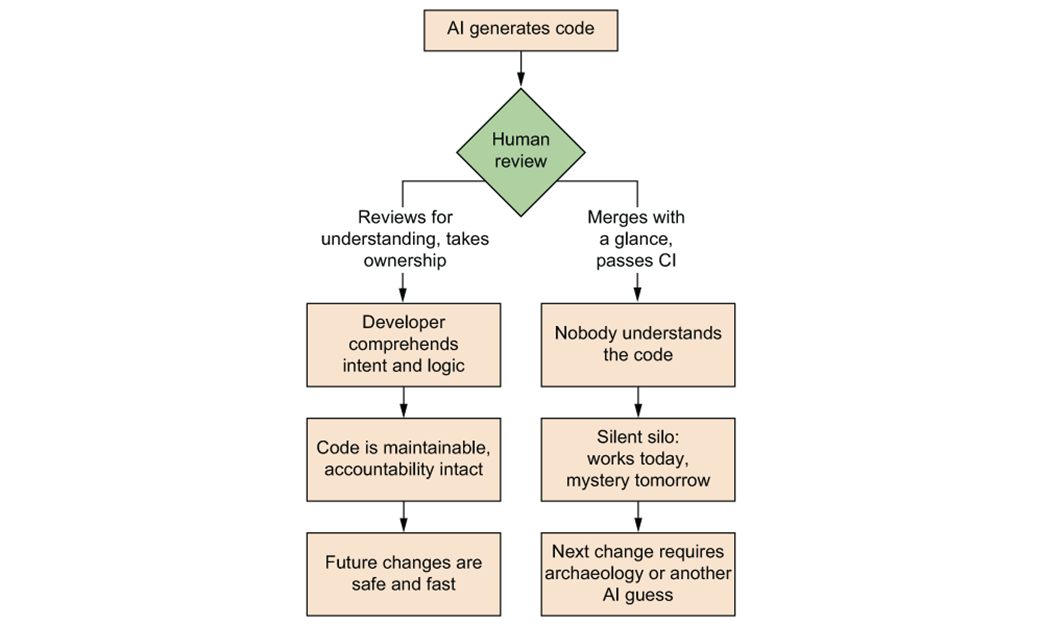
Human review as the accountability gate for agent-generated code.
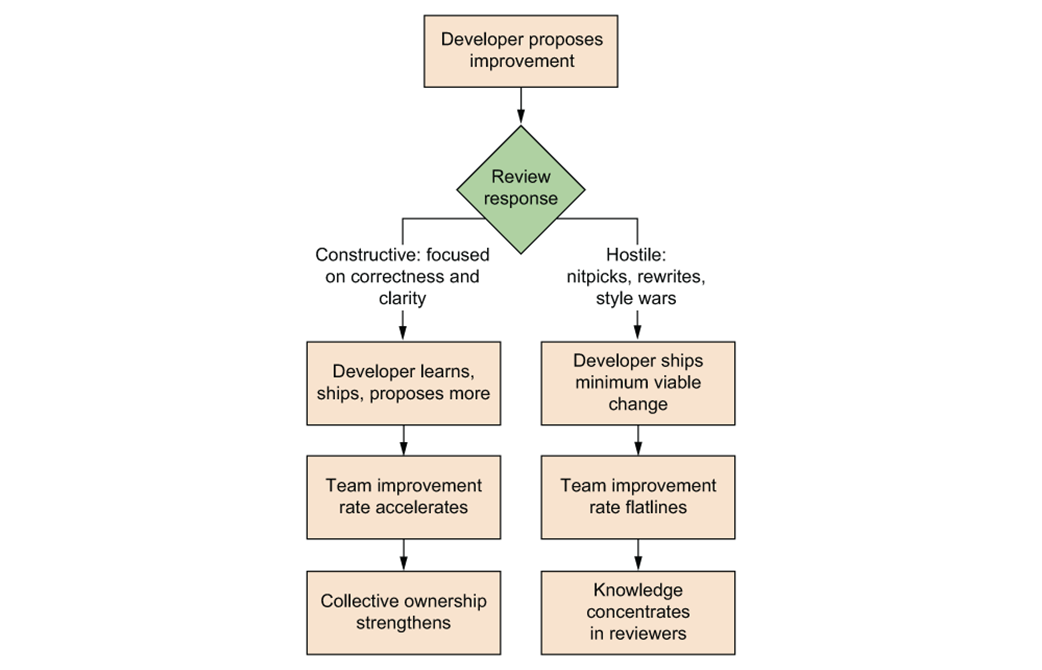
How review culture creates virtuous or vicious cycles for team improvement.
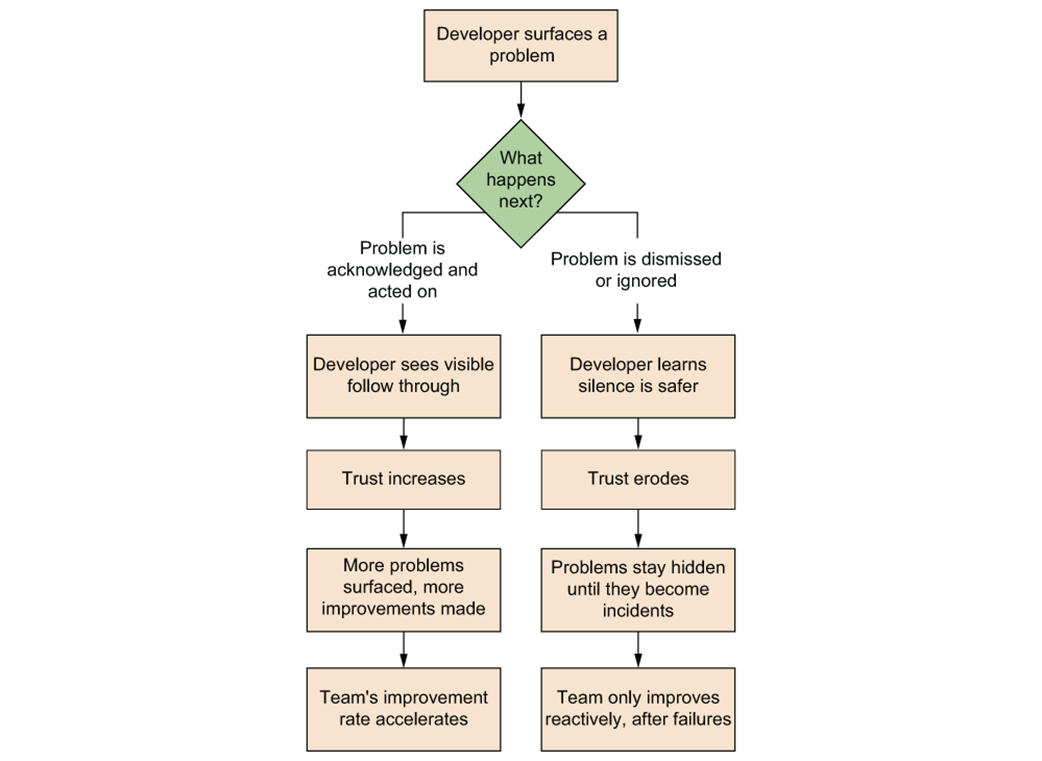
The reinforcing loop between honesty, action, and trust.
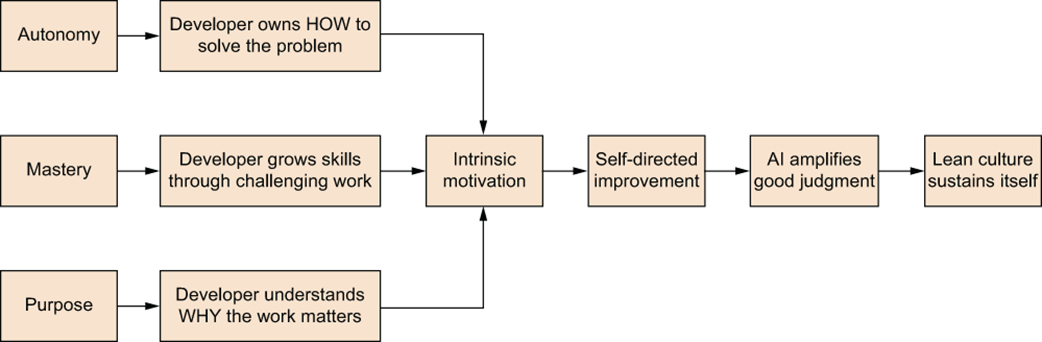
Autonomy, mastery, and purpose as drivers of self-sustaining Lean culture.
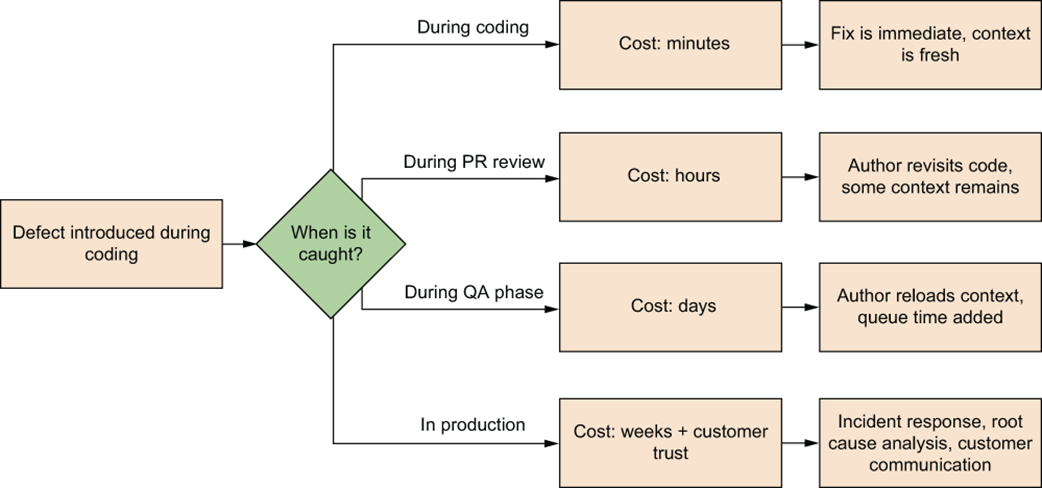
The cost of defect distance: catching defects later costs exponentially more.
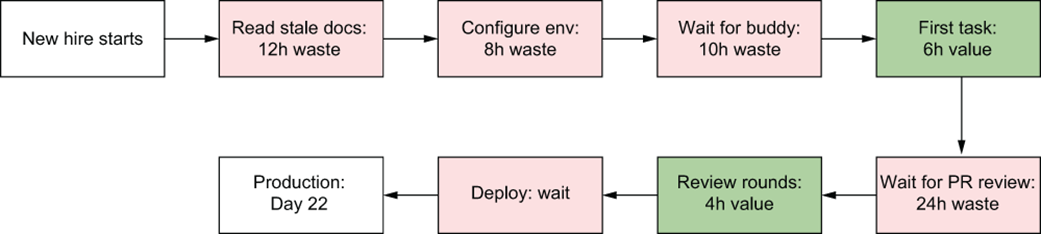
Onboarding value stream, red steps are waste, green steps add value.
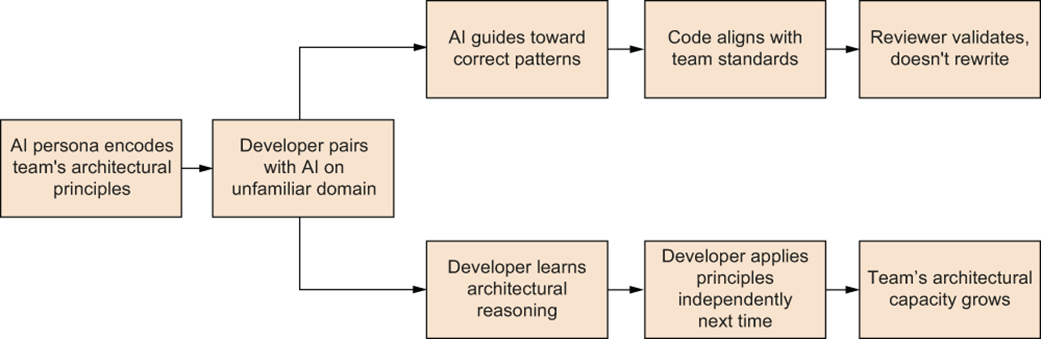
Dual value from an AI-assisted pairing session using a team persona.
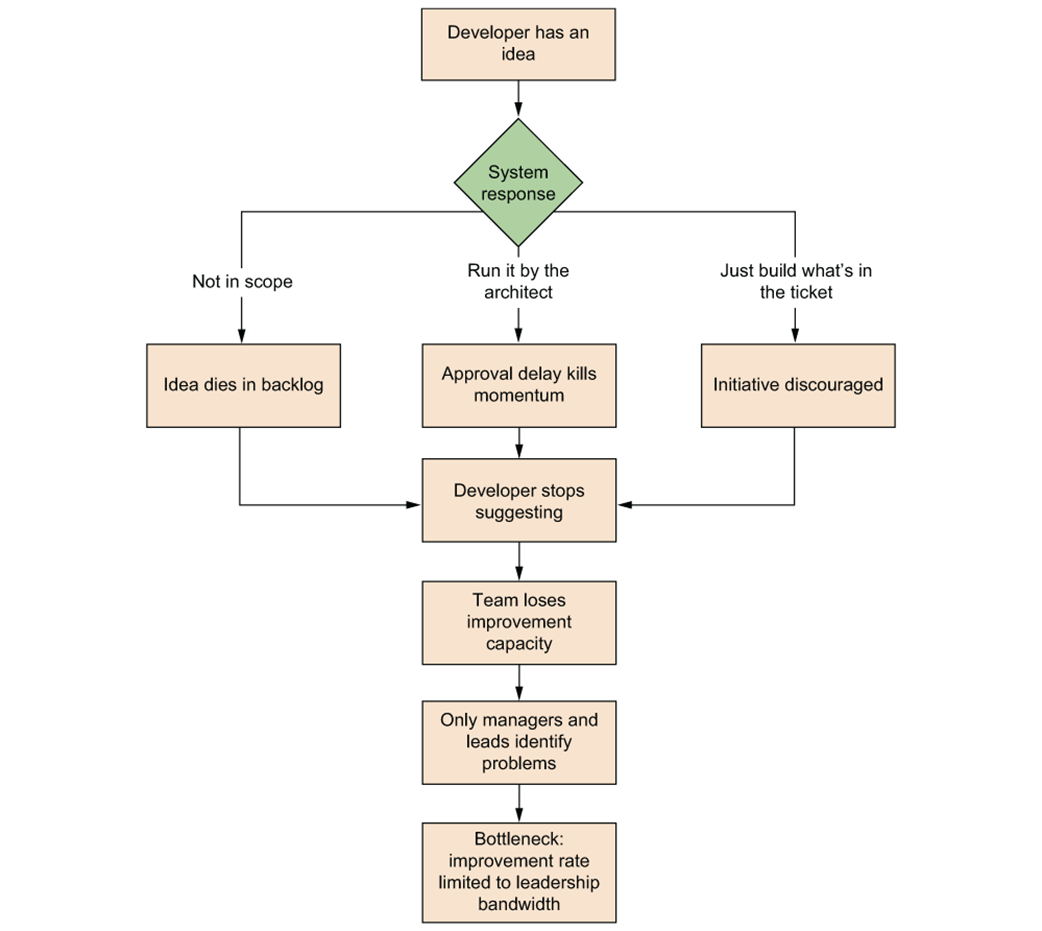
How organizational responses to initiative create an improvement bottleneck.
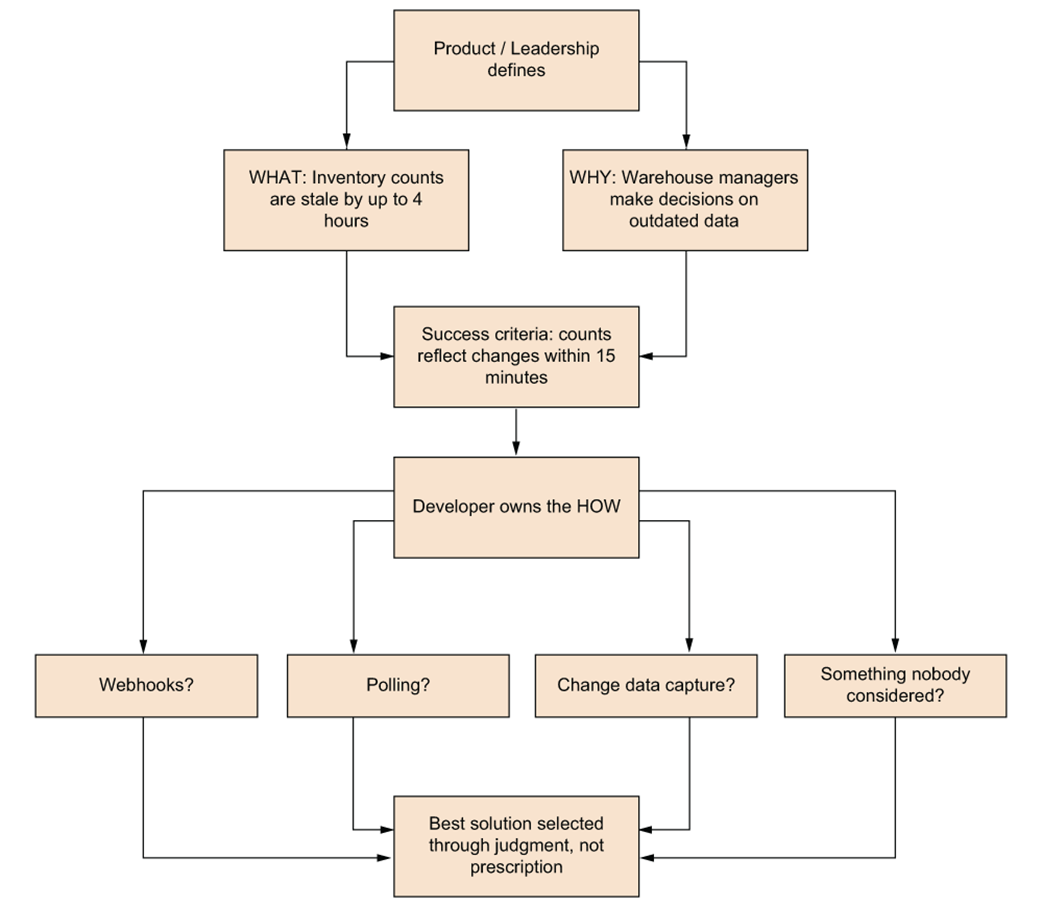
Separating the WHAT and WHY from the HOW in problem-framed tickets.

Summary

  • Respect for people is a system property: cross-training, shared ownership, and authority at the gemba, not slogans on a wall.
  • Psychological safety makes every Lean tool functional; without it, the andon cord goes unpulled, and retros produce silence instead of improvements.
  • PR review culture either accelerates experimentation or kills it; constructive reviews create virtuous cycles, hostile reviews create order takers.
  • Autonomy, mastery, and purpose turn developers from ticket processors into problem solvers who identify waste and propose improvements without being asked.
  • Collective code ownership eliminates single points of failure and distributes knowledge at the cost of coordination overhead that pays for itself during attrition.
  • Quality is cheapest when caught earliest; every handoff to a separate QA phase adds a queue that multiplies defect cost.
  • Onboarding waste is measurable and fixable: automate setup, provide day-one shipping tasks, and replace stale wikis with executable documentation.
  • AI-assisted pairing makes a team's documented architectural principles available even when the architect is absent. A shared persona helps developers navigate unfamiliar code and evaluate design choices, while human mentoring remains essential for developing judgment about which problems are worth solving.
  • Lean practices that work through osmosis at four people require explicit mechanisms, formalized retros, WIP limits, sub-teams, and protected improvement time at twelve.
  • A team's Lean maturity assessment reveals cultural bottlenecks; the lowest-scoring dimension is the constraint that limits all other improvement.

FAQ

What is the main Lean culture problem caused by knowledge silos?Knowledge silos create single points of failure. If one person owns critical system knowledge and leaves, is unavailable, or is overloaded, the value stream can stall because no one else can safely maintain or change that area.
Why is psychological safety so important in a Lean software team?Psychological safety makes it safe for people to raise problems, ask questions, and challenge assumptions. Without it, developers stay silent, defects remain hidden, and continuous improvement tools like andon, retrospectives, and root cause analysis stop working.
What does respect for people look like in code?It shows up in readable, maintainable code: clear names, explicit error handling, tests that document business rules, and visible contracts. Respectful code helps the next developer understand and change it without guessing.
Why must humans review AI-generated code?AI-generated code can pass tests while still lacking intent, context, and accountability. Human review restores ownership, checks architectural decisions, and ensures the code is understandable and safe to maintain.
How can code reviews either improve or harm team culture?Constructive reviews focus on correctness, clarity, and maintainability, which encourages developers to keep proposing improvements. Hostile or nitpicky reviews punish initiative, cause developers to avoid risk, and gradually reduce the team’s improvement rate.
How do autonomy, mastery, and purpose help prevent order-taker behavior?Autonomy lets developers choose the solution, mastery lets them keep growing in meaningful work, and purpose connects their effort to customer outcomes. Together, they help developers think beyond tickets and act as problem solvers instead of order takers.
What is the difference between strong ownership and collective ownership?Strong ownership means one person understands and maintains a component, which creates key-person risk and high onboarding cost. Collective ownership means multiple people can explain and change the code, reducing risk and improving resilience, though it requires more coordination.
How can a team reduce onboarding waste?By automating environment setup, giving new hires real small shipping tasks on day one, rotating buddies instead of assigning only one, and replacing stale wiki pages with living documentation such as scripts, tests, and decision records.
How can AI help with pairing without replacing human mentoring?AI can accelerate technical learning by explaining code, suggesting patterns, and helping explore solutions quickly. Human mentors are still needed for judgment, priorities, architectural tradeoffs, and career growth—things AI cannot reliably provide.
How can a team sustain Lean improvement as it grows?Use structural habits like problem-framed tickets, protected improvement time, visible improvement logs, asynchronous retrospectives, and broad cross-review. These practices help improvement scale with team size instead of depending on a few leaders.

pro $24.99 per month

  • access to all Manning books, MEAPs, liveVideos, liveProjects, and audiobooks!
  • choose one free eBook per month to keep
  • exclusive 50% discount on all purchases
  • renews monthly, pause or cancel renewal anytime

lite $19.99 per month

  • access to all Manning books, including MEAPs!

team

5, 10 or 20 seats+ for your team - learn more


Close
choose your plan

team

monthly
annual
$49.99
$499.99
only $41.67 per month
  • five seats for your team
  • access to all Manning books, MEAPs, liveVideos, liveProjects, and audiobooks!
  • choose another free product every time you renew
  • choose twelve free products per year
  • exclusive 50% discount on all purchases
  • renews monthly, pause or cancel renewal anytime
  • renews annually, pause or cancel renewal anytime
  • Build High Value Software Systems Build High Value Software Systems ebook for free

Close
choose your plan

team

monthly
annual
$49.99
$499.99
only $41.67 per month
  • five seats for your team
  • access to all Manning books, MEAPs, liveVideos, liveProjects, and audiobooks!
  • choose another free product every time you renew
  • choose twelve free products per year
  • exclusive 50% discount on all purchases
  • renews monthly, pause or cancel renewal anytime
  • renews annually, pause or cancel renewal anytime
  • Build High Value Software Systems Build High Value Software Systems ebook for free