18 Where to go from here
You’ve reached the end of the book with a practical, working foundation for building local AI applications on a Mac. What began with basic terminal use and simple scripts has grown into the ability to install and manage tools, run models locally, write Python with isolated environments, build Streamlit interfaces, create chatbots with streaming and memory, and troubleshoot problems with confidence. Along the way, you also learned how to compare models, shape their behavior with prompts and settings, and understand the rapidly changing open model ecosystem.
The chapter emphasizes that this knowledge is not just theoretical—it is immediately useful. With these skills, you can prototype AI apps quickly, build private internal tools without depending on external services, keep sensitive data on your own hardware, fine-tune a model for a specific domain, and make informed choices about when local models are preferable to proprietary APIs. It frames this as a meaningful transition: from someone who merely uses AI tools to someone who can build them, adapt them, and understand what is happening behind the interface.
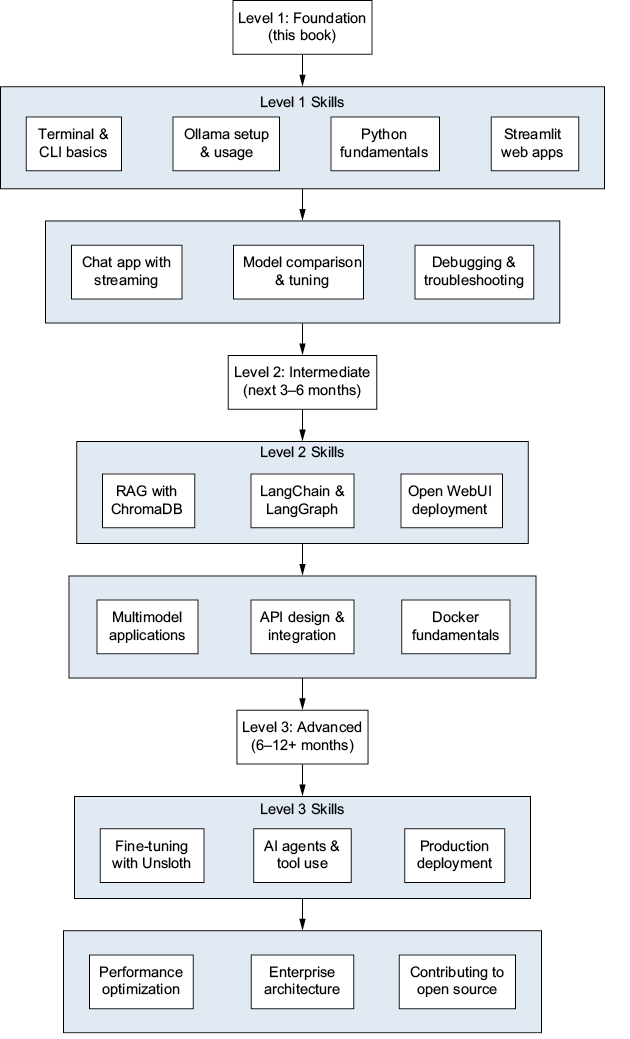
Looking ahead, the book presents a learning roadmap that starts from your current foundation and moves toward intermediate and advanced work. The next steps include deeper RAG systems, LangChain workflows, deployment and infrastructure, fine-tuning, autonomous agents, production monitoring, and community contribution. The overall message is simple: the field will keep changing, but the habits that matter most—starting projects, experimenting, debugging, sharing what you learn, and staying curious—will remain valuable no matter what tools emerge next.
A three-level learning roadmap showing the progression from the foundational skills covered in this book through intermediate and advanced topics
Exercises
- Review what you have learned—Look back through the chapters and list your top five takeaways—the concepts or skills that were most valuable or surprising to you. Write a short reflection on what challenged you most and what you are most proud of.
- Pick a level-2 project and start this week—Choose one project from the level-2 recommendations in section 18.2.2 (or from the ten project ideas in section 16.7.1). Write down three concrete steps you will take in the next seven days to begin. Do not wait until you feel ready; start now.
- Join one community—Visit Reddit’s r/LocalLLaMA, the Ollama Discord, or Hugging Face. Read a few posts. Ask a question. Introduce yourself. You are part of this community now.
- Share your chatbot with someone and explain how it works—Find a friend, family member, or colleague and walk them through your locally running AI. Explain the architecture: terminal, Ollama, Python, Streamlit. Demonstrate it running live. Teaching forces you to articulate what you know and reveals what you still need to learn.
- Visit https://aigym.co.jp and explore the resources—AIGYM is my AI education company. Bookmark the site and check for new courses, tools, and educational content that can support your continued growth.
- Set a 90-day learning goal—Write down one specific skill you want to have in 90 days (e.g., “Build and deploy a RAG application that my team can use”). Break it into monthly milestones:
- Month 1: Complete a tutorial and build a minimal prototype.
- Month 2: Extend the prototype with real data and a polished interface.
- Month 3: Deploy it, get feedback, and iterate.
Put the first milestone on your calendar for 30 days from today. Having a concrete target with a deadline transforms vague intentions into real progress.
FAQ
What is the main takeaway from Chapter 18, “Where to go from here”?
The chapter’s main message is that you have finished the book with a practical foundation for building local AI applications on a Mac. You now know how to install and run models locally, build interfaces, debug problems, work with RAG, and think about model selection and economics. The chapter encourages you to use those skills to start building your next project.
What skills did I gain by completing the book?
You gained a broad set of practical skills, including terminal navigation, Homebrew, Ollama, Python scripting, virtual environments, Streamlit, chatbot development, model comparison, prompt engineering, debugging, RAG, LangChain, and awareness of the open model ecosystem. You also learned how to fine-tune and deploy models locally using tools like Unsloth and Ollama.
Why does the chapter say I am now a builder, not just a user, of AI?
Because you can now create AI tools yourself instead of only using tools built by others. You can prototype applications, choose models for specific tasks, build internal tools, keep data local, and customize model behavior. That shifts you from consuming AI products to designing and building them.
What should I build next after finishing this book?
The chapter recommends choosing a project that solves a real problem for you, your team, or your workplace. Good next projects include a document Q&A system, a chatbot with persistent memory, a model comparison tool, a personal knowledge base, or a Streamlit dashboard for model evaluation.
What is the best way to keep learning after this book?
Follow the learning roadmap in stages: strengthen your foundation, then focus on one intermediate area such as RAG or LangChain, and later move into advanced areas like fine-tuning, agents, and production deployment. The chapter emphasizes depth over breadth—build one complete project before jumping to another topic.
What intermediate topics should I study next?
The chapter suggests moving into RAG and document intelligence, LangChain and application frameworks, and deployment and infrastructure. That means learning things like chunking documents, vector search, reranking, chains, tools, LangGraph, Docker, web deployment, API design, and CI/CD.
What advanced topics are recommended for later study?
Advanced topics include fine-tuning with Unsloth or Axolotl, LoRA and QLoRA, domain-specific models, benchmark evaluation, reinforcement learning techniques like GRPO, autonomous agents, multi-agent systems, reliability evaluation, cloud deployment, monitoring, security, and compliance.
Why does the chapter emphasize local AI instead of relying only on cloud APIs?
Because local AI can be more reliable, private, and cost-effective. The chapter notes that hosted models can change, become unavailable, or be affected by policy decisions, while local models give you a fallback that remains under your control. Local deployment can also help with sensitive data and long-term cost management.
How should I approach the fast-changing AI landscape?
The chapter advises focusing on fundamentals rather than chasing every new tool. Models, frameworks, and APIs will keep changing, but the core skills—breaking problems into steps, reading errors, connecting models to interfaces, managing state, and debugging—will still apply. If you understand those principles, you can adapt quickly to new tools.
What final advice does the chapter give for continuing my AI journey?
The chapter gives three core principles: start building, share what you learn, and stay curious. It encourages you to begin a project, explain your work to others, and keep learning as the field evolves. The overall message is simple: you now have the skills to build something meaningful, so keep going and make something useful.

 Build Applications with Local AI Models on a Mac ebook for free
