17 The open model revolution of 2026
In early 2026, the AI field hit a turning point when several open models rapidly reached or surpassed the best proprietary systems on major benchmarks. This changed the basic assumption that closed models would always lead, and it made local AI feel newly viable for serious work rather than just experimentation. The chapter frames this moment as a genuine shift in power: the gap between what large companies run in the cloud and what individuals can run on their own machines narrowed dramatically.
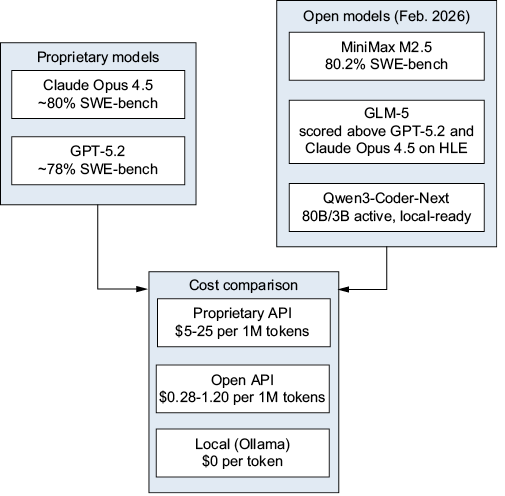
The chapter highlights three standout models as evidence of this shift. GLM-5 is presented as a massive 744B-parameter mixture-of-experts model that activates only a small portion of its weights per query, was trained on Huawei chips, and became the first open model to outperform top proprietary systems on a major reasoning benchmark. Qwen3-Coder-Next shows how sparse MoE design can compress strong coding capability into a practical footprint for consumer hardware, while MiniMax M2.5 demonstrates that open coding models can match leading proprietary coding performance at a tiny fraction of the cost. Together, these examples show that open models are now both competitive and economically compelling.
The practical takeaway is that local AI becomes much more powerful when frontier-quality models can be run, customized, and deployed without cloud dependence. The chapter explains how this changes the economics of agentic systems, where many calls and retries quickly become expensive in the cloud but are effectively free locally except for hardware and electricity. It then walks through a fine-tuning-to-deployment pipeline using Unsloth and Ollama, emphasizing that individuals can now specialize world-class base models for legal, medical, translation, or coding tasks on their own machines. The broader message is that the core skills covered in the book—running models locally, shaping behavior with prompts, building agents, and fine-tuning—are no longer secondary skills; they are the foundation of the next wave of AI development.
Timeline of the February 2026 open model breakthroughs, showing five major events in ten days

Benchmark comparison showing open models matching or exceeding proprietary models on major evaluations
Summary
- Several seismic shifts in AI occurred in February 2026 as a result of new model releases.
- GLM-5 is a 744B-parameter open model (40B active via MoE), trained entirely on Chinese Huawei Ascend chips, with an MIT license, that beat GPT-5.2 and Claude Opus 4.5 on Humanity’s Last Exam.
- Qwen3-Coder-Next is an 80B-parameter coding model with only 3B active parameters via MoE, designed for coding agents and potentially runnable on consumer hardware.
- MiniMax M2.5 is an open model that scores 80.2% on SWE-bench Verified, matching Claude Opus at one twentieth the cost.
- Open source models make autonomous AI agents economically viable by reducing per-task costs from dollars to zero.
- The Unsloth-to-Ollama pipeline (introduced in chapter 16) lets you fine-tune a frontier open model, export it to GGUF, and deploy it locally: the complete creation cycle.
FAQ
What changed in February 2026 to make this chapter such a turning point?
In a ten-day period, multiple open models matched or exceeded the best proprietary systems on major benchmarks. That closed much of the gap between what you can run locally and what large AI companies run in the cloud.What is GLM-5, and why is it important?
GLM-5 is a 744B-parameter mixture-of-experts model from Zhipu. Even though it has 744B total parameters, only about 40B are active per query, making it efficient in practice. It was notable for beating top proprietary models on Humanity’s Last Exam and for being trained on Huawei Ascend chips instead of NVIDIA GPUs.Why does the book emphasize that GLM-5 was trained on Huawei chips?
Because it proves frontier-scale model training is not limited to the NVIDIA-centered hardware ecosystem. That widens the possible infrastructure paths for advanced AI development.What makes Qwen3-Coder-Next different from earlier Qwen models?
Qwen3-Coder-Next is an ultra-sparse MoE model designed specifically for coding agents. It has about 80B total parameters, but only 3B are active at a time, giving it a much smaller runtime footprint while preserving strong coding knowledge.Can Qwen3-Coder-Next run on consumer hardware?
Yes, quantized versions may fit on a regular desktop or laptop with enough RAM. The exact requirement depends on the quantization and model size, so the model card or Ollama page should be checked before downloading.What did MiniMax M2.5 achieve on SWE-bench Verified?
MiniMax M2.5 scored 80.2% on SWE-bench Verified, matching Claude Opus. That is significant because SWE-bench Verified measures real-world software engineering capability.Why are open models economically attractive for AI agents?
Because agents make many reasoning steps, tool calls, and retries, which adds up quickly with cloud billing. Open models can reduce those costs dramatically, and local deployment can bring per-token cost to zero aside from hardware and electricity.What does the Unsloth-to-Ollama pipeline do?
It lets you fine-tune a base model with Unsloth, export it as a GGUF file, create an Ollama Modelfile, and run the custom model locally. In other words, it turns a general model into a specialized local model you control.Why is customization more powerful now than it was before 2026?
Because fine-tuning no longer starts from a merely “good enough” base model. It now starts from world-class open models, so specialization builds on frontier capability instead of a weaker baseline.What should I do if I want to try these models on my Mac?
Start with the largest quantized version your Mac can comfortably support, check RAM guidance first, and use Ollama to pull and run a compatible model. The chapter specifically suggests trying Qwen3-Coder-Next, comparing its output to models you already use, and monitoring memory withollama ps.
 Build Applications with Local AI Models on a Mac ebook for free
