16 Advancing to RAG, Web UI, and fine-tuning
The chapter broadens a working local chatbot into a platform for more capable AI apps. It frames the existing Streamlit/Ollama setup as a foundation and then shows how retrieval, polished interfaces, reusable model definitions, orchestration frameworks, agent patterns, and fine-tuning can all extend what a local model can do. The emphasis stays practical: keep inference local when possible, understand the tradeoffs, and choose the right technique for the job.
A major focus is retrieval-augmented generation, which lets an AI answer questions from your own documents instead of relying only on pretraining. The chapter explains how embeddings turn text into vectors, how similarity search finds relevant chunks, and why chunking long documents is necessary for limited context windows. It also demonstrates a simple local RAG workflow with ChromaDB and Ollama, then shows how that same idea applies to real files and knowledge bases, reducing hallucinations by grounding answers in source material.
From there, the chapter surveys tools and workflows that make local AI more usable and extensible. Open WebUI offers a ready-made ChatGPT-like front end for Ollama, while Modelfiles let you package prompts, parameters, and templates into reusable custom models. LangChain is introduced as a way to compose prompts, LLMs, memory, retrievers, and tools into chains and agents, and the chapter explains agentic patterns such as evaluate-and-act loops, plus examples like OpenClaw and PicoClaw. It closes with a fine-tuning overview using Unsloth, explaining when fine-tuning is appropriate, how GGUF and quantization fit into local deployment, and what kinds of projects and learning resources can help readers keep building beyond the book.
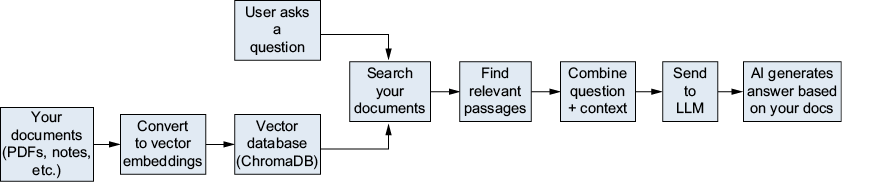
The RAG pipeline: a user query is matched against a document database, relevant chunks are retrieved, and the LLM generates an answer using those chunks as context.
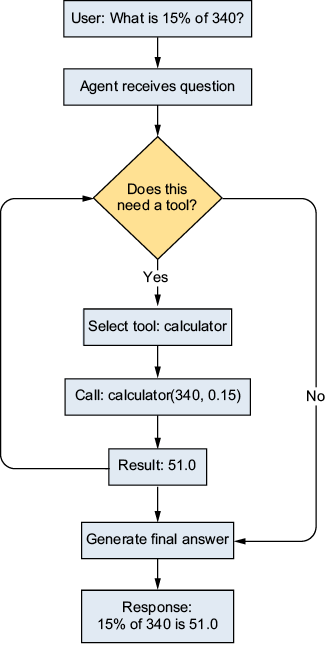
The agent loop: the LLM receives a task, decides which tool to use, executes it, reads the result, and repeats until the task is complete. Loop behavior emerges when the agent repeats the evaluate-act cycle for multistep tasks.
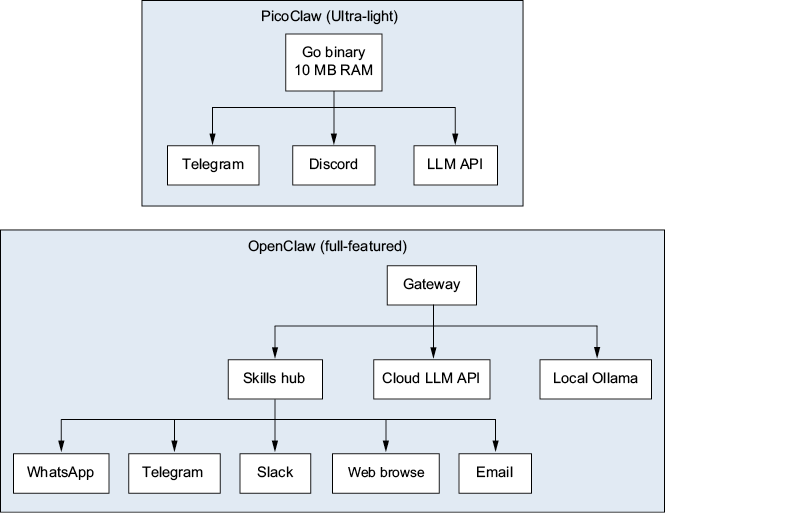
The architectural contrast between OpenClaw and PicoClaw: a full-featured agent and an ultra-lightweight agent, both connecting to LLM backends
The Unsloth fine-tuning pipeline: from training data through fine-tuning and GGUF export to a custom model running in Ollama

Summary
- With RAG (retrieval-augmented generation), you give your AI access to your own documents using vector databases like ChromaDB.
- Open WebUI is a free, ChatGPT-like interface that runs locally with Ollama via Docker.
- Use Modelfiles to create custom-named models with built-in system prompts and parameters.
- LangChain is a framework for building complex LLM applications with chains, tools, and agents.
- Agentic AI is AI that can take actions, use tools, and make autonomous decisions.
- OpenClaw and PicoClaw represent two ends of the agent spectrum: full-featured and ultra-lightweight autonomous AI agents.
- API cost economics show why open source models and local deployment are critical for agents that make hundreds of API calls per task.
- Fine-tuning is the process of further training a model on your own data to change its fundamental behavior (e.g., training it on a new language or domain).
- The GGUF format is the standard format for running quantized models on consumer hardware.
- Unsloth is the recommended fine-tuning accelerator: it is designed to reduce training time and VRAM use compared with conventional fine-tuning workflows, although actual gains depend on the model, hardware, and settings, and it offers a streamlined pipeline to Ollama.
- GGUF quantization is the method by which
Q4_K_Mand other formats compress models for local deployment.

 Build Applications with Local AI Models on a Mac ebook for free
